
Quick Summary:
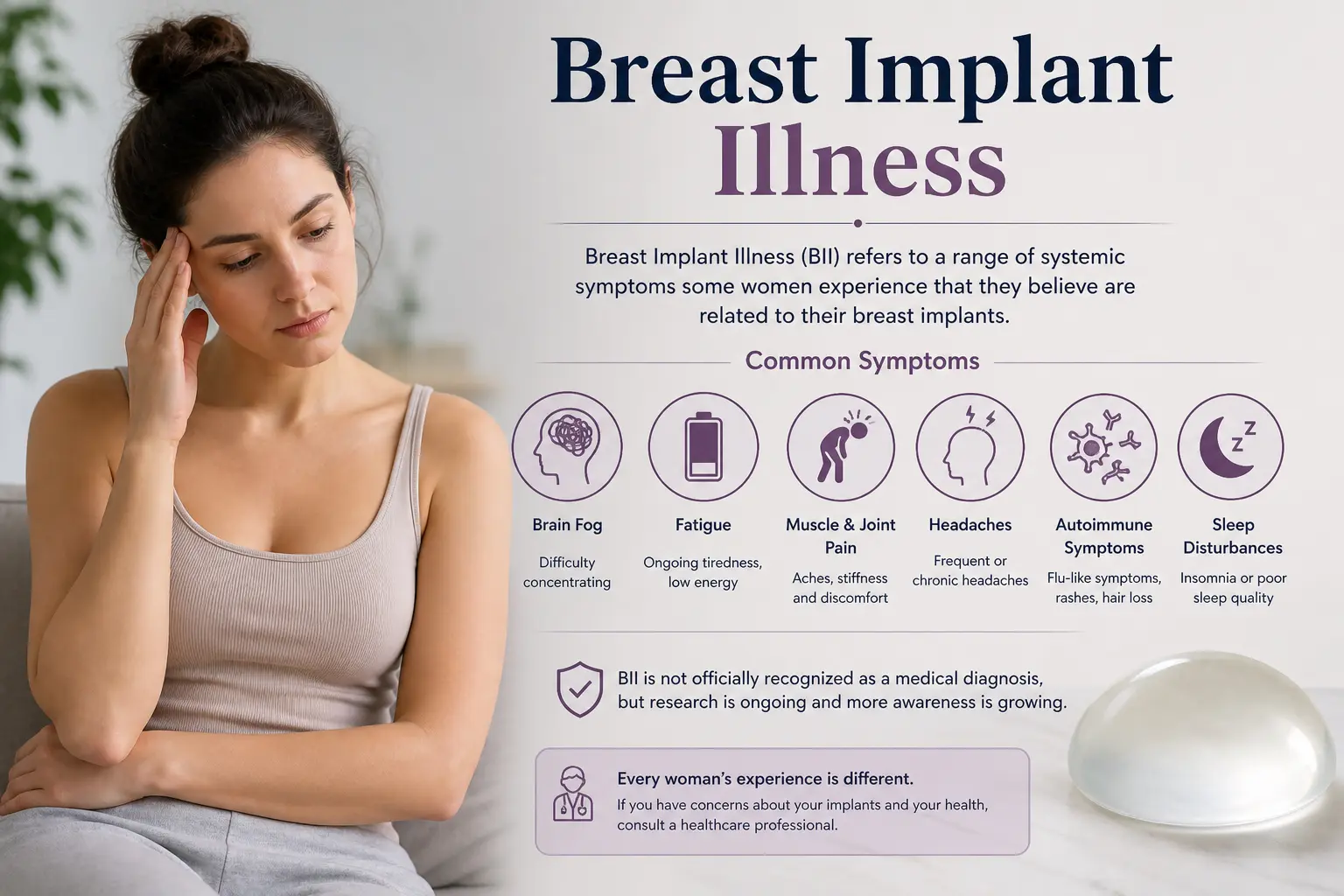
Breast implant illness (BII) is a term people use for a range of whole-body symptoms — such as fatigue, joint pain, “brain fog”, rash and hair loss — that they associate with their breast implants. According to the FDA, BII is not recognized as a formal medical diagnosis and there are no specific tests to define it, but such symptoms have been reported with all types of breast implants. A 2025 systematic review of 33 studies (6,048 women) found that 81.9% of patients reported symptom improvement after implant removal. This guide covers symptoms, possible causes, how BII is assessed, and what to know about implant removal (explant) surgery.
Quick Comparison Table: BII vs BIA-ALCL
| Feature | Breast Implant Illness (BII) | BIA-ALCL |
|---|---|---|
| Nature | A term for whole-body symptoms people associate with implants (not a cancer) | A rare cancer of the immune system (a lymphoma) |
| Formal diagnosis? | No — not recognized as a formal medical diagnosis (FDA) | Yes — a confirmed cancer diagnosis |
| Implant types linked | Reported with all types of breast implants (FDA) | Mostly textured implants: 73% of 1,380 cases reported to the FDA by 30 June 2024 |
| Key symptoms | Fatigue, joint pain, brain fog, anxiety, hair loss, rash | Swelling, a lump or pain around the implant, usually years after surgery |
| How common? | Unknown — FDA reports cannot show incidence or prevalence | Rare |
| Treatment | Symptom care, or implant removal after assessment | Removal of the implant and surrounding scar tissue; some patients need further treatment |
| What to do | See your GP or implant surgeon (MHRA) | Get any new swelling or lump checked promptly |
Why Trust This Guide
This guide draws on the FDA review of medical device reports on systemic symptoms, the FDA page on breast implant risks, MHRA guidance from the UK regulator, the 2025 Ferreira et al. systematic review in Aesthetic Plastic Surgery, a 2025 JNCI cohort study of breast cancer survivors, and the joint patient safety advisory on implant removal and capsulectomy from ISAPS, The Aesthetic Society and ASERF.
This guide is written by the Carely Clinic Medical Team and is updated when major evidence changes. It is medical education content, not a substitute for a personal consultation with your doctor or surgeon.
What Is Breast Implant Illness (BII)?
BII describes whole-body symptoms reported by some people with breast implants — including fatigue, joint pain, brain fog and hair loss. The MHRA describes it as a term people use for a variety of health problems they associate with their breast implants.
The FDA notes that these symptoms and what causes them are poorly understood, and that researchers are investigating their origins. In October 2021, the FDA took several actions to strengthen breast implant risk communication.
BII is not recognized as a formal medical diagnosis, and there are no specific tests or recognized criteria to define it (FDA). The evidence is mixed: the 2025 systematic review concludes that BII is a real, multifactorial clinical entity, while a 2025 JNCI study of 9,590 breast cancer survivors in the Netherlands found that women reconstructed with silicone implants did not report more BII-associated symptoms than women without implants. For people living with these symptoms, they are real — and they deserve a careful medical assessment.
What Are the Symptoms of Breast Implant Illness?
BII produces a wide, variable range of symptoms that differs from person to person, which is why it is difficult to identify and assess.
Symptoms can appear anywhere from right after implantation to years later. In the FDA review of 10,318 medical device reports (January 2008 to June 2024), the average time from implantation to symptom onset — where it was known — was 5.6 years, with a range of 0 to 42.5 years.
Physical Symptoms
Fatigue and joint problems are among the most reported symptoms. Fatigue appeared in 41.1% and joint issues in 30.9% of the FDA reports, and in the 2025 systematic review the most common symptoms were fatigue (58.3%), joint pain (51%) and muscle pain (44%).
Other physical symptoms people report include muscle aches, rash, hair loss and weight changes. Because these symptoms are common in the general population too, they need to be assessed by a doctor before being attributed to implants.
Cognitive and Mental Health Symptoms
Brain fog involves difficulty concentrating, memory lapses and a feeling of mental haziness. The FDA lists memory loss and “brain fog” among the symptoms that may be associated with breast implants, and “fog” appeared in 22.5% of the FDA reports.
Cognitive symptoms can include word-finding difficulties and slowed thinking. Anxiety (22.9% of FDA reports) and depression (16.9%) are also reported; researchers note the relationship may work both ways — anxiety can affect how symptoms are experienced, or it may follow a long, unexplained illness. Either way, both should be discussed with a healthcare provider.
Key Point
BII does not fit a single disease pattern, and its symptoms overlap with many other conditions. A full medical check-up comes first — implant removal is a surgical decision made after other causes have been looked at.
What Causes Breast Implant Illness?
No single, confirmed cause of BII has been established. The 2025 systematic review describes BII as multifactorial, involving immune dysregulation, chronic inflammation and microbial biofilms — mechanisms that may act alone or together.
Immune and Inflammatory Response
One leading theory is that, in some people, the immune system reacts to the implant as a foreign object, triggering an inflammatory response that extends beyond the breast.
Individual genetics and differences in the immune system are thought to influence who is affected — which may help explain why most people with implants do not develop these symptoms. The MHRA notes that there is still no definitive evidence or known scientific process showing that breast implants cause these symptoms.
Biofilm and Microbial Colonisation
Another theory is that bacterial biofilm on the implant surface causes chronic, low-grade inflammation.
Biofilm — a thin layer of microorganisms that sticks to implant surfaces — is difficult for the immune system to clear. The 2025 review lists biofilms among the possible factors, but this theory does not explain every case, and most researchers see it as one contributing factor rather than the only cause.
Implant Material Sensitivity
Some patients may be sensitive to materials in the implant, such as the silicone outer shell or the gel fill.
Saline implants also have a silicone outer shell — one reason symptoms are reported with both saline and silicone gel implants. See our guide to silicone vs saline implants for how the two types differ. This pathway is still poorly understood.
How Is Breast Implant Illness Diagnosed?
There is no single blood test, scan or biopsy that confirms BII — assessment is based on a careful medical history and ruling out other causes.
A doctor will usually take a detailed history, noting when symptoms began relative to breast augmentation or implant replacement. Blood tests, a rheumatology review and imaging may be used to rule out conditions with similar symptoms, such as lupus, rheumatoid arthritis, thyroid disease and fibromyalgia.
If no other cause is found and symptoms developed or worsened after implants were placed, a consultation with a plastic surgeon to discuss the implants is a reasonable next step. Some doctors check antinuclear antibodies (ANA), but a positive ANA result on its own does not diagnose BII.
In the UK, the MHRA advises anyone with health problems they feel may be related to their breast implants to see their GP or implant surgeon first, and encourages reporting symptoms through the Yellow Card scheme. In the US, the FDA encourages patients to report symptoms through MedWatch.
If you have implants and are considering removal, you can send your implant details (implant card or surgical records, date of surgery and any recent scans) and your symptoms to our team through a free online consultation. Our team replies within 24 hours. You can also read about breast surgery at Carely Clinic.
What Are the Treatment Options for BII?
Two broad approaches exist: managing symptoms while monitoring, or surgical removal of the implants (explant).
Watchful Waiting and Symptom Management
For people with mild symptoms and no urgent clinical concern, watchful waiting means monitoring symptoms over time while treating each one with a GP or specialist — for example rheumatology review or mental health support.
This approach leaves the implants in place, but it may suit people who are unsure about surgery, want more information, or have medical reasons that make surgery inadvisable.
Explant Surgery (Implant Removal)
Explant surgery — removal of the breast implants — is the option most often discussed for BII. The FDA notes that in some cases removal without replacement is reported to reverse symptoms, and the MHRA says some people report improvement once their implants are removed.
Improvement is likely but not guaranteed. In the 2025 systematic review, 81.9% of patients reported symptom improvement after explantation. In the FDA reports that included this information, 687 of 785 noted improvement, while 98 noted no improvement or worsening. The joint ISAPS, Aesthetic Society and ASERF advisory states that symptom improvement was independent of whether part or all of the capsule (the scar tissue around the implant) was removed.
For an overview of breast procedures at Carely Clinic, including implant removal and revision, see breast aesthetics at Carely Clinic.
Explant Surgery: What to Expect
Explant surgery is usually performed under general anaesthesia. How long it takes, and whether you stay overnight, depends on what is planned — removal alone, removal with capsulectomy, or removal combined with a breast lift.
Simple Removal vs. Capsulectomy
Simple removal takes out the implant only and leaves the capsule (scar tissue) in place; a capsulectomy removes some or all of the capsule as well, which adds surgical time and complexity.
The joint patient safety advisory from ISAPS, The Aesthetic Society and ASERF states that there is currently no good peer-reviewed evidence that capsulectomy is required for symptom improvement in the absence of other indications. It lists capsular contracture, rupture of a gel implant and, possibly, the removal and exchange of textured implants as relative indications for total capsulectomy. This challenges the belief, often shared on social media, that capsulectomy is essential for BII recovery.
En Bloc Removal
En bloc removal takes out the implant and its surrounding capsule as one intact unit. According to the joint advisory, the absolute indication for en bloc capsulectomy is a malignancy in the capsule, such as BIA-ALCL — not routine BII treatment.
En bloc surgery is more extensive than simple removal. The advisory says the term should not be used for a capsulectomy performed without malignancy, and that surgeons who say en bloc capsulectomy is required for symptom improvement should not do so without scientific data to support the claim. Be cautious of any clinic that markets en bloc as the only appropriate BII treatment.
Recovery After Explant
Recovery depends on the procedure: removal alone is usually a shorter recovery than removal with capsulectomy or a breast lift. Your surgeon will give you a personal timeline for returning to work, exercise and normal activity.
When symptoms improve, the timing varies from person to person. Have a realistic discussion with your surgeon about expectations, including the possibility that not all symptoms will resolve.
Key Point
BII symptoms are real to the people who experience them. Current evidence suggests improvement after implant removal does not depend on removing the whole capsule, so ask your surgeon to explain why any additional surgery is recommended.
BII vs BIA-ALCL: Understanding the Difference
BII and BIA-ALCL are separate conditions that are often confused, and telling them apart matters because BIA-ALCL needs prompt medical attention.
BII involves whole-body symptoms (fatigue, brain fog, joint pain) without a confirmed disease process. BIA-ALCL (breast implant-associated anaplastic large cell lymphoma) is a rare cancer of the immune system that develops in the fluid or scar tissue around the implant. According to the FDA, most cases appear years after implants are placed, with symptoms such as swelling, a lump or pain around the implant.
As of 30 June 2024, the FDA had received reports of 1,380 BIA-ALCL cases worldwide: 73% involved textured implants, 3% smooth implants and 24% did not specify the surface. If you notice new swelling, a lump or fluid around an implant, get it checked promptly — do not wait for a routine review.
The FDA explains that BIA-ALCL is treated by removing the implant and the surrounding scar tissue, and some patients need further treatment. Read more in our guide to textured gummy bear implants.
BII Symptom and Treatment Summary Table
| Category | Details |
|---|---|
| Most reported symptoms (FDA reports) | Fatigue 41.1%, joint issues 30.9%, anxiety 22.9%, brain fog 22.5%, hair loss 19.6% |
| Most common symptoms (2025 review) | Fatigue 58.3%, joint pain 51%, muscle pain 44% |
| Implant types affected | Reported with all types, regardless of filling, shape or surface (FDA) |
| Average symptom onset | 5.6 years after implantation where known (range 0–42.5 years; FDA reports 2008–June 2024) |
| Formal diagnosis available? | No — no specific tests or recognized criteria; assessed by ruling out other causes |
| Main surgical option | Explant surgery (implant removal) |
| Improvement after removal | 81.9% reported improvement (2025 review of 33 studies, 6,048 women) |
| Is capsulectomy required? | No good peer-reviewed evidence it is required for symptom improvement without other indications (ISAPS / Aesthetic Society / ASERF advisory) |
| En bloc removal | Absolute indication: malignancy in the capsule, such as BIA-ALCL |
| Implant removal at Carely Clinic | Available after assessment; price given on WhatsApp |
Breast Implant Removal at Carely Clinic in Istanbul
At Carely Clinic in Istanbul, breast implant removal and revision are available after assessment. Because the procedure varies from patient to patient, the price is given on WhatsApp once our team has reviewed your details.
Surgery takes place at a JCI-accredited partner hospital in Istanbul, confirmed in your written treatment plan. After examining you and reviewing any scans, your surgeon explains whether removal alone, capsulectomy or removal with a breast lift is appropriate — and why.
Before you travel, send your implant card or surgical records, the date of your original operation, any recent scans and a description of your symptoms. Our team replies within 24 hours.
If BII is your main concern, see your GP or a specialist first to rule out other causes, as the MHRA advises. Removal is a surgical decision best made once other conditions have been checked.
Considering implants for the first time? Our guides to breast augmentation in Turkey, silicone vs saline implants and breast augmentation Turkey vs UK explain the options, safety and costs.
Questions about your implants? Book a free online consultation with Carely Clinic.
Learn more about breast aesthetics at Carely Clinic.
Frequently Asked Questions
What are the symptoms of breast implant illness?
The most reported symptoms are fatigue, joint and muscle pain, brain fog, anxiety, hair loss and rash. In a 2025 systematic review of 6,048 women, the most common were fatigue (58.3%), joint pain (51%) and muscle pain (44%). In the FDA’s review of 10,318 reports, the average time to symptom onset, where known, was 5.6 years after implantation.
Is breast implant illness real?
The symptoms are real for the people who experience them, but BII is not recognized as a formal medical diagnosis and there is no specific test, according to the FDA. A 2025 systematic review describes BII as a real, multifactorial clinical entity, while a 2025 JNCI study of breast cancer survivors found no increase in BII-associated symptoms with silicone implant reconstruction. Research is ongoing.
How do you know if you have breast implant illness?
There is no single test for BII. Doctors rule out conditions with similar symptoms — such as lupus, rheumatoid arthritis, thyroid disease and fibromyalgia — using blood tests, imaging and specialist review. In the UK, the MHRA advises seeing your GP or implant surgeon first; in the US, the FDA encourages reporting symptoms through MedWatch.
Can saline implants cause breast implant illness?
Yes. The FDA states that these symptoms have been reported with all types of breast implants, regardless of filling, shape or surface. Saline implants also have a silicone outer shell, which is one possible reason symptoms are reported with both saline and silicone gel implants.
Does breast implant illness go away after explant?
Many people improve, but it is not guaranteed. In a 2025 systematic review, 81.9% of patients reported symptom improvement after implant removal. In FDA reports that included this information, 687 of 785 noted improvement and 98 noted no improvement or worsening. A joint ISAPS, Aesthetic Society and ASERF advisory states that improvement was independent of whether part or all of the capsule was removed.
What is the difference between BII and BIA-ALCL?
BII describes whole-body symptoms such as fatigue and brain fog and is not a cancer. BIA-ALCL is a rare cancer of the immune system that develops in the fluid or scar tissue around an implant. By 30 June 2024, the FDA had received reports of 1,380 BIA-ALCL cases worldwide, 73% involving textured implants. New swelling, a lump or pain around an implant should be checked promptly.
How long does it take for breast implant illness symptoms to appear?
Symptoms can appear anywhere from right after implantation to years later. In the FDA’s review of 10,318 reports from January 2008 to June 2024, the average time to onset — where it was known — was 5.6 years, with a range of 0 to 42.5 years. This wide range is one reason linking symptoms to implants needs a careful medical history.
Is breast implant illness an official diagnosis?
No. The FDA states that BII is not recognized as a formal medical diagnosis and that there are no specific tests or recognized criteria to define it. The UK regulator, the MHRA, says it is not yet known whether there is a link between breast implants and the reported symptoms, and encourages reporting them through the Yellow Card scheme.
What is en bloc explant surgery?
En bloc removal takes out the implant and its surrounding capsule as one intact unit. A joint advisory from ISAPS, The Aesthetic Society and ASERF states that the absolute indication for en bloc capsulectomy is malignancy in the capsule, such as BIA-ALCL, and that there is no good peer-reviewed evidence that capsulectomy is required for symptom improvement without other indications.
How much does breast implant removal cost?
The cost depends on whether the implants are simply removed, whether some or all of the capsule is removed, and whether a breast lift is added. At Carely Clinic in Istanbul, implant removal and revision are available after assessment, and the price is given on WhatsApp once our team has reviewed your details. Whichever clinic you choose, ask for an itemised written quote.
Can breast implant illness cause autoimmune disease?
This has not been established. A 2025 JNCI study of 9,590 breast cancer survivors, with a median follow-up of 13.7 years, found that women with silicone implant reconstruction did not have a significantly increased risk of any individual BII-associated symptom. Some BII patients test positive for antinuclear antibodies (ANA), but a positive result alone does not show that implants caused it.
What does breast implant illness brain fog feel like?
People describe difficulty concentrating, memory lapses, mental haziness, word-finding problems and slowed thinking that can affect work and daily life. The FDA lists memory loss and “brain fog” among symptoms that may be associated with breast implants, and “fog” appeared in 22.5% of the FDA’s reports. Because brain fog has many causes, it should be assessed by a doctor.
Is breast implant removal covered by insurance?
Coverage depends on your insurer and on the medical reason for removal. Because the FDA does not recognize BII as a formal diagnosis, removal for BII symptoms alone may not be covered, while removal for a confirmed problem such as rupture or BIA-ALCL may be treated differently. Check with your insurer before surgery and ask your surgeon for an itemised quote.
Does Carely Clinic remove breast implants?
Yes. Breast implant removal and revision are available at Carely Clinic in Istanbul after assessment. Send your implant card or surgical records, the date of your original surgery, any recent scans and your symptoms through WhatsApp; our team replies within 24 hours, and the price is given once your details have been reviewed.
Conclusion
BII is not a formal diagnosis, but the symptoms are real for the people who experience them — fatigue, joint pain and brain fog are among the most reported — and most patients in published studies report improvement after implant removal.
The 2025 Ferreira et al. review of 6,048 women across 33 studies found that 81.9% reported symptom improvement after explantation, and the joint ISAPS, Aesthetic Society and ASERF advisory found no good evidence that capsulectomy is required for symptom improvement without other indications. At the same time, a 2025 JNCI cohort study found no increase in BII-associated symptoms among breast cancer survivors with silicone implant reconstruction, so research is still evolving.
For anyone experiencing unexplained fatigue, cognitive difficulties or joint pain after breast augmentation, the recommended path is a medical workup to exclude other causes, followed by a consultation with a qualified plastic surgeon to discuss whether implant removal is appropriate.
Individual requirements and outcomes vary. This guide provides general information based on published research, FDA and MHRA information, and peer-reviewed studies. Consult qualified medical professionals for personalised advice.
Written by Carely Clinic Medical Team · Last updated: November 2026