
Quick Summary
Natural breast augmentation uses your own fat — not implants — to add breast volume. Fat is removed by liposuction from areas such as the tummy or thighs, purified and injected into the breasts. A surgeon writing for the American Society of Plastic Surgeons (ASPS) describes the ideal patient as someone wanting a half-cup to full-cup increase, and the NHS notes that some of the injected fat is reabsorbed during the first few months. At Carely Clinic in Istanbul, natural breast augmentation costs €2,400 all-inclusive (around £2,100 or $2,800; valid until December 2026).
| Factor | Natural Breast Augmentation (Fat Transfer) | Implant Augmentation |
|---|---|---|
| Material | Your own body fat | Silicone implant (Carely Clinic uses silicone only) |
| Typical size increase | Half a cup to a full cup is ideal (ASPS surgeon); more volume may need 2–3 procedures | Chosen by implant size |
| Fat loss | Some injected fat is reabsorbed in the first months (NHS) | Not applicable |
| Scarring | Small liposuction and injection incisions | Incision in the fold under the breast (at Carely Clinic) |
| Implant-specific risks | None — no rupture, capsular contracture or BIA-ALCL | Rupture, capsular contracture, BIA-ALCL (rare) |
| Fat-specific risks | Fat necrosis, fat embolism, uneven results (NHS) | Not applicable |
| Future surgery | No device to replace; extra sessions may be needed for more volume | Implants are not lifetime devices (FDA) |
| Body contouring benefit | Yes — liposuction of the donor area | No |
| Requires donor fat | Yes — enough fat is needed | No |
| Price at Carely Clinic (all-inclusive) | €2,400 | €3,450 |
Why Trust This Guide
This guide draws on NHS information on surgical fat transfer, ASPS patient articles on fat transfer for breast augmentation, the ASPS fat transfer guiding principles and the NHS advice on cosmetic surgery abroad.
This guide is written by the Carely Clinic Medical Team and is updated when guidance changes. It is medical education content, not a substitute for a personal surgical consultation.
What Is Natural Breast Augmentation?
Natural breast augmentation is an implant-free procedure that uses your own body fat to increase breast volume and improve shape, with no foreign material placed in the body. A surgeon writing for the ASPS notes that fat gives moderate enlargement — it can help fill out your bra size, but not necessarily change it.
The procedure is also called fat transfer breast augmentation, breast fat grafting or lipofilling; the NHS also calls surgical fat transfer a “fat graft” or “lipomodelling”. Liposuction removes fat from a donor area, the fat is purified, and it is injected into the breast.
Interest in implant-free options has grown, but fat transfer and implants give very different results — understanding the limits of fat transfer is the key to being happy with the outcome.
How Does the Procedure Work?
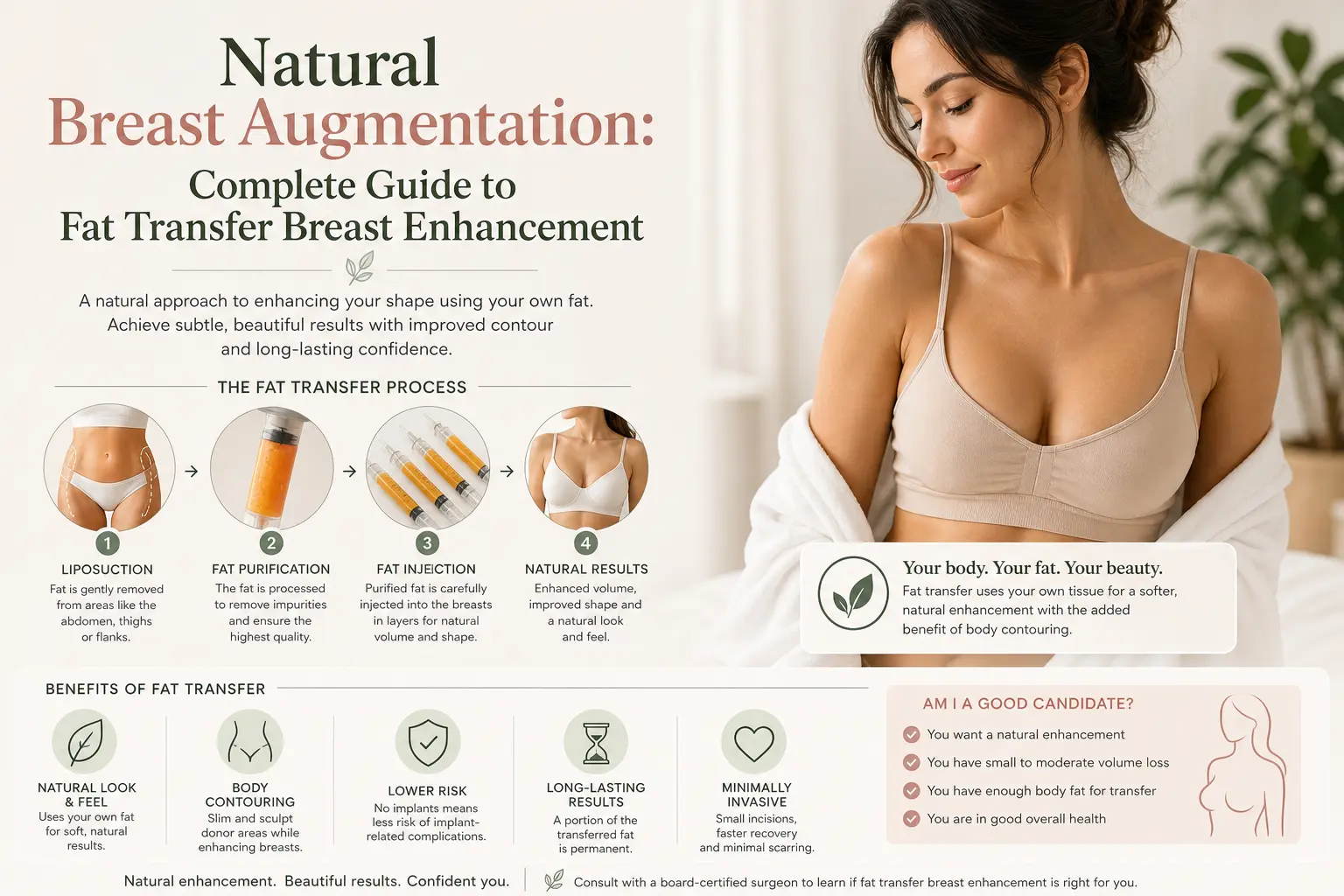
Fat transfer has three stages — liposuction, purification and injection. The NHS notes the procedure usually lasts a couple of hours and can be done under general or local anaesthetic.
Step 1: Fat Harvesting via Liposuction
Fat is removed from areas such as the abdomen, thighs or flanks through small incisions using a thin cannula.
The donor area is chosen where you have enough fat and would benefit from contouring. At Carely Clinic, fat is harvested with VASER-assisted liposuction.
Step 2: Fat Purification and Processing
The harvested fat is processed — for example by centrifuging or filtering — to separate usable fat from blood, oil and fluid before injection.
Processing methods vary between surgeons. Research continues into ways of improving fat survival, but the technique your surgeon uses should be explained to you before surgery.
Step 3: Fat Injection Into the Breast
The purified fat is injected in many small amounts through a fine cannula into different layers of the breast, building volume gradually.
Spreading the fat in small amounts gives it the best contact with a blood supply; large deposits are more likely to die, which can cause fat necrosis (hard lumps of dead fat tissue). How much fat can be injected depends on your breasts and your available donor fat.
Who Is a Good Candidate?
Good candidates are healthy non-smokers with enough donor fat who want a modest, natural-looking increase — a surgeon writing for the ASPS describes the ideal patient as wanting a half-cup to full-cup augmentation.
Ideal Candidates
Patients who want a subtle enhancement, have enough fat in areas such as the abdomen or thighs, and prefer no implant are the best candidates.
Other factors that support candidacy include realistic expectations, being happy to have liposuction of the donor area, no active breast disease and a stable weight. Women who have lost upper breast volume after pregnancy or breastfeeding, or who have mild asymmetry, are often good candidates; a surgeon writing for the ASPS describes combining fat grafting with a breast lift as a favourite operation for new mothers.
Who Is Not a Good Candidate?
People with too little donor fat, those wanting a large increase, or those with significant sagging that needs a breast lift are usually better served by implants or a combined approach.
Smoking reduces blood supply to the transferred fat. The ASPS guiding principles advise caution with fat grafting in patients at high risk of breast cancer, such as those with a BRCA-1 or BRCA-2 mutation — if you have a personal or strong family history of breast cancer, discuss it with your doctor and surgeon first.
How Much Can It Increase Breast Size?
Fat transfer gives a modest increase: a surgeon writing for the ASPS says the ideal patient wants a half-cup to full-cup augmentation, and that a significant volume increase can take two to three procedures. The final size is smaller than the size straight after surgery, because some fat is reabsorbed.
Volume Increase Per Session
The NHS notes that it can take up to 6 months for a surgical fat transfer to fully take effect, as some of the injected fat may be reabsorbed during the first few months.
This is the most important limitation to understand. Unlike implants, which give an immediate and predictable size, fat transfer results depend on how much fat survives. The breasts look larger straight after surgery than the final result, partly because of swelling. The stable result becomes clear once the surviving fat has settled.
When a Second Session Is Needed
Patients who want more volume, or who lose more fat than expected, may choose a second fat transfer session once the first result has settled.
At Carely Clinic, we discuss staged planning at consultation, so you know in advance whether one session is likely to be enough for your goals. The price of any further session is confirmed on WhatsApp.
Fat Survival: How Much Fat Stays?
Not all transferred fat survives. A surgeon writing for the ASPS puts retention at about 50 to 70 percent, and notes that a percentage of the transferred fat will always vanish, however successful the procedure.
Results vary with technique. In a study of 81 women described in an ASPS press release (Plastic and Reconstructive Surgery, May 2012), fat survival was about 80% with several weeks of external pre-expansion (the Brava device) before surgery, compared with about 55% reported without pre-expansion.
The ASPS guiding principles note that there is limited scientific evidence on the safety and efficacy of fat transfer procedures, so any clinic quoting a precise survival rate for your result should be treated with caution.
Key Point
Some of the transferred fat will always be lost. Plan for a modest increase, and ask your surgeon whether a second session is likely to be needed for your goals.
In practice, careful harvesting, gentle processing and injecting small amounts in layers all help more fat survive — so ask your surgeon how they perform each step.
Pros and Cons of Natural Breast Augmentation
Fat transfer offers a natural feel, no implant-related risks and body contouring at the donor site — but the increase is modest, enough donor fat is needed, and some fat is always reabsorbed.
Benefits of Fat Transfer Augmentation
Because no implant is used, there is no implant rupture, no capsular contracture and no implant-associated BIA-ALCL, and no device to monitor or replace — the FDA states that breast implants are not lifetime devices.
Liposuction of the donor area can slim the tummy, flanks or thighs at the same time. Incisions are small. Recovery is usually well tolerated — a surgeon writing for the ASPS notes that many patients have surgery on a Friday and return to work the following Monday.
Drawbacks and Limitations
The increase is limited, results depend on how much fat survives, and significant weight gain or loss after surgery can change breast volume.
Very slim patients may not have enough donor fat. More than one session may be needed for the desired volume, which adds recovery time and cost. Risks listed by the NHS include fat necrosis, fat embolism (a blockage in a blood vessel caused by fat), haematoma and thick or obvious scars.
Natural Breast Augmentation vs. Implants
Fat transfer and implants differ most in how much size they can add: fat gives a modest increase, while implants can add more volume in one operation. Fat transfer has a natural feel and no implant to monitor or replace.
For patients who want a subtle, natural result and have enough donor fat, fat transfer is often a good choice. For those who want a larger increase, more predictable results or correction of significant sagging, implant breast augmentation or a combined approach is usually more suitable.
The two techniques are not mutually exclusive: a surgeon writing for the ASPS notes that fat transfer can be used in combination with implants to achieve the result a patient wants — for example to soften the edges of an implant.
Compare implant options in our guides to silicone vs saline implants and breast implant sizes, or read about breast augmentation at Carely Clinic.
Mammograms After Fat Transfer: What You Need to Know
Fat transfer to the breast can cause changes such as oil cysts, fat necrosis or calcifications that may show on breast imaging. The ASPS guiding principles state that concern about fat grafts interfering with breast cancer detection is not validated, while noting this is based on a limited number of studies.
Because of this, it is important that anyone reading your breast imaging knows you have had fat transfer.
Always tell your GP, radiologist and screening service that you have had fat grafting to the breast before any mammogram or breast scan, so findings can be interpreted correctly, and keep a record of the date and the areas treated.
Can Fat Transfer Be Combined With Implants?
Yes. A surgeon writing for the ASPS notes that fat transfer can be used in combination with implants — for example, to soften the transition at the edges of the implant or improve contour.
Fat transfer is also used when implants are removed: an ASPS surgeon describes it as a great option when explanting and performing a breast lift. At Carely Clinic, fat transfer to the breast is available after breast implant removal, and a breast lift can be performed in the same operation as removal.
In slim patients with little natural breast tissue, fat can also be placed over the upper part of an implant to make the outline less visible.
Natural Breast Augmentation Cost
At Carely Clinic in Istanbul, natural breast augmentation costs €2,400 all-inclusive (around £2,100 or $2,800; valid until December 2026). For comparison, the NHS says a surgical fat transfer in the UK usually costs between £3,000 and £8,000, depending on the procedure and the size of the area treated.
How the Costs Compare
| Option | Price | What Is Included |
|---|---|---|
| Natural breast augmentation at Carely Clinic, Istanbul | €2,400 all-inclusive | Surgery with VASER-assisted fat harvesting, anaesthesia, hospital stay of 1–2 nights, six nights in a 5-star hotel, VIP transfers, compression garments, 12 months of WhatsApp follow-up |
| Implant breast augmentation at Carely Clinic, Istanbul | €3,450 all-inclusive | Same package, including Arion silicone implants (Mentor or Motiva at an extra cost) |
| Surgical fat transfer in the UK (NHS figure) | £3,000–£8,000 | Depends on the procedure and the size of the area treated (NHS) |
At Carely Clinic, natural breast augmentation costs less than implant augmentation because no implants are needed. The €2,400 price is for fat transfer only — a breast lift, if you need one, is priced separately. Prices are fixed in euros and valid until December 2026.
What the Carely Clinic Package Includes
The Carely Clinic package includes surgery at a JCI-accredited partner hospital in Istanbul (confirmed in your written treatment plan), anaesthesia, a hospital stay of 1–2 nights, six nights in a 5-star hotel, VIP transfers, compression garments and 12 months of WhatsApp follow-up, with check-ins at 1 week and 1, 3, 6 and 12 months and a 24/7 emergency line.
If you might want a second session later, discuss it at consultation; its price is confirmed on WhatsApp. Payment is made in Istanbul before surgery — nothing is paid before you travel.
Recovery Timeline
The NHS notes that the treated areas will probably be quite bruised and swollen for a few weeks and that you may want to take a couple of weeks off work, and it can take up to 6 months for the result to fully take effect.
| Timeframe | What to Expect |
|---|---|
| First days | Swelling and bruising at the donor area and breasts; compression garments; gentle walking encouraged |
| First week | Rest; at Carely Clinic, 7 days in Istanbul with a fit-to-fly check — the NHS advises not flying for 5 to 7 days after breast surgery |
| First weeks | Bruising and swelling settle over a few weeks; many patients take a couple of weeks off work (NHS) |
| First months | Some injected fat is reabsorbed; the breast shape settles and the donor area refines |
| Up to 6 months | The result fully takes effect (NHS); discuss a second session if you want more volume |
Because no implant pocket is created, there is no muscle to stretch or lift, so the breasts often feel less tight than after implant surgery — although the liposuction areas can be sore and bruised. Follow your surgeon’s advice on compression garments, lifting and exercise.
Natural Breast Augmentation at Carely Clinic in Istanbul
At Carely Clinic in Istanbul, natural breast augmentation (fat transfer to the breast) costs €2,400 all-inclusive (around £2,100 or $2,800; valid until December 2026). This price covers fat transfer only; a breast lift or implant removal is planned and priced separately on WhatsApp.
Fat is harvested with VASER-assisted liposuction, processed and injected in small amounts into the breasts. Surgery takes place at a JCI-accredited partner hospital in Istanbul, confirmed in your written treatment plan.
The package includes a hospital stay of 1–2 nights, six nights in a 5-star hotel, VIP transfers, compression garments and 12 months of WhatsApp follow-up. You stay 7 days in Istanbul and have a fit-to-fly check before your flight home, in line with the NHS advice not to fly for 5 to 7 days after breast surgery.
We discuss staged planning from the first consultation, so you know whether one session is likely to meet your goals or whether implants or a combined approach would suit you better.
After you return home, follow-up continues for 12 months on WhatsApp, with check-ins at 1 week and 1, 3, 6 and 12 months; our team replies within 24 hours, and a 24/7 emergency line is available.
Start with a free online consultation: send photos on WhatsApp, and our team reviews your anatomy and donor areas and confirms whether you are a candidate before you travel. Payment is made in Istanbul before surgery.
Frequently Asked Questions
What is natural breast augmentation?
Natural breast augmentation uses your own body fat, removed by liposuction, to increase breast volume without implants. The fat is usually taken from the tummy, thighs or flanks, purified and injected into the breasts in small amounts. The NHS also calls surgical fat transfer a “fat graft” or “lipomodelling”.
How does natural breast augmentation work?
There are three stages: liposuction to harvest fat, processing to separate usable fat from blood, oil and fluid, and injection of the fat in small amounts into the breast. The NHS notes that a surgical fat transfer usually lasts a couple of hours. At Carely Clinic, fat is harvested with VASER-assisted liposuction.
Who is a good candidate for fat transfer breast augmentation?
Good candidates are healthy non-smokers with enough donor fat who want a modest, natural-looking increase — a surgeon writing for the ASPS describes the ideal patient as wanting a half-cup to full-cup augmentation. People with very little body fat, those wanting a large increase or those with significant sagging are usually better served by implants or a combined approach.
How much can natural breast augmentation increase breast size?
Fat transfer gives a modest increase. A surgeon writing for the ASPS says the ideal patient wants a half-cup to full-cup augmentation, and a significant volume increase can take two to three procedures. Because some fat is reabsorbed, the final size is smaller than straight after surgery.
How long do natural breast augmentation results last?
The NHS notes it can take up to 6 months for a surgical fat transfer to fully take effect, as some fat is reabsorbed in the first few months. The fat that survives behaves like the rest of your body fat, so significant weight gain or loss can change breast volume.
What are the risks and complications of fat transfer breast augmentation?
Risks listed by the NHS include loss of some of the injected fat, fat necrosis (death of fat tissue), fat embolism, haematoma and thick or obvious scars. Fat necrosis can cause lumps or oil cysts in the breast. The ASPS guiding principles also list infection and bleeding, and note that severe complications appear to be extremely rare.
How much does natural breast augmentation cost in Turkey?
At Carely Clinic in Istanbul, natural breast augmentation costs €2,400 all-inclusive (around £2,100 or $2,800; valid until December 2026), including surgery, anaesthesia, a hospital stay of 1–2 nights, six nights in a 5-star hotel, VIP transfers, compression garments and 12 months of WhatsApp follow-up. The price is for fat transfer only; a breast lift is priced separately. The NHS says a surgical fat transfer in the UK usually costs between £3,000 and £8,000.
Is natural breast augmentation safe?
Using your own fat removes implant-specific risks such as rupture and capsular contracture, but fat transfer is still surgery, with risks such as fat necrosis, fat embolism, haematoma and infection. The ASPS guiding principles note that there is limited scientific evidence on fat transfer and advise caution in patients at high risk of breast cancer, such as BRCA-1 or BRCA-2 carriers.
What is the fat survival rate after breast fat transfer?
Survival varies. A surgeon writing for the ASPS puts retention at about 50 to 70 percent, and notes that some transferred fat will always vanish. In a 2012 study of 81 women described by the ASPS, survival was about 80% with Brava pre-expansion, compared with about 55% reported without it. Your surgeon should explain realistic expectations for you.
Can natural breast augmentation affect mammograms?
Fat transfer can cause oil cysts, fat necrosis or calcifications that may show on breast imaging. The ASPS guiding principles state that concern about fat grafts interfering with breast cancer detection is not validated, based on a limited number of studies. Always tell your radiologist and screening service that you have had fat grafting before any mammogram.
Can fat transfer be combined with breast implants?
Yes. A surgeon writing for the ASPS notes that fat transfer can be used in combination with implants, for example to soften the edges of an implant. Fat transfer is also used after implant removal, often with a breast lift. At Carely Clinic, fat transfer to the breast is available after implant removal.
What is the recovery time after natural breast augmentation?
The NHS says the treated areas will probably be bruised and swollen for a few weeks and that you may want a couple of weeks off work; a surgeon writing for the ASPS notes many patients return to work after a weekend. The result can take up to 6 months to fully take effect. The NHS advises not flying for 5 to 7 days after breast surgery.
Does Carely Clinic offer fat transfer breast augmentation?
Yes. Carely Clinic in Istanbul offers natural breast augmentation with VASER-assisted fat harvesting for €2,400 all-inclusive, at a JCI-accredited partner hospital confirmed in your written treatment plan. Send photos on WhatsApp for a free assessment; our team replies within 24 hours and confirms whether you are a candidate before you travel.
Conclusion
Natural breast augmentation with fat transfer offers implant-free enhancement — ideally a half-cup to full-cup increase — with no risk of implant rupture or capsular contracture, but some of the fat is always reabsorbed.
Fat transfer suits patients who want a natural result, have realistic expectations about a modest increase and would benefit from liposuction at the donor site. There is no implant to monitor or replace, although a second session may be needed for more volume.
For patients who want a larger or more predictable increase, implants or a combined implant-and-fat approach are usually more suitable. A consultation with a qualified plastic surgeon who performs both techniques is the best way to decide.
Individual requirements and outcomes vary. This guide provides general information based on NHS and ASPS guidance. Consult qualified medical professionals for personalised advice.
Ready to find out if you are a candidate for natural breast augmentation? Contact Carely Clinic for a free online consultation on WhatsApp — no travel required.
Written by Carely Clinic Medical Team · Last updated: November 2026