
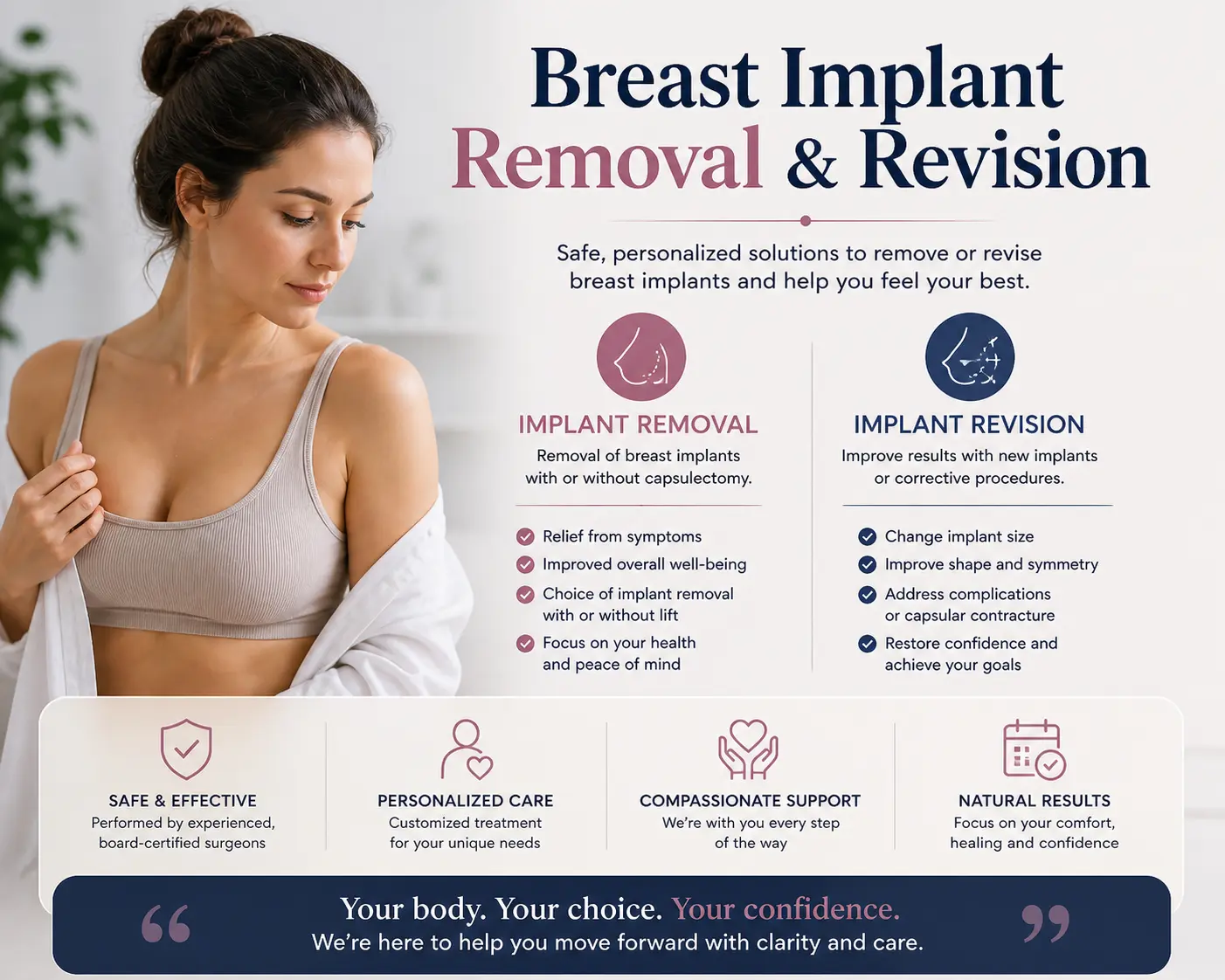
Quick Summary
Breast implant removal (explant) and revision surgery treat problems such as capsular contracture or implant rupture, and help people who want a different size or no implants at all. The FDA states that breast implants are not lifetime devices, and recommends that people with silicone implants have their first ultrasound or MRI screening for silent rupture 5–6 years after surgery, then every 2–3 years. At Carely Clinic in Istanbul, implant removal, implant exchange, removal with a breast lift and fat transfer after removal are all available after assessment.
This guide covers the reasons for surgery, removal and revision options — from simple exchange to total capsulectomy — recovery, cost and what to expect after explant.
Why Do Patients Choose Breast Implant Removal or Revision?
The most common reasons for removal or revision are capsular contracture, implant rupture, symptoms associated with breast implant illness, and a wish to change size or style. The ASPS lists changing breast size, pain from capsular contracture, concern about rupture or implant movement, and switching from saline to silicone or to a different implant style.
Implants are not permanent devices. An ASPS article from March 2025 notes that most implants require an exchange every 10 to 15 years, and the NHS says breast implants do not last a lifetime and are likely to need replacing at some point. Understanding your reason for surgery is the first step toward choosing the right procedure.
Capsular Contracture
Capsular contracture is the most commonly reported complication after breast implant surgery, according to the American Academy of Family Physicians (AAFP), which cites 10-year capsular contracture rates of 18.9% for primary augmentation with silicone implants and as high as 20.8% for augmentation with saline implants.
The body normally forms a thin layer of scar tissue — called a capsule — around any implant. When this capsule thickens and tightens abnormally, it squeezes the implant, causing it to harden, distort, and in severe cases become painful. Graded on a scale of I (soft, normal) to IV (hard, painful, and visibly deformed), Grade III and IV contracture typically requires surgical intervention.
Treatment usually involves removing the implant together with the hardened capsule. If the patient wants to keep implants, a new implant is placed — sometimes in a new or adjusted pocket — in the same operation.
Implant Rupture or Leakage
A saline implant rupture is usually obvious because the breast deflates as the saline is absorbed, while a silicone implant rupture is often silent and needs ultrasound or MRI to detect.
According to the FDA labeling guidance, people with silicone gel implants and no symptoms should have their first ultrasound or MRI at 5–6 years after surgery, then every 2–3 years; MRI is recommended for anyone with symptoms or unclear ultrasound results. Saline implants have no screening recommendation because rupture is detectable without it. The NHS advises that a ruptured implant will need to be removed.
Breast Implant Illness (BII)
Breast implant illness (BII) is a term people use for whole-body symptoms — such as fatigue, joint pain, brain fog and hair loss — that they associate with their implants. According to the FDA, BII is not recognized as a formal medical diagnosis and there are no specific tests to define it.
Many people report improvement after removal: in a 2025 systematic review of 33 studies (6,048 women), 81.9% reported symptom improvement after explantation. A joint advisory from ISAPS, The Aesthetic Society and ASERF states that there is currently no good peer-reviewed evidence that capsulectomy is required for symptom improvement without other indications. Medical evaluation to rule out other causes should come first — see our guide to breast implant illness.
BIA-ALCL (breast implant-associated anaplastic large cell lymphoma) is a different condition: a rare cancer of the immune system. As of 30 June 2024, the FDA had received reports of 1,380 cases worldwide: 73% involved textured implants, 3% smooth implants and 24% did not specify the surface.
Size or Aesthetic Change
Life changes — such as weight loss, pregnancy and menopause — change the breast around an implant and are a common reason people choose to resize or remove their implants, as surgeons quoted by the ASPS explain.
Some people choose a larger implant, others downsize for comfort, and some switch from saline to silicone or to a different implant style. Others want to return to a natural breast without implants, sometimes combined with fat transfer or a breast lift to improve shape.
Breast Implant Removal vs. Revision: What Is the Difference?
Breast implant removal means taking implants out without replacing them; revision means changing the existing result — by exchanging implants, correcting the pocket or treating a complication — usually in one operation.
Breast revision is typically an outpatient procedure, according to The Aesthetic Society, and the ASPS lists intravenous sedation or general anaesthesia as options. Complexity and cost depend on what is needed: a simple exchange in a healthy pocket is a very different operation from a revision with capsulectomy, pocket correction and a breast lift.
Implant Exchange (Replacement)
In an implant exchange, the existing implant is removed and a new one — a different size, profile, brand or type — is placed, often through the existing incision. The ASPS lists the breast-fold (inframammary), breast lift and areola incisions as options.
Exchange suits patients whose implant pocket is healthy and whose main goal is an aesthetic change. Manufacturer warranties vary — the ASPS notes that after ten years, the costs of replacement surgery are no longer covered — so check your implant card and warranty terms.
For implant brands and types, see our guides to breast augmentation at Carely Clinic, Motiva vs Mentor implants and silicone vs saline implants.
Explant Without Replacement
Explant surgery — implant removal without replacement — leaves the breast to soften and reshape over the following months, and the result depends heavily on skin elasticity and how much volume the implants added.
This option suits patients who no longer want implants and accept a smaller breast. Surgeons discuss the chance of sagging (ptosis) before surgery; a breast lift in the same operation or later is often offered to patients with larger implants or loose skin. Fat transfer is another option for patients who want modest volume without implants.
Types of Capsulectomy: En Bloc, Total, and Partial Explained
Capsulectomy types differ in how much of the capsule (the scar tissue around the implant) is removed and whether the implant and capsule come out as a single unit — which affects complexity, incision length and when each is appropriate.
Choosing the right technique depends on your reason for surgery, where the implant sits (above or below the muscle), the condition of the capsule and whether rupture or BIA-ALCL is a concern. Your surgeon will explain which approach is appropriate and why.
En Bloc Capsulectomy
En bloc capsulectomy removes the implant and the entire surrounding capsule as one intact, unopened unit.
It is the most extensive technique and needs a longer incision. According to the joint ISAPS, Aesthetic Society and ASERF advisory, the absolute indication for en bloc capsulectomy is a malignancy in the capsule, such as BIA-ALCL, and the term en bloc should not be used for a capsulectomy performed without malignancy.
Total Capsulectomy
Total capsulectomy removes the entire capsule, but not necessarily in one piece.
The joint advisory lists capsular contracture, rupture of a gel implant and, possibly, removal and exchange of textured implants as relative indications for total capsulectomy. How much capsule can be removed safely depends on where the implant sits and how firmly the capsule is attached to the chest wall.
Partial Capsulectomy
Partial capsulectomy removes only part of the capsule and leaves the rest in place.
It may be used when complete removal is not clinically necessary — for example, in some revisions where a new implant is placed. It is a shorter, less complex procedure than total or en bloc capsulectomy.
En Bloc vs. Total vs. Partial Capsulectomy: Comparison Table
The three techniques compared — useful for asking the right questions at consultation.
| Factor | En Bloc Capsulectomy | Total Capsulectomy | Partial Capsulectomy |
|---|---|---|---|
| Method | Implant and entire capsule removed as one intact unit | Entire capsule removed, not necessarily in one piece | Part of the capsule removed; the rest left in place |
| Capsule opened? | No | Yes — usually | Yes |
| Main indications | Malignancy in the capsule, such as BIA-ALCL (absolute indication) | Capsular contracture, rupture of a gel implant, possibly textured implant exchange (relative indications) | When complete capsule removal is not clinically necessary |
| Required for BII symptom improvement? | No good peer-reviewed evidence | No good peer-reviewed evidence | — |
| Incision | Longer incision | Depends on the case | Often the existing incision |
| Complexity | Highest | Moderate to high | Lowest |
Key Point
More capsule removal is not automatically better. Ask your surgeon why a particular technique is recommended for your case — en bloc removal is reserved for capsular malignancy, such as BIA-ALCL.
What Happens to Your Breasts After Implant Removal?
After explant surgery, the breast tissue gradually softens and settles over the following months; the final result varies with implant size, how long the implants were in place and skin elasticity.
Having realistic expectations about how the breasts will look after removal is one of the most important parts of the decision.
Skin Elasticity and Ptosis After Removal
Patients with larger implants worn for many years are more likely to have loose skin and sagging after removal, because long-term stretching reduces the skin’s ability to retract.
Younger patients and those with smaller implants usually see better skin retraction. Surgeons assess sagging by the position of the nipple relative to the breast fold to decide whether a breast lift in the same operation, or later, is advisable. At Carely Clinic, a breast lift can be performed in the same operation as implant removal.
Fat Transfer After Explant
Fat transfer to the breast is an option for patients who want to keep some volume without implants, using fat taken by liposuction from areas such as the abdomen or thighs.
The volume gain is modest compared with implants, and not all transferred fat survives, so it is better suited to patients downsizing from moderate implants than to replacing large ones. At Carely Clinic, fat transfer to the breast is available after implant removal.
See our breast lift in Turkey guide for how a lift reshapes the breast.
The Breast Implant Removal & Revision Procedure: Step by Step
Removal and revision procedures follow a similar sequence; the key differences are how the capsule is managed, whether new implants are placed and whether a breast lift or fat transfer is added.
Operating time depends on the plan. At Carely Clinic, surgery takes place at a JCI-accredited partner hospital in Istanbul, confirmed in your written treatment plan.
Step 1 — Pre-operative assessment: Blood tests, a review of your implant history (implant card or surgical records), ultrasound or MRI where needed, and surgical planning.
Step 2 — Anaesthesia: Usually general anaesthesia; the ASPS also lists intravenous sedation as an option for some revisions.
Step 3 — Incision: The original incision is often reused. A breast lift uses lift incisions, and en bloc capsulectomy needs a longer incision.
Step 4 — Implant and capsule management: The surgeon removes the implant and performs any planned capsulectomy. If an implant has ruptured, escaped gel is cleared. If a new implant is being placed, the pocket is assessed and adjusted.
Step 5 — New implant placement (if applicable): The new implant is placed and the pocket adjusted if needed to correct its position.
Step 6 — Drain placement: A small, thin tube may be placed temporarily to drain excess blood or fluid (ASPS).
Step 7 — Closure: Incisions are closed, and a surgical bra or support garment is applied.
Recovery After Breast Implant Removal or Revision
According to The Aesthetic Society, it typically takes one to two weeks to recover from breast implant revision surgery, and recovery is likely to be shorter after implant removal alone. Capsulectomy, pocket correction or a breast lift add to recovery time.
The First Weeks
Expect swelling, bruising and tightness in the first days, managed with pain relief and a support garment.
If drains were placed, they are removed when fluid has reduced. Sleeping on your back with your upper body raised helps reduce swelling. Gentle walking is encouraged early, while lifting, reaching overhead and strenuous activity are restricted until your surgeon allows them.
Returning to Work and Daily Activities
The Aesthetic Society notes that after implant replacement it is often possible to return to work within seven to ten days.
Underwire bras, exercise and lifting are reintroduced gradually, on your surgeon’s advice. Patients who also had a breast lift or pocket correction usually need longer before returning to full activity. Scar care with silicone products can begin once the incisions have fully closed.
The Following Months
Healing continues for several weeks as swelling decreases (ASPS), and the breast shape keeps settling over the following months.
After removal without replacement, the breast tissue continues to soften and reshape for several months. Scars keep fading for many months — see our guide to breast augmentation scars.
Cost of Breast Implant Removal & Revision
Breast implant removal and revision costs vary widely with the procedure, the country and what the quote includes.
| What affects the cost | Why it matters |
|---|---|
| Removal only or exchange | Exchange includes the cost of new implants; removal alone does not |
| Capsulectomy | Removing some or all of the capsule adds surgical time |
| Breast lift or fat transfer | Combining procedures adds time and cost, but avoids a second operation |
| Implant brand | At Carely Clinic, Arion, Mentor and Motiva implants are available |
| What the quote includes | Hospital stay, hotel, transfers and follow-up are often billed separately — ask for an itemised written quote |
At Carely Clinic: breast implant removal and revision packages include a hospital stay of 1–2 nights, six nights in a 5-star hotel, VIP transfers and 12 months of WhatsApp follow-up. The price depends on the procedure and is given on WhatsApp after our team reviews your details.
The FDA warns that even if you have complications, the cost of implant removal or replacement may not be covered by insurance, and the NHS notes that you will have to pay for any follow-up surgery you may need after cosmetic breast enlargement. Check with your insurer in writing before booking.
Breast Implant Removal & Revision at Carely Clinic in Istanbul
At Carely Clinic in Istanbul, breast implant removal and revision are available after assessment, including:
Implant removal without replacement, with or without capsulectomy as your surgeon advises · Implant exchange, with new implants placed in the same operation · Removal with a breast lift in the same operation · Fat transfer to the breast after removal.
Surgery takes place at a JCI-accredited partner hospital in Istanbul, confirmed in your written treatment plan. The package includes a hospital stay of 1–2 nights, six nights in a 5-star hotel, VIP transfers and 12 months of WhatsApp follow-up, with check-ins at 1 week and 1, 3, 6 and 12 months and a 24/7 emergency line.
Before you travel, send your implant card or surgical records, the date of your original surgery, any recent scans and your goals through WhatsApp. Our team replies within 24 hours, and the price is given once your details have been reviewed. Payment is made in Istanbul before surgery — nothing is paid before you travel.
If new implants are placed, you receive an implant card with the brand, model, size and serial numbers at discharge, and your surgeon will also check that you are fit to fly before you return home.
Learn more about breast aesthetics at Carely Clinic or book a free online consultation.
Frequently Asked Questions
When should you get breast implants removed?
Consider removal or revision if you have capsular contracture, a confirmed rupture, persistent pain, a change you are unhappy with, or symptoms you associate with breast implant illness. The FDA states that breast implants are not lifetime devices and recommends the first ultrasound or MRI for silicone implants at 5–6 years after surgery, then every 2–3 years. An ASPS article notes that most implants require an exchange every 10 to 15 years.
What happens to your breasts after implant removal?
After removal, the breast tissue gradually softens and reshapes over several months. The final result depends on skin elasticity, your natural breast tissue, implant size and how long the implants were in place. Patients with larger implants or stretched skin may have sagging and may benefit from a breast lift, and fat transfer can add modest volume without implants.
Is breast implant removal surgery painful?
Discomfort is usually manageable with pain relief, and The Aesthetic Society notes that recovery is likely to be shorter, with minimal discomfort, after implant removal alone. Procedures with capsulectomy or a breast lift involve more swelling and discomfort, and drains may be placed for a short time.
How long does breast implant removal surgery take?
Operating time depends on what is planned: removal alone is shorter, while capsulectomy, a breast lift or fat transfer add time. Breast revision is typically an outpatient procedure, according to The Aesthetic Society. At Carely Clinic, the package includes a hospital stay of 1–2 nights, and your surgeon confirms the plan after assessment.
What is the difference between en bloc and total capsulectomy?
En bloc capsulectomy removes the implant and the entire capsule as one intact, unopened unit; total capsulectomy removes the entire capsule but not necessarily in one piece. A joint ISAPS, Aesthetic Society and ASERF advisory states that the absolute indication for en bloc capsulectomy is a malignancy in the capsule, such as BIA-ALCL, while capsular contracture and gel implant rupture are relative indications for total capsulectomy.
Do you need to remove the capsule when removing implants?
Not always. The joint ISAPS, Aesthetic Society and ASERF advisory states there is currently no good peer-reviewed evidence that capsulectomy is required for symptom improvement without other indications. Capsule removal may be advised for capsular contracture, rupture of a gel implant or capsular malignancy, so your surgeon will recommend an approach for your specific case.
Do I need a breast lift after implant removal?
It depends on skin laxity, implant size and how long the implants were in place — patients with larger implants worn for many years are most likely to benefit. Your surgeon assesses sagging by the position of the nipple relative to the breast fold. At Carely Clinic, a breast lift can be performed in the same operation as implant removal, which avoids a second anaesthetic.
How much does breast implant removal cost?
The cost depends on whether implants are removed or exchanged, whether capsulectomy is needed and whether a breast lift or fat transfer is added. At Carely Clinic in Istanbul, removal and revision packages include a hospital stay of 1–2 nights, six nights in a 5-star hotel, VIP transfers and 12 months of WhatsApp follow-up, and the price is given on WhatsApp after our team reviews your details. Whichever clinic you choose, ask for an itemised written quote.
Can breast implants cause illness (BII)?
Some people report whole-body symptoms such as fatigue, joint pain and brain fog that they associate with their implants, but the FDA states that BII is not recognized as a formal medical diagnosis and there are no specific tests to define it. In a 2025 systematic review, 81.9% of patients reported symptom improvement after implant removal. A medical evaluation to rule out other causes should come first.
What is capsular contracture and how is it treated?
Capsular contracture happens when the scar tissue capsule around an implant tightens and hardens, distorting the breast and sometimes causing pain. The AAFP describes it as the most commonly reported complication after breast implant surgery and cites 10-year rates of 18.9% for primary silicone augmentation and up to 20.8% for saline augmentation. Surgical treatment usually removes the implant and the hardened capsule, with a new implant placed if desired.
How long is recovery after breast implant revision?
According to The Aesthetic Society, recovery from breast implant revision typically takes one to two weeks, it is often possible to return to work within seven to ten days after implant replacement, and recovery is likely to be shorter after removal alone. Capsulectomy, pocket correction or a breast lift extend recovery, and the breast shape continues to settle over the following months.
Does insurance cover breast implant removal?
Often not. The FDA warns that even if you have complications, the cost of implant removal or replacement may not be covered by insurance, and the NHS notes that you will have to pay for any follow-up surgery after cosmetic breast enlargement. Coverage depends on your policy and the medical reason for removal, so confirm the terms with your insurer in writing before surgery.
Can I replace my breast implants at the same time as removal?
Yes. Implant exchange removes the existing implants and places new ones in the same operation, and the surgeon can also treat the capsule or adjust the pocket. People change size, profile, brand or type, for example from saline to silicone. At Carely Clinic, new implants can be placed in the same operation, with Arion, Mentor and Motiva implants available.
Does Carely Clinic offer breast implant removal and revision?
Yes. At Carely Clinic in Istanbul, implant removal, implant exchange, removal with a breast lift and fat transfer after removal are available after assessment. Surgery takes place at a JCI-accredited partner hospital confirmed in your written treatment plan. Send your implant details and goals on WhatsApp; our team replies within 24 hours and gives the price once your details are reviewed.
Conclusion
Breast implants are not lifetime devices (FDA), and many people will need removal or revision at some point. The right procedure — exchange, removal, capsulectomy or removal with a lift — depends on your reason for surgery and your anatomy.
The key takeaways: capsular contracture is the most commonly reported complication and a common reason for revision; en bloc capsulectomy is reserved for capsular malignancy such as BIA-ALCL, and there is no good evidence that capsulectomy is needed for BII symptom improvement without other indications; and the breast’s appearance after removal depends on skin elasticity, implant size and time in place, with a breast lift or fat transfer as options.
Whether you are considering an implant exchange, removal for BII concerns or a combined revision with a breast lift, the first step is a consultation with a qualified plastic surgeon who can assess your anatomy, implant history and goals.
Individual requirements and outcomes vary. This guide provides general information based on FDA, NHS, ASPS and other published guidance and research. Consult qualified medical professionals for personalised advice.
If you would like to explore your breast implant removal or revision options, contact Carely Clinic for a free online consultation with our Istanbul team. You receive a personalised plan on WhatsApp before you commit to travel.
Written by Carely Clinic Medical Team · Last updated: November 2026
Sources:
- U.S. Food and Drug Administration (FDA) — Things to Consider Before Getting Breast Implants: https://www.fda.gov/medical-devices/breast-implants/things-consider-getting-breast-implants
- FDA — Breast Implants: Certain Labeling Recommendations to Improve Patient Communication (2020): https://www.fda.gov/media/131885/download
- FDA — Medical Device Reports of Breast Implant-Associated Anaplastic Large Cell Lymphoma: https://www.fda.gov/medical-devices/breast-implants/medical-device-reports-breast-implant-associated-anaplastic-large-cell-lymphoma
- FDA — Medical Device Reports of Systemic Symptoms in Women with Breast Implants: https://www.fda.gov/medical-devices/breast-implants/medical-device-reports-systemic-symptoms-women-breast-implants
- American Academy of Family Physicians — Breast Implants: Common Questions and Answers (2021): https://www.aafp.org/pubs/afp/issues/2021/1100/p500.html
- American Society of Plastic Surgeons (ASPS) — Breast Implant Revision: https://www.plasticsurgery.org/cosmetic-procedures/breast-implant-revision
- ASPS News — What You Need to Know About Breast Implant Revisions (March 2025): https://www.plasticsurgery.org/news/articles/what-you-need-to-know-about-breast-implant-revisions
- The Aesthetic Society — Breast Revision Aftercare and Recovery: https://www.theaestheticsociety.org/procedures/breast/breast-revision/aftercare-recovery
- NHS — Breast enlargement: https://www.nhs.uk/tests-and-treatments/cosmetic-procedures/cosmetic-surgery/breast-enlargement/
- ISAPS, The Aesthetic Society and ASERF — Patient Safety Advisory: Breast Implant Removal and Capsulectomy: https://www.isaps.org/media/djtnnugi/230509-joint-patient-safety-advisory-breast-implant-removal-and-capsulectomy.pdf
- Ferreira et al. — Breast Implant Illness: Systematic Review and Meta-analysis, Aesthetic Plastic Surgery (2025): https://link.springer.com/article/10.1007/s00266-025-05142-x