
Quick Summary
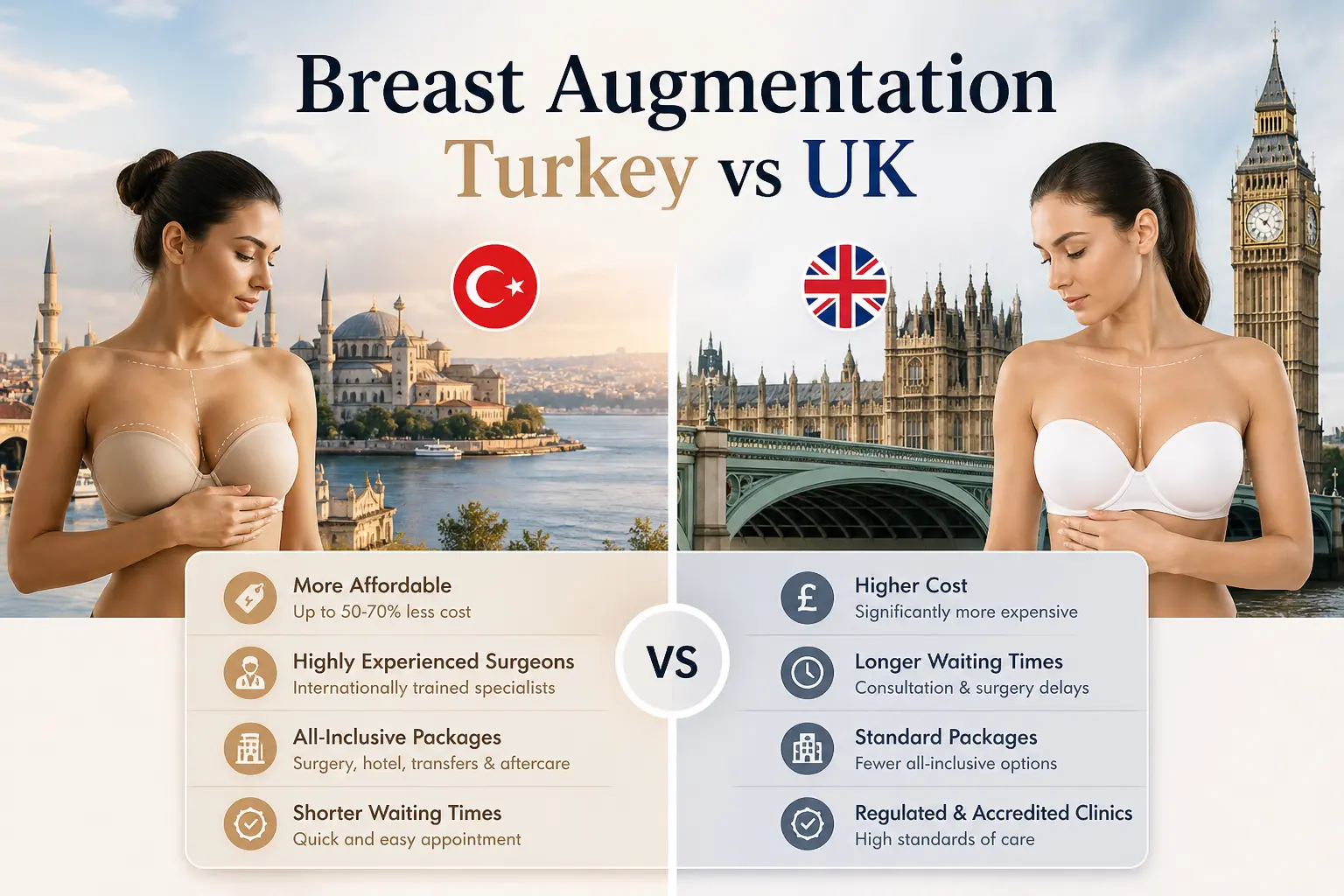
Breast augmentation in Turkey costs £3,200–£5,000 all-inclusive versus £5,000–£9,000 in the UK, a saving of 40–65%. Turkey performed 48,179 breast augmentations in 2024 (ISAPS), using the same FDA-approved implants available in the UK.
The key differences are regulatory framework, aftercare continuity, and BCIR registration — not implant quality. Accredited Turkish clinics with TPRECD-certified surgeons deliver comparable outcomes to UK private clinics for the right patient.
This guide compares cost, safety, regulation, surgeon qualifications, and aftercare.
Quick Comparison: Turkey vs UK at a Glance
Turkey saves British patients 40–65% on breast augmentation costs, with identical implant brands and comparable surgical techniques, but a fundamentally different regulatory and aftercare infrastructure.
| Factor | Turkey | UK |
|---|---|---|
| Cost (all-inclusive) | £3,200–£5,000 | £5,000–£9,000 (surgery only) |
| Implant Brands | Mentor, Motiva, Natrelle (FDA/CE) | Mentor, Motiva, Natrelle (FDA/CE) |
| Surgical Regulator | Ministry of Health / TPRECD | CQC / GMC / BAAPS |
| Hospital Accreditation | JCI (top-tier clinics) | CQC registered (mandatory) |
| BCIR Registration | Not included | Automatic |
| In-Person Pre-Op | Usually on arrival day | Multiple appointments |
| Length of Stay Required | 7–10 days | Day surgery or 1 night |
| Long-Term Aftercare | Remote (WhatsApp/video) | In-person access to surgeon |
| Annual Procedure Volume (Turkey) | 48,179 breast augs (ISAPS 2024) | ~28,000 breast augs (BAAPS 2023) |
| Legal Recourse | Complex — Turkish law applies | UK law, no-win-no-fee available |
Why Trust This Guide
This guide draws on the ISAPS 2024 Global Survey (2,900+ surgeons, 117 countries), BAAPS published audit data, CQC and TPRECD regulatory frameworks, and peer-reviewed data from the Journal of Plastic, Reconstructive & Aesthetic Surgery.
Carely Clinic’s editorial team reviews all content for clinical accuracy, updating articles when regulatory guidance changes. This is medical education content — not a substitute for personalised surgical consultation.
Cost of Breast Augmentation: Turkey vs UK
Breast augmentation in Turkey costs £3,200–£5,000 all-inclusive in 2026, compared to £5,000–£9,000 in the UK — where the quoted price covers surgery, anaesthesia, and implants, but not accommodation, transfers, or extended follow-up.
The price difference is structural, not qualitative. Turkish clinics operate with lower facility overheads, lower labour costs relative to local wages, and benefit from Turkish lira exchange rates that have depreciated significantly since 2023. These factors reduce operating costs without reducing implant brand quality or surgical technique.
For UK patients, the realistic total cost of choosing Turkey includes the surgery package plus return flights (typically £150–£300 from London), travel insurance with surgical complication cover, and potentially a private GP consultation in the UK post-return. Even accounting for these additions, the all-in cost of Turkish breast augmentation typically remains 35–55% below UK private clinic prices.
| Country | Average Cost (2026) | What’s Typically Included |
|---|---|---|
| Turkey (Istanbul) | £3,200–£5,000 | Surgery, implants, hospital, hotel, transfers, follow-up |
| UK (national average) | £5,000–£9,000 | Surgery, anaesthesia, implants (hotel/transfers not included) |
| US | $8,000–$12,000 | Surgery fees only (no accommodation) |
| Australia | A$12,000–A$16,000 | Surgery fees only |
Adding anatomical (teardrop) implants increases Turkish package costs by approximately £400–£600. Combining augmentation with a breast lift raises totals to £4,300–£5,900 in Turkey, compared to £8,000–£12,000 in the UK for the same combination.
Expert Insight
“The price difference between Turkey and the UK for breast augmentation reflects lower facility overheads and favourable exchange rates — not differences in implant quality or surgical skill at accredited centres.”
— Source: ISAPS Global Survey 2024; HayatMed Audited Outcomes, January 2024–October 2025
What’s Included in a Turkish All-Inclusive Package
Standard Turkish breast augmentation packages are genuinely all-inclusive in a way that UK quotes are not — covering logistics that UK patients would otherwise fund separately.
A mid-range Turkish package (£3,200–£4,500) typically includes: surgeon and anaesthetist fees, FDA/CE-marked implants from a named brand, 1–2 nights in a private hospital room, 5–7 nights in a 4-star hotel near the clinic, airport pick-up and return transfer, post-operative compression garment, prescribed medications, and 12-month remote follow-up via WhatsApp or video call.
Budget packages under £2,500 frequently omit hotel upgrades, limit follow-up to a single session, or exclude a private hospital room. Always request an itemised quote rather than accepting a headline all-inclusive figure — this lets you identify exactly what is and is not covered before committing.
Items that are almost never included in any Turkish package, regardless of price tier: your return flight from the UK, travel insurance with surgical complication cover, and any revision surgery needed after you return home.
Learn more about what to expect from breast augmentation surgery at Carely Clinic, including a full breakdown of package inclusions.
Safety and Regulation: How the Two Countries Compare
Turkey and the UK operate fundamentally different regulatory systems for cosmetic surgery — understanding both is essential for making a safe, informed decision.
UK Regulatory Framework
UK private clinics are regulated by the Care Quality Commission (CQC), which conducts regular inspections and enforces mandatory standards for patient safety, infection control, and record-keeping. All surgeons performing breast augmentation in the UK must be registered on the GMC’s specialist register in plastic surgery.
Membership of BAAPS (British Association of Aesthetic Plastic Surgeons) or BAPRAS (British Association of Plastic, Reconstructive and Aesthetic Surgeons) is voluntary but indicates peer-reviewed standards beyond the GMC minimum. UK patients have access to the Ombudsman system and no-win-no-fee legal routes if standards are breached.
Turkish Regulatory Framework
Turkey’s cosmetic surgery sector is regulated by the Ministry of Health, with licensing requirements for facilities and surgeons — but enforcement standards vary significantly between accredited and non-accredited providers.
JCI (Joint Commission International) accreditation is the most meaningful quality signal for international patients at Turkish hospitals. JCI-accredited facilities are audited against over 1,300 patient safety standards covering infection prevention, sterilisation, emergency protocols, and quality monitoring. Istanbul has a higher concentration of JCI-accredited hospitals than almost any other medical tourism city.
TPRECD Certification: Turkey’s Equivalent to GMC Specialist Registration
TPRECD (Türk Plastik Rekonstrüktif ve Estetik Cerrahi Derneği) is Turkey’s national plastic surgery association, requiring specialist surgical training comparable to UK BAPRAS membership. Verified TPRECD certification is the minimum standard to look for in any Turkish breast surgeon.
Many senior Turkish surgeons also hold ISAPS or EBOPRAS (European Board of Plastic Reconstructive and Aesthetic Surgery) membership, indicating international peer review in addition to national certification.
The practical safety gap between Turkey and the UK is not country-level but clinic-level. A TPRECD-certified surgeon operating in a JCI-accredited Istanbul hospital operates within a framework comparable to a UK private clinic. An uncredentialed surgeon at a non-licensed facility represents an entirely different risk profile. The critical work for UK patients is distinguishing between these two tiers — which the vetting checklist below is designed to support.
For a deeper understanding of breast augmentation safety statistics regardless of country, our breast augmentation safety guide covers global complication rates, BIA-ALCL data, and how to assess risk factors.
Surgeon Qualifications: What to Look For
The biggest safety variable in Turkish breast augmentation is not the country — it is the individual surgeon’s credentials and procedure volume.
The minimum qualifications to verify before booking any Turkish surgeon: current TPRECD certification (verify at tpcd.org.tr), the number of breast augmentations performed annually (300+ is a reasonable benchmark for specialisation), before-and-after portfolios specific to breast augmentation (not general plastic surgery), and documentation of who will actually perform each step of the surgery.
A documented risk in the Turkish cosmetic tourism sector is the “ghost surgery” phenomenon, where a senior surgeon represents a clinic but trainees perform the procedure. This practice is neither universal nor unique to Turkey — but it is a specific question to ask directly: “Who performs the surgery from first incision to closure?” Request written confirmation.
ISAPS 2024 data places Turkey among the top global medical tourism destinations, with 1.29 million foreign patients treated annually. High-volume centres performing hundreds of breast augmentations per year achieve surgeon specialisation that smaller UK practices — where a surgeon might perform 50–100 breast augmentations per year — do not replicate. Volume and specialisation are legitimate quality arguments for Turkey’s leading clinics.
Implant Quality: Are Turkish Implants the Same?
Implant Brands Available in Turkey
Accredited Turkish clinics use Mentor, Motiva, and Natrelle (Allergan Aesthetics) — the same three brands most commonly used by UK private surgeons, all carrying FDA approval and CE marking.
ISAPS 2024 data confirms that fifth-generation cohesive silicone gel implants account for 88% of breast augmentations globally. Turkey’s accredited clinics use the same generation of devices through the same international supply chain. The implant placed in Istanbul and the implant placed in London are, in terms of device specification, identical products.
Round vs Teardrop Implants in Turkey
Round implants account for approximately 70% of breast augmentations in Turkey, with teardrop (anatomical) implants making up the remaining 30% and adding £400–£600 to package cost.
Both shapes are available at leading Turkish clinics. The surgical decision should be based on your anatomy, desired outcome, and surgeon recommendation — not on what a clinic’s standard package includes. If a clinic pushes one option without discussing your anatomy first, that is a clinical red flag.
What differs between Turkey and the UK on implants is traceability, not quality. UK patients having surgery in Britain are automatically enrolled in the BCIR, which records the exact implant model, serial number, and batch. This system enables automatic contact in the event of an implant recall. Patients having surgery in Turkey must obtain this documentation themselves — a critical point covered in the BCIR section below.
Expert Insight
“Breast augmentation safety depends far more on surgeon volume, facility accreditation, and patient screening than on the country of surgery. At high-volume accredited centres, complication rates converge globally.”
— Source: Journal of Plastic, Reconstructive & Aesthetic Surgery, 2024; ISAPS Global Survey 2024
Aftercare and Follow-Up: A Critical Difference
Aftercare is where the practical gap between Turkey and the UK is most significant — and where patients most often underestimate the implications.
Short-Term Aftercare in Turkey
During your stay (days 1–10), aftercare in Turkish all-inclusive packages is structured and intensive: daily wound checks, surgeon review before discharge, and a fit-to-fly assessment before you return to the UK. This in-country acute aftercare is comparable to UK private clinic standards.
Long-Term Aftercare Continuity
After you return home, long-term follow-up with your Turkish surgeon is remote — typically WhatsApp check-ins and video consultations at weeks 6, 12, and 24, with no in-person access unless you travel back to Istanbul.
If you experience a complication in the UK — capsular contracture, asymmetry requiring revision, or a suspected implant issue — you will need to manage this through UK private healthcare at your own cost, or seek NHS assessment (which does not cover corrective surgery for elective cosmetic procedures performed abroad). This is a genuine financial and practical risk to plan for.
The most resilient approach for patients choosing Turkey is to arrange a follow-up appointment with a UK-based private GP or cosmetic surgeon at 6–8 weeks post-operation, provide them with your full surgical documentation, and establish an explicit plan for how complications would be managed. This adds £100–£300 to your total cost but substantially reduces the aftercare gap.
The BCIR Gap: What UK Patients Must Know
UK patients who have breast augmentation in Turkey are not registered on the Breast and Cosmetic Implant Registry (BCIR) — a fact that no competitor article covering this topic adequately addresses.
The BCIR covers all breast implant procedures performed by UK private providers and the NHS in England, Scotland, and Northern Ireland. Its primary safety function is enabling authorities to trace and contact patients in the event of an implant safety alert — as demonstrated by the 2019 Allergan BIOCELL textured implant recall, when thousands of UK patients were contacted proactively.
Patients who have surgery abroad are excluded from this system by default. This does not mean their implants are less safe — the device is identical — but it does mean they will not receive automatic notification if a batch or model is later flagged.
The practical mitigation is straightforward: obtain written documentation of your implant brand, model number, serial number, lot/batch number, and implant size before you leave Turkey. Provide a copy to your UK GP for your personal medical record. Register your implant details with the manufacturer directly (Mentor and Motiva both offer patient implant registries). This takes under 30 minutes and closes the recall-notification gap.
Who Should Choose Turkey — and Who Shouldn’t
Patients Who Benefit Most from Turkey
Turkey is a well-matched choice for patients who: are in good general health with no significant comorbidities, have straightforward anatomy without complex asymmetry or prior breast surgery, have done thorough clinic and surgeon vetting, are comfortable with remote long-term follow-up, and have arranged a UK-based follow-up plan before departure.
The financial case is strongest for patients comparing Turkey to premium London or Southern England prices — where savings of £4,000–£6,000 on equivalent quality are realistic.
Patients Who Should Stay in the UK
The UK private clinic route makes more sense for patients who: have had prior breast surgery, implant removal, or mastectomy reconstruction; have significant tissue asymmetry requiring complex surgical planning; have chronic health conditions that may complicate healing; are unable to take 7–10 days away from family or work commitments; or simply want the ability to see their surgeon in person at any point during recovery without booking flights.
It also makes sense for patients for whom the cost difference is modest — London prices and Turkish prices converge at certain points of the market, particularly for premium-brand teardrop implants with extended aftercare packages.
Why Carely Clinic in Istanbul
Carely Clinic performs breast augmentation using Mentor and Motiva implants at a JCI-accredited Istanbul hospital, with surgeons holding TPRECD certification and ISAPS membership, serving patients from 47+ countries annually.
Turkey performed 48,179 breast augmentations in 2024 according to ISAPS — more than in most European countries combined — and Istanbul’s concentration of high-volume specialist clinics creates the surgeon specialisation that underpins strong outcomes data. Carely Clinic’s surgeons perform breast augmentation as a core specialisation, not as one of many general plastic surgery procedures, which aligns with the volume-to-outcome evidence.
Our all-inclusive packages for British patients cover surgery at a JCI-accredited Istanbul hospital, anaesthesia, implants from your chosen brand, 1–2 nights private hospital stay, 6 nights hotel accommodation, airport transfers, and 12-month remote follow-up.
We provide full written implant documentation — brand, model, serial number, and batch — at discharge, and we brief every international patient on how to register their implants with the manufacturer and how to establish UK-based follow-up. We do not offer the cheapest packages on the market; we offer packages designed to close the aftercare and traceability gaps that create complications in medical tourism.
Learn more about breast augmentation at Carely Clinic in Istanbul or contact our patient coordination team for a personalised quote and video consultation.
Summary Comparison Table
| Decision Factor | Turkey Advantage | UK Advantage |
|---|---|---|
| Cost | ✅ 40–65% lower all-inclusive | — |
| Implant Quality | ✅ Same FDA/CE brands | ✅ Same FDA/CE brands |
| Surgeon Volume | ✅ Higher volume at specialist centres | — |
| Regulation | — | ✅ Mandatory CQC / GMC oversight |
| BCIR Registration | — | ✅ Automatic |
| Long-Term Aftercare | — | ✅ In-person surgeon access |
| Legal Recourse | — | ✅ UK law, no-win-no-fee |
| Wait Time | ✅ Weeks (not months) | — |
Frequently Asked Questions
How much does breast augmentation cost in Turkey vs the UK?
Breast augmentation in Turkey costs £3,200–£5,000 all-inclusive in 2026, compared to £5,000–£9,000 in the UK where the quote typically covers surgery only. Turkish packages routinely bundle surgeon fees, anaesthesia, implants, 1–2 nights hospital stay, 5–7 nights hotel accommodation, airport transfers, and 12-month remote follow-up. The price gap reflects lower operating costs and Turkish lira exchange rates — not differences in implant brand or surgical technique.
Is breast augmentation safe in Turkey?
Breast augmentation in Turkey is safe at JCI-accredited hospitals with TPRECD-certified surgeons, where complication rates are comparable to UK private clinic benchmarks. The risk rises sharply at non-accredited facilities — a distinction the statistics often miss, since UK-based figures from BAAPS reflect complications from cosmetic tourism broadly, not exclusively from credentialed Turkish clinics. Patients who research accreditation, surgeon credentials, and aftercare protocols face substantially lower risk than those who book based on price alone.
What are the risks of getting a boob job in Turkey?
The primary risks specific to Turkey include limited in-person pre-operative consultations, aftercare gaps once you return to the UK, and no automatic entry onto the Breast and Cosmetic Implant Registry (BCIR). General surgical risks — capsular contracture (3–5% within 10 years), implant rupture, infection (average 1–2% globally), and asymmetry — are present regardless of country. Choosing a TPRECD-certified surgeon at a JCI-accredited hospital and arranging UK-based follow-up with your GP mitigates the country-specific risks significantly.
Can the NHS treat complications from breast augmentation done in Turkey?
The NHS will treat life-threatening complications from any surgery, regardless of where it was performed, but will not fund corrective or revision surgery for cosmetic procedures carried out abroad as a matter of routine policy. This means if you experience capsular contracture, implant displacement, asymmetry, or an unsatisfactory aesthetic outcome after surgery in Turkey, the cost of revision falls entirely to you as a private expense. Planning for this financially — either through specialist medical tourism insurance or a revision fund — is a practical step every patient considering Turkey should take before booking.
Is it safe to fly after breast augmentation in Turkey?
Most surgeons issue a fit-to-fly letter after 7 days for short-haul flights, but flying after surgery increases the risk of deep vein thrombosis (DVT) and pulmonary embolism (PE) — blood clots that can form in the legs and travel to the lungs. UK clinics including MYA advise waiting a minimum of 4 weeks before any flying post-surgery; Turkish clinics and ISAPS guidance set the minimum at 7 days for short-haul travel with medical clearance. The key safeguards are compression stockings, adequate hydration, in-flight leg exercises, and explicit fit-to-fly confirmation in writing from your surgeon before you board.
What is included in a breast augmentation package in Turkey?
A standard all-inclusive Turkish breast augmentation package covers surgeon fees, anaesthesia, the implants themselves, 1–2 nights in hospital, 5–7 nights hotel accommodation, airport transfers, post-operative garments, medications, and 12-month remote follow-up via WhatsApp or video call. The UK equivalent typically covers surgery, anaesthesia, and implants — hotel and transfer costs are the patient’s own. Budget Turkish packages under £2,500 often omit hotel upgrades, extended follow-up, or private rooms, so always request an itemised quote.
How do I choose a safe clinic in Turkey for breast surgery?
Verify that the hospital holds current JCI accreditation (searchable at qualitycheck.jointcommission.org) and that your surgeon is certified by the TPRECD (Turkish Plastic, Reconstructive and Aesthetic Surgery Association). Request the surgeon’s before-and-after portfolio for breast augmentation specifically, confirm the implant brand and model in writing, and ask how post-operative complications are managed once you return to the UK. A clinic that cannot answer these questions clearly is a red flag regardless of its price or online reviews.
What happens if something goes wrong after surgery in Turkey?
If complications occur while you are still in Turkey, your clinic’s surgical team should manage them — confirm their emergency protocol and 24-hour contact before booking. Once you return to the UK, your NHS GP can provide initial assessment, but the NHS does not cover corrective surgery for elective cosmetic procedures performed abroad, so private revision costs fall to you. Specialist medical tourism insurance that covers surgical complications (not just trip cancellation) is strongly recommended, though policies vary widely and require careful review.
Is it worth getting a boob job in Turkey?
For patients who vet their clinic thoroughly, Turkey offers 40–65% savings with comparable implant quality to UK private clinics — a genuine value proposition. The calculation changes when you factor in BCIR registration, revision risk, and managing complications from abroad. Turkey suits healthy candidates with straightforward anatomy and a verified aftercare plan; it is not the right choice for patients who prioritise the simplest possible follow-up pathway.
How long do I need to stay in Turkey after breast augmentation?
Most Turkish clinics require a minimum 7–10 day stay: 1–2 nights in hospital post-surgery, followed by 5–7 nights in a hotel for initial recovery and wound checks. A fit-to-fly letter is issued at the final pre-departure appointment, typically on day 7, confirming you are medically cleared to travel. Most professional associations advise waiting at least 7 days before flying after breast augmentation, though individual surgeon guidance may vary based on your specific procedure and recovery.
Will I be on the UK breast implant registry if I have surgery in Turkey?
No — the UK Breast and Cosmetic Implant Registry (BCIR) only records procedures performed by UK private providers and the NHS in England, Scotland, and Northern Ireland. This matters because the BCIR is the mechanism by which patients are contacted in the event of an implant safety alert or recall, as happened with the 2019 Allergan BIOCELL textured implant recall. UK patients who have breast augmentation abroad should keep all implant documentation — brand, model, serial number, and batch number — and provide it to their GP for their personal medical record.
Conclusion
Turkey offers 40–65% cost savings and comparable implant quality, while the UK provides stronger regulatory oversight, BCIR registration, and easier aftercare continuity — the right choice depends on clinic vetting and personal circumstances.
For British patients, the core question is not “Turkey or UK?” but “which specific clinic, which specific surgeon, and what is my aftercare plan?” A TPRECD-certified surgeon at a JCI-accredited Istanbul hospital using FDA-approved implants delivers outcomes comparable to a UK private clinic. An unvetted clinic selected on price alone carries substantially higher risk. The 8-point checklist in this guide, combined with independent travel insurance and a UK-based follow-up plan, closes most of the risk differential.
The BCIR gap is the one asymmetry that cannot be fully closed by due diligence — but it can be mitigated by keeping implant documentation and registering directly with the manufacturer.
Individual requirements and outcomes vary. This guide provides general information based on international guidelines and published research. Consult qualified medical professionals for personalised advice.
Medical Review: Dr. Alirza Jahangirov