
Quick Summary
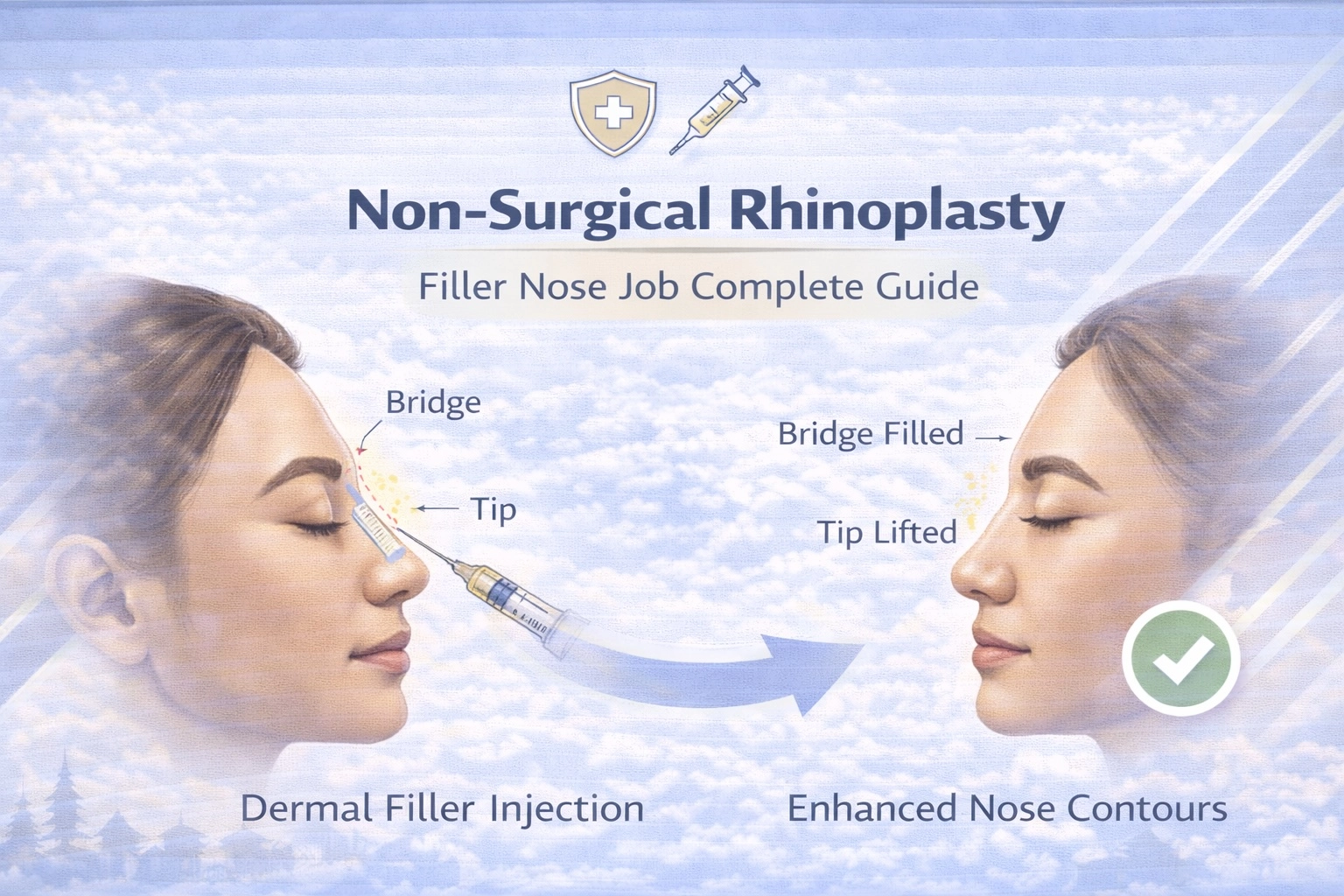
Non-surgical rhinoplasty (also called liquid rhinoplasty or a filler nose job) uses injectable dermal filler to change the shape of the nose without surgery. It can camouflage a small bump, lift a drooping tip slightly or fill a depression; it cannot make a nose smaller, narrow the nostrils or improve breathing, and the result is temporary.
In the largest published safety review — 2,488 filler rhinoplasty procedures over 10 years — 7.6% had an adverse event, most of them minor, and 0.20% were serious (ischaemia or skin necrosis). The US FDA lists the nose among the areas where it recommends against injecting dermal filler, because filler accidentally injected into a blood vessel can cause tissue death, blindness or stroke.
Carely Clinic does not offer non-surgical (filler) rhinoplasty. Our nose surgeons perform surgical rhinoplasty in Turkey at €2,850 all-inclusive (valid until December 2026), which permanently reshapes bone and cartilage. This guide explains what filler can and cannot do, so you can decide which route fits your nose.
Why Trust This Guide
Every figure in this article comes from a source you can open: Rivkin’s 10-year safety review of 2,488 nonsurgical rhinoplasty procedures (Facial Plastic Surgery & Aesthetic Medicine 2021;23(1):6–11); the US FDA page on dermal fillers (approved uses, unapproved uses and risks); the Layliev et al. 2017 analysis of 4,978 surgical rhinoplasty patients (Aesthetic Surgery Journal 37(7):757–767); and the NHS pages on nose reshaping and what to check before any cosmetic procedure. We do not perform filler rhinoplasty, so we have no commercial reason to sell it to you — or to talk you out of it. Where a statement is clinical opinion rather than data, we say so.
What Is Non-Surgical Rhinoplasty?
Non-surgical rhinoplasty is the injection of small amounts of dermal filler — usually hyaluronic acid — under the skin of the nose to change its outline. Nothing is removed and nothing is cut: the practitioner adds volume in chosen spots so that, in profile or from the front, the nose looks straighter, more lifted or more even.
Because only volume is added, every change is a camouflage rather than a correction. A bump is hidden by filling the dips above and below it; a droopy tip is made to look higher by supporting it from underneath. The FDA notes that absorbable fillers are broken down by the body over time, so the effect fades and the treatment has to be repeated to maintain it.
It is worth knowing what the filler is approved for. In the United States, dermal fillers are approved for facial wrinkles and folds and for adding volume to the lips, cheeks, chin and back of the hands. Injecting the nose is listed by the FDA under “unapproved uses” — the agency recommends against it. That does not make the procedure illegal (clinicians may use approved products off-label), but it is one reason to treat it as a medical procedure with real risks rather than a beauty treatment.
What Can Non-Surgical Rhinoplasty Fix?
Filler suits small, well-defined problems on a nose that is otherwise the right size. It is the wrong tool for a nose that is too big, too wide or hard to breathe through.
Concerns Non-Surgical Rhinoplasty CAN Address
- A small dorsal hump: filler above and below the bump straightens the profile line. The bump is still there under the filler, and the bridge becomes slightly higher overall. For permanent removal see our guide to dorsal hump removal.
- A mildly drooping tip: filler at the base of the tip can give a modest lift. A heavy or bulbous tip needs tip rhinoplasty to reshape the cartilage.
- Small dents and asymmetries: a depression on one side of the bridge or a shallow irregularity can be filled to even out the contour.
- A low or flat bridge: filler along the dorsum adds height and definition — one of the few situations where adding volume is exactly what the nose needs.
- Minor irregularities after surgery: small contour steps left after a rhinoplasty are sometimes treated with filler instead of a revision operation. Note the higher complication rate on operated noses discussed under Safety below.
What Non-Surgical Rhinoplasty CANNOT Do
- Make the nose smaller: filler only adds. A nose that looks straighter after filler is a slightly larger nose.
- Narrow a wide nose or wide nostrils: this needs bone and cartilage to be moved or removed, which only surgery does.
- Improve breathing: a deviated septum or collapsed nasal valve is an internal structural problem; filler on the outside does nothing for it. See rhinoplasty for breathing problems.
- Correct a large hump or a clearly crooked nose: the amount of filler needed to hide a big deformity would make the nose obviously bulky.
- Last: all absorbable filler results are temporary.
Non-Surgical vs Surgical Rhinoplasty
The core difference is simple: filler adds volume temporarily; surgery removes, moves and rebuilds bone and cartilage permanently, and can make a nose smaller as well as straighter. The table uses figures from the NHS nose reshaping page for surgery and the FDA and Rivkin 2021 for filler.
| Factor | Non-surgical rhinoplasty (filler) | Surgical rhinoplasty |
|---|---|---|
| What it does | Adds volume to camouflage a bump, dent or low bridge | Removes, moves and reshapes bone and cartilage |
| Can reduce size | No | Yes |
| Can improve breathing | No | Yes (septum and valve work can be combined) |
| Anaesthesia | Topical or local numbing | General anaesthetic |
| Operating time | Minutes | 1.5 to 3 hours (NHS) |
| Recovery | Normal activities the same day; bruising/swelling for days | Splint about 1 week; up to 2 weeks off work (NHS) |
| Duration of result | Temporary — fades as the filler is absorbed | Permanent (the nose still ages naturally) |
| Reversible | Hyaluronic acid filler can be dissolved with hyaluronidase | No — changes are permanent |
| Serious complications | 0.20% in 2,488 procedures (ischaemia/necrosis); blindness and stroke reported with facial filler (FDA) | 0.7% major complications in 4,978 patients (Layliev 2017) |
| At Carely Clinic | Not offered | €2,850 all-inclusive (valid until December 2026) |
Choose Non-Surgical Rhinoplasty If:
You want a subtle change to a nose that is the right size — a small bump softened, a dent filled, a slightly higher bridge — you accept that it is temporary and will need repeating, and you are not ready for surgery or cannot have a general anaesthetic.
Choose Surgical Rhinoplasty If:
You want the nose smaller, narrower or permanently straight; you have a large hump, a crooked nose or a heavy tip; you have breathing problems; or you have done the sums and would rather pay once than return every year. Our guide to open vs closed rhinoplasty explains how the surgical approach is chosen.
Some people use filler as a preview before surgery. That can help you visualise a straighter profile, but remember the preview adds volume while surgery usually removes it, so the two results are never the same.
Types of Dermal Fillers for Nose Reshaping
Practitioners choose between two families of product. We describe them generically; the exact product, and how long it is expected to last, should be named by the practitioner who injects you.
Hyaluronic Acid Fillers
Hyaluronic acid (HA) is a gel of a substance that occurs naturally in skin. Its key advantage in the nose is that it can be dissolved with an injection of the enzyme hyaluronidase — immediately if filler blocks a blood vessel, or later if you dislike the result. Firmer HA gels are preferred for the bridge because they hold their shape under the skin.
Calcium Hydroxylapatite
Calcium hydroxylapatite (CaHA) is a firmer, longer-lasting gel that cannot be dissolved. If it is placed badly or causes a vascular problem there is no antidote, which is why many injectors avoid it in the nose altogether or limit it to the radix (the top of the bridge between the eyes).
Filler Selection Considerations
Reversibility is the main reason HA is the usual choice for a first filler rhinoplasty. Whatever the product, the FDA advises against buying filler online (counterfeit or unapproved products), against injecting yourself, and against needle-free injection devices, which are not approved for dermal filler and have been linked to serious adverse events.
Am I a Good Candidate?
Good Candidates Include:
- Adults whose facial growth is complete and who want a small, specific change — a softened bump, a filled dent, a slightly higher bridge.
- People who want to see a straighter profile before deciding on surgery, understanding the limits of that preview.
- People who cannot or do not want to have a general anaesthetic or take time off for recovery.
- Patients with a minor contour irregularity after rhinoplasty, after discussing the higher risk on an operated nose with their injector.
Poor Candidates Include:
- Anyone whose main complaint is that the nose is too big or too wide — filler will make it bigger.
- Anyone with breathing problems.
- People with a large hump, a clearly crooked nose or a bulbous tip.
- People with active skin infection or inflammation on the nose, or a history of serious allergic reaction to filler.
- People who would find a treatment that needs repeating a burden rather than a convenience.
The Procedure: What to Expect
A filler rhinoplasty is a short clinic procedure. The NHS advises that before any cosmetic procedure you should be offered a consultation, be told about the products that will be used and what could go wrong, and be given a cooling-off period to think before you commit.
Before: the practitioner examines the nose, discusses what filler can realistically achieve, and takes your medical history, including previous nose surgery, allergies and blood-thinning medicines. Avoiding alcohol and non-essential blood-thinning painkillers beforehand reduces bruising — follow the specific advice you are given.
During: numbing cream or a local anaesthetic is applied; the injection points are marked; small amounts of filler are placed with a fine needle or a blunt cannula, usually in tiny deposits along the midline of the bridge where the risk of hitting a vessel is lowest; the filler is then moulded by hand and the result checked with you sitting up. You will feel pressure and brief stinging rather than pain.
After: you can go home straight away. Some redness, swelling and tenderness is normal for a few days, and bruising is possible. Avoid pressing on the nose, strenuous exercise, saunas and heavy glasses or sunglasses for the period your practitioner specifies, because pressure can move the filler before it settles (after surgical rhinoplasty the advice on glasses is stricter — see glasses after rhinoplasty). Any sudden severe pain, whitening or dusky colour of the skin, or any change in your vision, is an emergency: contact the practitioner immediately, because dissolving the filler quickly can prevent permanent damage.
How Long Do Results Last?
Non-surgical rhinoplasty results are temporary. The FDA puts it plainly: how long the effect lasts “depends on the filler material and the area where it is injected”, and because absorbable fillers are broken down by the body, “patients may need to repeat the procedure after some time to maintain the desired effect”. Ask the practitioner for the expected duration of the specific product they plan to use, and treat it as an estimate.
Factors Affecting Duration
- Product: firmer, more cross-linked gels generally persist longer than soft ones; CaHA generally outlasts HA but cannot be dissolved.
- Site and movement: the bridge of the nose moves little, which tends to favour longevity compared with mobile areas such as the lips.
- Amount and placement: precise placement in the right tissue plane by an experienced injector matters more than volume.
- You: metabolism, smoking and sun exposure all influence how fast filler is absorbed.
Maintaining Results
Each repeat treatment is a new injection with the same risks and the same cost as the first. Some practitioners suggest topping up before the previous filler has fully gone; others prefer to let it absorb completely so the nose can be reassessed. There is no published evidence that one schedule gives better long-term results than the other, so this is practitioner preference.
Safety and Risks
The best safety data come from Rivkin’s review of 2,488 nonsurgical rhinoplasty procedures in 2,275 patients, performed by one experienced injector over 10 years and published in Facial Plastic Surgery & Aesthetic Medicine in 2021. The overall adverse-event rate was 7.6%; most events were common injection reactions such as bruising, swelling and redness. Five cases (0.20%) were serious — ischaemia or skin necrosis from compromised blood supply. Patients who had already had surgical rhinoplasty had significantly more adverse events than those who had not (10.8% vs 7.4%), because surgery changes the blood supply of the nose.
Common Side Effects (Expected)
- Redness, swelling and tenderness at the injection points, settling over days.
- Bruising, which can take longer to fade.
- Slight asymmetry while swelling settles.
Potential Complications (Rare)
- Lumps or visible irregularity: filler placed too superficially or in too large a bolus; HA can be massaged or dissolved.
- Infection: increasing pain, heat, redness or fever after the first days needs prompt assessment.
- Migration: filler moving from where it was placed, listed by the FDA among the rarer risks of dermal filler.
- Nodules or granulomas: firm lumps that can appear weeks or months later.
Serious Complications (Very Rare)
The FDA describes unintentional injection into a blood vessel as “the most concerning risk” of dermal filler, adding that the chance is low but the consequences “can be serious and may be permanent”. Reported complications include necrosis (death of tissue), vision abnormalities including blindness, and stroke. The nose is a particularly high-risk site because its arteries connect to the arteries of the eye and are compressed in a tight space under thin skin — which is why the FDA lists the nose among the areas it recommends against injecting.
Minimizing Risk
- Choose a medically qualified practitioner who injects noses regularly and, in the words of the NHS, is “trained and experienced in the procedure you’re having” with “the right insurance to correct anything that goes wrong”.
- Prefer hyaluronic acid for the nose, and confirm that hyaluronidase is in the room before the first injection.
- Tell the injector about any previous nose surgery; the risk is measurably higher on an operated nose.
- Know the warning signs (sudden severe pain, blanching, dusky skin, visual change) and how to reach the practitioner out of hours.
- Never buy filler online or use needle-free devices (FDA warning).
What Non-Surgical Rhinoplasty Costs
Filler rhinoplasty is priced per session, and the price depends on the country, the practitioner’s qualifications and the product and volume used. Because every repeat is a new session, the real cost is the annual cost over the years you intend to keep the result, not the price of the first appointment. Any clinic quoting you should state what is included — consultation, product, review visit and, importantly, access to hyaluronidase if something goes wrong.
We do not publish filler prices because we do not offer the treatment, and we have removed the country-by-country price table that appeared on this page before: those figures had no dated source. For comparison, surgical rhinoplasty at Carely Clinic is a single all-inclusive price of €2,850 all-inclusive (valid until December 2026), covering the operation under general anaesthesia at a JCI-accredited hospital, one hospital night (two if your surgeon advises), six nights in a hotel in Istanbul, airport and clinic transfers, and 12 months of follow-up — see the rhinoplasty package in Turkey for the full list.
Non-Surgical Rhinoplasty at Carely Clinic
Carely Clinic does not perform non-surgical rhinoplasty. Our nose procedures are surgical and are carried out by ENT surgeons — Op. Dr. Vepa Silapov and Assoc. Prof. Dr. Mustafa Sagit — who correct the structure of the nose rather than disguise it. For the small, temporary changes filler offers, we think a short clinic visit close to home, with a practitioner you can reach quickly if a vessel is compromised, serves you better than flying to Istanbul for a treatment that fades.
If what you want is a permanently straighter, smaller or better-breathing nose, that is what we do. Rhinoplasty in Turkey at Carely Clinic is €2,850 all-inclusive (valid until December 2026); the operation takes place at BHT CLINIC İstanbul Tema Hospital (JCI-accredited May 2024; TEMOS January 2026; TÜSKA Gold June 2026). You pay nothing before you have met your surgeon in Istanbul, and after the operation our medical team follows your photos at 1 week and 1, 3, 6 and 12 months on WhatsApp. Send us your photos through the contact page and we will tell you within 24 hours whether surgery is the right route for your nose — and if a small change is all you need, we will say so.
Summary Table
| Aspect | Non-surgical rhinoplasty (filler) |
|---|---|
| What it is | Dermal filler injected under the skin of the nose to change its outline |
| Best for | Small hump camouflage, shallow dents, low bridge, slight tip lift |
| Cannot do | Reduce size, narrow the nose, improve breathing, fix large or crooked deformities |
| Anaesthesia and time | Topical/local numbing; a short clinic procedure |
| Recovery | Same-day return to normal activities; redness, swelling, bruising for days |
| Duration | Temporary; depends on product and site (FDA); repeat sessions needed |
| Reversible | Yes for hyaluronic acid (hyaluronidase); no for calcium hydroxylapatite |
| Adverse events | 7.6% overall, 0.20% serious in 2,488 procedures (Rivkin 2021); higher after previous nose surgery (10.8% vs 7.4%) |
| Most serious risk | Filler in a blood vessel — necrosis, blindness, stroke (FDA) |
| Regulatory status | Nose injection is an unapproved use of dermal filler in the US (FDA) |
| At Carely Clinic | Not offered; surgical rhinoplasty €2,850 all-inclusive (valid until December 2026) |
Frequently Asked Questions
How painful is non-surgical rhinoplasty?
Most people describe pressure and brief stinging rather than pain. Numbing cream or local anaesthetic is applied first, and many filler products contain a local anaesthetic. The nose can feel tender for a few days afterwards. Sudden severe pain during or after the injection is not normal — it can signal filler in a blood vessel and needs immediate attention.
Can non-surgical rhinoplasty make my nose smaller?
No. Filler only adds volume, so the nose becomes slightly larger even when it looks straighter or more balanced. Making a nose smaller, narrower or shorter requires surgical rhinoplasty, which removes and reshapes bone and cartilage.
Is non-surgical rhinoplasty safer than surgery?
It avoids a general anaesthetic and a surgical recovery, but it is not risk-free. In a 10-year review of 2,488 filler rhinoplasty procedures, 7.6% had an adverse event and 0.20% were serious (ischaemia or skin necrosis). The FDA warns that filler accidentally injected into a blood vessel can cause tissue death, blindness or stroke, and lists the nose among the areas it recommends against injecting. Surgical rhinoplasty had a 0.7% major complication rate in an analysis of 4,978 patients. The two carry different risks; neither is zero.
How do I choose between non-surgical and surgical rhinoplasty?
Ask what you want changed. A small bump, a shallow dent or a low bridge on a nose that is the right size can be camouflaged temporarily with filler. A nose that is too big or too wide, a large hump, a crooked nose, a heavy tip or any breathing problem needs surgery. If you want the result to be permanent, surgery is the only option.
Can I wear glasses after non-surgical rhinoplasty?
Your practitioner will ask you to avoid pressure on the nose from heavy glasses or sunglasses for a period after the injection, because the frame can shift filler before it settles. Follow the specific time they give you. After surgical rhinoplasty the restriction is longer and stricter, since the bones are healing.
What happens when the filler wears off?
The body gradually absorbs hyaluronic acid filler and the nose returns to its previous shape. The change is gradual rather than sudden. If you want to keep the result you book another session, with the same risks and cost as the first; if not, you simply let it fade.
Can non-surgical rhinoplasty be reversed?
Hyaluronic acid filler can be dissolved with an injection of the enzyme hyaluronidase — this is also the emergency treatment if filler blocks a blood vessel, which is why injectors should have it in the room. Calcium hydroxylapatite filler cannot be dissolved and has to be absorbed by the body over time.
How often do I need touch-up treatments?
There is no fixed interval. How long filler lasts depends on the product, where it is placed and your own metabolism; the FDA notes that patients may need to repeat the procedure to maintain the effect. Ask your practitioner for the expected duration of the product they use, and remember that each repeat is a full new session.
Can I combine non-surgical rhinoplasty with other treatments?
Filler in the nose is often done at the same appointment as filler in the chin or cheeks to balance the profile, and this is a clinical decision for the practitioner. If you are planning surgical rhinoplasty, tell the surgeon about any filler already in the nose, as it can be dissolved beforehand to let the surgeon see the true anatomy.
What should I look for in a practitioner?
A medically qualified practitioner who injects noses regularly, uses hyaluronic acid, keeps hyaluronidase available, explains the warning signs of a blocked vessel and can be reached out of hours. The NHS advises choosing someone trained and experienced in the specific procedure, with insurance to correct anything that goes wrong, and taking a cooling-off period before you commit.
Is non-surgical rhinoplasty right for fixing my nose after surgery?
Filler can soften a small contour irregularity left after rhinoplasty, but the risk is higher on an operated nose: in the 2,488-procedure review, patients with previous surgical rhinoplasty had 10.8% adverse events compared with 7.4% in those without, because surgery alters the blood supply. Larger problems — a collapsed bridge, a pinched or asymmetric tip, breathing difficulty — need revision rhinoplasty, which at Carely Clinic is from €3,000 all-inclusive.
How do results compare to surgical rhinoplasty?
Filler gives a subtle, temporary improvement in outline by adding volume; surgery gives a permanent change in structure and can make the nose smaller, narrower and easier to breathe through. For a small bump on a nose you otherwise like, the two can look similar in profile for a while. For anything larger, only surgery delivers the result.
Conclusion
Non-surgical rhinoplasty is a useful, limited tool: a short injection that can hide a small bump, fill a dent or raise a low bridge for a while, with an adverse-event rate of 7.6% and a serious-complication rate of 0.20% in the largest published series. It cannot make a nose smaller, it cannot help you breathe, it fades, and because the nose is a high-risk site for filler, the choice of practitioner matters more than the choice of product.
Carely Clinic does not offer it. If the change you want is permanent — a smaller, straighter or better-functioning nose — surgical rhinoplasty in Turkey at €2,850 all-inclusive (valid until December 2026) is what our ENT surgeons do, and we are happy to tell you honestly from your photos whether surgery, filler or nothing at all is the right answer for your nose.
Individual results and risks vary. This guide provides general information based on the published sources cited above and is not a substitute for a consultation with a qualified practitioner.
Ready to find out whether surgery is the right route? Contact Carely Clinic with your photos; our medical team replies within 24 hours, and your surgeon confirms the plan at your consultation in Istanbul.
Written by Carely Clinic Medical Team · Last updated: November 2026