
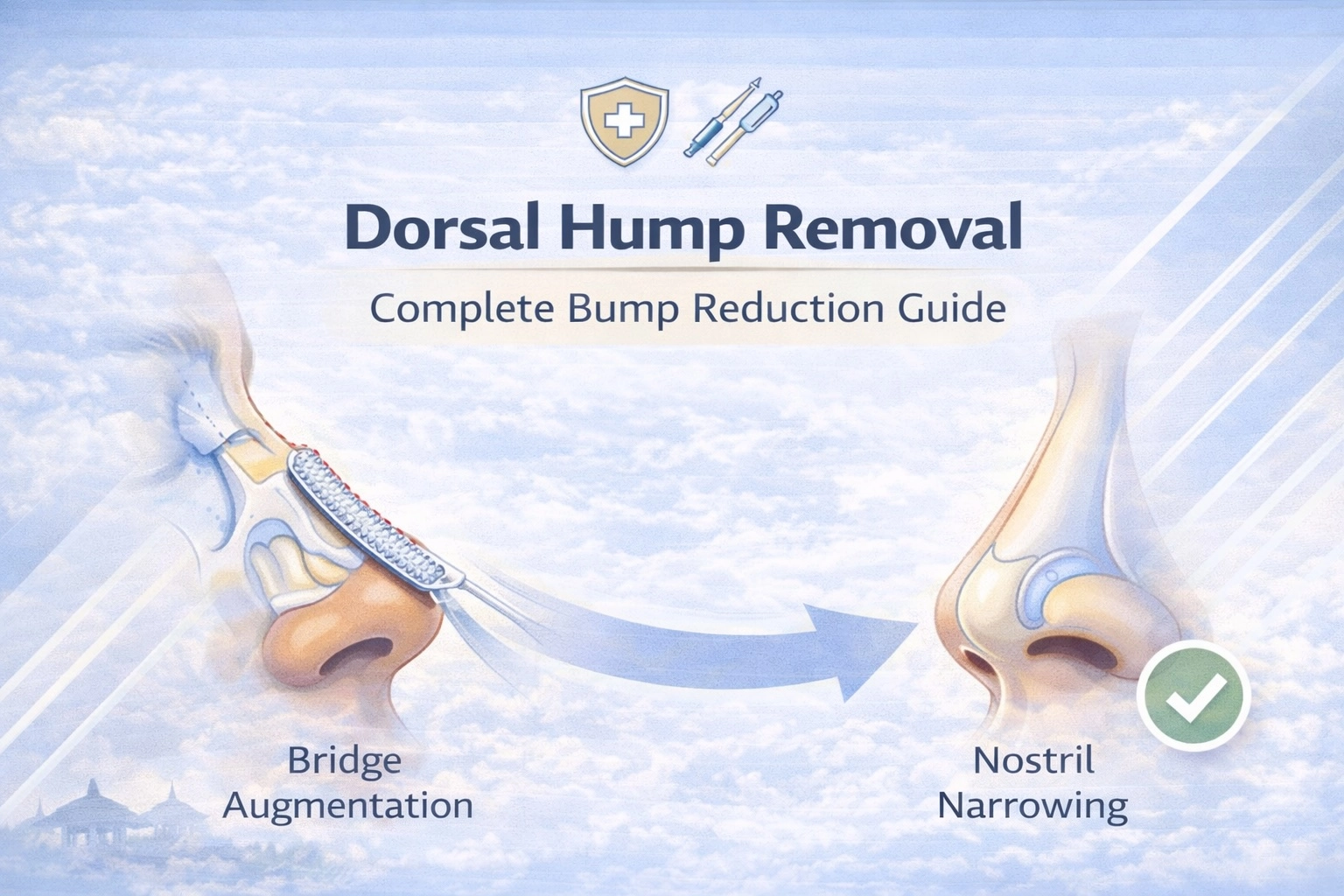
Quick Summary
Dorsal hump removal is a rhinoplasty that smooths the bump on the bridge of the nose by reducing the excess bone and cartilage, or by lowering the whole bridge as one unit (preservation technique). It is done under general anaesthesia; the NHS gives 1.5 to 3 hours for nose reshaping, a splint for about a week and up to 2 weeks off work.
It is one of the most common operations in cosmetic surgery: according to the ISAPS Global Survey 2025, more than one million rhinoplasties are performed by plastic surgeons each year, making it the second most common facial surgery after eyelid surgery. The major complication rate is low — 0.7% in a 2017 analysis of 4,978 rhinoplasty patients.
This guide covers what a dorsal hump is and why it forms, the surgical techniques (including component reduction and dorsal preservation), filler as a non-surgical alternative, safety data, the recovery timeline, and what dorsal hump removal costs — at Carely Clinic it is part of the standard rhinoplasty in Turkey package at €2,850 all-inclusive (valid until December 2026).
Sources Used in This Guide
Every figure in this article comes from a source you can open: the Layliev et al. 2017 analysis of 4,978 rhinoplasty patients (Aesthetic Surgery Journal 37(7):757–767); Rettinger’s review of rhinoplasty risks (GMS Current Topics in Otorhinolaryngology 2007;6:Doc08); the Shim et al. 2025 meta-analysis of preservation versus structural hump reduction (Facial Plastic Surgery & Aesthetic Medicine 27(6):564–571); the 2025 meta-analysis of open versus closed rhinoplasty (Plastic and Reconstructive Surgery – Global Open, 1,067 patients); Rivkin’s safety review of 2,488 filler rhinoplasties (Facial Plastic Surgery & Aesthetic Medicine 2021;23(1):6–11); the ISAPS Global Survey 2025; and the NHS, Mayo Clinic and Cleveland Clinic patient guides. Where a statement is surgeon opinion rather than data, we say so.
What Is a Dorsal Hump?
A dorsal hump is a visible bump on the bridge of the nose. Its upper part is bone and its lower part is cartilage, and together they give the profile a convex line that many people want smoothed by rhinoplasty.
The nasal dorsum — the bridge — runs from between the eyes to the tip. It is made of the paired nasal bones above and the upper lateral cartilages below, which meet the septum in the middle. When this line projects forward, it shows as a bump in profile; from the front the nose usually looks normal, which is why many people only notice their hump in photographs taken from the side.
A dorsal hump rarely affects breathing on its own, because it sits on the outside of the airway. The concern is almost always aesthetic — and it is one of the most common reasons people seek rhinoplasty. When a hump comes together with a deviated septum or a narrow nasal valve, breathing is treated in the same operation.
Causes of Dorsal Humps
Dorsal humps are mostly inherited; injury and the changes of ageing are the other common causes.
Genetic Factors
The most common cause is simply family: if a parent has a prominent bridge, children are more likely to have one. A hereditary hump usually becomes noticeable in adolescence, when the nose grows faster than the rest of the face.
A prominent bridge is a normal feature in many populations — it is common in people of Mediterranean, Middle Eastern and Eastern European descent, among others — and is a natural characteristic, not a deformity.
Trauma and Injury
A blow to the nose from sport, a fall or an accident can leave a bump. When the nasal bones heal out of line, or extra bone (callus) forms at the fracture site, the bridge becomes irregular. A childhood injury that was never obvious can become visible during adolescent growth.
Age-Related Changes
With age the tip of the nose tends to droop and the skin thins and loses elasticity. Both changes make an existing hump look more prominent, even though the bridge itself has not grown.
Surgical Techniques for Dorsal Hump Removal
A dorsal hump can be reduced by removing the excess bone and cartilage (structural or component reduction) or by lowering the whole bridge as one piece (dorsal preservation). The surgeon chooses the technique, and the open or closed approach, according to the size of the hump, your anatomy and whether breathing also needs attention.
Open Rhinoplasty
In the open approach a small incision across the columella (the skin between the nostrils) lets the surgeon lift the skin and see the bone and cartilage directly. It is preferred for larger humps and for cases that combine hump reduction with tip rhinoplasty or grafts. The columella scar fades over the first year. See open vs closed rhinoplasty for the full comparison.
Closed Rhinoplasty
In the closed approach all incisions are inside the nostrils, so there is no external scar. It is well suited to isolated hump reduction and bridge straightening. The 2025 meta-analysis of 1,067 patients found no significant difference between open and closed approaches in results, swelling, operating time or complications; the choice follows the anatomy and the surgeon’s training.
Component Hump Reduction Technique
Component dorsal hump reduction treats the three parts of the bridge separately rather than cutting the hump off as a single block: the upper lateral cartilages are freed from the septum, the septal cartilage is lowered in small increments, the bony hump is reduced with a rasp or ultrasonic instrument, the result is checked by sight and touch, and the middle vault is then stabilised — with spreader grafts or spreader flaps — and the bones narrowed with osteotomies if needed.
Treating bone and cartilage separately lets the surgeon lower the bridge gradually while keeping the dorsal aesthetic lines straight, and reduces the risk of two classic problems of older “en bloc” hump removal: the inverted-V deformity and narrowing of the internal nasal valve.
Preservation Rhinoplasty
Dorsal preservation takes the opposite route: instead of removing the hump, the surgeon removes a strip of septal cartilage beneath the bridge and frees the nasal bones so the whole dorsum settles to a lower position with its surface intact. A 2025 systematic review and meta-analysis of four randomised trials (419 patients) found preservation gave better patient-reported breathing and appearance scores than structural hump reduction, with the authors noting that the evidence base is still small. It suits straight, V-shaped humps with good skin; it is less suitable for a low radix, a wide middle vault or most revisions. Our guide to preservation rhinoplasty explains who is a candidate.
Osteotomies
After a sizeable hump is removed the two nasal bones no longer meet in the middle — an “open roof”. Osteotomies, controlled cuts along the sides of the nasal bones, let the surgeon move the bones inward to close the roof and narrow the bridge. They are the main reason for bruising around the eyes after hump reduction; a small hump reduced by rasping alone may not need them.
Ultrasonic (Piezoelectric) Rhinoplasty
Piezoelectric instruments cut and shape bone with ultrasonic vibration while sparing the soft tissue around it. Surgeons who use them report more precise bone work and less bruising than with traditional rasps and chisels; the comparative evidence is still limited, and the technique is a tool within rhinoplasty rather than a different operation. At Carely Clinic, your surgeon decides which instruments your nose needs; the price is the same.
Key Point
Whether the hump is removed in components or the bridge is lowered as one unit, the goals are the same: a straight dorsal line in profile, a smooth bridge from the front, and an airway that works at least as well as before. The technique is chosen for your anatomy — a large bony hump, a mostly cartilaginous hump, thick or thin skin, and whether the septum needs correcting all point to different solutions.
Preparing for Dorsal Hump Rhinoplasty
Good preparation makes the operation safer and the recovery smoother. The points below are general; your surgeon’s written instructions take precedence.
Medical Evaluations
Before rhinoplasty you will have:
- Blood tests, including a blood count and clotting tests
- A medical history review and physical examination, including an anaesthetic assessment
- A nasal examination and standardised photographs for planning
- A discussion of your goals, usually with computer imaging of the planned profile
Medications to Avoid
Tell your surgeon about every medicine and supplement you take. Typically you will be asked to stop, for the period your surgeon specifies, anything that increases bleeding:
- Aspirin and aspirin-containing products (unless prescribed for a medical condition — ask first)
- Anti-inflammatory painkillers such as ibuprofen and naproxen
- Vitamin E, fish oil and omega-3 supplements
- Herbal products such as St John’s wort, ginkgo biloba and garlic supplements
Lifestyle Preparation
- Stop smoking for as long as your surgeon instructs before and after surgery: nicotine narrows the small blood vessels that heal the skin and bone.
- Avoid alcohol in the days before surgery, as directed, to reduce bleeding risk.
- Eat well — tissue repair needs protein, vitamins and fluids.
- Arrange support: at Carely Clinic you spend the first night in hospital with nursing care, and your coordinator accompanies your transfers.
Day Before Surgery
- Prepare pillows so you can sleep with your head raised
- Have soft foods, lip balm and saline spray ready
- Choose loose, front-opening clothing — nothing pulled over the head
- Shower and wash your hair (the splint must stay dry for a week)
- Fast from the time the hospital tells you
Non-Surgical Alternatives
Non-surgical rhinoplasty uses dermal filler to camouflage a dorsal hump by adding volume above and below the bump so the profile looks straighter. It does not remove the hump; the nose becomes slightly larger overall, and the effect is temporary.
How Non-Surgical Rhinoplasty Works
Hyaluronic acid filler is injected into the radix (the area above the hump, between the eyes) and sometimes just below the hump, so the line from forehead to tip appears straight in profile. The treatment takes minutes under topical anaesthetic, and you can return to normal activities the same day. The effect is temporary and the treatment has to be repeated.
Limitations of Non-Surgical Options
Filler can give a useful preview of a straighter profile, but it has clear limits:
- The nose becomes larger, not smaller
- Results are temporary and need repeating
- It cannot treat breathing problems
- It cannot disguise a large hump convincingly
- Filler can migrate over time
- Rare but serious vascular complications: the blood supply to the nasal skin can be blocked
In a 10-year safety review of 2,488 filler rhinoplasty procedures by a single injector (Facial Plastic Surgery & Aesthetic Medicine, 2021), the overall adverse-event rate was 7.6%, most of them common injection-site reactions, and five cases (0.20%) were serious — ischaemia or skin necrosis. Patients who had already had surgical rhinoplasty had significantly more adverse events (10.8% vs 7.4%), because the blood supply of an operated nose is altered.
If you want the hump permanently removed and a smaller profile, surgery is the only option.
Is Dorsal Hump Removal Safe?
Rhinoplasty, including hump reduction, has a low rate of serious complications: 0.7% in a 2017 analysis of 4,978 patients in Aesthetic Surgery Journal, with haematoma and infection each about 0.2%.
Complication Rates and Statistics
The Layliev et al. 2017 study tracked major complications (those needing an emergency visit, admission or re-operation within 30 days) in 4,978 rhinoplasty patients:
- Overall major complication rate: 0.7%
- Haematoma: 0.2%
- Infection: 0.2%
- Pulmonary complications: 0.1%
- Rhinoplasty alone: 0.58%, rising to 1.02% when one other body area was operated on at the same time and 2.09% with two other areas
- Age 40 or over: relative risk 2.05 for any major complication (p = 0.04); gender, smoking status and BMI did not significantly change the risk
Revision is a separate question from complications. Rettinger’s review puts the revision rate after primary rhinoplasty at 5% to 15% in the literature, and notes that the risk falls with surgeon experience; our guide to revision rhinoplasty covers the numbers in detail.
Risk Factors
Some factors raise the risk or make the result less predictable:
- Smoking: nicotine narrows blood vessels and slows healing
- Previous nasal surgery: scar tissue makes a revision more complex
- Age over 40: higher relative risk of a major complication in the Layliev data
- Combining several operations: the complication rate roughly doubles with each additional body area
- Thick nasal skin: slower resolution of swelling and less visible definition
- Unrealistic expectations: dissatisfaction despite a technically good result
How to Minimise Risk
The NHS lists the specific risks of nose reshaping as permanent breathing difficulty, damage to the cartilage wall between the nostrils, an altered sense of smell and heavy nosebleeds, plus the general risks of bleeding, a blood clot, infection and reaction to the anaesthetic. You reduce them by:
- Choosing a surgeon whose specialty training covers the nose (ENT or plastic surgery) and who performs rhinoplasty regularly
- Having the operation in an accredited hospital with proper anaesthesia and emergency cover
- Telling your surgeon your full medical history and every medicine and supplement you take
- Stopping smoking for as long as instructed before and after surgery
- Avoiding blood-thinning medicines and supplements as directed
- Following the pre- and post-operative instructions exactly
Recovery Timeline
Recovery after dorsal hump removal follows the NHS timeline for nose reshaping: a splint for about 7 days, up to 2 weeks off work, bruising around the eyes for up to 3 weeks, strenuous exercise after 4 to 6 weeks, and up to 6 months for swelling to go completely (NHS). The Cleveland Clinic puts about 90% of swelling gone by three months, the Mayo Clinic most of it within a year, and the tip can keep refining to 12–18 months.
Week 1: Acute Recovery
The first week is for rest with your head raised. Expect:
- A splint taped over the bridge, and sometimes soft internal splints
- Swelling and bruising that peak within 48–72 hours — more if osteotomies were done
- Discomfort that most patients describe as pressure and congestion rather than pain, managed with tablets
- A blocked nose and mouth-breathing
- Some blood-stained discharge for the first days (normal)
The splint comes off at about 7 days — see our guide to rhinoplasty cast removal. You will see the new line of the bridge straight away, still under considerable swelling.
Week 2: Early Healing
- Bruising fades; the NHS says it can last up to 3 weeks around the eyes
- Swelling visibly decreases
- Most people return to desk work and quiet social life (NHS: up to 2 weeks off)
- Columella stitches are removed if the open approach was used
- Saline spray keeps the inside of the nose moist — do not blow your nose until your surgeon allows it
Weeks 3–6: Transition Period
- Swelling of the bridge settles faster than swelling of the tip
- Bruising has usually gone by 3 weeks; swimming is generally allowed (NHS)
- Nasal breathing improves as internal swelling goes down
- Walking and light activity are encouraged; strenuous exercise and contact sports from 4–6 weeks (NHS)
- Ask your surgeon before resting glasses on the bridge — see glasses after rhinoplasty
Months 1–3: Progressive Refinement
By three months about 90% of the swelling has gone according to the Cleveland Clinic. The bridge is close to its final shape; the tip usually stays fuller for longer. Our guide to rhinoplasty swelling stages explains what is normal at each point.
Months 6–12: Final Results
Residual swelling, mostly at the tip, resolves gradually; thick skin takes longest, sometimes to 18 months. Your surgeon assesses the final result at 12 months. At Carely Clinic, photo reviews on WhatsApp are scheduled at 1 week and 1, 3, 6 and 12 months.
Tips for Optimal Recovery
- Keep your head raised, including in bed, for the first couple of weeks
- Cold compresses on the cheeks and under the eyes — not on the nose — for the first 48 hours
- Drink enough water and go easy on salty food, which increases fluid retention
- No strenuous activity, heavy lifting or bending for 4–6 weeks (NHS)
- Don’t blow your nose until your surgeon allows it; sneeze through your mouth
- Protect from the sun: healing skin and any columella scar darken easily — use SPF 30+ and a hat
- Attend every follow-up: your surgeon catches small problems early
What Results Can You Expect?
Dorsal hump removal gives a straighter bridge in profile. The bridge settles quickly; the complete result, including the tip, is judged at 12 months.
Realistic Expectations
Modern rhinoplasty aims for a nose that fits the face, not a nose that announces surgery. Computer imaging at the consultation shows the planned profile, but the actual result depends on your anatomy, your skin thickness and how you heal. No surgeon can promise a specific outcome, and no reliable “satisfaction rate” exists that applies to your nose; be wary of clinics that quote one.
Profile Preferences by Gender
Women often ask for a straight or very slightly concave bridge with a subtle break above the tip. Men usually want a straight dorsal line without any scoop, keeping a stronger profile. These are preferences, not rules — the right profile is the one that suits your face.
The over-reduced “ski-slope” bridge of past decades is now considered an obvious sign of surgery. Current technique — component reduction with a stabilised middle vault, or dorsal preservation — aims to keep the dorsal lines natural.
Factors Affecting Outcomes
- Skin thickness: thick skin hides fine definition and swells longer; thin skin shows every contour, including small irregularities
- Hump composition: a mostly bony hump needs osteotomies; a mostly cartilaginous hump may suit preservation
- Previous surgery: revisions are more complex and less predictable
- Realistic goals: patients with achievable expectations are the most satisfied
Dorsal Hump Removal at Carely Clinic, Istanbul
At Carely Clinic, rhinoplasty is led by Op. Dr. Vepa Silapov, an ear, nose and throat surgeon specialising in rhinoplasty, with Assoc. Prof. Dr. Mustafa Sagit (ENT) performing primary and revision rhinoplasty. Our surgeons perform open, closed, preservation, functional and revision rhinoplasty, and decide at your in-person consultation — after examination, photographs and 3D imaging — whether your hump is best treated by component reduction or dorsal preservation, and whether the septum needs correcting at the same time.
Surgery is performed under general anaesthesia in an accredited partner hospital such as BHT CLINIC İstanbul Tema Hospital (JCI accredited May 2024, TEMOS re-accredited January 2026, TÜSKA Gold 2026), named in your written treatment plan, with 1 night in hospital (2 if your surgeon advises) and 6 nights in a 5-star hotel — about 7 days in Istanbul, with the splint removed before you fly home. Send your photos on WhatsApp and our medical team replies within 24 hours; nothing is paid before you have met your surgeon. Read more on our rhinoplasty in Turkey page or contact Carely Clinic.
Cost Comparison by Country
Dorsal hump removal at Carely Clinic in Istanbul costs €2,850 all-inclusive (valid until December 2026) as part of the standard rhinoplasty package — the price is the same whether your hump is reduced in components or by dorsal preservation, and septoplasty is included when needed. In the UK, the NHS puts private nose reshaping at £4,000 to £7,000 for the surgery alone; in the US, the ASPS 2024 fee survey gives a surgeon fee of $7,500 to $12,500 before facility and anaesthesia charges.
| Country / Provider | Price | What the figure covers | Source |
|---|---|---|---|
| Turkey — Carely Clinic, Istanbul | €2,850 all-inclusive | Surgery (septoplasty when needed), anaesthesia, 1 night hospital, 6 nights 5-star hotel, VIP transfers, 12 months WhatsApp follow-up | Carely Clinic price list, valid until December 2026 |
| United Kingdom (private) | £4,000–£7,000 | Surgery; consultations, follow-up and any further surgery may be extra | NHS, nose reshaping, reviewed 22 September 2023 |
| United States | $7,500–$12,500 | Surgeon’s fee only; anaesthesia, facility and hospital fees are extra | ASPS 2024 Average Surgeon/Physician Fees |
Why Prices Differ
The figures do not measure the same thing: the Carely Clinic price is a fixed package that includes the hospital, the hotel and transfers, while the UK and US figures cover surgery or the surgeon’s fee alone. Lower hospital and staff costs and the exchange rate explain most of the difference in the surgery itself; we do not publish a percentage saving because the comparison is not like-for-like. We also do not list countries for which no official, dated price source exists.
What’s Included at Carely Clinic
- Surgeon and anaesthesia fees — septoplasty included when needed
- Hospital stay: 1 night (2 if your surgeon advises)
- Pre-operative examination and blood tests
- 6 nights in a 5-star hotel near the hospital
- VIP airport and clinic transfers
- Nasal splint and medication
- Interpreter at the clinic and a dedicated patient coordinator
- 12 months of WhatsApp follow-up with photo reviews at 1 week and 1, 3, 6 and 12 months
Costs to Budget For
- Flights and travel insurance (not included)
- Any extra nights if your surgeon asks you to stay longer
- Any combined procedure beyond rhinoplasty, quoted separately before you travel
- Revision surgery, if ever needed — see revision rhinoplasty (from €3,000 at Carely Clinic)
For a detailed comparison with British private clinics, see rhinoplasty in Turkey vs the UK, and for the full list of inclusions the rhinoplasty package in Turkey page.
Frequently Asked Questions
Does dorsal hump removal hurt?
Not during surgery — it is performed under general anaesthesia. Afterwards most patients describe pressure, congestion and a dull ache rather than sharp pain, managed with ordinary tablets for the first few days. Bruising and tenderness around the eyes are the main source of discomfort when osteotomies are done, and they settle over the first two to three weeks.
How long does dorsal hump rhinoplasty take?
The NHS gives 1.5 to 3 hours for nose reshaping. A simple hump reduction without other work sits at the shorter end; adding osteotomies, spreader grafts, tip refinement or septoplasty lengthens the operation, and a revision through scar tissue takes longer still. Your surgeon gives you an estimate at the consultation.
Will I have visible scars?
With the closed approach, no — all incisions are inside the nostrils. With the open approach there is a small scar across the columella, between the nostrils, which fades over the first year into a thin line in the natural shadow of the nose. Osteotomies done from inside leave no visible mark; if tiny external punctures are used they fade within weeks.
Can a dorsal hump grow back after surgery?
Bone and cartilage that have been removed do not grow back. What can happen is that a small irregularity or an under-corrected hump becomes visible once the swelling has gone, or that scar tissue forms over the bridge — and with dorsal preservation the lowered bridge can partly drift back if the bones were not fully mobilised. Published revision rates after primary rhinoplasty range from 5% to 15% (Rettinger), and most revisions are small corrections rather than a full hump returning.
At what age can I have dorsal hump rhinoplasty?
Once the nose has stopped growing, which surgeons generally place in the late teens; the exact timing is judged individually, and younger patients need parental consent and a careful discussion of expectations. There is no upper age limit for a healthy patient, but the 2017 Aesthetic Surgery Journal analysis of 4,978 patients found a roughly doubled relative risk of major complications over the age of 40 (RR 2.05), so the pre-operative assessment matters more as you get older.
Will dorsal hump removal affect my breathing?
The hump itself rarely affects breathing, because it sits outside the airway. What matters is how it is removed: taking the hump off as a single block can narrow the internal nasal valve, which is why modern component reduction stabilises the middle vault with spreader grafts or flaps, and why preservation techniques keep it intact. If you already breathe badly, say so — a deviated septum is corrected in the same operation, and at Carely Clinic septoplasty is included in the price when needed.
How soon can I fly after rhinoplasty?
At Carely Clinic the trip is planned around this: the splint is removed at about day 7, your surgeon examines you, and you fly home the same day. Flying itself does not damage the surgery; the reasons to wait a week are the splint, the early swelling and being near your surgeon if anything needs attention. Drink plenty of water on the flight and keep your head up.
Can I wear glasses after dorsal hump removal?
Not resting on the bridge for the first 4 to 6 weeks, because the nasal bones are still setting after osteotomies and the weight of frames can leave a dent. In the meantime use contact lenses, bridgeless glasses, a forehead support or tape the glasses so they do not touch the nose. Your surgeon tells you when normal glasses are safe; our glasses after rhinoplasty guide explains the options.
Is non-surgical rhinoplasty a good alternative to surgery?
For a small hump on a nose you are otherwise happy with, filler can straighten the profile temporarily by adding volume above and below the bump — but it makes the nose slightly larger, it does not remove anything, it has to be repeated, and it carries a small risk of serious vascular complications (five serious cases in 2,488 procedures in a 2021 safety review). For permanent hump removal and a smaller nose, surgery is the only option.
How do I choose a qualified surgeon?
Look for completed specialist training in ear, nose and throat surgery or plastic surgery, a practice in which rhinoplasty is routine, before-and-after photos of noses like yours, and surgery in an accredited hospital. Ask who exactly will operate and check their profile by name. At Carely Clinic, rhinoplasty is led by Op. Dr. Vepa Silapov (ENT) with Assoc. Prof. Dr. Mustafa Sagit, and the hospital is named in your written treatment plan.
What’s the difference between dorsal hump reduction and full rhinoplasty?
Hump reduction changes the bridge only. A full rhinoplasty may also refine the tip, narrow the nostrils, straighten a crooked nose or correct the septum. Many patients combine hump reduction with tip work so the whole profile stays in proportion — lowering a bridge can make an unchanged tip look more projected. Your surgeon advises whether the hump alone is the issue; at Carely Clinic the price is the same either way.
Can I combine dorsal hump removal with other procedures?
Within the nose, yes: tip refinement, nostril reduction and septoplasty are routinely combined with hump reduction in one operation. Combining rhinoplasty with operations on other parts of the body is possible but raises the complication rate — from 0.58% for rhinoplasty alone to 1.02% with one other body area and 2.09% with two, in the 2017 analysis of 4,978 patients. Your surgeon advises what is sensible to combine; anything beyond rhinoplasty is quoted separately before you travel.
Conclusion
Dorsal hump removal is one of the most common and best-understood operations in facial surgery. Done by component reduction or dorsal preservation, with the middle vault protected, it gives a straight bridge with a low rate of serious complications — 0.7% in the largest analysis — and a recovery that follows a predictable timeline: a week in a splint, two weeks before most people are back at work, and a year before the final result is judged.
The decisions that matter are the surgeon and the technique chosen for your particular hump — bony or cartilaginous, large or small, with or without a septum that needs correcting. Choose a surgeon who performs rhinoplasty regularly, ask how they will protect your airway, and give the result time.
Individual results and recovery timelines vary. This guide provides general information based on the published sources cited above. Consult a qualified surgeon for advice about your own nose.
Ready to explore dorsal hump removal? Contact Carely Clinic with your photos; our medical team replies within 24 hours with a preliminary assessment, and your surgeon confirms the plan at the consultation in Istanbul.
Written by Carely Clinic Medical Team · Last updated: November 2026