
Quick Summary:
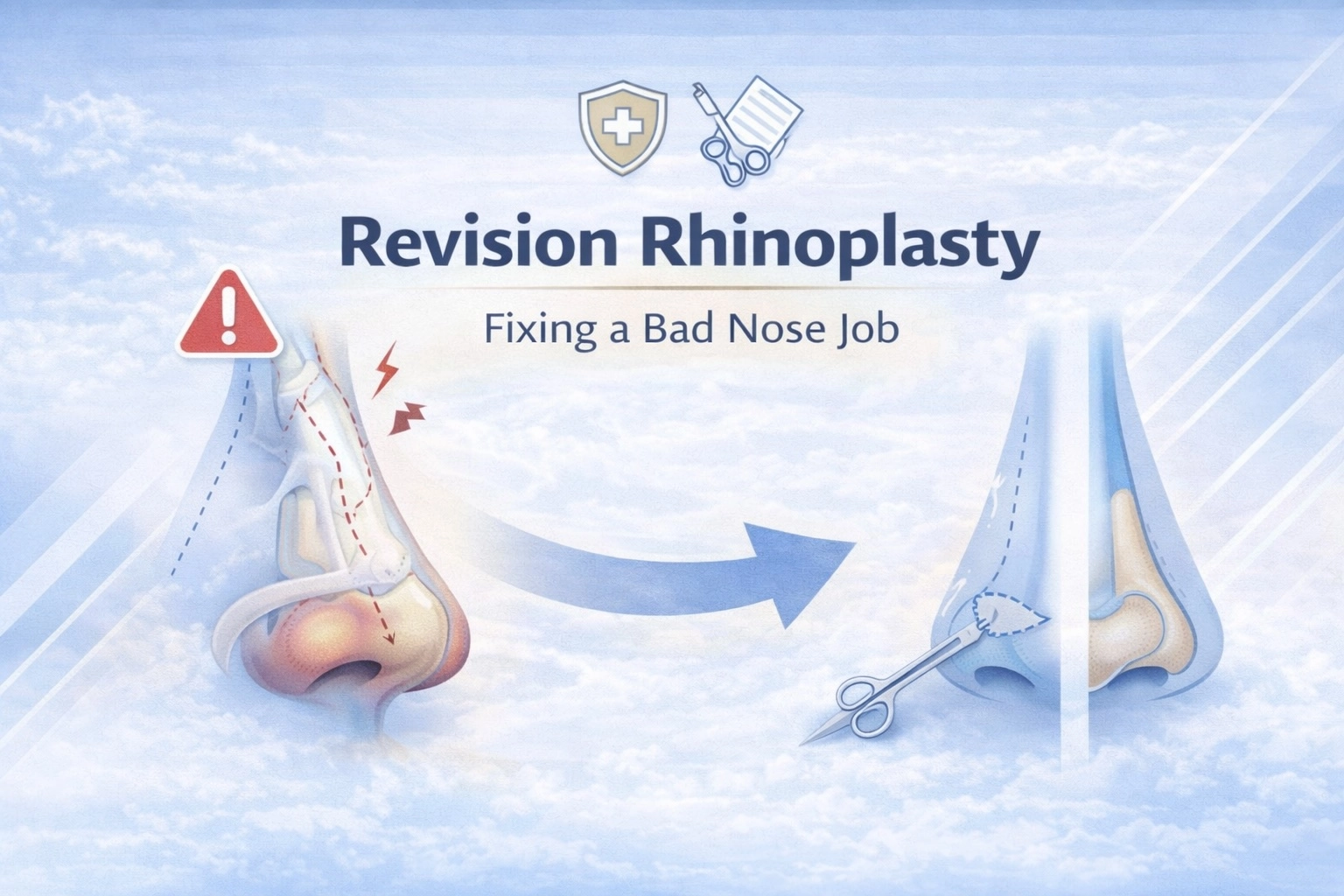
Revision rhinoplasty is a second operation that corrects the shape or breathing problems left by a previous nose job. It is harder than a first rhinoplasty because the surgeon works through scar tissue, with less cartilage to use, and it carries a higher chance of needing yet another operation.
The numbers worth knowing come from two large studies: in a US database of 175,842 patients, 3.1% of first-time rhinoplasties were revised within at least three years, against 11.0% of operations that were themselves already revisions (Spataro et al., JAMA Facial Plastic Surgery 2016); and in a German specialist clinic, 23.9% of revision patients needed a further revision, compared with 10.5% after primary surgery (Hacker et al., Plastic and Reconstructive Surgery 2021).
This guide explains why nose jobs fail, what revision surgery and cartilage grafting involve, when it is safe to operate again, what recovery looks like, and what revision rhinoplasty costs at Carely Clinic in Istanbul (from €3,000 all-inclusive (valid until December 2026)). The surgeons who perform rhinoplasty in Turkey at Carely Clinic also perform revisions.
Sources Used in This Guide
The figures in this article come from: Spataro et al. 2016, JAMA Facial Plastic Surgery 18(3):212–219 (175,842 patients); Hacker et al. 2021, Plastic and Reconstructive Surgery 148(3):532–541 (245 patients, primary vs revision); Rettinger 2007, GMS Current Topics in Otorhinolaryngology 6:Doc08 (review of risks and complications); Moretti & Sciuto 2013, Acta Otorhinolaryngologica Italica 33:190–195 (54 rib-graft patients); Layliev et al. 2017, Aesthetic Surgery Journal 37(7):757–767 (4,978 patients); an American Society of Plastic Surgeons article on revision rhinoplasty (2019); and the NHS, Mayo Clinic and Cleveland Clinic patient guides. Where a statement is surgeon opinion rather than data, we say so.
What Is Revision Rhinoplasty?
Revision rhinoplasty is a secondary operation that corrects aesthetic or functional problems resulting from a previous nose surgery. It needs different techniques from a first rhinoplasty because the surgeon is working through scar tissue and with altered anatomy.
Also called secondary rhinoplasty, it addresses problems that appeared after the first operation or concerns that were never fully resolved. Unlike primary rhinoplasty, the tissues have already been operated on: there is often less septal cartilage left, the blood supply to the skin is reduced, and the planes the surgeon normally follows are scarred.
The American Society of Plastic Surgeons describes revision cases as among the most difficult operations aesthetic plastic surgeons face, and notes that revision rhinoplasty has a higher revision rate than primary rhinoplasty. The surgeon must dissect through scar, rebuild weakened support, and frequently add cartilage taken from the septum, ear or rib.
Most revision patients want both shape and breathing improved. In the 2021 Plastic and Reconstructive Surgery study of 245 patients, almost two-thirds of revision patients had functional and aesthetic problems in combination, and complex reconstructive techniques and grafts from outside the nose were used far more often than in primary cases.
Why Do Nose Jobs Fail?
Primary rhinoplasty fails for three kinds of reasons — surgical technique, the patient’s anatomy and healing, and expectations that were never aligned — and published revision rates after a first rhinoplasty range from about 3% in large databases to 5–15% in specialist reviews (Spataro 2016; Rettinger 2007).
Understanding what went wrong the first time is the most useful preparation for a revision consultation. The causes below are the ones surgeons report most often.
Surgical Factors
Removing too much cartilage or bone is one of the most common technical causes. When too much structural support is taken away, the nostrils can collapse inward, the tip can look pinched, or the bridge can sink into a saddle shape. These problems need rebuilding with cartilage grafts rather than further reduction.
Ignoring breathing during a cosmetic operation is another. Rettinger’s review reports that breathing problems are the main complaint in 70% of patients who come for revision rhinoplasty, and that around 10% of patients complain of residual or new breathing problems after a primary rhinoplasty. A deviated septum or a weak nasal valve that was not treated the first time does not fix itself.
Poor planning and poor communication complete the list: when the goals were never agreed in detail before surgery, the result can be technically acceptable and still disappointing to the patient.
Patient Factors
Some noses are simply harder to operate on. Thick skin, weak cartilage and asymmetric structures all make a predictable result more difficult. Rettinger notes that certain anatomical variants are found more often in revision patients than in primary cases — most frequently the combination of a low radix (a low starting point of the bridge), a narrow cartilaginous dorsum and an under-projected tip.
Smoking impairs healing. Nicotine narrows the small blood vessels that keep the nasal skin alive after surgery, slowing recovery and, in extreme cases, causing tissue loss. Surgeons ask patients to stop before and after the operation for this reason.
Unrealistic expectations do not cause a surgical failure, but they cause dissatisfaction even when the surgery went well. Clear, honest communication before the first operation is the best protection.
Unpredictable Healing
Even with good technique, healing can change the result. Scar tissue forms differently in every patient and can alter the shape over months or years; cartilage grafts can warp, be partly absorbed or shift; and tissues can contract unevenly. This is why surgeons judge a rhinoplasty at a year, not at a month.
Key Point
The chance of needing yet another operation is higher after a revision than after a first rhinoplasty: 23.9% compared with 10.5% in the Hacker et al. 2021 series, and 11.0% compared with 3.1% in the US database study. A revision deserves the most experienced surgeon you can find, and realistic goals.
Common Problems Revision Surgery Corrects
Revision rhinoplasty most often treats six problems: breathing difficulties, a crooked or asymmetric nose, pollybeak deformity, inverted-V deformity, tip problems (over-rotated, drooping or pinched), and structural collapse.
Each has a specific cause and a specific repair. Knowing which one you have makes the consultation far more productive.
Breathing Difficulties
Functional problems are the most distressing outcome of a failed rhinoplasty, and, as noted above, they are the main complaint of 70% of revision patients in Rettinger’s review. Nasal valve collapse, a hole in the septum (perforation) and a narrowed airway all affect daily life.
Internal valve collapse happens when the cartilage supporting the middle of the nose was weakened or removed, so the side walls fall inward when you breathe in. External valve collapse affects the nostrils themselves, which pinch closed on inhalation. Both are usually treated with cartilage grafts — spreader grafts for the internal valve, alar batten grafts for the nostrils — to restore support.
Asymmetry and Crookedness
A crooked nose after surgery can result from uneven cartilage removal, asymmetric healing, or scar contracting on one side. Sometimes removing a hump simply reveals a deviation that was hidden before.
Tip asymmetry — one side of the tip looking different from the other — comes from uneven healing, displaced cartilage or technical error. Correction needs careful reshaping and often small grafts to balance the two sides.
Pollybeak Deformity
A pollybeak is fullness just above the tip, giving the profile a parrot-beak look. It is the single most common reason for revision: Rettinger reports that the pollybeak is the indication in about 50% of all revision rhinoplasties.
It develops when the cartilaginous part of the bridge was reduced too little, the bony part too much, scar tissue builds up above the tip, or the tip loses support and droops. Treatment depends on the cause — some cases need a little more reduction, others need the tip supported.
Inverted-V Deformity
An inverted-V deformity appears as a shadow across the bridge shaped like an upside-down V. It is a classic sign of hump removal without proper support of the middle vault cartilages.
When the bump is reduced and the bones are narrowed with osteotomies but the upper lateral cartilages are not supported, the middle third of the bridge becomes pinched. Spreader grafts placed between the septum and the upper lateral cartilages correct both the look and the airflow.
Tip Problems
An over-rotated tip looks too short and turned up, showing too much nostril. It happens when too much tip cartilage was removed or the tip was set too high.
A drooping (under-rotated) tip hangs down and often becomes more obvious when smiling; weak tip support or over-weakened cartilage is the usual cause.
A pinched tip comes from over-aggressive narrowing of the tip cartilages and looks artificial. Rebuilding it needs cartilage grafts to restore natural width and projection.
Structural Collapse
Severe over-resection can leave a flattened or saddled nose. These cases need the most extensive reconstruction, usually with rib cartilage to rebuild the whole framework.
Revision Rates: What the Numbers Show
There is no reliable “success rate” for revision rhinoplasty — the studies measure different things — so this article reports only the figures that come from identifiable research, and says what each one actually measured.
How Often a First Rhinoplasty Is Revised
The largest dataset is the 2016 JAMA Facial Plastic Surgery study of 175,842 septorhinoplasty patients in California, Florida and New York, followed for at least three years: the overall revision rate was 3.3%, 3.1% after a primary operation and 11.0% when the operation was already a revision. Operations done for cosmetic reasons had a higher revision rate (7.9%) than those done for breathing. Younger age, female sex, a history of anxiety and autoimmune disease were associated with more revisions.
Specialist reviews quote higher figures: Rettinger puts revision rates after primary rhinoplasty at 5% to 15% in the literature, with 3.6% in his own series of 302 consecutive primary rhinoplasties. The difference reflects how “revision” is defined and who is counting.
What Revision Patients Can Expect
In the 2021 Plastic and Reconstructive Surgery comparison of 153 primary and 92 revision patients at a specialist clinic, another revision was needed in 23.9% of the revision group during follow-up, against 10.5% of the primary group (p = 0.006). The authors conclude that patients should be told about the increased complexity, the likely need for grafts from outside the nose, and the increased risk of a further revision.
The general surgical risks are low but real: in a 2017 analysis of 4,978 rhinoplasty patients, the major complication rate was 0.7%, with haematoma and infection each about 0.2%. The NHS lists permanent breathing difficulty, damage to the septal cartilage, altered sense of smell and heavy nosebleeds as the specific risks of nose reshaping.
| Statistic | Figure | What it measured | Source |
|---|---|---|---|
| Revision after primary septorhinoplasty | 3.1% | 172,324 primary operations, ≥3-year follow-up, US state databases | Spataro 2016 |
| Revision after an operation that was already a revision | 11.0% | 3,518 secondary operations, same database | Spataro 2016 |
| Revision rate quoted in specialist reviews | 5–15% | Range reported in the literature; 3.6% in the author’s own 302 cases | Rettinger 2007 |
| Further revision after revision rhinoplasty | 23.9% vs 10.5% | 92 revision vs 153 primary patients, one specialist clinic | Hacker 2021 |
| Revision patients with breathing problems as main complaint | 70% | Literature figure quoted in a review | Rettinger 2007 |
| Pollybeak as the indication for revision | about 50% | Literature figure quoted in a review | Rettinger 2007 |
| Major complications (any rhinoplasty) | 0.7% | 4,978 patients | Layliev 2017 |
When Can You Have Revision Surgery?
Most surgeons wait at least 12 months after a primary rhinoplasty before operating again, because the nose keeps changing for about a year: the Mayo Clinic notes that most swelling is gone within a year, and the Cleveland Clinic that about 90% of swelling has gone by three months with minimal swelling possible for up to a year. In the US database study, the median time to revision was 1.2 years after the first operation.
Why the Wait Matters
The waiting period is not arbitrary. While swelling persists, the surgeon cannot see the true extent of the deformity; scar tissue that has not matured is harder to dissect; and operating on tissue that is still healing adds trauma to a blood supply that is already reduced.
When Earlier Intervention May Be Appropriate
Some problems should not wait a year. Severe breathing obstruction, infection, a displaced graft or another acute complication may need early correction. Small adjustments — a steroid injection into thick scar above the tip, for example — can sometimes be done earlier than a full surgical revision. Your surgeon decides case by case.
How to Know You Are Ready
Before pursuing revision, be sure you have given the nose enough time, and be clear about which concerns are real and achievable. A consultation with a surgeon who performs revisions regularly will tell you whether your problem can be corrected, how, and when. Patients who have worked through their disappointment with the first result and arrive with specific, realistic goals do better.
The Revision Rhinoplasty Procedure
Revision rhinoplasty is done under general anaesthetic, usually takes 2 to 4 hours, most often uses an open approach, and frequently involves cartilage grafting to rebuild the nose.
Open or Closed Approach
The open approach — a small incision across the columella, the strip of skin between the nostrils — lets the surgeon lift the skin and see every structure directly. For most revisions this visibility matters more than the tiny external scar, which fades over months in most patients.
A closed approach, through incisions inside the nostrils only, can be enough for minor revisions that do not need extensive rebuilding.
What Happens During Surgery
The operation starts with careful dissection through the scar from the first surgery. This step cannot be rushed: hurried dissection can damage the blood supply or the cartilage that remains.
Once the framework is exposed, the surgeon assesses the damage and carries out the plan: removing scar tissue, repositioning displaced cartilage, straightening the bones with osteotomies, and placing grafts to rebuild support and contour.
Complexity varies enormously. A small asymmetry may take 90 minutes; a full reconstruction with rib cartilage harvest can take 4 hours or more.
Anaesthesia and Hospital Stay
Revision rhinoplasty is performed under general anaesthetic. Many clinics in the United States and United Kingdom send patients home the same day; at Carely Clinic you stay 1 night in hospital, or 2 if your surgeon advises it, before returning to your hotel.
Cartilage Grafting in Revision Surgery
Cartilage grafts are needed in most revision rhinoplasties. They are taken from the septum when enough remains, otherwise from the ear or the rib, depending on how much structure must be rebuilt.
Why Grafts Are Necessary
A first rhinoplasty usually removes tissue; a revision usually has to add it back. Grafts rebuild weakened support, replace missing structure, smooth irregularities and improve both breathing and shape.
Grafts from the patient’s own body remain the standard choice because they integrate naturally and resist infection; synthetic implants carry higher risks of infection and extrusion.
Septal Cartilage
The septum is the ideal source — thin, flat, strong and already inside the nose. It works well for spreader grafts, columellar struts and tip support.
In revisions, however, the septum has often already been used or damaged. When enough remains, it is used first; when it does not, the surgeon looks outside the nose.
Ear Cartilage
Ear (conchal) cartilage is the usual next choice — the ASPS notes that surgeons often take cartilage from the ear and occasionally from the rib. Harvested from the bowl of the ear through a hidden incision, it provides enough material for moderate reconstruction without changing the shape of the ear.
Its natural curve suits tip grafts and small supports, but limits its use for long, straight structural grafts. The donor site heals with a scar hidden in the ear’s natural crease; discomfort is mild and brief.
Rib Cartilage
Rib cartilage provides abundant, strong material for major reconstruction — enough to rebuild an entire nasal framework. In a 2013 series of 54 patients in Acta Otorhinolaryngologica Italica, most of them revisions, the authors call autogenous rib cartilage an outstanding material for reconstructive septorhinoplasty, with a lower rate of resorption, infection and extrusion than donor or synthetic implants.
Its disadvantages are an additional incision on the chest and a tendency to warp. In the same 54-patient series, there were no graft extrusions; 4 patients had an infection at the recipient site, 2 had significant resorption, 3 had warping (2 of whom needed a revision), and 2 had a donor-site problem. Surgeons reduce warping by carving the graft symmetrically and waiting for early bending before placing it.
Recovery Timeline
Recovery after revision rhinoplasty follows the same pattern as a first rhinoplasty — a splint for about a week, up to 2 weeks off work and strenuous exercise after 4 to 6 weeks according to the NHS — but swelling often lasts longer because of scar tissue, and the final result is judged at 12 to 18 months.
First week: Expect swelling, bruising around the eyes, a blocked nose and discomfort that most patients describe as pressure rather than pain. The splint stays on for about 7 days (see our guide to rhinoplasty cast removal). Keep your head raised, including in bed, and avoid bending or straining. If an ear or rib graft was taken, the donor site is sore for a few days.
Weeks 2–4: Most bruising fades within 2 weeks and desk work is usually possible, though the NHS says you may need up to 2 weeks off. Breathing improves as the internal swelling goes down. Keep avoiding strenuous activity, heavy lifting and anything that could knock the nose; light walking is encouraged.
Weeks 4–6: Strenuous exercise and contact sports can restart at 4 to 6 weeks (NHS). Ask your surgeon before wearing glasses on the bridge — see glasses after rhinoplasty. Some numbness at the tip is normal and can last months.
Months 3–12: The Cleveland Clinic notes that about 90% of swelling has gone by three months after a rhinoplasty, with minimal swelling possible for up to a year; after a revision the tip in particular tends to stay swollen longer. Our guide to rhinoplasty swelling stages explains what is normal at each point.
Months 12–18: Your surgeon assesses the final result at 12 months, and subtle refinement can continue to 18 months, especially in thick skin or after extensive grafting.
| Timeframe | Milestone | What to expect |
|---|---|---|
| Days 1–3 | Peak swelling and bruising | Rest, head raised, cold compresses on the cheeks (not the nose) |
| About day 7 | Splint removal | First view of the new shape; significant swelling remains |
| Week 2 | Bruising fades | Most patients feel comfortable in public; desk work possible (NHS: up to 2 weeks off) |
| Weeks 4–6 | Exercise resumes | Strenuous exercise and contact sports after 4–6 weeks (NHS) |
| Month 3 | Most swelling gone | About 90% after rhinoplasty (Cleveland Clinic); revisions often lag behind |
| Months 6–12 | Tip refinement | Minimal swelling possible for up to a year (Mayo Clinic, Cleveland Clinic) |
| Months 12–18 | Final result | Assessed by your surgeon at 12 months; refinement can continue to 18 |
Revision Rhinoplasty Cost in Turkey
Revision rhinoplasty at Carely Clinic in Istanbul costs from €3,000 all-inclusive (valid until December 2026). The price covers the revision operation with cartilage grafting when it is needed, the hospital night, 6 nights in a 5-star hotel, VIP transfers and 12 months of WhatsApp follow-up; your exact price is confirmed in your written treatment plan after your surgeon has reviewed your photos and, ideally, the report of your first operation. Full details are on the revision rhinoplasty package in Turkey page.
Revision costs more than a first rhinoplasty everywhere, because it takes longer and often needs grafts, but no official body publishes a revision-specific price for the UK or the US. The reference points that do exist are for primary nose reshaping: the NHS gives £4,000 to £7,000 for the surgery in the UK (reviewed 22 September 2023), and the ASPS 2024 fee survey gives a surgeon fee of $7,500 to $12,500 in the US, before facility and anaesthesia charges. We do not quote a percentage saving, because those figures and an all-inclusive package do not measure the same thing; see rhinoplasty in Turkey vs the UK for a detailed comparison.
How to Choose a Revision Rhinoplasty Surgeon
Choose a surgeon whose specialty training covers the nose — ear, nose and throat (otolaryngology) or plastic surgery — who performs revision rhinoplasty regularly, who can show before-and-after photos of secondary cases like yours, and who operates in an accredited hospital.
Specialty and Experience
A medical licence alone does not make a rhinoplasty surgeon. Look for completed specialist training in otolaryngology or plastic surgery and a practice in which revisions are routine. The ASPS points out that experienced rhinoplasty surgeons see revision cases more often than those who do the operation infrequently, and that no ethical surgeon can guarantee the outcome of a revision.
Ask what share of the surgeon’s rhinoplasty work is revision, and whether they have treated your specific problem — a surgeon excellent at valve collapse may have less experience with complex tip reconstruction, or vice versa.
Before-and-After Photos
Ask to see revision cases similar to yours, from several angles and at different stages of healing. Natural results that suit the face matter more than dramatic ones. Be cautious of a gallery that shows only best cases; a transparent surgeon will discuss limitations too.
Communication
Revision rhinoplasty depends on trust. The surgeon should listen to what bothers you, explain the plan and its limits, and tell you honestly what cannot be fixed. Ask what happens if the result does not meet expectations, and keep the answer in writing.
Revision Rhinoplasty at Carely Clinic, Istanbul
At Carely Clinic, rhinoplasty is led by Op. Dr. Vepa Silapov, an ear, nose and throat surgeon specialising in rhinoplasty, and Assoc. Prof. Dr. Mustafa Sagit (ENT), who performs primary and revision rhinoplasty. Before you travel, our medical team asks for photos of your nose and, where possible, the operation report from your first surgery, and replies within 24 hours with a preliminary assessment; the surgical plan itself is made when your surgeon examines you in Istanbul.
Surgery takes place in an accredited partner hospital such as BHT CLINIC İstanbul Tema Hospital (JCI accredited May 2024, TEMOS re-accredited January 2026, TÜSKA Gold 2026), named in your written treatment plan. The package is from €3,000 all-inclusive (valid until December 2026) and includes the revision operation with cartilage grafting when it is needed, the hospital night, 6 nights in a 5-star hotel, VIP transfers and 12 months of WhatsApp follow-up; the trip takes about 7 days, and no payment is made until you have met your surgeon. Read more on our rhinoplasty in Turkey page or contact Carely Clinic to start the assessment.
Frequently Asked Questions
Is revision rhinoplasty more painful than the first surgery?
Not usually. Patients tend to describe pressure and congestion rather than pain, and discomfort peaks in the first 2 to 3 days and settles with the medication you are given. If cartilage is taken from the ear or rib, the donor site is sore for a few days as well. The operation itself is longer than a first rhinoplasty, but that does not translate into more pain afterwards.
How many times can you have revision rhinoplasty?
There is no fixed limit, but each operation is harder than the last because of scar tissue and dwindling cartilage, and the chance of needing yet another one rises — 23.9% after a revision versus 10.5% after a primary operation in a 2021 Plastic and Reconstructive Surgery study. Surgeons therefore try to correct everything in one well-planned revision rather than several small ones.
Can revision rhinoplasty fix breathing problems caused by previous surgery?
Yes — restoring the airway is one of the main goals. Surgeons rebuild collapsed nasal valves with spreader or alar batten grafts, straighten a deviated septum and remove scar tissue narrowing the airway. In a 2021 study, almost two-thirds of revision patients had both breathing and appearance problems, and a 2007 review reports breathing as the main complaint in 70% of revision patients.
Will my nose be more fragile after revision rhinoplasty?
Not once it has healed. A well-performed revision usually strengthens the nose, because it rebuilds support with cartilage grafts rather than removing more tissue. During the first weeks the grafts must be protected from knocks and pressure; after 12 to 18 months normal life, sport and glasses pose no special risk.
How long should I wait before revision rhinoplasty?
At least 12 months after the first operation in most cases. The Mayo Clinic notes that most swelling is gone within a year and the Cleveland Clinic that minimal swelling can persist for up to a year, so earlier than that the surgeon cannot judge the final shape. In a US database of 175,842 patients the median time to revision was 1.2 years. Exceptions are acute problems — severe obstruction, infection or a displaced graft — which may need earlier treatment.
What if I’m unhappy with my revision rhinoplasty results?
Give it time first: swelling after a revision lasts longer than after a first rhinoplasty, and the tip in particular keeps changing for a year or more. At Carely Clinic any concern about your result is reviewed by your surgeon during the 12-month WhatsApp follow-up, and the next steps are discussed with you individually. Before any surgery, ask the clinic what happens if a further correction is needed, and keep the answer in writing.
Is medical tourism safe for revision rhinoplasty?
It can be, if you choose carefully. Confirm the surgeon’s specialty and revision experience by name, confirm which hospital you will be operated in and check its accreditation on the accreditor’s own website, plan about 7 days in the country so the splint is removed before you fly, and make sure follow-up after you return home is defined in writing. Send your first operation report in advance so the surgeon knows what was done.
Can non-surgical rhinoplasty fix problems from previous surgery?
Only small ones, and only temporarily. Dermal fillers can camouflage a minor irregularity or small asymmetry for several months to a couple of years, but they cannot repair collapsed valves, a saddle nose or breathing problems, and filler placed in a previously operated nose carries its own risks because the blood supply is altered. For structural problems, surgical revision is the treatment.
How long does revision rhinoplasty surgery take?
Usually 2 to 4 hours under general anaesthetic. A minor revision of a small asymmetry can take about 90 minutes; a full reconstruction with rib cartilage harvest can take 4 hours or more. Your surgeon will estimate the time once the plan is clear.
Should I use the same surgeon for my revision?
It depends on why the first operation fell short. If the surgeon planned well and the problem is a healing issue, staying with them is reasonable — they know exactly what was done. If the problem is a technical error or a complex deformity, seek a surgeon who performs revisions regularly. Either way, obtain your operation report; it is the most useful document a revision surgeon can have.
What questions should I ask during my revision rhinoplasty consultation?
Ask how often the surgeon performs revisions and whether they have treated your specific problem; where the cartilage for grafts will come from; what can and cannot be corrected; which hospital you will be in; what the price includes; how follow-up works after you fly home; and what happens if a further correction is needed. Ask to see before-and-after photos of similar revision cases.
How much does revision rhinoplasty cost in Turkey?
At Carely Clinic in Istanbul, revision rhinoplasty costs from €3,000 all-inclusive, valid until December 2026, covering the operation with cartilage grafting when needed, the hospital night, 6 nights in a 5-star hotel, VIP transfers and 12 months of WhatsApp follow-up. The exact price is confirmed in your written treatment plan after your surgeon has reviewed your case. No official UK or US body publishes a revision-specific price; the NHS gives £4,000 to £7,000 for primary nose reshaping in the UK.
What is the success rate of revision rhinoplasty?
No reliable overall success rate exists, because studies measure different outcomes. The figures that do exist are revision rates: in a 2021 specialist-clinic study, 23.9% of revision patients needed another operation compared with 10.5% after a primary rhinoplasty, and in a US database of 175,842 patients 11.0% of secondary operations were revised again compared with 3.1% of primary ones. In other words, most revision patients do not need further surgery, but the risk is roughly two to three times higher than after a first rhinoplasty.
Conclusion
Revision rhinoplasty can correct both the look and the breathing problems left by a previous nose job, but it is a harder operation than the first one, with a two- to three-fold higher chance of needing further surgery in the published data. The best results come from waiting until the nose has fully settled, understanding exactly what went wrong, and choosing a surgeon who rebuilds noses regularly.
At Carely Clinic in Istanbul, revision rhinoplasty is performed by our rhinoplasty surgeons in an accredited partner hospital, from €3,000 all-inclusive (valid until December 2026), with the price confirmed in writing before you travel and nothing paid before you have met your surgeon.
Disclaimer: Individual requirements and outcomes vary. This guide provides general information based on the published research cited above. Consult a qualified surgeon for advice about your own case.
If you are considering revision rhinoplasty, contact Carely Clinic with your photos and your previous operation report; our medical team replies within 24 hours with a preliminary assessment.
Written by Carely Clinic Medical Team · Last updated: November 2026