
Quick Summary
Male rhinoplasty is nose surgery planned to keep a man’s nose looking masculine: a strong, straight bridge, a tip that is not turned up, and a width that suits a broader face. The most common mistake is doing too much — a 2003 review in Plastic and Reconstructive Surgery warns that “excessive dorsal reduction or tip refinement produces unsatisfactory results” in men, and that masculine features must be preserved.
Men usually ask for one of four things: a smaller hump, a straighter nose after an injury, better breathing, or a nose that fits the rest of the face. These can often be done in one operation. In a large published safety analysis of 4,978 rhinoplasties, the major complication rate was 0.7%.
At Carely Clinic in Istanbul, male rhinoplasty is part of our standard rhinoplasty in Turkey package at €2,850 all-inclusive (valid until December 2026), including septoplasty for breathing, tip work and ear cartilage grafts when needed; rib cartilage cases are from €3,000.
Why Trust This Guide
Every figure here comes from a source you can open: the Plastic and Reconstructive Surgery review of male rhinoplasty (2003;112(4):1071–1085); Nuyen et al. on how people perceive male nasal profiles (JAMA Facial Plastic Surgery 2019;21(5):419–425); the Layliev et al. 2017 analysis of 4,978 rhinoplasty patients (Aesthetic Surgery Journal 37(7):757–767); the 2017 systematic review of rhinoplasty reoperations; Rettinger’s review of rhinoplasty risks; the 2025 meta-analysis of open versus closed rhinoplasty; and the NHS, Mayo Clinic and Cleveland Clinic patient guides. Figures we could not trace to a source have been removed.
What Is Male Rhinoplasty?
Male rhinoplasty is not a separate operation. It uses the same incisions, cartilage work and bone work as any rhinoplasty, but towards a different goal: a nose that looks natural on a male face. That usually means removing less, keeping the bridge strong and straight, and leaving the tip less rotated and less pinched than in a typical female rhinoplasty.
The 2003 review in Plastic and Reconstructive Surgery describes male patients as often having “relatively nonspecific complaints” and stresses that the surgeon must confirm realistic goals and make sure the patient has understood the risks, benefits and options before surgery. In practice, that means a consultation that turns “I want a better nose” into a written list of specific changes — and a list of what stays the same.
Many men combine a cosmetic change with a functional one: a deviated septum, collapsed nasal valves or an old fracture can be corrected in the same operation — see septorhinoplasty and rhinoplasty for breathing problems.
Male vs Female Nose Aesthetics
The differences are about proportion and restraint, not about a fixed “male nose”. Your face, your ethnicity and your own preferences matter more than any rule.
Dorsal Profile
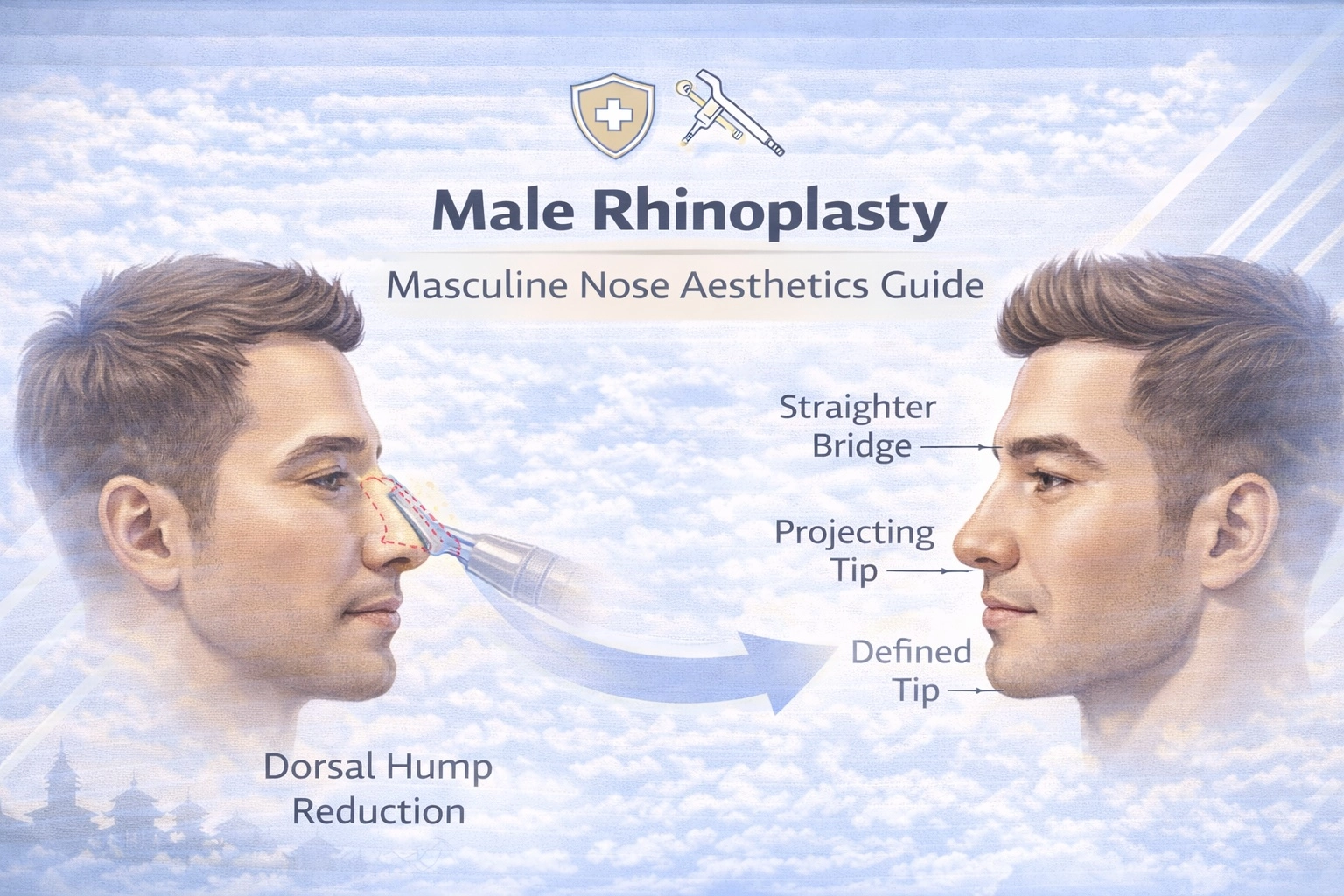
Most men want a straight bridge. A deeply scooped, concave profile can look out of place on a male face, so reduction is usually conservative. Some men prefer to keep a slight hump as part of their character — that is a legitimate choice, and it should be written into the plan. Large humps can still be reduced substantially; see dorsal hump removal.
Tip Rotation and Projection
Female rhinoplasty often turns the tip slightly upwards. In men the tip is usually left closer to its natural angle and is not over-narrowed, because a small, upturned tip is one of the quickest ways to make a nose look “done”. Tip techniques are covered in tip rhinoplasty.
Supratip Break
The supratip break is the small dip just above the tip that many women ask for. Surgeons generally avoid creating a pronounced one in men, aiming instead for a smooth line from the bridge into the tip.
Bridge Width
A man’s nose is often wider at the bridge, in proportion to a broader face and jaw. Narrowing it too much can unbalance the face, so bone work is planned with the whole face in view rather than the nose alone.
Skin Thickness
Many men have thicker, oilier nasal skin. Thick skin hides fine changes and takes longer to settle, so the framework has to be shaped clearly enough to show through and the final result takes longer to appear. Our ethnic rhinoplasty guide explains how surgeons plan around thick skin.
What Research Says About the “Ideal” Male Nose
There is no single ideal male nose, and many of the exact “ideal angles” quoted online have no traceable source. The most useful evidence comes from perception studies. In Nuyen et al. (2019), 503 people rated computer-altered profile photos of one man. The version judged most attractive had a gently sloping bridge, a nasofrontal angle (where the nose meets the forehead) of 130° and a nasolabial angle (between the base of the nose and the upper lip) of 97°.
Two findings are useful when planning surgery. First, there was a marked rejection of the version with a dorsal hump among many respondents. Second, the researchers found no clear preference in nose shape when people judged how masculine the man looked, although the straight and sloping versions were more often linked with femininity. So a smaller, straighter bridge was rated more attractive, but its effect on how masculine he looked was mixed — one reason surgeons reduce conservatively in men. The study has clear limits: it used a single face, and most respondents were women, so it guides the conversation rather than setting a target.
Key Point
Angles from studies describe what people preferred on someone else’s face. Your plan should be built from your own photos, your proportions and the specific changes you want.
Common Reasons Men Seek Rhinoplasty
Most men come with one main concern, often linked to function or an old injury, and want an improvement that does not look operated on.
Dorsal Hump
A bump on the bridge, from genetics or an injury, is the most common request — including large humps. Reduction is usually combined with narrowing the bones so the bridge does not look flat and wide afterwards. Details are in our dorsal hump removal guide.
Breathing Problems
A deviated septum, weak nasal valves or enlarged turbinates can block one or both sides of the nose and affect sleep and exercise. These are corrected in the same operation — at Carely Clinic within the same price. See rhinoplasty for breathing problems.
Previous Nasal Fracture
A nose broken in sport or an accident may be crooked outside and blocked inside. Straightening it usually means repositioning bone and the septum together. If the nose has already been operated on, the surgery becomes a revision rhinoplasty.
Facial Balance
Some men feel their nose is too large, too wide or too prominent for their face. The goal is a nose that people stop noticing — in proportion with the brow, cheeks, jaw and chin.
Bulbous or Wide Tip
A round, poorly defined tip can make the whole nose look bigger. In men it is refined with sutures and support grafts while keeping enough width to look natural.
Who Is a Good Candidate?
A good candidate is an adult whose nose has finished growing, who is in good general health and who can describe specifically what he wants changed.
Age
Surgeons wait until the nose has finished growing, usually from the late teens; there is no upper age limit for healthy adults. In the Layliev data, patients aged 40 and over had about twice the relative risk of a major complication, which your surgeon will discuss with you.
Health
- No uncontrolled heart, lung or bleeding conditions, and blood-thinning medicines reviewed with your doctor
- Diabetes and blood pressure controlled before surgery
- No active sinus or nasal infection
- Willing to stop smoking for as long as your surgeon instructs before and after surgery
Expectations
Men who do best can name the change they want, accept that the result takes months to settle, and are doing it for themselves. The 2003 review stresses verifying realistic goals before surgery; a surgeon may suggest waiting, or decline to operate, if the concern is very small or the expectations are not achievable.
When to Wait
Surgery is postponed for an active infection, uncontrolled medical conditions or a recent nasal injury that has not yet healed. A psychological assessment may be suggested if the worry about the nose is out of proportion to what others can see.
Surgical Techniques
Male rhinoplasty uses either the closed approach, with all incisions inside the nostrils, or the open approach, with a small extra incision across the skin between the nostrils. A 2025 meta-analysis of 1,067 patients found no significant difference between the two in results, swelling or complications, so the choice depends on what needs to be done.
Closed Rhinoplasty
Suited to hump reduction, straightening and limited tip changes. There is no external scar. See closed rhinoplasty.
Open Rhinoplasty
Gives the surgeon a direct view of the cartilage, which helps when the tip needs support grafts, the septum is badly bent or the nose has been operated on before. The small scar under the nose usually fades well. See open rhinoplasty and open vs closed rhinoplasty.
What Changes for Men
- Conservative hump reduction, keeping a straight, strong bridge
- Tip support with the patient’s own cartilage rather than removal, so the tip does not drop or narrow too much
- Bone work planned to keep the bridge in proportion with a broader face
- Septum, valves and turbinates treated in the same operation when breathing is affected
- Allowance for thicker skin, which hides fine detail
Some surgeons shape bone with ultrasonic (piezoelectric) instruments instead of a chisel. It is one of several tools; what matters most is how much is changed, not which instrument is used.
Is Male Rhinoplasty Safe?
Rhinoplasty has a low rate of serious complications. In the 2017 Aesthetic Surgery Journal analysis of 4,978 rhinoplasties, the major complication rate was 0.7%, with haematoma and infection each about 0.2%. Patients aged 40 and over had about twice the relative risk of a major complication.
Further surgery is the more common problem. In a 2017 systematic review pooling 49 studies, primary open rhinoplasty was reoperated in 2.73% of 7,902 cases and primary closed in 1.56% of 765 cases, a difference that was not statistically significant. Rettinger puts rhinoplasty revision rates at 5–15% overall. A residual hump, an over-refined tip and breathing that is still blocked are typical reasons men ask for a revision.
Possible Risks
The NHS lists the specific risks of nose reshaping as:
- Permanent breathing difficulty
- Damage to the cartilage wall between the nostrils (the septum)
- An altered sense of smell
- Heavy nosebleeds
- The general risks of any operation: bleeding, a blood clot, infection and a reaction to the anaesthetic
A result that is uneven or not what you hoped for is the most common reason for further surgery, which is why the plan is agreed in detail beforehand.
How to Lower Your Risk
- Choose a surgeon who performs rhinoplasty routinely and shows you results on noses like yours
- Have surgery in an accredited hospital under general anaesthesia
- Stop smoking and review blood-thinning medicines and supplements as instructed
- Follow the aftercare instructions and attend every review
Recovery Timeline
Recovery follows the standard rhinoplasty timeline from the NHS, Cleveland Clinic and Mayo Clinic. Men with thick skin should expect the tip to take longest to settle. Our swelling stages, cast removal and glasses after rhinoplasty guides cover each phase in detail.
| When | What to expect | What to do |
|---|---|---|
| Week 1 | Swelling and bruising around the nose and eyes; blocked nose; splint in place (NHS: about 7 days) | Head raised, cold compresses on the cheeks, no nose-blowing, prescribed medicines |
| About day 7 | Splint removed; first look at the new shape, still swollen | Review with your surgeon; at Carely Clinic you fly home after this check |
| Weeks 2–4 | Bruising fading (NHS: up to 3 weeks); most people back at desk work by 2 weeks (NHS) | No strenuous activity or heavy lifting; keep glasses off the bridge |
| Weeks 4–6 | Shape clearer; breathing more open | Strenuous exercise usually from 4 to 6 weeks (NHS); contact sports only when your surgeon agrees |
| Months 2–6 | Cleveland Clinic: about 90% of swelling gone by three months in general; the bridge settles before the tip | Photo reviews with your surgeon |
| Months 6–18 | Mayo Clinic: most swelling gone within a year; with thick skin the tip can refine to 12–18 months | Judge the final result at a year or later |
Key Point
If you play contact sports, ask your surgeon for a specific return date — a blow to the nose in the first weeks can move healing bone.
Male Rhinoplasty at Carely Clinic, Istanbul
Our nose surgeons are ENT specialists who treat appearance and breathing together: Op. Dr. Vepa Silapov, our lead rhinoplasty surgeon, and Assoc. Prof. Dr. Mustafa Sagit. At the consultation in Istanbul your surgeon examines your nose inside and out, agrees with you what will change and what will stay — for example whether a slight hump is kept — and confirms the plan in writing before you pay anything. The price is €2,850 all-inclusive (valid until December 2026), including septoplasty, tip work, ear cartilage grafts and turbinate reduction when needed; from €3,000 with rib cartilage.
Surgery takes place under general anaesthesia at BHT CLINIC İstanbul Tema Hospital (JCI-accredited May 2024; TEMOS re-accredited January 2026; TÜSKA Gold June 2026), named in your treatment plan, with one night in hospital (two if your surgeon advises) and six nights in a hotel — about seven days in Istanbul. After you fly home, our medical team reviews your photos on WhatsApp at 1 week and at 1, 3, 6 and 12 months. Send your photos through the contact page; we reply within 24 hours.
Cost Comparison by Country
At Carely Clinic male rhinoplasty is priced like any primary rhinoplasty — €2,850 all-inclusive (valid until December 2026) — with rib cartilage cases from €3,000 and revision rhinoplasty from €3,000. For comparison, the NHS gives £4,000 to £7,000 for private nose reshaping in the UK, and the ASPS 2024 fee survey gives a US surgeon’s fee of $7,500 to $12,500 before anaesthesia and facility charges.
| Country | Price | What it covers | Source |
|---|---|---|---|
| Turkey — Carely Clinic, Istanbul | €2,850 all-inclusive (valid until December 2026); from €3,000 with rib cartilage | Surgery under general anaesthesia at a JCI-accredited hospital; septoplasty, tip work and ear grafts if needed; 1 night in hospital (2 if advised); 6 nights hotel; transfers; 12 months of follow-up | rhinoplasty package in Turkey |
| United Kingdom (private) | £4,000–£7,000 | Surgery; consultations, follow-up and further surgery may be extra | NHS, nose reshaping, reviewed 22 September 2023 |
| United States | $7,500–$12,500 | Surgeon’s fee only; anaesthesia, facility and hospital fees are extra | ASPS 2024 Average Surgeon/Physician Fees |
Our Turkey vs UK rhinoplasty comparison sets full prices side by side.
Frequently Asked Questions
How is male rhinoplasty different from female rhinoplasty?
The techniques are the same; the goals differ. Male rhinoplasty usually keeps a straighter, stronger bridge, leaves the tip less turned up and less narrowed, avoids a pronounced dip above the tip and keeps the width in proportion with a broader face. The most common mistake in men is removing too much, which a 2003 Plastic and Reconstructive Surgery review says produces unsatisfactory results.
What is the ideal age for male rhinoplasty?
Surgeons wait until the nose has finished growing, usually from the late teens. There is no upper age limit for healthy men, but in a 4,978-patient analysis those aged 40 and over had about twice the relative risk of a major complication, so health checks matter more with age.
How long does male rhinoplasty surgery take?
It depends on what is being done — a hump reduction alone is shorter than a combined operation with septoplasty, grafts and bone work. Your surgeon gives you an estimate for your own plan. At Carely Clinic surgery is done under general anaesthesia with one night in hospital, two if your surgeon advises.
Will there be visible scars after male rhinoplasty?
Closed rhinoplasty leaves no external scar because all incisions are inside the nostrils. Open rhinoplasty adds a small incision across the skin between the nostrils, which usually fades well. A 2025 meta-analysis found no significant difference in results or complications between the two approaches.
How long until I can return to work after rhinoplasty?
The NHS says most people return to work after about 2 weeks. The splint comes off at about a week and bruising can take up to 3 weeks to fade. Jobs involving heavy lifting or physical contact need longer; strenuous exercise usually resumes from 4 to 6 weeks.
Can rhinoplasty fix my breathing problems?
Often, yes. A deviated septum, collapsed nasal valves or enlarged turbinates can be corrected in the same operation as the cosmetic change. At Carely Clinic septoplasty and turbinate reduction are included in the €2,850 price.
What is the major complication rate for male rhinoplasty?
In a 2017 Aesthetic Surgery Journal analysis of 4,978 rhinoplasties, the major complication rate was 0.7%, with haematoma and infection each about 0.2%. Risk was higher at age 40 and over. Further surgery is more common: Rettinger puts rhinoplasty revision rates at 5–15% overall.
How much does male rhinoplasty cost in Turkey compared to the USA?
At Carely Clinic male rhinoplasty is €2,850 all-inclusive (valid until December 2026), or from €3,000 with rib cartilage. The ASPS 2024 survey gives a US surgeon’s fee of $7,500 to $12,500 before anaesthesia and facility charges, and the NHS gives £4,000 to £7,000 for private surgery in the UK.
When will I see my final rhinoplasty results?
You see the new shape when the splint comes off at about a week. Cleveland Clinic says about 90% of swelling is usually gone by three months, and the Mayo Clinic says most swelling settles within a year. With thick skin, common in men, the tip can keep refining for 12 to 18 months.
What happens if I’m unhappy with my rhinoplasty results?
Small irregularities often settle as swelling goes down, so surgeons usually wait about a year before judging the result. If a change is still needed, it is a revision rhinoplasty, from €3,000 at Carely Clinic. Agreeing a clear written plan before surgery is the best way to avoid it.
Can I wear glasses after male rhinoplasty?
Glasses should not rest on the bridge while the bones heal. Contact lenses are usually fine once the swelling around the eyes allows. Your surgeon will tell you when glasses can go back on; our guide to glasses after rhinoplasty explains the options in the meantime.
Is male rhinoplasty more difficult than female rhinoplasty?
It is often considered more demanding. Thicker skin hides fine changes, the margin for over-correction is small, and a 2003 Plastic and Reconstructive Surgery review notes that male patients often have less specific complaints, so agreeing clear goals takes more time. The key is preserving masculine features while making the change.
Conclusion
Successful male rhinoplasty is defined by what it leaves alone as much as by what it changes: a strong, straight bridge, a tip that is supported rather than shrunk, and a width that suits the face. Breathing problems and old injuries can be corrected in the same operation.
At Carely Clinic it is performed by ENT surgeons at a JCI-accredited hospital for €2,850 all-inclusive (valid until December 2026), including septoplasty, tip work and ear cartilage grafts when needed, or from €3,000 when rib cartilage is required.
Individual results and recovery timelines vary. This guide provides general information based on the published sources cited above. Consult a qualified surgeon for advice about your own nose.
Considering male rhinoplasty? Contact Carely Clinic with front, side and three-quarter photos; our medical team replies within 24 hours, and your surgeon confirms the plan at your consultation in Istanbul.
Written by Carely Clinic Medical Team · Last updated: November 2026