
Quick Summary
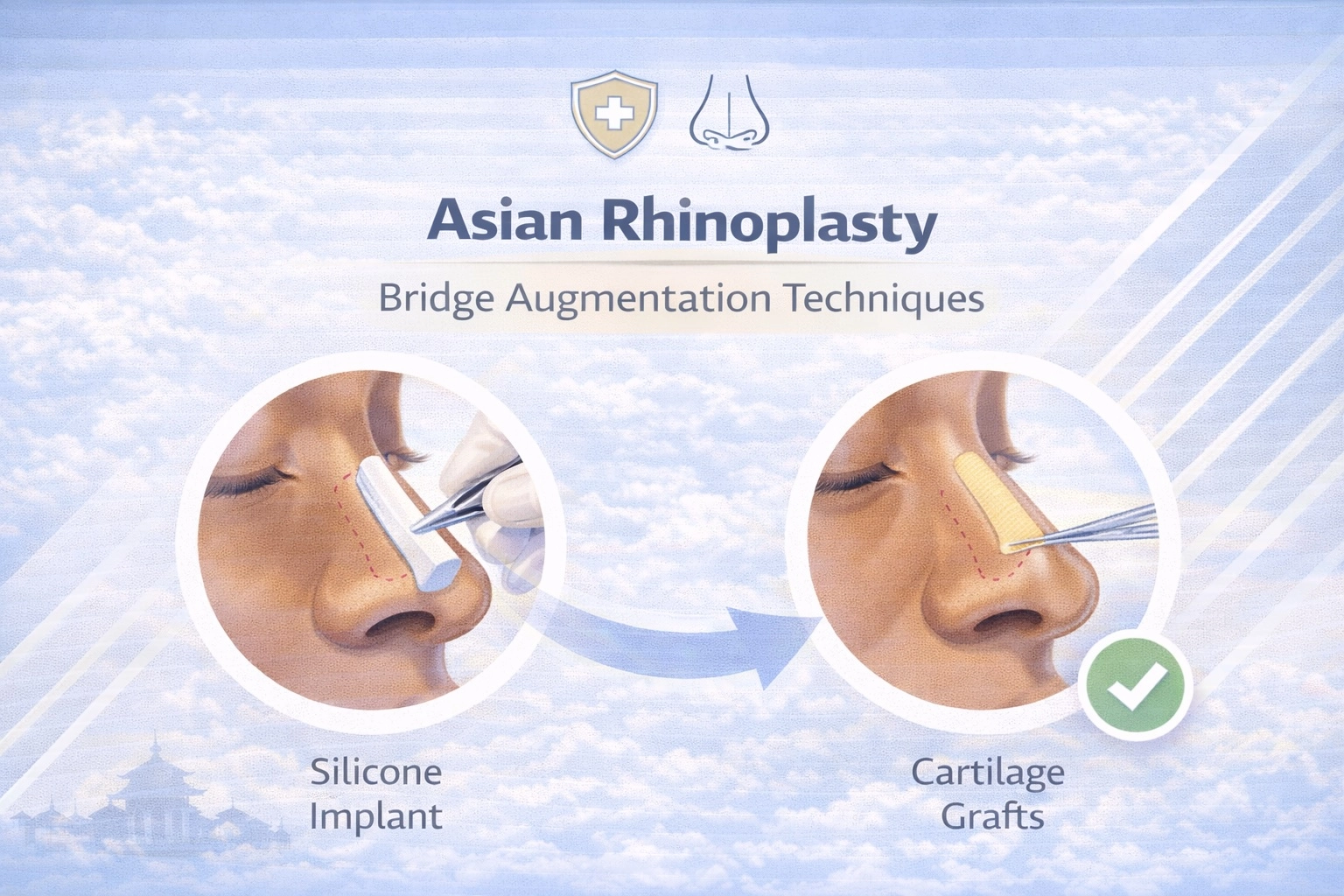
Asian rhinoplasty is nose surgery planned around features common in East and Southeast Asian noses — a low bridge, a less projected, rounder tip, a wider base and often thick skin. Most patients need the bridge built up rather than reduced, so the central decision is the material: a synthetic implant (silicone or Gore-Tex) or the patient’s own cartilage.
Both work, and both have trade-offs. In a 2022 meta-analysis of 27 studies (3,803 cases) of synthetic dorsal implants, infection was 2.75%, extrusion 0.78% and revision 6.40% (7.64% for silicone). Rib cartilage avoids a foreign body but adds a chest donor site; in a meta-analysis of 10 studies (491 patients), warping was 3.08% and chest scarring or keloid 5.45%.
At Carely Clinic in Istanbul, our surgeons build the bridge and tip with the patient’s own cartilage, not implants. Asian rhinoplasty is part of our standard rhinoplasty in Turkey package at €2,850 all-inclusive (valid until December 2026) with septal or ear cartilage, or from €3,000 when rib cartilage is needed.
Why Trust This Guide
Every figure here comes from a source you can open: Bergeron and Chen, Asian Rhinoplasty Techniques (Seminars in Plastic Surgery 2009;23(1):16–21); the Keyhan et al. 2022 meta-analysis of synthetic dorsal implants; the Wee et al. 2014 meta-analysis of rib cartilage grafts; Daniel and Calvert on diced cartilage grafts (Plastic and Reconstructive Surgery 2004;113(7):2156–2171); Ma et al. on diced rib cartilage in 22 Asian patients (Chinese Medical Journal 2015;128(19):2679–2681); the Layliev et al. 2017 analysis of 4,978 rhinoplasties; Rettinger’s review of rhinoplasty risks; and the NHS, Mayo Clinic and Cleveland Clinic patient guides. Figures we could not trace to a source have been removed.
What Is Asian Rhinoplasty?
Asian rhinoplasty is a form of ethnic rhinoplasty: the same operation as any rhinoplasty, planned towards a different goal. Instead of making the nose smaller, it usually adds structure — raising a low bridge, projecting and defining the tip, and narrowing a wide base conservatively — while keeping the nose in harmony with the face.
The aim is enhancement, not a “Western” nose. A bridge raised too high or a tip pushed too far can look out of place, strain the skin and, with implants, increase the risk of complications. Good planning sets a height and tip position that suit your face and your skin.
Common requests are a low bridge or flat area between the eyes, a round or poorly defined tip, wide nostrils, and a nose that looks short or wide from the front. Some patients try filler in the bridge first; our non-surgical rhinoplasty guide explains why Carely Clinic does not offer it.
Asian Nasal Anatomy: Understanding Key Differences
Bergeron and Chen summarise the typical East Asian nose as “shorter, wider, and less projecting” than a Caucasian nose, and Ma et al. describe a broad low dorsum, decreased tip projection, thick skin, abundant subcutaneous tissue and a weak cartilage framework. These are tendencies, not rules — many patients differ, and many have mixed ancestry.
Upper Third (Nasal Bridge)
The bony bridge and the area between the eyes (the radix) are often low, which makes the profile flat and the nose look wider from the front.
Middle Third (Dorsum)
The cartilaginous part of the bridge is usually less projecting. Some patients have a small hump despite the low overall profile, which changes the plan.
Lower Third (Nasal Tip)
The tip is often rounder, less projected and without a clear supratip break, and the base is wider relative to the height of the nose (Bergeron and Chen). The tip cartilages are often small and soft, so they cannot be shaped by sutures alone.
Skin Characteristics
Thick skin with abundant soft tissue hides fine changes and takes longer to settle. It covers an implant or graft well, but it also means the framework underneath must be strong and well defined for the result to show.
Bridge Augmentation Materials Compared
Bridge augmentation uses either an alloplastic (synthetic) implant or autologous tissue — the patient’s own cartilage. Each has a place; the table summarises what the published evidence shows.
Alloplastic (Synthetic) Materials
Silicone and Gore-Tex (expanded polytetrafluoroethylene, ePTFE) implants give a predictable shape, avoid a second operating site and are widely used in Asia. Their drawback is that a foreign body can become infected, shift or push through the skin, sometimes years later.
Autologous (Patient’s Own Tissue) Materials
Septal, ear or rib cartilage cannot be rejected and becomes part of the nose. The trade-offs are the need to harvest it, a longer operation, and — with large solid rib grafts — a risk of warping.
Hybrid Approaches
Some surgeons combine an implant for the bridge with cartilage for the tip. At Carely Clinic we use the patient’s own cartilage for both.
| Material | What the evidence shows | Source |
|---|---|---|
| Synthetic implants (pooled) | 27 studies, 3,803 cases: infection 2.75%, extrusion 0.78%, revision 6.40% (silicone 7.64%) | Keyhan et al. 2022 |
| Silicone (one large series) | Complications 16%, reoperation 8%; infection 5.3%, extrusion 2.8%, deviation 5.0%; larger implants had more infection and extrusion | Bergeron and Chen 2009, citing the Chang Gung series |
| Gore-Tex / ePTFE (one large series) | 853 patients: complications 4.2%, infection 2.1%, implant removal 2.2% | Bergeron and Chen 2009, citing Jin et al. |
| Rib cartilage (pooled) | 10 studies, 491 patients: warping 3.08%, resorption 0.22%, infection 0.56%, displacement 0.39%, chest scar or keloid 5.45%, revision 14.07% | Wee et al. 2014 |
| Diced cartilage in fascia | 20 patients: grafts maintained without evidence of absorption at a minimum of 1 year | Daniel and Calvert 2004 |
| Diced rib cartilage, no fascia | 22 Asian patients, mean follow-up 8.9 months: no warping, infection or absorption; 1 revision for overcorrection | Ma et al. 2015 |
These figures come from different study designs and follow-up periods, so they are not directly comparable — but they show the pattern: implants avoid a donor site and carry a long-term foreign-body risk; cartilage avoids that risk and adds a donor site.
Silicone Implants for Dorsal Augmentation
Solid silicone implants are the most familiar option in Asia. They are carved to fit, inserted through incisions inside the nose and can be removed if needed. Bergeron and Chen note the absence of donor-site morbidity as their main advantage.
Implant Shapes
An I-shaped implant raises the bridge only; an L-shaped implant also extends into the columella to push the tip forward. Critics argue the L-shape puts pressure on the tip skin and favours extrusion, which is one reason many surgeons now pair an I-shaped implant with cartilage for the tip.
Complication Considerations
In the large Chang Gung series cited by Bergeron and Chen, silicone augmentation had a 16% complication rate and an 8% reoperation rate, with infection in 5.3%, extrusion in 2.8% and deviation in 5.0%; larger implants had higher infection and extrusion rates. In the 2022 meta-analysis, the revision rate for silicone was 7.64%. These risks persist for as long as the implant is in place.
Gore-Tex (ePTFE) Implants
Gore-Tex is a porous synthetic material: tissue grows into it, which helps it stay in place and feel softer than silicone. The same ingrowth makes it harder to remove if a problem develops.
What the Evidence Shows
In the Korean series of 853 patients cited by Bergeron and Chen, complications occurred in 4.2%, with infection in 2.1% and implant removal in 2.2%. The 2022 meta-analysis pooled ePTFE with silicone and high-density polyethylene; the authors considered the overall rates acceptable while noting that autologous grafts are generally regarded as safer.
Considerations
Gore-Tex suits surgeons and patients who want an implant with a softer feel. Because it integrates with tissue, removal and revision are more difficult than with silicone — an important point if you are weighing a synthetic material.
Autologous Cartilage Grafts
Using your own cartilage avoids the foreign-body risks of implants. The choice of donor site depends on how much cartilage is needed — and in many Asian patients the septum is small, so ear or rib cartilage is often required for a meaningful rise in the bridge.
Septal Cartilage
The first choice when there is enough: it is flat, firm and taken from inside the nose through the same incisions. It is often used for tip support and smaller augmentations. Taking it can also correct a deviated septum (septorhinoplasty) — see rhinoplasty for breathing problems.
Auricular (Ear) Cartilage
Taken through an incision behind the ear. It is softer and curved, which makes it useful for the tip and for modest, layered or diced bridge grafts, but less suitable as a single straight graft for a large augmentation.
Costal (Rib) Cartilage
Provides the most material and the strongest support, so it is used for substantial augmentation and in revisions, including after implant problems. Large solid rib grafts can warp; Bergeron and Chen note that large cartilage grafts over the dorsum often warp over time, and the Wee et al. meta-analysis found warping in 3.08%.
Donor Site Considerations
Rib cartilage requires a small incision on the chest. In the meta-analysis, hypertrophic scarring or keloid at the chest donor site occurred in 5.45%. Tell your surgeon if you tend to form raised scars. At Carely Clinic septal and ear grafts are included in the standard price; rhinoplasty with rib cartilage is from €3,000.
Diced Cartilage Fascia (DCF) Technique
Diced cartilage solves the warping problem of solid grafts: the cartilage — usually from the rib — is cut into very small pieces and shaped along the bridge, either wrapped in a sleeve of fascia (a thin connective tissue layer) or placed without a wrap.
What the Evidence Shows
In Daniel and Calvert’s 2004 study of 50 diced cartilage grafts, grafts wrapped in Surgicel (an absorbable material) failed and that arm was stopped, while 20 grafts wrapped in fascia were maintained without evidence of absorption at a minimum of one year; fascia-wrapped dorsal grafts were palpable. Ma et al. used diced rib cartilage without fascia in 22 Asian patients (12 primary, 10 revision): over a mean follow-up of 8.9 months they observed no warping, infection or absorption, and one patient needed revision for overcorrection.
Advantages and Limits
Bergeron and Chen list the absence of warping as the main advantage of diced cartilage. Its limits are a longer operation, a chest donor site, the possibility of a palpable or slightly uneven graft, and the fact that the published series are small, with follow-up of months to a few years.
Nasal Tip Refinement in Asian Rhinoplasty
A higher bridge without a matching tip looks unbalanced, so the tip is almost always treated at the same time. Because the tip cartilages are often small and soft, refinement depends on support rather than removal. Our tip rhinoplasty guide covers the techniques in detail.
Cartilage Support Techniques
A septal extension graft or a columellar strut — made from septal, ear or rib cartilage — gives the tip a stable base to project from. Shield or cap grafts can add definition that shows through thick skin.
Suture Techniques
Sutures narrow and shape the tip cartilages when they are strong enough. In many Asian noses they are combined with support grafts rather than used alone.
Alar Base Considerations
Wide nostrils or flare can be reduced by removing a small wedge where the nostril meets the cheek (alarplasty). It is done conservatively — over-narrowing is hard to reverse — and usually assessed after the tip has been projected, because a stronger tip makes the base look narrower. At Carely Clinic alarplasty is included in the standard price when needed. Our African rhinoplasty guide discusses alar base reduction in thick-skinned noses.
Recovery Timeline and What to Expect
Recovery follows the standard rhinoplasty timeline from the NHS, Cleveland Clinic and Mayo Clinic, with a longer final phase when the skin is thick. If cartilage is taken from the ear or rib, that site is sore for the first days. Our swelling stages, cast removal and glasses after rhinoplasty guides cover each phase in detail.
| When | What to expect | What to do |
|---|---|---|
| Week 1 | Swelling and bruising around the nose and eyes; blocked nose; splint in place (NHS: about 7 days); chest or ear soreness if cartilage was taken there | Head raised, cold compresses on the cheeks, no nose-blowing, prescribed medicines |
| About day 7 | Splint removed; first look at the new shape, still swollen | Review with your surgeon; at Carely Clinic you fly home after this check |
| Weeks 2–4 | Bruising fading (NHS: up to 3 weeks); most people back at desk work by 2 weeks (NHS) | No strenuous activity; keep glasses off the bridge |
| Weeks 4–6 | Shape clearer; breathing more open | Strenuous exercise usually from 4 to 6 weeks (NHS) |
| Months 2–6 | Cleveland Clinic: about 90% of swelling gone by three months in general; the bridge settles before the tip | Photo reviews with your surgeon |
| Months 6–18 | Mayo Clinic: most swelling gone within a year; with thick skin the tip refines to 12–18 months | Judge the final result at a year or later |
Key Point
With thick skin, the bridge shows its new height early and the tip refines last. Early photos understate the final definition.
Asian Rhinoplasty at Carely Clinic, Istanbul
Our nose surgeons are ENT specialists who perform structural rhinoplasty with septal, ear and rib cartilage: Op. Dr. Vepa Silapov, our lead rhinoplasty surgeon, and Assoc. Prof. Dr. Mustafa Sagit. We do not use silicone or Gore-Tex implants — the bridge and tip are built with your own cartilage. At the consultation in Istanbul your surgeon examines your skin, septum and proportions, agrees with you how high the bridge should be and which features to keep, and confirms in writing — before you pay anything — whether septal and ear cartilage are enough or rib cartilage is needed.
The price is €2,850 all-inclusive (valid until December 2026), including septal and ear cartilage grafts and alarplasty when needed; from €3,000 with rib cartilage. Surgery takes place under general anaesthesia at BHT CLINIC İstanbul Tema Hospital (JCI-accredited May 2024; TEMOS re-accredited January 2026; TÜSKA Gold June 2026), named in your treatment plan, with one night in hospital (two if your surgeon advises) and six nights in a hotel — about seven days in Istanbul. Our medical team then reviews your photos on WhatsApp at 1 week and at 1, 3, 6 and 12 months. Send your photos through the contact page; we reply within 24 hours.
Cost Comparison by Country
At Carely Clinic Asian rhinoplasty is priced like any primary rhinoplasty — €2,850 all-inclusive (valid until December 2026) — with rib cartilage cases from €3,000 and revision rhinoplasty, including after implant problems, from €3,000. For comparison, the NHS gives £4,000 to £7,000 for private nose reshaping in the UK, and the ASPS 2024 fee survey gives a US surgeon’s fee of $7,500 to $12,500 before anaesthesia and facility charges; rib grafting usually adds to both.
| Country | Price | What it covers | Source |
|---|---|---|---|
| Turkey — Carely Clinic, Istanbul | €2,850 all-inclusive (valid until December 2026); from €3,000 with rib cartilage | Surgery under general anaesthesia at a JCI-accredited hospital; septal and ear grafts and alarplasty if needed; 1 night in hospital (2 if advised); 6 nights hotel; transfers; 12 months of follow-up | rhinoplasty package in Turkey |
| United Kingdom (private) | £4,000–£7,000 | Surgery; consultations, follow-up and further surgery may be extra | NHS, nose reshaping, reviewed 22 September 2023 |
| United States | $7,500–$12,500 | Surgeon’s fee only; anaesthesia, facility and hospital fees are extra | ASPS 2024 Average Surgeon/Physician Fees |
Our Turkey vs UK rhinoplasty comparison sets full prices side by side.
Frequently Asked Questions
What is the best implant material for Asian rhinoplasty?
There is no single best material. Synthetic implants avoid a donor site but carry a long-term risk of infection, shifting or extrusion — in a 2022 meta-analysis of 3,803 cases, revision was 6.40% overall and 7.64% for silicone. Your own cartilage avoids those risks but needs to be harvested. At Carely Clinic we use the patient’s own cartilage only.
How much height can bridge augmentation add?
It depends on your skin, your face and the material. Thick skin covers a graft well but limits fine definition; thin skin shows every edge. Your surgeon plans a height that suits your profile and that your skin can carry safely — raising the bridge too far is one of the main causes of implant problems.
Will the implant look or feel unnatural?
A well-placed graft or implant should not be visible, but some can be felt. Silicone feels firmer than tissue; Gore-Tex is softer because tissue grows into it. Diced cartilage wrapped in fascia was palpable in one study, and solid rib grafts can warp. Your own cartilage becomes part of the nose once healed.
What are the risks of silicone implants long-term?
Infection, shifting or deviation, thinning of the overlying skin and extrusion. In one large Asian series, silicone augmentation had a 16% complication rate and an 8% reoperation rate, with infection in 5.3% and extrusion in 2.8%; larger implants had higher rates. These risks last as long as the implant is in place.
How does Asian rhinoplasty differ from standard rhinoplasty?
The techniques are the same; the goal differs. Most Asian rhinoplasties add structure — raising the bridge and supporting the tip — rather than removing it, and plan around thick skin and soft cartilage. The aim is a more defined nose that still suits the face, not a Western nose.
Can I have rhinoplasty if I’ve had filler injections?
Usually, yes. Tell your surgeon exactly what was injected and when. Hyaluronic acid filler can be dissolved with an enzyme (hyaluronidase); other fillers may need to be removed during surgery. Your surgeon decides the timing after examining you. Our non-surgical rhinoplasty guide explains the risks of nose filler.
How long do rhinoplasty results last?
Changes to bone and cartilage are permanent, and grafts of your own cartilage become part of the nose. Synthetic implants are intended to be permanent but carry a lifelong risk of complications that may require removal. The nose still ages naturally with the rest of the face.
When can I wear glasses after rhinoplasty?
Glasses should not rest on the bridge while it heals, especially after augmentation. Your surgeon will tell you when they can go back on; until then, contact lenses or taping the glasses to the forehead are common options. Our guide to glasses after rhinoplasty explains them.
Is rhinoplasty in Turkey safe for international patients?
Safety depends on the surgeon, the hospital and the follow-up, not the country. At Carely Clinic rhinoplasty is performed by ENT surgeons under general anaesthesia at BHT CLINIC İstanbul Tema Hospital (JCI-accredited May 2024, TEMOS January 2026, TÜSKA Gold June 2026), with photo follow-up on WhatsApp for 12 months. In a 4,978-patient analysis, the major complication rate of rhinoplasty was 0.7%.
What if I’m not satisfied with my results?
Small irregularities often settle as swelling goes down, so surgeons usually wait about a year before judging the result. If a change is still needed, it is a revision rhinoplasty, from €3,000 at Carely Clinic, including revisions after implant problems elsewhere. Rettinger puts rhinoplasty revision rates at 5–15% overall.
How do I choose between implants and autologous cartilage?
Weigh a donor site against a foreign body. Implants mean a shorter operation and no harvest, but a lifelong risk of infection or extrusion. Your own cartilage means a harvest — and with rib, a chest scar — but no foreign body. At Carely Clinic we use your own cartilage: septal or ear cartilage within €2,850, rib cartilage from €3,000.
Does insurance cover Asian rhinoplasty?
Cosmetic rhinoplasty is generally not covered. Surgery to correct a breathing problem, such as a deviated septum, is sometimes covered depending on your policy and country. Check with your insurer before booking.
Conclusion
Asian rhinoplasty raises a low bridge and defines a soft tip while keeping the nose in harmony with the face. The main decision is the material: synthetic implants avoid a donor site but carry a long-term foreign-body risk; the patient’s own cartilage avoids that risk and adds a harvest site. Diced cartilage addresses the warping of solid rib grafts, but the published series are still small.
At Carely Clinic we build the bridge and tip with your own cartilage, performed by ENT surgeons at a JCI-accredited hospital for €2,850 all-inclusive (valid until December 2026) with septal or ear cartilage, or from €3,000 with rib cartilage. Our ethnic rhinoplasty guide compares the approaches for other heritages.
Individual results and recovery timelines vary. This guide provides general information based on the published sources cited above. Consult a qualified surgeon for advice about your own nose.
Considering Asian rhinoplasty? Contact Carely Clinic with front, side and three-quarter photos; our medical team replies within 24 hours, and your surgeon confirms the plan at your consultation in Istanbul.
Written by Carely Clinic Medical Team · Last updated: November 2026