
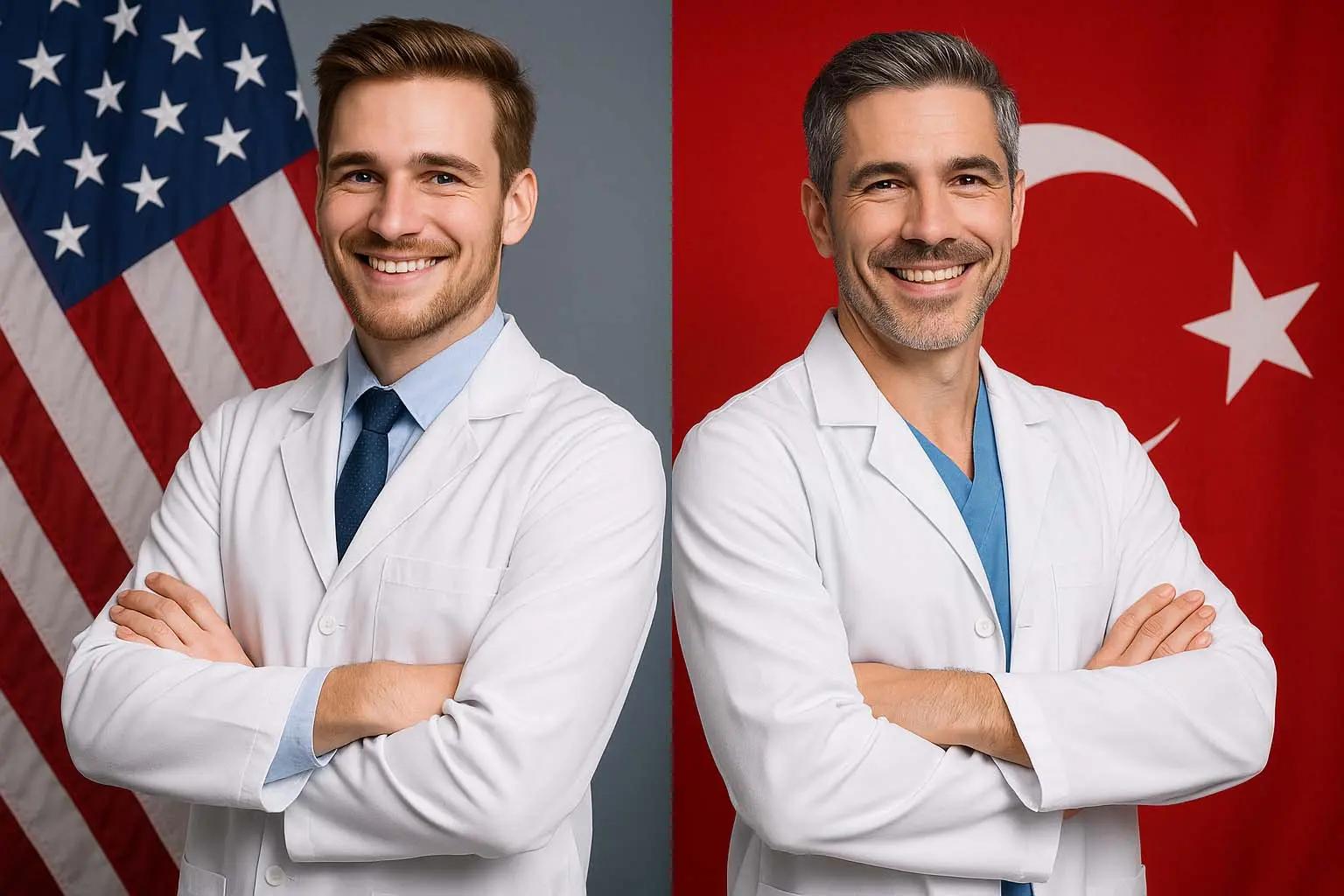
A hair transplant in Turkey usually costs a fraction of what it costs in the United States. That part of the comparison is real: the published figures put most US procedures between $6,000 and $15,000, and Turkish ones at a few thousand dollars.
What the price does not tell you is how the result will turn out. We found no published data showing better or worse results in either country, and in both the outcome depends on the doctor and on who performs each step. This guide compares a hair transplant in Turkey vs the US on what can be compared: prices and where they come from, what a quote includes, who operates, your legal position, travel and follow-up.
Quick Summary:
- Price in the US: published figures run from about $4,400 to $17,000, and the average FUE patient on RealSelf reported paying $11,229
- Price in Turkey: about $2,300 to $3,500 at one platform’s partner clinics. Carely Clinic’s price is €1,800 all-inclusive
- What you add for Turkey: flights, travel insurance, and the days away
- Who operates: the same question in both countries. In the US any licensed physician may legally perform a hair transplant, and the specialist boards warn about technicians doing the surgery
- Legal protection: stronger at home. US medical bodies and the State Department say your options are limited if something goes wrong abroad
- Follow-up: in person in the US, by photos and messages from Turkey
A note on our own position: Carely Clinic is in Istanbul, so we are not neutral. For that reason every figure below names its source, and where no reliable figure exists we say so.
Turkey vs US at a Glance
| United States | Turkey | |
|---|---|---|
| Published prices | $4,400 to $17,000, depending on the source | $2,300 to $3,500 on one platform. €1,800 at Carely Clinic |
| How it is priced | Usually per graft | Often one price for the procedure |
| Hotel and transfers | Not needed if you live nearby | Often in the price |
| Flights | None, or a domestic trip | Long-haul, at your cost |
| Entry | Not applicable | US ordinary passport holders are visa-exempt for up to 90 days in any 180-day period |
| Insurance | Not normally covered: it is elective cosmetic surgery | Not normally covered, and Medicare and Medicaid do not pay bills abroad |
| Financing | Offered by clinics and lenders | Ask the clinic |
| Legal recourse | US law and US courts | Limited, according to the US State Department |
| Follow-up | In person | Remote. At Carely Clinic, 12 months on WhatsApp |
Sources for each line are named in the sections below. All were read in November 2026.
How Much Does a Hair Transplant Cost in the US and in Turkey?
Most US procedures cost between $6,000 and $15,000. In Turkey, published prices run from about $2,300 to $3,500, and Carely Clinic’s price is €1,800 all-inclusive. Flights are extra.
Neither country has official price data. The main industry survey, the practice census of the International Society of Hair Restoration Surgery (ISHRS), does not publish fees. What exists are figures from review sites, clinic chains, lenders and booking platforms. Each has its own angle, so we give four and say what each one is.
In the United States
- RealSelf (patient reviews, updated 11 July 2023): the average cost of an FUE hair transplant was $11,229, based on 1,574 patient reviews, with some patients paying as much as $21,000. By state, the average was $12,562 in California, $10,669 in New York and $8,250 in Texas
- Bosley (US clinic chain, page updated 28 February 2026): a hair transplant with Bosley typically costs between $4,400 and $12,000, and most of its procedures cost between $6,000 and $12,000, priced per graft
- Cherry (US patient-financing company, updated 6 August 2026): the average ranges from $6,000 to $15,000 or more. The figures are the amounts patients asked to finance at its partner clinics in early 2026, so they leave out anyone who paid without a loan
- Bookimed (booking platform, updated 2 September 2026): $8,000 to $17,000 in the United States
Read together, these put most US procedures somewhere between $6,000 and $15,000, with the total driven by the number of grafts. The RealSelf figure is the only one that comes from patients and not from a seller, and it is more than three years old.
In Turkey
The same booking platform lists $2,300 to $3,500 at its partner clinics in Turkey. Like the US figures, this is a platform’s number and not official data.
Carely Clinic’s price is €1,800 all-inclusive, valid until December 2026, with no graft cap and no per-graft charge. It includes the procedure, pre-operative blood tests, a PRP session, 3 nights in a 5-star hotel, VIP airport transfers, medications, the first wash at the clinic, an aftercare kit and 12 months of follow-up. Flights are not included. Our price is in euros, so check the exchange rate on the day you compare.
What to Add Before You Compare
The honest comparison is total against total. To a Turkish price, add:
- Return flights to Istanbul
- Travel health insurance, which the CDC advises should cover medical evacuation
- The days away from work, including travel days
- A companion’s flight, if you do not want to travel alone
- The cost of going back, if you ever want to be seen in person
To a US quote, check what is and is not in it. RealSelf advises asking whether a quote includes the consultation fee, the surgeon’s fee, the facility fee, anaesthesia, surgical supplies and post-operative appointments. If you would travel to another state for a particular surgeon, add that trip as well.
On the published figures the gap is several thousand dollars, so there is room for the flight. Do the sum with your own quotes before you decide.
Insurance and Financing
Health insurance does not normally pay for a hair transplant in either country, because it is elective cosmetic surgery. For care abroad, the State Department adds that US Medicare and Medicaid do not cover expenses outside the country and that most hospitals and doctors abroad do not accept US health insurance.
Financing is where staying in the US has an advantage. Clinics there commonly work with lenders: Bosley advertises payments from $129 a month, and Cherry quotes rates from 0% to 35.99% depending on the borrower. A loan spreads the cost. It does not reduce it, and at the higher rates it adds a good deal. Compare the total you would repay with the total cost of the trip.
US Patients: Get a Written Plan and Fixed Price
Carely Clinic, Istanbul • €1,800 All-Inclusive until December 2026 • FUE or DHI • No Graft Cap
Send Your Photos on WhatsAppWho Actually Performs the Surgery?
It depends on the clinic, in both countries, and the law does not settle it for you.
It is easy to assume that an American clinic means a specialist surgeon doing the work. That is not guaranteed. The American Board of Hair Restoration Surgery (ABHRS) states on its own website that any individual with a medical licence can legally perform hair restoration surgery (American Board of Hair Restoration Surgery). Board certification is not a legal requirement.
The same board sets the standard it expects: making the extraction incisions and making the incisions for placing the grafts cannot be delegated, and both must be performed by the physician of record. The ISHRS takes a similar position, and warns that growing numbers of unlicensed personnel worldwide are performing substantial medical parts of the surgery (ISHRS consumer alert). The warning names no country, and the ISHRS notes that laws vary by country and by state.
So the question to ask is identical in Istanbul and in Illinois: who designs the hairline, who makes the incisions, who extracts the grafts and who places them, and what are their qualifications? The ISHRS also advises asking whether everyone involved is covered by malpractice insurance (ISHRS, questions to ask).
What the Volume Numbers Do and Do Not Show
You will read that Turkish surgeons perform thousands of procedures a year and American surgeons a few hundred. We found no source for the Turkish figure. For the US there is one: in the ISHRS 2025 census, member surgeons in the United States and Canada performed 200 surgical procedures each on average in 2024 (ISHRS 2025 Practice Census). The census does not report Turkey.
Volume cuts both ways in any case. A doctor who does this every day has practice. A clinic that runs many patients a day has less of the doctor’s time for each. Ask how many patients the doctor treats on the day of your procedure.
How to Check a Doctor
In the US, confirm the doctor’s medical licence with the state medical board, and look the doctor up in the ABHRS public directory if they claim that certification. In Turkey, ask the same of the doctor: name, specialty, where they trained, and their role in your procedure. In both countries the doctor should be someone the clinic names before you commit, not someone you meet for the first time on the day.
Are the Techniques Different?
No. FUE and DHI are the same techniques wherever they are performed, and clinics in both countries offer them. Marketing terms differ more than methods do. Our guide to FUE vs DHI explains what each one involves.
Be careful with claims about machines and about scars. The ISHRS states that no machine can automatically perform all the aspects of hair restoration surgery, and that there is no such thing as scarless surgery in hair transplantation.
Are Results Better in Turkey or in the US?
There is no evidence either way. We found no published study or registry that compares results between clinics in Turkey and clinics in the United States. Websites that give a “graft survival rate” or “satisfaction rate” for each country do so without a source, so we do not repeat them. A country does not have a success rate. A doctor has results, and you can ask to see them.
What the ISHRS census does show is what a typical procedure looks like among its members worldwide. The average first procedure used about 2,350 grafts, and two-thirds of the surgeons surveyed said their patients needed one procedure on average to reach the result they wanted. Our graft calculator guide explains how your own number is estimated.
To judge a clinic in either country, ask for dated photos of the same patient before surgery and at 12 months, with close-ups of the front edge. Our guide to hairline design explains what to look for, and the results timeline shows why 12 months is the point to judge.
What Legal Protection Do You Have?
Less in Turkey than at home. This is the strongest argument for staying in the United States, and comparisons written by clinics abroad tend to skip it.
The US State Department says of Turkey that your legal options in case of malpractice may be limited, that the quality of care varies, and that a small number of US citizens have suffered serious complications or died during or after cosmetic or other elective surgery (US Department of State, Türkiye). That warning covers all elective surgery. A hair transplant under local anaesthesia is a much smaller operation than most of it, but the legal point applies the same way.
American medical bodies say the same about surgery abroad in general. The American Society of Plastic Surgeons warns that there may be no legal recourse if negligence occurs, that follow-up care after the patient returns is limited, and that it can be hard to find a surgeon at home to treat a problem or revise the work (ASPS briefing paper). The American Board of Cosmetic Surgery puts it bluntly: going out of the country negates the legal protections you would normally have (American Board of Cosmetic Surgery). The CDC notes that medical tourists might not have the same legal recourse if complications develop (CDC Yellow Book, Medical Tourism).
What you can do about it: get the treatment plan, the price and the aftercare terms in writing before you travel, take copies of all your medical records home, as the CDC advises (CDC, Medical Tourism), and ask the clinic in writing what happens, and who pays, if a problem needs treatment after you fly home.
What the Process Looks Like in Each Country
Staying in the US
You can meet the doctor in person before you decide and return for check-ups afterwards. If you need a second session later, it is a short trip. Nothing about the process requires a passport or a long-haul flight.
Travelling to Turkey
At Carely Clinic the stay is four days and three nights: arrival, blood tests, assessment and hairline design on day 1, the procedure and a PRP session on day 2, the first wash at the clinic on day 3 and the flight home on day 4. Add a long-haul flight in each direction.
Entry is simple for Americans. Turkey’s Ministry of Foreign Affairs lists US ordinary passport holders as exempt from visa for up to 90 days in any 180-day period (Turkish Ministry of Foreign Affairs, visa information). The State Department rates Turkey at Level 2, exercise increased caution, and Istanbul is not in one of its higher-level areas.
Follow-up is remote. At Carely Clinic it continues on WhatsApp for 12 months, with photo reviews at 1 week and at 1, 3, 6 and 12 months. The transplanted hair sheds in the first weeks (see shock loss), so most questions come when you are already home.
Turkey or the US: Which One Suits You?
The US May Suit You Better If
- You want to meet the doctor in person before you commit and be seen in person afterwards
- Legal protection under US law matters to you
- You cannot take the travel days or a long-haul flight
- You would rather pay monthly through a lender than pay for one trip
- You have found a named US doctor who performs the key steps personally and whose results you have seen
Turkey May Suit You Better If
- The US quotes you have are out of reach and you do not want a loan
- You want one fixed price that covers the hotel and transfers
- You are comfortable with follow-up by photos and messages
- You can take four days plus travel
- You have found a clinic that names the doctor, tells you who performs each step and puts its terms in writing
In both lists the last line is the one that counts. A low price does not make a careless clinic a good choice, and a high price does not guarantee that the doctor does the work.
10 Questions to Ask a Clinic in Either Country
- Who designs my hairline, and when do I see and approve it?
- Who makes the incisions, who extracts the grafts and who places them? What are their qualifications?
- How many patients does the doctor treat on the day of my procedure?
- Is the price per graft or fixed? If there is a graft cap, what do extra grafts cost?
- What exactly is included, and what is not?
- Will I get a written treatment plan and a written price before I pay anything?
- Is everyone involved in my surgery covered by malpractice insurance?
- Who answers my questions after surgery, and for how long?
- What happens, and who pays, if I have a problem or need a touch-up?
- Will I get copies of all my records?
What Carely Clinic Offers
At Carely Clinic in Istanbul, hair transplants are performed at the clinic under local anaesthesia. Dr. Yeşim Güner designs the hairline and makes the recipient-site incisions herself, and her team assists with extracting and placing the grafts. The techniques are FUE with sapphire blades, at no extra charge for the blades, and DHI with an implanter pen. You send photos of your hair and donor area on WhatsApp, Dr. Güner reviews them, and our team replies within 24 hours with a written treatment plan that states the technique, the hairline plan and the fixed price.
The price is €1,800 all-inclusive, valid until December 2026, with no graft cap. See the hair transplant cost in Turkey page, compare the hair transplant packages, or see all our all-inclusive packages. If you are weighing Mexico as well, read hair transplant in Mexico vs Turkey.
More hair transplant guides: the UK vs Turkey, why people go to Turkey for hair transplants, Sapphire FUE and Afro hair transplants in Turkey.
Frequently Asked Questions
How much does a hair transplant cost in the US compared with Turkey?
Published US figures run from about $4,400 to $17,000, and the average FUE patient on RealSelf reported paying $11,229 (July 2023). One booking platform lists $2,300 to $3,500 at its partner clinics in Turkey (September 2026). Carely Clinic’s price is €1,800 all-inclusive. Add flights and travel insurance to any Turkish price.
Is a hair transplant in Turkey as good as in the US?
It depends on the doctor, not the country. We found no published study or registry comparing results between the two. In both countries, ask who performs each step of the surgery, check the doctor’s qualifications, and ask for dated photos of the same patients before surgery and at 12 months.
Is it safe to have a hair transplant in Turkey?
A hair transplant is done under local anaesthesia and is a small operation, but it is still surgery. The US State Department rates Turkey at Level 2 and says the quality of care there varies, so the clinic and the doctor matter. Get the plan and the price in writing, and take copies of your records home.
Do Americans need a visa for a hair transplant in Turkey?
Turkey’s Ministry of Foreign Affairs lists US ordinary passport holders as exempt from visa for up to 90 days in any 180-day period. The US State Department mentions a medical visa for some medical procedures, so if you want certainty, confirm with the nearest Turkish consulate before you book.
Does insurance cover a hair transplant in the US or in Turkey?
Not normally. A hair transplant is elective cosmetic surgery, so health insurance does not usually pay for it in either country. For care abroad, the State Department adds that Medicare and Medicaid do not cover expenses outside the United States and that most doctors abroad do not accept US health insurance.
Can any doctor perform a hair transplant in the US?
Legally, yes. The American Board of Hair Restoration Surgery states that any individual with a medical licence can legally perform hair restoration surgery. Board certification is not a legal requirement. That is why it matters to ask who makes the incisions and extracts the grafts, in the US as much as abroad.
What legal protection do I have if I go to Turkey?
Less than at home. The State Department says your legal options in case of malpractice may be limited in Turkey, and the American Society of Plastic Surgeons warns there may be no legal recourse after surgery abroad. Get the treatment plan, price and aftercare terms in writing before you travel.
What happens if I have a problem after I fly home?
Ask before you book, and get the answer in writing. You may need care from a doctor at home, so take copies of all your medical records with you. At Carely Clinic, follow-up continues on WhatsApp for 12 months, with photo reviews at 1 week and at 1, 3, 6 and 12 months.
How long do I need to stay in Turkey for a hair transplant?
At Carely Clinic the stay is four days and three nights: assessment and hairline design on day 1, the procedure on day 2, the first wash at the clinic on day 3 and the flight home on day 4. Add a long-haul flight in each direction.
Can I finance a hair transplant?
In the US, commonly. Clinics work with lenders: one national chain advertises payments from $129 a month, and one financing company quotes rates from 0% to 35.99% depending on the borrower. A loan spreads the cost and at higher rates adds to it, so compare the total you would repay with the full cost of travelling.
Conclusion
The price gap between Turkey and the United States is real. On the published figures, a hair transplant in Turkey costs several thousand dollars less than most American quotes, even before you count what a Turkish price often includes.
What you give up is equally real: in-person follow-up, the protection of US law, and the ease of staying home. And what does not change with the country is the thing that decides the result, which is who actually performs your surgery.
If the US quotes you have are within reach and you value those protections, staying home is a sound choice. If they are not, Turkey is a serious option, provided the clinic names the doctor, tells you who does each step and puts everything in writing.
To see what that looks like for your own case, send photos of your hair and donor area on WhatsApp. Dr. Güner reviews them and our team replies within 24 hours with a written treatment plan and the fixed price.
How this guide was written: Carely Clinic is in Istanbul, so we relied on sources outside the clinic: the US State Department, the CDC, the Turkish Ministry of Foreign Affairs, the ISHRS, the American Board of Hair Restoration Surgery, the American Society of Plastic Surgeons and the American Board of Cosmetic Surgery, all linked in the text and read in November 2026. US prices come from four commercial sources, which we name with their dates but do not link: RealSelf, Bosley, Cherry and Bookimed. We left out every figure we could not trace to a source.
This guide provides general information and is not medical, legal or travel advice. Prices, entry rules and travel advisories change, so check the current official pages before you book.
Written by Carely Clinic Medical Team · Last updated: November 2026