
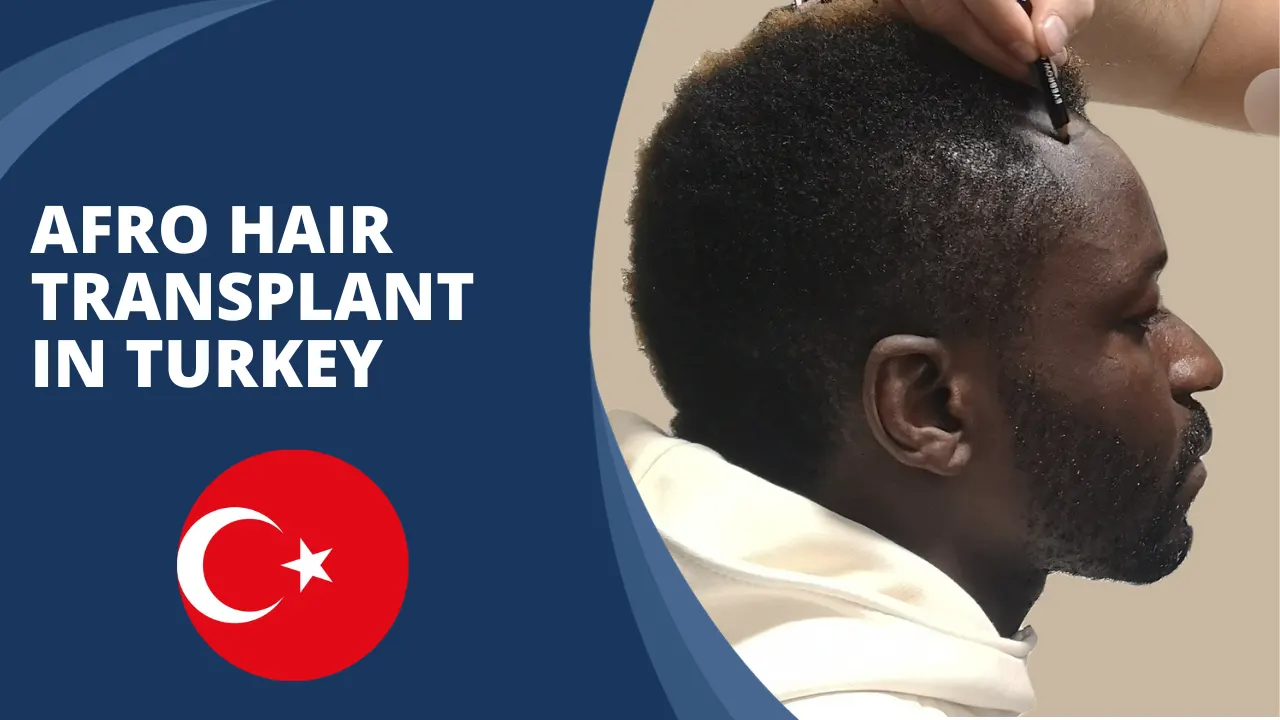
An Afro hair transplant in Turkey is the same FUE or DHI procedure as any other hair transplant, with one step that is harder: taking the grafts out. Afro-textured follicles curve under the skin, so they are easier to cut during extraction, and the medical reference StatPearls advises patients with this hair type to choose a surgeon experienced in managing it.
That makes “the best Afro hair transplant in Turkey” a question about one clinic and one team, not about a country or the name of a technique. This guide to hair transplants in Turkey for Afro-textured, Afro-Caribbean and tightly curled hair covers what is different, what the published evidence shows, the risks, the price, and the questions to ask before you book.
Quick Summary:
- What is different: the follicle is curved or C-shaped under the skin, which raises the risk of cutting it during extraction
- The evidence: thin. We found two small published studies, and no published transection or graft survival rate for any clinic in Turkey
- Diagnosis first: traction alopecia can be transplanted. Active scarring hair loss, such as CCCA, cannot
- Keloids: the risk is higher with darker skin. Tell the clinic if you have ever had a keloid scar
- Technique: no study shows FUE or DHI to be better for Afro-textured hair. The extraction step is the same in both
- At Carely Clinic: we treat patients with Afro-textured hair for the same €1,800 all-inclusive price, and Dr. Yeşim Güner designs the hairline and makes the incisions herself
A note on our own position: Carely Clinic is in Istanbul, so we are not neutral. For that reason every medical statement below names its source, and where we found no evidence we say so.
What Is Different About an Afro Hair Transplant?
The follicle. StatPearls describes Afro-textured hair as having naturally curved or C-shaped follicles that are more prone to damage during extraction and implantation, and says this raises the risk of follicle transection and can affect graft survival (StatPearls, Hair Transplantation).
Transection means the follicle is cut and the graft is lost. In FUE, each graft is removed with a small round punch. A punch is a straight tube, and a follicle that curves below the surface does not follow it. The hair you can see does not show which way the root bends, so the person extracting has to adjust as they go.
| Step | What changes with Afro-textured hair | Source |
|---|---|---|
| Diagnosis | Traction alopecia and scarring hair loss (CCCA) are more common and must be ruled in or out first | American Academy of Dermatology |
| Extraction | Curved follicles are easier to cut, which is why an experienced operator is advised | StatPearls |
| Hairline design | The typical hairline is lower and straighter, and the design should respect that | StatPearls |
| Implantation | Curved grafts are also more prone to damage when they are placed | StatPearls |
| Scarring | Higher risk of keloid scars in both the donor and the recipient area | StatPearls, NHS |
Everything else is the same operation: local anaesthesia, grafts taken from the back and sides of the head, and the same results timeline.
What Does the Published Evidence Show?
Less than clinic websites suggest. The two published studies we found on extraction in Afro-textured hair are both small. The first, published in 2016 in Plastic and Reconstructive Surgery Global Open, looked back at 18 patients of African descent. In 8 of them, standard rotary punches either failed or cut too many follicles, and a curved, non-rotary punch did better.
Two cautions apply to it. We read the medical news report of the study, not the paper itself, and that report notes that the author holds patents on the punch he tested (Healio, October 2016). The author also points out that people of African descent are not one group: how tightly the hair curls varies, and so does how hard the extraction is.
The second, published in 2023 by the same lead author and colleagues, tested a newer device, developed by him, in 152 patients, six of whom had Afro-textured hair (Clinical, Cosmetic and Investigational Dermatology, 2023). Six patients are too few to draw a rate from.
We found no published transection rate, graft survival rate or satisfaction rate for Afro hair transplants in Turkey, or for any named clinic. Some clinic and booking pages quote very high graft survival or success rates. None of those we read named a source. Clinics also commonly say that curl gives more coverage per graft, so fewer grafts are needed. We found no published measurement of that either, so do not accept a graft number on that basis alone. Our graft calculator guide explains how the number should be reached.
Is FUE or DHI Better for Afro Hair?
Neither has been shown to be better. We found no study that compares FUE and DHI in Afro-textured hair. The two differ in how the grafts are placed, not in how they are taken out, and extraction is where the difficulty lies.
In FUE, the doctor first makes the recipient incisions and the grafts are then placed with forceps. In DHI, each graft is loaded into an implanter pen that makes the site and places the graft in one movement. Sapphire blades change only the incision step of FUE. Our guides to FUE vs DHI and Sapphire FUE go through the differences.
So a technique name on a website tells you little about how a clinic will handle curly or coiled hair. Who extracts the grafts, and how often they work with hair like yours, tells you more.
Who Is a Good Candidate for an Afro Hair Transplant?
Someone whose hair loss has been diagnosed and is stable, and who has enough donor hair. The diagnosis comes first because two causes of hair loss that are more common in people of African descent, women in particular, need different handling.
Traction Alopecia
Traction alopecia is hair loss caused by styles that pull on the hair. The American Academy of Dermatology lists tight braids, cornrows, locs, tight buns and ponytails, and extensions or weaves, and says it can become permanent the longer it goes untreated (AAD, Hairstyles that pull). StatPearls lists traction alopecia among the appropriate indications for a hair transplant. The pulling has to stop first, or the new hair is exposed to the same damage.
CCCA and Other Scarring Hair Loss
Central centrifugal cicatricial alopecia (CCCA) is the most common scarring hair loss in women of African descent, according to the Academy (AAD, CCCA). It destroys follicles and can cause permanent hair loss, and early treatment gives the best chance of keeping hair. StatPearls states that a hair transplant is contraindicated in active scarring alopecia because the likelihood of failure is high.
If your hair loss has not been diagnosed, see a dermatologist before you approach any clinic. A transplant placed into active scarring hair loss is likely to fail, and the donor hair used for it does not grow back.
Pattern Hair Loss
The NHS says a hair transplant is suitable for people with permanent baldness of the type that runs in families, and is not usually suitable for hair loss that causes bald patches, such as alopecia areata (NHS, Hair transplant). That applies to every hair type.
What Are the Risks of an Afro Hair Transplant?
The same as for any hair transplant, plus two that matter more with Afro-textured hair: keloid scars and lost grafts.
Keloid Scars
StatPearls says that people with darker skin have a higher risk of keloid scarring in both the donor and the recipient area. The NHS says you are more likely to get a keloid if you are of south Asian, Chinese, African Caribbean or Black African origin, or if you have had one before, and that keloids cannot be prevented (NHS, Keloid scars).
We found no published figure for how often keloids form after a hair transplant. The NHS lists the chest, shoulders, chin, neck, lower legs and ears as the most common sites, and the scalp is not on that list. Even so, if you have ever had a keloid, tell the clinic before you book and ask a doctor whether surgery is sensible for you.
Lost Grafts
Every follicle cut during extraction is one fewer to transplant, and donor hair is limited. This is the practical reason experience matters: a team that cuts too many grafts in curly hair uses up donor hair that cannot be replaced.
The General Risks
The NHS describes a hair transplant as generally a safe procedure, but it is still surgery. The transplanted hair often falls out after a few weeks before it regrows (see shock loss), and FUE leaves many tiny scars in the donor area that are not usually very noticeable. The wider risks of travelling for surgery are covered in why people go to Turkey for hair transplants.
How Is the Hairline Designed for Afro-Textured Hair?
Lower and straighter than the standard template, as a rule. StatPearls says hairline design needs special attention in these patients to keep the typically lower, straighter hairline of Black hair.
A rule is only a starting point. The better guide is your own hairline before the loss, so send old photos with your enquiry, and ask to see the line drawn and to agree it before any incision is made. Our guide to hairline design has a checklist for that day.
How Much Does an Afro Hair Transplant Cost in Turkey?
There is no independent price data for Afro-textured hair specifically. For hair transplants in general, a survey of 87 Istanbul clinics published in April 2025 found an average of £1,464 for 1,500 grafts. Carely Clinic charges €1,800 all-inclusive, the same price as for any other hair type.
Some clinics quote a separate price for Afro-textured hair. The ranges published by booking platforms and clinics differ widely and come from their own data, so we do not repeat them here. Ask for a fixed, written price that states whether your hair type changes it.
Carely Clinic’s price is valid until December 2026, with no graft cap and no per-graft charge. It includes the procedure, pre-operative blood tests, a PRP session, 3 nights in a 5-star hotel, VIP airport transfers, medications, the first wash at the clinic, an aftercare kit and 12 months of follow-up. Flights are not included. See the hair transplant packages and the cost page.
Get a Written Plan and Fixed Price
Carely Clinic, Istanbul • €1,800 All-Inclusive until December 2026 • Same Price for Afro-Textured Hair • No Graft Cap
Send Your Photos on WhatsAppHow Do You Choose the Best Clinic for an Afro Hair Transplant in Turkey?
By its experience with your hair type and by who does each step, not by a ranking. There is no independent ranking of clinics for Afro hair transplants in Turkey. The “best clinic” lists we read while writing this guide were published by a hospital group that listed only its own hospitals, and by a booking platform that carries an advertiser disclosure.
The International Society of Hair Restoration Surgery tells patients to ask who will be involved in performing the surgery, what their training and experience are, and whether they are licensed (ISHRS, Before you choose a surgeon). For Afro-textured hair, we would put it as these eight questions:
- How often do you treat Afro-textured hair?
- Who extracts the grafts, and who makes the incisions?
- Can I see dated photos of your own patients with a curl pattern like mine?
- Has the cause of my hair loss been diagnosed, and by whom?
- I have had a keloid scar (if you have). Does that change your advice?
- Where will my hairline sit, and why there?
- How did you arrive at the number of grafts, and does my hair type change the price?
- Who answers my messages after I fly home, and for how long?
A clinic should answer all eight plainly and in writing. If the answer to the first is a slogan and the answer to the third is a stock photo, keep looking. If you are comparing countries, our guides to the UK vs Turkey, Turkey vs the US and Mexico vs Turkey set out the prices and the checks.
What Happens After an Afro Hair Transplant?
The recovery follows the same timeline as any hair transplant. The NHS says the transplanted hair often falls out after a few weeks, new hair usually starts to appear after about 4 months, and the full result takes 10 to 18 months.
Styling is where Afro-textured hair needs more thought. The American Academy of Dermatology says tight braids, cornrows, locs, weaves and extensions can cause hair loss by pulling, especially on relaxed hair. Those are the styles to be careful with on a transplanted area. We found no published guidance on exactly when braids, locs or relaxers can be restarted after a transplant, so ask your clinic for its instructions in writing.
At Carely Clinic the stay is four days and three nights: arrival, blood tests, assessment and hairline design on day 1, the procedure and a PRP session on day 2, the first wash at the clinic on day 3 and the flight home on day 4. Follow-up continues on WhatsApp for 12 months, with photo reviews at 1 week and at 1, 3, 6 and 12 months.
What Carely Clinic Offers
Carely Clinic treats patients with Afro-textured hair. Hair transplants are performed at the clinic in Istanbul under local anaesthesia. Dr. Yeşim Güner designs the hairline and makes the recipient-site incisions herself, and her team assists with extracting and placing the grafts. The techniques are FUE with sapphire blades, at no extra charge for the blades, and DHI with an implanter pen.
You send photos of your hair and donor area on WhatsApp, Dr. Güner reviews them, and our team replies within 24 hours with a written treatment plan that states the technique, the hairline plan and the fixed price. The price is €1,800 all-inclusive whatever your hair type. We also offer beard transplants, and you can see all our all-inclusive packages.
Frequently Asked Questions
Can Afro hair be transplanted?
Yes. Afro-textured hair is transplanted with the same FUE and DHI methods as other hair types. The difference is that the follicles are curved under the skin, which makes them easier to cut during extraction, so the medical reference StatPearls advises choosing a surgeon experienced with this hair type.
Why is an Afro hair transplant more difficult?
Because the follicle is curved or C-shaped below the skin. StatPearls says this makes it more prone to damage during extraction and implantation and raises the risk of transection, which means the follicle is cut and the graft is lost. That is why the experience of the person extracting matters.
Which is the best clinic in Turkey for an Afro hair transplant?
There is no independent ranking. The lists we read were published by a hospital group listing its own hospitals and by a booking platform. Judge a clinic by how often it treats Afro-textured hair, who extracts the grafts, and whether it can show dated photos of patients with hair like yours.
Is FUE or DHI better for Afro hair?
Neither has been shown to be better. We found no study comparing the two in Afro-textured hair. They differ in how grafts are placed, not in how they are extracted, and extraction is the difficult step. Carely Clinic offers both.
How much does an Afro hair transplant cost in Turkey?
There is no independent price data for Afro-textured hair specifically. A survey of 87 Istanbul clinics published in April 2025 found an average of £1,464 for a 1,500-graft hair transplant. Carely Clinic charges €1,800 all-inclusive until December 2026, the same price for every hair type.
Can I have a hair transplant if I get keloids?
Tell the clinic and ask a doctor before you book. StatPearls says darker skin carries a higher risk of keloid scarring in the donor and recipient areas, and the NHS says a previous keloid makes another more likely. We found no published figure for how often keloids form after a hair transplant.
Can traction alopecia be treated with a hair transplant?
It can. StatPearls lists traction alopecia among the appropriate indications for a hair transplant, and the American Academy of Dermatology says a hair restoration procedure may be recommended in serious cases. The tight styling that caused the loss has to stop first.
Can women with Afro-textured hair have a hair transplant?
It depends on the cause of the hair loss. Traction alopecia can be suitable once the pulling has stopped. CCCA, the most common scarring hair loss in women of African descent, is not suitable while it is active. See a dermatologist for a diagnosis first.
How long does it take to see results?
The NHS timeline applies to every hair type: the transplanted hair often falls out after a few weeks, new hair usually starts to appear after about 4 months, and the full result takes 10 to 18 months.
Who performs the procedure at Carely Clinic?
Dr. Yeşim Güner designs the hairline and makes the recipient-site incisions herself, and her team assists with extracting and placing the grafts. The procedure is done at the clinic in Istanbul under local anaesthesia.
Conclusion
An Afro hair transplant is a standard operation with a harder extraction step, a hairline that should not be copied from a template, and a higher risk of keloid scars. The published evidence is thin, so percentages on clinic websites deserve less weight than plain answers about who does the work.
Get the cause of your hair loss diagnosed first. Then choose the clinic by its experience with hair like yours, and get the plan, the graft number and the price in writing.
If you would like our answers for your own case, send photos of your hair and donor area on WhatsApp. Dr. Güner reviews them and our team replies within 24 hours with a written treatment plan and the fixed price.
How this guide was written: Carely Clinic is in Istanbul, so we relied on sources outside the clinic: StatPearls, the NHS, the American Academy of Dermatology and the ISHRS, all linked in the text and read in November 2026. The 2016 study is described from a Healio news report because we could not open the paper itself, and the 2023 study from the publisher’s page. The price survey is by Wimpole Clinic, a UK clinic, published in April 2025, which we name but do not link. We left out every figure we could not trace to a source.
This guide provides general information and is not medical advice. Whether a hair transplant is suitable for you depends on a diagnosis and an individual assessment.
Written by Carely Clinic Medical Team · Last updated: November 2026