
Quick Summary
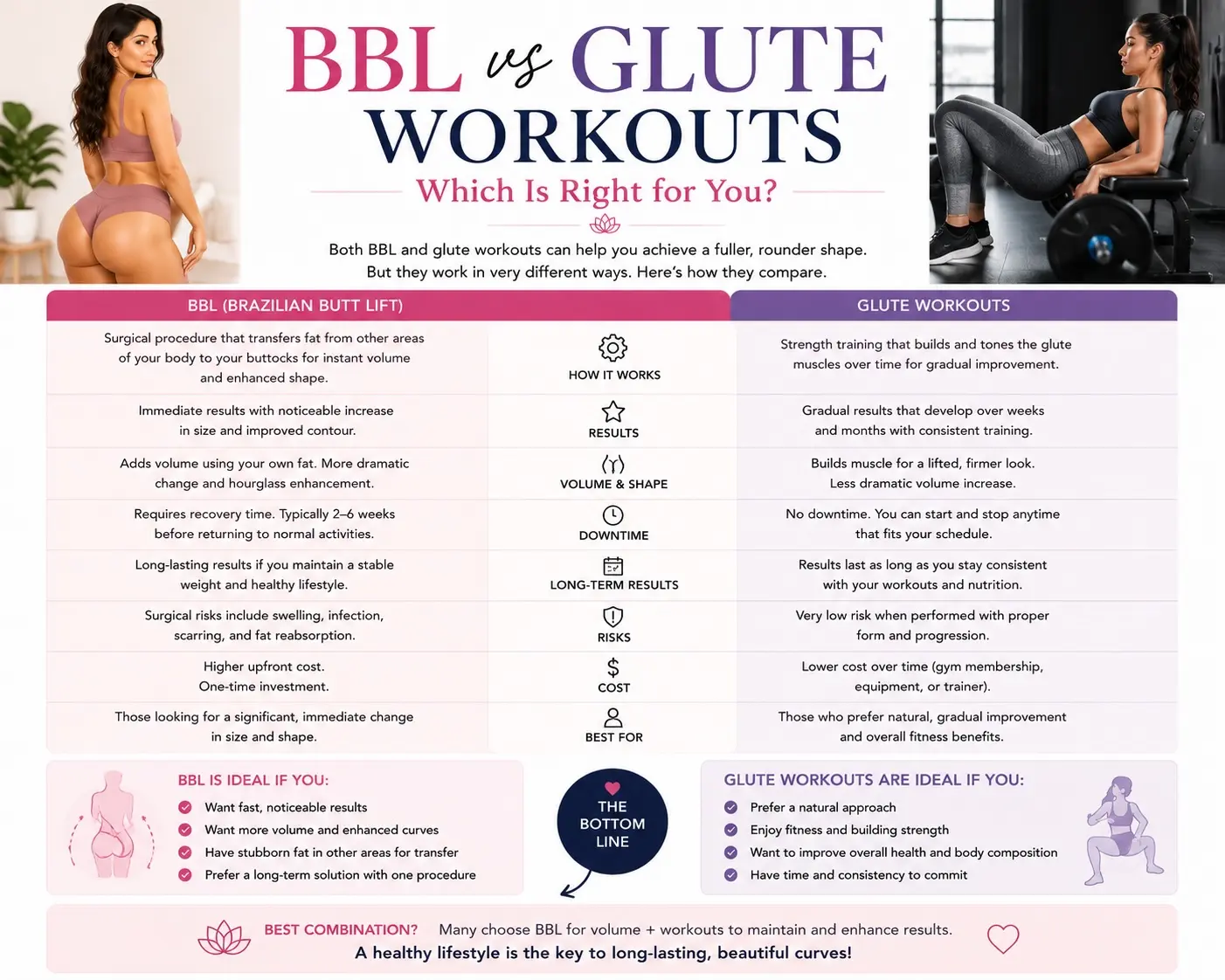
A Brazilian Butt Lift delivers immediate, sculpted results using your own fat, while glute workouts build muscle over 6-12 months within genetic limits. BBL surgery in the UK costs £8,000-£14,000; in Turkey, all-inclusive packages run £3,200-£4,800 (approximately $4,000-$6,000 / €3,700-€5,600).
Neither option is universally better — the right choice depends on timeline, budget, health status, and realistic expectations. This guide compares both options across every key factor.
What Is a BBL and How Does It Differ from Glute Training?
A BBL transfers your own harvested fat into the buttocks to add volume and reshape contour immediately after a 3-4 hour procedure. Glute workouts build the gluteus maximus, medius, and minimus over 6-12 months, improving firmness within genetic limits. Published ASERF research places BBL mortality at approximately 1 in 14,952 when performed using subcutaneous-only technique.
The key distinction is what each method actually changes. A BBL adds fat volume and can reshape the entire silhouette — including hip dips and waist contour — in a single procedure. Exercise cannot alter bone structure or fat distribution patterns. Subcutaneous fat placement, established by the Multi-Society Gluteal Fat Grafting Task Force, is the current safety standard. Ultrasound guidance is increasingly used at high-volume centres to confirm injection depth in real time.
For UK and US patients seeking significant, predictable reshaping, Turkey provides accredited BBL surgery at 60-75% lower cost than domestic pricing.
Why Trust This Guide
This guide draws on published ASPS procedural statistics, ISAPS global survey data, ASERF safety research, and BAAPS guidance on gluteal fat grafting.
This content is educational, not a substitute for a personalised surgical or fitness consultation.
BBL vs Glute Workouts: Head-to-Head Comparison
At a glance, BBL and glute training target the same goal through entirely different mechanisms. The table below compares both approaches across the factors patients ask about most.
| Factor | BBL Surgery | Glute Workouts |
|---|---|---|
| Results timeline | Immediate volume; final contour at 3-6 months | 6-12 months of consistent training for visible change |
| Type of change | Volume, projection, hip-dip correction, waist contouring | Muscle firmness and moderate shape improvement only |
| Genetic ceiling | Bypasses genetic limits entirely | Limited by bone structure, fat distribution, and hormones |
| Cost (all-inclusive) | UK: £8,000-£14,000 / US: $10,000-$15,000 / Turkey: £3,200-£4,800 (€3,700-€5,600 / $4,000-$6,000) | Gym membership + equipment: £20-£80 / $25-$100 per month |
| Risks | Surgical: infection, fat embolism, asymmetry, anaesthesia | Minor: knee strain, lower back strain with poor form |
| Permanence | Permanent fat cells; affected by weight changes | Muscle atrophies within months if training stops |
| Hip dip correction | Yes — targeted fat injection corrects hip dips directly | No — hip dips are structural and cannot be exercised away |
| Health benefits | Body contouring only; no metabolic benefit | Bone density, cardiovascular, metabolic, and mental health benefits |
| Can they be combined? | Yes — glute training from week 6 post-BBL enhances and prolongs surgical results | |
How Glute Training Works — and Where It Has Limits
Resistance training builds the gluteal muscles progressively, but it cannot change what exercise doesn’t control.The three gluteal muscles respond to progressive overload — increasing load over time — which stimulates hypertrophy and improves shape and firmness.
The Three Gluteal Muscles
The gluteus maximus drives hip extension and lower-body power; the gluteus medius stabilises the pelvis and determines outer hip shape; the gluteus minimus deepens the outer contour. All three must be trained for full aesthetic development.
Squats, hip thrusts, Romanian deadlifts, and cable kickbacks are the four compound and isolation movements that collectively address all three gluteal muscles. Strength and conditioning research consistently recommends 3-5 sets per movement, 3 times per week, for evidence-based hypertrophy.
Where Glute Training Has Limits
Genetics set the ceiling. Bone structure, fat distribution, and the ratio of fast-twitch to slow-twitch muscle fibres are genetically determined. Hip dips occur because of the distance between the iliac crest and the femur — a skeletal trait no exercise can alter. For patients whose goals exceed what their genetics allow, glute training alone will not close the gap.
It also takes time. Published strength and conditioning research consistently shows meaningful glute hypertrophy requires 6-12 months of consistent, progressive training. Even after that period, muscle will atrophy within months if training stops.
What a BBL Actually Changes (and What It Cannot)
A BBL is a body contouring procedure, not a weight loss operation. It harvests fat via liposuction from the abdomen, flanks, waist, or thighs, purifies it, and injects it into the subcutaneous layer of the buttocks at multiple depths to add volume and reshape contour.
How BBL Fat Transfer Works
Surgeons transfer 300-800 millilitres of purified fat per cheek, depending on donor fat availability and aesthetic goals. Following established safety standards, all injections are placed in the subcutaneous plane — above the muscle fascia. Ultrasound guidance is used by experienced surgeons to confirm injection depth and reduce fat embolism risk. Approximately 60-70% of transferred fat survives permanently.
Results Timeline: BBL vs Exercise
| Milestone | BBL | Glute Workouts |
|---|---|---|
| Day 1 | Immediate volume increase visible | No visible change |
| Weeks 2-6 | Swelling reduces; fluffing phase begins | Neuromuscular adaptation; minimal visual change |
| Month 3 | Fat reabsorption mostly complete; shape settles | Early hypertrophy visible in leaner patients |
| Month 6 | Final contour fully visible | Meaningful shape change visible with consistency |
| Month 12+ | Stable; maintains with weight stability | Full development achieved with progressive training |
What a BBL cannot do is equally important to understand. Surgery does not reduce body weight. It cannot address loose, sagging skin — patients with significant skin laxity may need a gluteal lift instead of a BBL. And weight fluctuations after surgery will cause the transferred fat to grow or shrink proportionally, which is why stable weight before and after surgery is a prerequisite for optimal results.
Expert Insight
“The most common misconception I encounter in consultations is that a BBL and glute training are competing choices. In practice, patients who combine their procedure with a disciplined resistance training programme at six weeks post-operatively consistently report superior shape, firmness, and longevity of results compared to those who rely on surgery alone.”
— Reflecting current clinical practice on combining surgical and exercise-based body contouring
5 Factors That Determine Which Option Is Right for You
The decision between BBL surgery and glute training is not about which is objectively better — it is about which solves your specific problem. Five factors reliably predict which path delivers the outcome you want.
Factor 1 — How Much Change Do You Need?
If your goal is firmer, more toned buttocks with moderate improvement, glute training is sufficient. If you need significant volume, hip-dip correction, or a full hourglass silhouette, exercise alone cannot deliver that outcome.
Factor 2 — Your Timeline
Glute workouts require 6-12 months of consistent progressive training to produce visible results. A BBL delivers immediate volume with a final result visible at 3-6 months. If you have a defined timeline — a wedding, a milestone birthday, or a travel window — surgery produces results on a predictable schedule that training cannot match.
Factor 3 — Budget
Cost is a practical filter, not a quality judgment. BBL surgery in the UK costs £8,000-£14,000 for surgery only. In Turkey, all-inclusive packages cover surgery, hospital stay, hotel, transfers, and aftercare at £3,200-£4,800 (approximately $4,000-$6,000 / €3,700-€5,600). Glute training costs £20-£80 per month in ongoing gym membership. Explore Carely Clinic’s BBL pricing guide for a full cost breakdown.
Factor 4 — Health Status and Eligibility
Surgery requires a BMI of 18.5-32, non-smoker status for at least 4-6 weeks prior, and no uncontrolled cardiovascular disease, diabetes, or active infection. Glute training has no formal eligibility threshold, though beginners should seek guidance from a certified personal trainer to avoid injury.
Factor 5 — Long-Term Maintenance Commitment
Both options require ongoing effort to maintain results. BBL results are permanent at the cellular level, but weight gain affects the transferred fat. Muscle built through exercise atrophies within months of stopping training. Patients who commit to regular glute training after a BBL typically enjoy the best of both outcomes — structural volume from surgery and improved firmness from consistent resistance work.
Clinical observation across body contouring practice indicates that patients who achieve stable weight 3-6 months before surgery and begin structured resistance training 6-8 weeks post-operatively show the highest rates of long-term result satisfaction.
Warning Signs to Watch For After BBL Surgery
Any significant change in your recovery after BBL surgery warrants prompt contact with your surgical team. Most complications are manageable when identified early — delayed reporting is the primary preventable risk factor.
The following warning signs require urgent attention within the first 6 weeks post-operatively, per standard post-operative protocols.
| Warning Sign | What It May Indicate | Action Required |
|---|---|---|
| Fever above 38.5°C / 101.3°F | Surgical site infection or systemic infection | Contact your surgeon immediately; do not wait |
| Wound separation or opening | Incision dehiscence; infection risk | Cover with clean dressing; contact surgical team within 2 hours |
| Fluid-filled swelling (seroma) | Seroma or haematoma formation | Same-day contact with surgeon; may require drainage |
| Redness, heat, or discharge at incision | Local infection | Urgent surgical review; antibiotic treatment likely required |
| Calf pain, swelling, or redness | Deep vein thrombosis (DVT) | Emergency presentation; do not massage the calf |
| Sudden chest pain or breathlessness | Pulmonary embolism (PE) — life-threatening | Call emergency services (999 in UK; 911 in US) immediately |
| Sudden increase in pain beyond day 3 | Fat necrosis or developing infection | Same-day contact with surgical team |
Frequently Asked Questions
Can you get a BBL-like result from squats and glute training?
Squats and glute exercises cannot replicate the volume, symmetry, or hip-dip correction that a BBL provides. Exercise builds the gluteus maximus, medius, and minimus but cannot alter underlying bone structure or fat distribution. Even with optimal strength and conditioning practice, even elite-level glute training produces results within genetic limits only.
What happens to your BBL if you work out after surgery?
Properly timed exercise after a BBL can enhance and maintain your results by building underlying muscle support. Surgeons advise avoiding direct glute pressure and high-impact cardio for the first 6 weeks post-operatively. After 6 weeks, targeted glute training such as hip thrusts and squats is typically safe and beneficial.
How long after a BBL can you start working out?
Light walking is safe within the first 2 weeks post-BBL to support circulation and reduce clot risk. Low-impact resistance training is generally cleared at 6 weeks, per standard plastic surgery post-operative guidelines. High-intensity training and heavy lower-body lifting should wait a full 12 weeks to protect fat graft survival.
Will squats ruin my BBL results?
Squats performed after your surgeon’s 6-week post-operative clearance do not damage a healed BBL. Squats build gluteal muscle mass, which actually supports and enhances the transferred fat over time. Clinical evidence consistently shows physical activity improves long-term BBL outcomes once fat grafts have stabilised.
What exercises are best for maintaining BBL results?
Hip thrusts, glute bridges, squats, and Romanian deadlifts are the four most effective movements for BBL maintenance. These exercises target all three gluteal muscles without excessive caloric burn that could reduce fat graft volume. Aim for 2-3 resistance sessions per week, to preserve shape.
Is a BBL better than exercise for a bigger bum?
A BBL produces larger, more predictable volumetric results than exercise alone, particularly for significant reshaping goals. Exercise improves firmness and moderate size within genetic parameters; surgery restructures shape regardless of genetics.
How long do BBL results last compared to exercise results?
Fat cells that survive the initial 3-6 months post-BBL are considered permanent, though weight changes affect size.Exercise-built muscle is also permanent with continued training but will atrophy within months if training stops entirely. On balance, BBL results have a structural advantage, but exercise-maintained muscle provides superior long-term body composition benefits.
What are the risks of a BBL that exercise doesn’t carry?
BBL carries surgical risks including fat embolism, infection, asymmetry, seroma formation, and anaesthesia-related complications. The current mortality rate is approximately 1 in 15,000 when subcutaneous technique is used.
Who is a good candidate for BBL surgery?
Ideal candidates are non-smokers aged 18 or older with a BMI of 18.5-32 and sufficient donor fat. Candidates must be in stable overall health, free of active infection, uncontrolled diabetes, or cardiovascular disease. A BMI below 18.5 disqualifies candidates due to insufficient harvestable fat for a meaningful transfer.
Can you combine a BBL with a glute training programme?
BBL surgery combined with structured glute training produces superior, longer-lasting results than either approach alone. Surgeons recommend beginning glute-specific resistance training 6-8 weeks post-operatively, once fat grafts have stabilised. Building underlying gluteal muscle supports the transferred fat layer and reduces long-term volume loss from fat reabsorption.
How much fat is transferred in a BBL?
Surgeons typically transfer 300-800 millilitres of purified fat per cheek, depending on anatomy and aesthetic goals.Approximately 60-70% of transferred fat survives permanently; the remaining 30-40% is reabsorbed within 6 months. Surgeons account for this reabsorption rate when planning transfer volume to achieve the desired final result.
What is the “fluffing phase” after a BBL?
The fluffing phase occurs 6-8 weeks post-operatively, when skin stretches to accommodate newly settled fat grafts.During this phase, initial post-surgical firmness softens and the final contour becomes progressively more visible and natural. Most patients see their complete final result at 6-12 months, once swelling resolves and fat fully integrates.
Conclusion
BBL and glute workouts address different biological problems. Surgery reshapes fat and contour in one procedure; exercise builds muscle over months. The best long-term results almost always combine both approaches intelligently.
For patients whose goals are primarily functional — firmer, more toned buttocks with moderate shape improvement — a structured glute training programme using hip thrusts, squats, glute bridges, and Romanian deadlifts is the appropriate and cost-effective first step. Results will come within 6-12 months of consistent effort.
For patients who need significant volumetric change, hip-dip correction, or a full silhouette reshaping — and whose timeline, budget, and health profile support surgery — a BBL performed by an ISAPS-certified surgeon at a JCI-accredited facility provides a level of structural change that no training programme can replicate.
The strongest outcomes in clinical practice consistently come from the combination: surgery to establish the structural foundation, followed by committed glute training from week 6 onwards to build muscle beneath and around the transferred fat. Current clinical practice consistently supports a holistic post-operative fitness approach as the standard of care for long-term BBL maintenance.
If you are considering a BBL and want to understand whether you are a suitable candidate, request a consultation at Carely Clinic for a personalised assessment.
Individual outcomes vary. This guide provides general medical education based on international guidelines and published research. Consult qualified medical professionals for personalised advice.
Medical Review: Op. Dr. Alirza Jahangirov