
Quick Summary
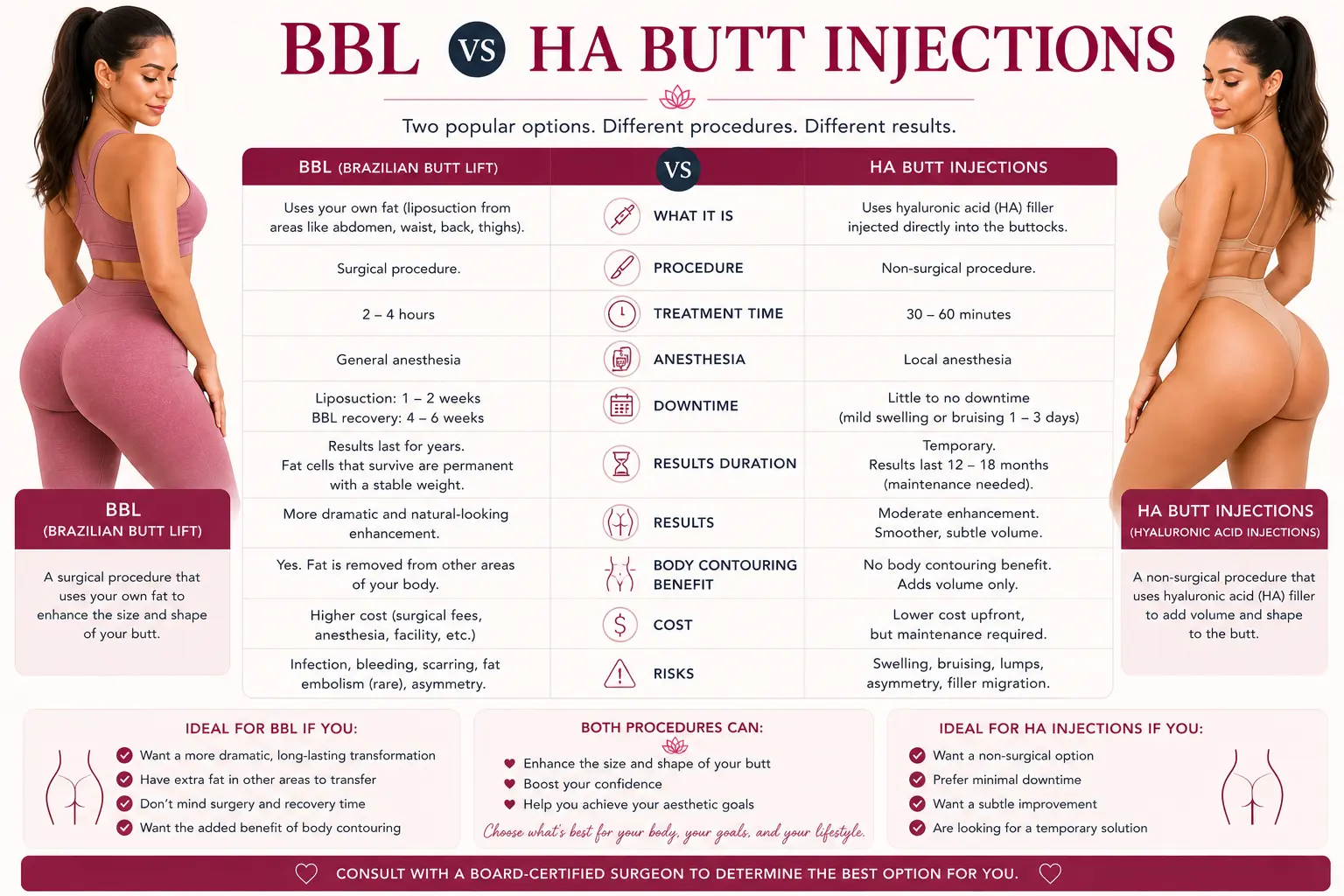
A BBL (Brazilian Butt Lift) uses your own fat, transferred surgically, for long-lasting results. HA butt injections use hyaluronic acid filler for immediate, non-surgical volume lasting 6-18 months. BBL costs £3,000-£8,000 in Turkey (£6,000-£10,000 UK); HA injections cost £800-£2,500 per session but require repeat treatments. This guide explains both in full.
What Is the Difference Between BBL and HA Butt Injections?
BBL and HA butt injections are the two most popular buttock enhancement options in 2026, differing fundamentally on invasiveness, longevity, cost, and who qualifies — here is exactly how to compare them.
BBL (Brazilian Butt Lift) and HA butt injections are the two most popular buttock enhancement options in 2026, but they differ on every key factor: invasiveness, longevity, cost, and candidacy. BBL surgically transfers your own fat to produce permanent volume; HA filler injections add temporary volume using hyaluronic acid, lasting 6-18 months per session. BBL is one of the most performed cosmetic surgical procedures globally, with hundreds of thousands of procedures performed annually.
For UK and US patients comparing costs, BBL ranges from £6,000-£10,000 ($8,000-$15,000 / €7,500-€13,000) domestically, wwhile Turkey offers the same procedure for £2,700-£4,100 ($3,200-$5,500 / €3,000-€5,000) at JCI-accredited hospitals. HA filler sessions cost £800-£2,500 ($1,000-$3,000 / €900-€2,800) but must be repeated every 12-18 months, making BBL more cost-effective long-term.
The right choice depends on your fat availability, budget, downtime tolerance, and whether you want permanent or reversible results.
Why Trust This Guide
This comparison draws on guidance from the American Society of Plastic Surgeons (ASPS), International Society of Aesthetic Plastic Surgery (ISAPS), British Association of Aesthetic Plastic Surgeons (BAAPS), and peer-reviewed safety research published in the Aesthetic Surgery Journal. It has been medically reviewed by Op. Dr. Alirza Jahangirov, Plastic, Reconstructive & Aesthetic Surgeon at Carely Clinic in Istanbul.
How Each Procedure Works: Step-by-Step
Understanding the mechanics of both procedures helps patients choose correctly — BBL involves two surgical stages while HA injections are a single outpatient appointment with immediate visible results.
The BBL Procedure
Two surgical stages define BBL. First, liposuction harvests fat from donor areas such as the abdomen, flanks, or thighs. The extracted fat is then purified and reinjected into the buttocks at precise depths within the subcutaneous layer.
Safety has improved significantly. Published research on BBL safety following the multi-society safety reforms has shown dramatic improvement, with subcutaneous-only fat placement now established as the standard at accredited facilities. This subcutaneous-only technique is now the established standard at accredited facilities.
The full procedure takes 2-4 hours under general anaesthesia. Patients wear a compression garment for 6-8 weeks and must avoid sitting directly on the buttocks for 2-4 weeks to maximise fat cell survival. Learn more about the BBL procedure at Carely Clinic.
The HA Injection Procedure
Entirely non-surgical. A practitioner marks the target areas, applies topical or local anaesthetic, and injects a dense hyaluronic acid body filler using a cannula or needle. Sessions take 30-60 minutes. Patients can return to most normal activities within 1-2 days.
Volume is more limited than BBL. HA fillers add modest, targeted volume — typically 200-600ml total — compared to the 500-1,500ml achievable with fat transfer. This makes HA injections ideal for hip dip correction, subtle projection, or shape refinement rather than dramatic augmentation.
5 Key Factors That Determine Which Procedure Is Right for You
Five clinical factors reliably determine whether BBL or HA injections is the appropriate procedure for any given patient — body composition, target volume, lifestyle, lifetime budget, and reversibility preference.
Factor 1: Body Fat Availability
BBL requires donor fat. Surgeons need sufficient fat to harvest from the abdomen, hips, or thighs. Patients with very low body fat or a BMI below 20 are typically not suitable for fat transfer. HA injections have no such requirement and are the default option for lean patients.
Factor 2: Desired Volume and Shape
Dramatic augmentation favours BBL. Fat transfer can add 500-1,500ml of volume and reshape the entire gluteal region. HA fillers are better suited to subtle enhancement, targeted projection, or hip dip correction. For patients wanting a significantly rounder or larger result, BBL provides outcomes HA cannot match.
Factor 3: Recovery Time and Lifestyle
Sitting restrictions make BBL a commitment. Patients typically avoid direct sitting for 2-4 weeks and return to desk work at 3-6 weeks. HA injections require 1-2 days of avoiding pressure on the area. For patients who cannot take extended time away from work, HA injections are the practical choice.
Factor 4: Budget Over Time
HA injections cost less upfront but more over time. A single HA session costs £800-£2,500 and must be repeated every 12-18 months. Over five years, a patient may spend £4,000-£12,500 on maintenance. A BBL in Turkey at £2,700-£4,100 often becomes the more economical option when viewed over the same horizon. Explore body contouring options at Carely Clinic.
Factor 5: Reversibility
HA injections are reversible; BBL is not. Hyaluronidase enzyme can dissolve HA filler rapidly if the patient is unhappy with results or experiences a complication. Transferred fat cannot be selectively removed. For patients trialling augmentation before committing surgically, HA injections provide a lower-risk starting point.
Cost Comparison: BBL vs HA Butt Injections by Country (2026)
BBL costs 60-70% less in Turkey versus the UK or US at JCI-accredited hospitals — the most significant cost differential in elective plastic surgery for international patients in 2026.
| Location | BBL (All-In) | HA Injections (Per Session) | Notes |
|---|---|---|---|
| Turkey (Istanbul) | £2,700-£4,100 / $3,200-$5,500 / €3,000-€5,000 | £400-£900 / $500-$1,100 / €450-€1,000 | JCI-accredited package includes hospital stay, transfers, garments |
| United Kingdom | £6,000-£10,000 / $7,500-$13,000 / €7,000-€12,000 | £800-£2,500 / $1,000-$3,000 / €900-€2,800 | BAAPS-registered surgeons; CQC-registered facilities |
| United States | £8,000-£15,000 / $10,000-$20,000 / €9,500-€18,000 | £800-£2,400 / $1,000-$3,000 / €900-€2,700 | ASPS board-certified surgeons; accredited surgical centres |
| Germany / EU | £6,000-£10,000 / $7,500-$12,500 / €7,000-€11,000 | £750-£2,200 / $900-$2,700 / €850-€2,500 | CE-marked fillers; EBOPRAS-certified surgeons |
Sources: 2025 published package pricing (Bookimed, Hayatmed), 2025 UK private clinic surveys, 2025 ASPS cost data. All currency conversions based on May 2026 exchange rates.
Results: Longevity, Volume, and Natural Appearance
BBL produces the most natural, long-lasting results because it uses your body’s own tissue; HA injections offer immediate but temporary enhancement that requires maintenance to sustain over time.
How Long Do Results Last?
BBL results are long-lasting once fat stabilises. Approximately 60-80% of transferred fat cells survive permanently; the remainder is absorbed within 3-6 months. Once the final volume is established, it behaves like any natural fat in the body, changing proportionally with weight fluctuations.
HA results are temporary by design. HYAcorp body filler lasts approximately 12 months; Lanluma (poly-L-lactic acid) can last up to 24 months via collagen stimulation. All HA products are eventually metabolised, requiring repeat sessions to maintain volume.
How Natural Do Results Look and Feel?
Fat feels indistinguishable from native tissue. Because BBL uses the patient’s own cells, the result integrates completely, moves naturally, and has no foreign-body sensation. This is a primary reason fat transfer now accounts for the substantial majority of all buttock augmentation procedures performed internationally.
HA body fillers are designed for natural feel. High-density body fillers such as HYAcorp MLF2 and Juvederm Voluma are formulated to mimic the feel of soft tissue. However, placing large volumes of filler in a single session can occasionally result in visible firmness or unevenness, which is why experienced injectors use conservative, staged approaches.
Expert Insight
“The subcutaneous fat layer of the buttock behaves very differently to facial tissue. Using a dense, cross-linked HA filler designed specifically for body use — not a repurposed facial filler — is the single most important factor in achieving a natural feel with injectable augmentation.”
— Reflecting current clinical practice in body filler technique
Safety Profiles: What the Data Says
Both procedures carry distinct risk profiles; modern BBL technique at accredited facilities has reduced mortality to near zero, while HA filler safety depends almost entirely on product choice and practitioner training.
BBL Safety Data
Technique determines risk. Following the Multi-Society Task Force safety reforms, published mortality data shows dramatic improvement when subcutaneous-only injection is used. ASERF research places current mortality at approximately 1 in 14,952 procedures. Earlier estimates of 1 in 3,000 mortality were associated with intramuscular injection, a technique now widely abandoned.
Standard surgical guidance recommends that patients select surgeons who use ultrasound-guided cannulation, inject exclusively above the gluteal muscle, and operate in accredited hospital facilities. These three measures collectively reduce pulmonary fat embolism risk to near-negligible levels.
HA Injection Safety Data
Legal body fillers are safe; unregulated substances are not. FDA-approved and CE-marked HA body fillers such as HYAcorp and Juvederm Voluma carry a low complication profile when used by trained practitioners. The primary risks are lumps, asymmetry, and rare vascular occlusion.
The critical safety distinction is provider qualification. Established clinical consensus in aesthetic medicine emphasises that body filler injection requires specific anatomical training, not simply facial filler experience. Practitioners should be trained in both the product and the anatomical region.
Patients requesting buttock enhancement should prioritise facility accreditation and surgeon technique over cost alone. The gap in safety outcomes between accredited and non-accredited providers is far greater than the gap between the two procedures themselves.
Warning Signs to Watch For
Patients who experience any of the following after BBL surgery or HA filler treatment should seek immediate medical review — early intervention prevents the vast majority of serious complications.
Most post-procedure discomfort after either treatment is expected and self-resolving. The warning signs below indicate complications requiring prompt medical attention, not normal recovery.
| Warning Sign | What It May Indicate | Action Required |
|---|---|---|
| Fever above 38.5°C (101.3°F) | Wound infection or systemic infection post-BBL | Contact your surgeon immediately; do not wait |
| Sudden shortness of breath or chest pain | Fat embolism (BBL) or vascular event | Call emergency services (999 UK / 112 EU / 911 US) immediately |
| Wound separation or opening at incision site | Dehiscence — requires prompt re-closure | Contact your surgeon within 24 hours |
| Calf pain, swelling, or redness (one leg) | Deep vein thrombosis (DVT) — common risk after surgery | Seek urgent medical evaluation; do not massage |
| Hard lumps or nodules (post HA filler) | Filler migration, granuloma, or product clumping | Contact your injecting practitioner; hyaluronidase may be needed |
| Sudden increase in pain after initial improvement | Developing infection, seroma, or haematoma | Contact your surgeon or clinic the same day |
| Skin discolouration or blanching (post filler) | Vascular occlusion — rare but requires urgent dissolution | Treat as emergency; contact practitioner and attend A&E if uncontactable |
Who Is NOT a Good Candidate?
Several absolute and relative contraindications apply to both procedures; understanding these before consultation ensures patients and surgeons can agree on the safest, most effective treatment plan for each individual.
Absolute Contraindications
Some patients cannot safely undergo either procedure.
The following conditions preclude BBL surgery and, in several cases, HA injection as well:
- Active infection anywhere in the body: Surgery or injection during active infection carries a high risk of haematogenous spread and must be deferred until fully resolved.
- Uncontrolled cardiovascular disease: General anaesthesia for BBL is contraindicated without cardiology clearance; heart failure or unstable arrhythmia disqualifies patients from surgery.
- Blood clotting disorders (uncontrolled): Both procedures carry haemorrhage risk, which is unacceptable in patients with unmanaged coagulopathy.
- Active cancer or recent chemotherapy: Immune compromise and vascular fragility make both surgical and injectable procedures inappropriate until oncology clearance is obtained.
- Pregnancy or breastfeeding: No elective cosmetic procedure, surgical or injectable, is appropriate during pregnancy or active breastfeeding.
Relative Contraindications
These cases may allow the procedure after medical optimisation.
- BMI below 18.5 or above 40 (BBL): Very low BMI limits available donor fat; very high BMI increases anaesthesia and wound-healing risk. Both groups may be treated after reaching a stable, healthier weight range.
- Active smoking (BBL): Smoking reduces fat cell survival rates and increases wound complication risk. Most surgeons require 6-8 weeks of smoking cessation pre-operatively.
- Keloid or hypertrophic scarring history: BBL liposuction incisions carry scarring risk for predisposed patients. HA injections are a lower-risk alternative in most cases.
- Diabetes (uncontrolled): Elevated HbA1c above 8% is associated with impaired wound healing and increased infection risk in surgical patients. Optimising diabetic control to HbA1c below 7.5% is typically required before surgery.
- NSAID or anticoagulant use: Aspirin, ibuprofen, and blood thinners increase bruising and bleeding risk for both procedures. Surgeons typically require a 7-14 day washout period, as per standard pre-operative protocols.
Managing Expectations
Results vary by individual anatomy and fat survival rate.
BBL patients should expect 20-40% initial volume reduction as non-surviving fat cells are absorbed in the first 3-6 months. Sitting restrictions exist to protect newly transferred fat; ignoring them correlates with lower graft survival. HA injection results may look slightly uneven in the first 2-4 weeks before the filler settles fully. Both procedures reward patient compliance with post-operative instructions.
HA Filler Brand Comparison: HYAcorp, Juvederm Voluma, Radiesse, and Lanluma
Not all injectable products are equivalent — four distinct formulations dominate the European and UK market for buttock enhancement, each with different mechanisms, longevity, and ideal use cases.
Choosing the correct product for buttock injection matters as much as provider selection. The four most used options in UK and EU clinical practice are compared below.
| Product | Type | Mechanism | Longevity | Reversible? | Best For |
|---|---|---|---|---|---|
| HYAcorp MLF2 | HA filler (body-grade) | Immediate volume via hydration | 10-14 months | Yes (hyaluronidase) | Full gluteal volume, hip dips |
| Juvederm Voluma XC | HA filler (Vycross technology) | Immediate volume, structural lift | 12-18 months | Yes (hyaluronidase) | Subtle lift and projection |
| Lanluma (PLLA) | Poly-L-lactic acid biostimulator | Gradual collagen stimulation | 18-24 months | No | Gradual results, skin quality improvement |
| Radiesse (+) | Calcium hydroxylapatite | Immediate volume + collagen scaffold | 12-18 months | No | Volume + skin tightening in one session |
Key note: HYAcorp MLF2 is specifically designed for large-body-area injection and uses a higher molecular weight cross-linking than facial fillers. Juvederm Voluma, while occasionally used off-label for body areas, is primarily a facial filler adapted for body use. Lanluma and Radiesse are biostimulators rather than true HA fillers and are not reversible with hyaluronidase. Read the Carely Clinic complete guide to body contouring for a deeper overview of filler selection.
Frequently Asked Questions
What is the difference between BBL and HA butt injections?
BBL transfers your own fat surgically; HA injections add temporary hyaluronic acid filler without surgery. Clinical data shows that, BBL produces permanent volume while HA results last only 6-18 months. BBL requires general anaesthesia and 4-6 weeks recovery; HA injections need 1-2 days downtime.
Which lasts longer — BBL or hyaluronic acid butt injections?
BBL results are long-lasting; transferred fat integrates permanently once the initial 30% absorption stabilises. HA filler is metabolised by the body, typically lasting 6-18 months before repeat sessions are needed. Over 3-5 years, BBL is therefore more cost-effective despite higher upfront cost.
How much do HA butt injections cost compared to a BBL?
HA butt injections cost £800-£2,500 ($1,000-$3,000) per session, with 2-4 sessions typically needed. A BBL in the UK costs £6,000-£10,000; in Turkey, JCI-accredited packages range from £2,700-£4,100. Current pricing data shows, Turkey offers 60-70% savings versus UK prices for the same surgical standard.
Are HA butt injections safe?
HA fillers such as HYAcorp are safe when injected by a qualified practitioner in a clinical setting. CE-marked body fillers carry a low complication rate when used by trained practitioners. Risk increases sharply with unlicensed providers using unregulated materials, which are never acceptable substitutes.
How long do HA butt injections last?
HA butt injections typically last 6-18 months depending on filler type, volume injected, and individual metabolism.HYAcorp lasts approximately 12 months; Lanluma, a collagen stimulator, may provide results for up to 24 months. Maintaining a stable body weight after treatment helps preserve results for the maximum duration.
Who is a good candidate for HA injections but not BBL?
Patients with insufficient body fat for harvest are the primary candidates for HA injections over BBL. Standard clinical practice indicates that a BMI below 20 with minimal fat deposits typically precludes fat transfer. HA injections also suit patients wanting subtle shape correction, such as hip dip filling, without surgical recovery.
Can HA filler be used to correct hip dips?
HA fillers are well-suited to hip dip correction, adding targeted volume to lateral gluteal hollows. Clinicians typically use 2-4 syringes of a dense body filler such as HYAcorp MLF2 per side. Results appear immediately and typically last 12 months before a maintenance session is recommended.
What happens if HA butt filler migrates?
Migrated HA filler can be dissolved with hyaluronidase enzyme, a key safety advantage over PLLA or silicone.Migration risk is low with correctly placed dense body filler. Choosing a practitioner trained in body filler protocols, not just facial filler, significantly reduces migration risk.
How many sessions of HA butt injections are needed?
Most patients require 2-3 initial sessions spaced 4-6 weeks apart to achieve their target volume. Maintenance sessions are then typically needed every 12-18 months to sustain results. Total number of syringes varies widely; hip dip correction may need 4 syringes while full augmentation needs 8-12.
Is BBL painful compared to filler injections?
BBL is performed under general anaesthesia, so the procedure itself is painless; post-operative soreness lasts 2-4 weeks. HA injections use topical or local anaesthetic and cause mild discomfort during the 30-60 minute session. Most patients rate HA injection discomfort at 2-4 out of 10 versus 5-7 out of 10 for BBL recovery.
Can you combine HA butt filler with a BBL?
HA filler can refine BBL results after surgery, targeting residual asymmetry or hip dips once swelling resolves.Most surgeons recommend waiting at least 6 months post-BBL before any filler treatment, before any filler treatment is performed. The combination approach allows precise fine-tuning without requiring a second surgical procedure.
What are the risks of HA injections vs BBL?
BBL carries surgical risks including fat embolism, infection, and anaesthesia complications, with modern mortality rates near 1 in 14,900. HA injections carry lower acute risk: lumps, asymmetry, and rare vascular occlusion are the primary concerns. Both procedures are safe in accredited facilities with appropriately trained practitioners; provider selection is the single biggest safety factor.
Conclusion
For patients with adequate donor fat seeking permanent results, BBL provides superior long-term value. For patients who are lean, want no surgery, or are trialling enhancement before committing, HA injections are the clinically appropriate first step.
BBL and HA butt injections are not competing procedures — they serve different patient profiles. BBL is the superior option for patients with sufficient donor fat who want permanent, high-volume results and can commit to 4-6 weeks of recovery. Over a 5-year horizon, it is also the more economical choice, particularly when performed in Turkey at 60-70% below UK or US pricing. HA injections — using body-grade products such as HYAcorp, Juvederm Voluma, Lanluma, or Radiesse — suit lean patients, those wanting reversible enhancement, and patients correcting specific areas such as hip dips without surgery. The two can also be combined: HA filler for post-BBL refinement is an established clinical approach.
Individual outcomes vary. This guide provides general medical education based on international guidelines and published research. Consult qualified medical professionals for personalised advice.
Medical Review: Op. Dr. Alirza Jahangirov