
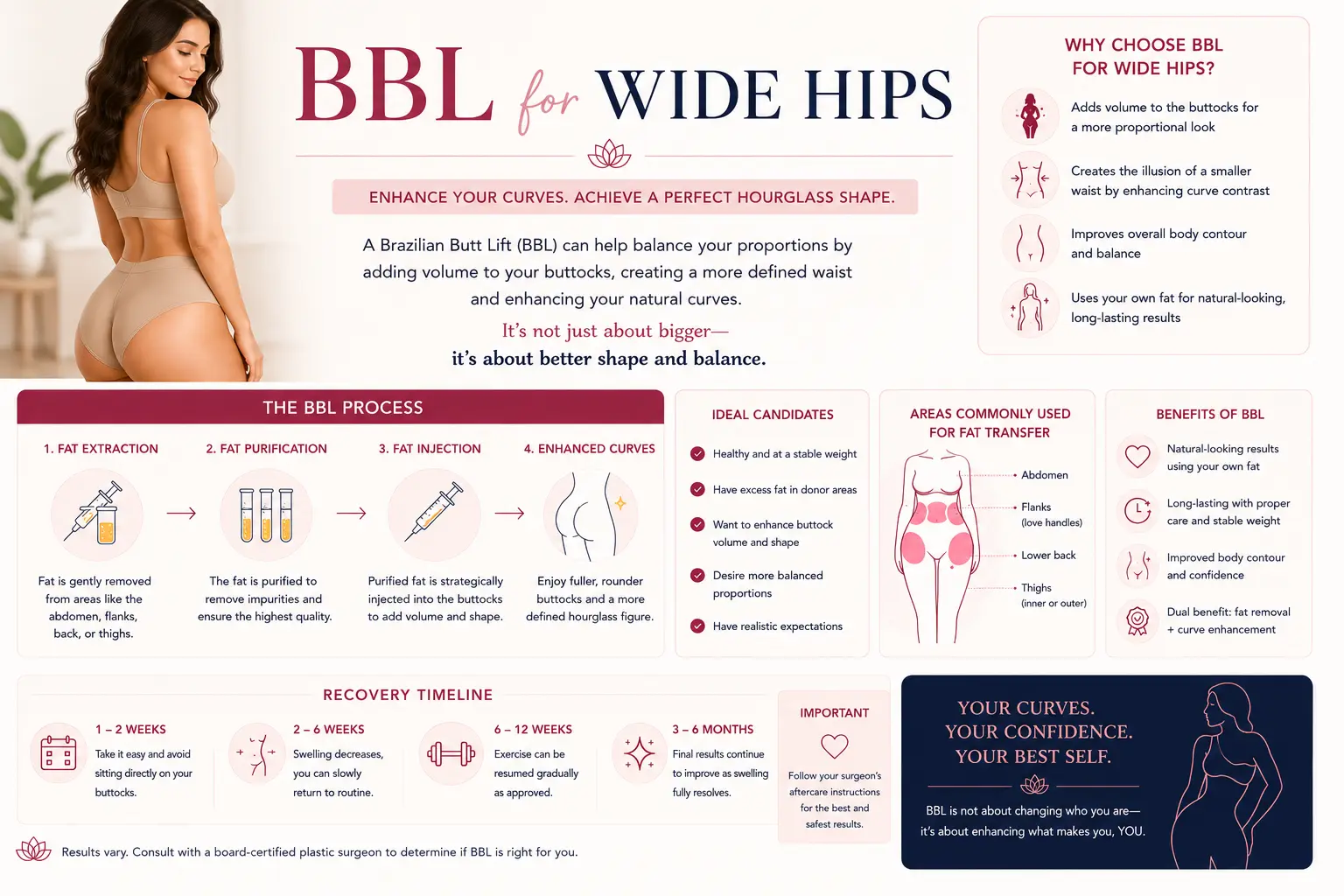
Quick Summary
A BBL for wide hips uses your own fat, harvested by liposuction from the abdomen or flanks, and transferred directly into the lateral hip area to create a broader, rounder silhouette.
BBL remains one of the fastest-growing cosmetic procedures globally. Subcutaneous fat placement, the established safety standard since the 2022 multi-society Practice Advisory, has dramatically improved BBL safety outcomes in published mortality data. This guide covers candidacy, the surgical process, recovery, costs in £/$/€, and what to expect at 3 and 6 months.
Why Trust This Guide
This guide draws on guidance and research from the American Society of Plastic Surgeons (ASPS), the International Society of Aesthetic Plastic Surgery (ISAPS), the ASERF Multi-Society Gluteal Fat Grafting Task Force, and peer-reviewed research published in the Aesthetic Surgery Journal. It has been medically reviewed by Op. Dr. Alirza Jahangirov, Plastic, Reconstructive & Aesthetic Surgeon at Carely Clinic in Istanbul. This article is educational and does not replace a personalised surgical consultation.
What Is a BBL for Wide Hips?
A BBL for wide hips is a fat grafting procedure that widens the lateral hip zone using your own purified fat. It simultaneously slims the donor areas — typically the waist and abdomen — to create a more defined hourglass ratio.
A Brazilian Butt Lift (BBL) is primarily known for buttock augmentation, but fat can be directed precisely into the hip region as the primary goal. Surgeons control exactly where volume is added by adjusting injection points along the lateral hip, the trochanteric zone, and the hip dip area.
What it produces. The result is a wider silhouette from the front and back view, a smoother outer hip line, and a more pronounced waist-to-hip ratio. No implants or synthetic materials are used — only your own fat.
Hip Dips vs. Lack of Hip Width: What’s the Difference?
Hip dips are depressions caused by bone structure; narrow hip width is about overall lateral volume. A BBL addresses both with targeted fat placement.
Hip dips (trochanteric depressions) occur when the distance between the ilium and hip socket is longer, creating an inward curve.
Narrow hip width means insufficient lateral volume overall, regardless of dip depth. A BBL for wide hips treats both simultaneously — filling the dip and projecting the outer hip — by placing fat at multiple injection depths within the subcutaneous layer.
How Does Fat Transfer to the Hips Work? (Step-by-Step)
The procedure involves three sequential stages: liposuction to harvest fat, centrifugal processing to purify it, and ultrasound-guided injection into the subcutaneous hip zone. Total surgical time is 2 to 4 hours under general anaesthesia.
Step 1: Fat Harvesting (Liposuction)
Fat is removed from donor areas — most commonly the abdomen, flanks, and lower back — using small-cannula liposuction.
360 liposuction is the most common approach, collecting fat from the entire midsection. This dual benefit — donor area slimming plus hip augmentation — is one of the procedure’s key advantages over implants.
Step 2: Fat Processing and Purification
Harvested fat is processed by centrifugation to remove blood, fluid, and damaged cells before injection.
Only viable fat cells are retained for transfer. Purification quality directly affects how much volume survives post-operatively. Modern processing via closed-system centrifugation, as recommended in ASPS guidelines, improves graft viability compared to older open-air techniques.
Step 3: Fat Injection into the Hip Zone
Purified fat is injected into the subcutaneous hip layer using cannulas guided by real-time ultrasound for accuracy and safety.
Subcutaneous placement is non-negotiable. The ASPS, ASAPS, and ISAPS 2022 Practice Advisory on Gluteal Fat Grafting established subcutaneous-only injection as the standard of care globally. Fat placed above the gluteal muscle cannot enter the large gluteal veins, which eliminates the primary mechanism behind pulmonary fat embolism.
Op. Dr. Jahangirov uses ultrasound guidance during every fat injection phase at Carely Clinic, confirming cannula position in real time throughout the procedure.
Fat Survival Rate: What to Expect at 3 and 6 Months
Initial swelling resolves by 6-8 weeks; final fat retention is assessed at 6 months, when grafted fat is considered permanent.
At 6-8 weeks: Swelling subsides and the hip shape becomes more visible. Results still look slightly larger than final due to residual oedema.
At 3 months: Shape is approximately 80-85% of final. Asymmetry, if any, is most visible at this stage and should be discussed with your surgeon.
At 6 months: According to a 2020 ASERF survey in Aesthetic Surgery Journal, 60-80% of transferred fat survives permanently at this point. Surgeons typically overcorrect by 10-20% during injection to account for expected reabsorption.
Expert Insight
“Fat grafted into the subcutaneous hip layer behaves like native fat once a blood supply is established. The 6-month mark is when I consider results permanent — weight stability after that point is the single biggest factor in maintaining volume.”
— Reflecting current clinical practice on fat grafting outcomes
How Much Hip Width Can a BBL Actually Add?
Surgeons typically inject 200-500 cc per hip, depending on available donor fat and aesthetic goals. Most patients see a visible 3 to 6 cm increase in outer hip projection at the 6-month mark.
Volume depends on donor fat. Patients with adequate midsection fat can transfer higher volumes for more dramatic results. Patients with lower body fat may see more modest width increases but still benefit from improved hip-to-waist definition.
Shape goals vary. Common target aesthetics include the hourglass figure (narrow waist, wide hips), the heart shape (full lower hip and buttock), and the O-shape (rounded, even projection). Your surgeon will plan injection points based on your skeletal structure and your stated goals.
Learn more about the full scope of BBL surgery at Carely Clinic.
5 Factors That Determine Your BBL Hip Results
Five variables directly influence how dramatic and long-lasting your hip BBL results will be: donor fat volume, surgeon technique, fat processing quality, recovery compliance, and post-operative weight stability.
1. Donor fat volume. Patients with more harvestable fat can transfer higher volumes, producing more dramatic width increases. Minimum viable donor fat for meaningful hip augmentation is approximately 500-700 cc harvestable across all donor sites.
2. Surgeon technique. Subcutaneous injection, established as the safety standard by the 2022 multi-society Practice Advisory, produces the best fat survival outcomes. Ultrasound guidance is increasingly used to confirm injection depth. Intramuscular placement is associated with higher reabsorption and significantly higher complication risk.
3. Fat processing quality. Closed-system centrifugation retains more viable fat cells than open-air decanting. Ask your clinic which processing method they use before booking.
4. Recovery compliance. Avoiding pressure on the hips for 3 weeks after surgery is the most critical factor in fat cell survival. Patients who sleep on their stomach consistently during this window retain meaningfully more volume.
5. Post-operative weight stability. Fat grafted into the hips responds to weight changes the same as native fat. A gain or loss of more than 5 kg after surgery can alter hip proportions, though results rarely reverse entirely.
Who Is a Good Candidate for a BBL for Wide Hips?
Good candidates are non-smokers in overall good health with a stable BMI under 33, sufficient donor fat in the abdomen or flanks, and realistic expectations for silhouette change — not skeletal restructuring.
The procedure cannot widen the actual pelvis — bone structure is unchanged. What changes is the soft tissue contour: the fat layer and subcutaneous volume that sits over the hip bones.
Typical ideal candidates include patients with an apple or ruler body shape (centralised fat distribution, minimal hip projection), patients with pronounced hip dips from skeletal structure, and patients who want a more pronounced waist-to-hip ratio without implants.
Who Is NOT a Good Candidate for a BBL for Wide Hips?
Absolute contraindications include active infection, blood clotting disorders, and BMI over 33 with active comorbidities. Relative contraindications include smoking, low BMI with minimal donor fat, and significant loose skin in donor areas.
Absolute Contraindications
These conditions prevent surgery entirely and cannot be resolved through optimisation before proceeding.
The procedure cannot be performed in these cases:
- Active infection or open wounds: Any unresolved infection is an absolute barrier due to contamination risk during fat processing and injection.
- Blood clotting disorders or anticoagulant therapy: Unmanaged coagulopathies create unacceptable bleeding and DVT risk. Standard surgical protocol requires anticoagulants to be stopped and clotting function confirmed before surgery.
- BMI over 33 with active comorbidities: Patients with a BMI above 33 alongside uncontrolled diabetes, severe cardiovascular disease, or sleep apnoea are not safe candidates for BBL surgery.
- Unrealistic anatomical expectations: Patients who expect hip bones to widen or who require more donor fat than their body can safely provide are not appropriate candidates.
Relative Contraindications
These factors may disqualify a patient until addressed, or may limit achievable volume transfer and results.
These cases may allow the procedure after optimisation:
- Active smokers: Smoking impairs fat cell survival and wound healing. Most surgeons recommend ceasing smoking at least 6 weeks before and after surgery.
- BMI under 18 with insufficient donor fat: Patients without sufficient harvestable fat may not achieve meaningful hip width. Hip implants or a skinny BBL approach may be discussed.
- Significant loose or sagging skin in donor areas: Liposuction in areas with excess loose skin can worsen skin laxity. Combined procedures such as abdominoplasty may be needed, increasing surgical scope.
- Recent significant weight change: Patients who have lost or gained more than 10 kg in the past 6 months should reach stable weight before surgery to protect graft survival.
Managing Expectations
Results enhance soft tissue contour, not bone structure — width gain is real, but proportional to available donor fat.
BBL for wide hips produces visible, measurable silhouette improvement for the right candidate. Patients with wider starting hip width who want subtle enhancement typically achieve very natural-looking results. Patients with minimal lateral projection who want dramatic change may need higher-volume transfer, which depends on available donor fat. Final shape is visible at 3 months and fully stable at 6 months, and can last many years with stable weight.
BBL for Wide Hips: Cost Comparison (£/$/€)
An all-inclusive BBL for wide hips in Turkey costs approximately £2,800-£3,500 ($3,500-$4,500 / €3,200-€4,200) — 60-75% less than equivalent procedures in the UK or US. Full package inclusions vary by clinic.
Cost differences between Turkey and Western markets are significant and consistent across 2025-2026 market data. The table below compares current pricing ranges by country with typical package inclusions.
| Country | Cost Range (GBP) | Cost Range (USD) | Cost Range (EUR) | Typical Package |
|---|---|---|---|---|
| Turkey (Istanbul) | £2,800-£3,500 | $3,500-$4,500 | €3,200-€4,200 | Surgery + anaesthesia + hospital stay + hotel + transfers + compression garment |
| United Kingdom | £8,000-£15,000 | $10,000-$18,500 | €9,500-€17,500 | Surgery + anaesthesia only (accommodation and transfers not included) |
| United States | £8,500-£14,500 | $10,500-$18,000 | €10,000-€17,000 | Surgery + anaesthesia + facility fee (variable inclusions) |
| Western Europe (avg.) | £7,500-£12,000 | $9,200-$14,800 | €8,800-€14,000 | Surgery + anaesthesia + 1-night stay (variable) |
Prices are indicative ranges based on 2025-2026 market data and vary by surgeon experience, extent of liposuction, and clinic. Formal quotes require consultation.
For a full breakdown of what Turkish packages include, see our cosmetic surgery cost guide for Turkey.
Warning Signs to Watch For After Your BBL
Most BBL recoveries are uneventful when managed correctly, but certain symptoms require immediate medical attention. Contact your surgeon or seek emergency care if you notice any of the warning signs listed below.
Post-operative monitoring is part of standard care at Carely Clinic. International patients receive a 24-hour WhatsApp support line and written emergency escalation protocols before departure.
| Warning Sign | What It May Indicate | Action Required |
|---|---|---|
| Fever above 38.5°C (101.3°F) | Systemic infection or abscess formation | Contact surgeon immediately; attend emergency review within 12 hours |
| Wound separation or open incision | Dehiscence; increased infection risk | Cover with clean dressing; contact surgeon same day |
| Increasing redness, warmth, or pus at incision | Local wound infection | Seek medical review within 24 hours; antibiotics may be required |
| Fluid accumulation (soft, fluctuant swelling) | Seroma or haematoma | Contact surgeon; may require aspiration under sterile conditions |
| Calf pain, swelling, or redness in one leg | Deep vein thrombosis (DVT) | Go to emergency department immediately |
| Sudden chest pain or shortness of breath | Pulmonary embolism or fat embolism | Call emergency services immediately (999 / 112 / 911) |
| Sudden increase in pain after day 5 | Infection, internal haematoma, or fat necrosis | Contact surgeon within 12 hours for assessment |
BBL for Wide Hips: Recovery Timeline
Full BBL recovery takes 6 weeks. The first 3 weeks are the most critical for fat cell survival — sleeping position, compression garment use, and avoiding hip pressure determine long-term volume retention.
| Recovery Stage | What to Expect | Key Instructions |
|---|---|---|
| Days 1-3 | Moderate-to-severe pain, bruising, swelling at all liposuction and injection sites | Sleep face-down; prescribed pain medication; gentle walking to prevent DVT |
| Week 1-2 | Swelling peaks then begins to reduce; bruising yellow-green; drains removed if used | Wear compression garment 24 hours; no sitting directly on hips or buttocks; light walking only |
| Week 3 | Most patients return to desk work; swelling decreasing; shape becoming visible | BBL pillow required for sitting; compression garment worn during day; no strenuous activity |
| Week 4-6 | Swelling mostly resolved; hip shape visible; donor sites firming | Light exercise resumes at 4 weeks; full exercise at 6 weeks; compression garment as directed |
| Month 3 | 80-85% of final shape visible; residual firmness in donor zones | Follow-up assessment recommended; lymphatic massage may be advised |
| Month 6 | Final result; 60-80% of transferred fat permanently integrated | Maintain stable weight; results are considered long-term permanent at this stage |
Expert Insight
“The single most common recovery mistake I see in international patients is returning to prolonged sitting too early — particularly on long-haul flights home. Patients flying back to the UK or US should use a BBL pillow throughout the journey and keep ankles moving to reduce DVT risk.”
— Op. Dr. Alirza Jahangirov, Carely Clinic Istanbul
How This Applies in Turkey
Turkey is one of Europe’s leading destinations for BBL procedures by volume, with Istanbul clinics offering all-inclusive packages at prices 60-75% lower than the UK or US.
Turkey has emerged as the leading destination in Europe for body contouring surgery. Turkish plastic surgeons perform a high volume of BBL procedures annually — with Istanbul in particular attracting patients from the UK, Germany, the Netherlands, and the US. Turkish plastic surgeons complete comprehensive specialisation training, with many holding international society memberships including EBOPRAS or ISAPS. High procedural volumes at established centres support refined technique and consistent outcomes over time.
What Turkish packages typically include. An all-inclusive BBL package in Istanbul — priced at £2,800-£3,500 ($3,500-$4,500 / €3,200-€4,200) at Carely Clinic — covers surgery, general anaesthesia, 1-2 nights hospital stay, hotel accommodation, airport and hospital transfers, compression garment, and post-operative follow-up appointments. This is substantially more inclusive than UK or US pricing (£8,000-£15,000 / $10,500-$18,000), where accommodation and transfers are typically extra.
When Can You Fly After Surgery?
Most surgeons clear patients to fly 7-10 days post-BBL, provided no complications are present and DVT prophylaxis is followed.
For UK patients flying home from Istanbul (approximately 3.5 hours) and US patients (10+ hours), flight timing and in-flight positioning matter significantly. Prolonged immobility is widely recognised as a DVT risk factor after body contouring surgery.
Standard guidance for BBL patients flying home: minimum 7 days post-surgery before flying; use a BBL pillow throughout the journey to avoid direct buttock pressure; wear compression stockings for the entire flight; move ankles and walk the aisle every 30-45 minutes on long-haul routes; stay hydrated and avoid alcohol.
Your surgeon will issue formal fit-to-fly clearance before departure and provide written emergency escalation instructions in English for your return journey.
Learn more about the full All-Inclusive Cosmetic Surgery Packages Turkey, and liposuction procedure details.
Frequently Asked Questions
Does a BBL actually widen your hips?
Yes, a BBL widens hips by transferring purified fat directly into the lateral hip area. Clinical data shows that, 60-80% of transferred fat survives long-term when subcutaneous technique is used. The simultaneous waist liposuction further enhances the hourglass effect by narrowing the midsection proportionally.
Can you get a BBL just for hips without a butt lift?
Fat grafting to the hips alone, without buttock augmentation, is a recognised procedure surgeons perform regularly. Many board-certified plastic surgeons report high demand for isolated hip fat transfer, especially for patients with hip dips. Your surgeon will assess available donor fat to determine whether a full or partial BBL is optimal.
How long do BBL hip results last?
BBL hip results are considered permanent once fat fully integrates, typically at the 6-month mark post-surgery.According to a 2020 ASERF survey in Aesthetic Surgery Journal, 60-80% of grafted fat survives long-term. Major weight fluctuations after surgery are the primary factor that can reduce or alter lasting results.
What is the recovery like after a BBL for wide hips?
Full BBL recovery takes approximately 6 weeks, with the most critical restrictions applying during the first 3 weeks. Patients must avoid pressure on the hips and buttocks for 3 weeks.
Who is a good candidate for a BBL to widen hips?
Good candidates have sufficient donor fat, a stable BMI under 33, and realistic expectations for the outcome. Standard candidacy criteria require non-smoking status, stable weight, and adequate donor fat in the abdomen or flanks. Patients seeking a modest silhouette change with waist definition typically achieve the most satisfying and proportionate results.
What is the difference between hip augmentation and a BBL?
A BBL uses your own fat to add volume; hip augmentation can use either fat or silicone implants. In current clinical practice, fat transfer is the preferred method due to lower rejection and infection risk. Implants suit patients with insufficient donor fat, while a BBL offers more natural results for suitable candidates.
Can a skinny person get a BBL for hips?
Slim patients with a BMI at or below 25 may qualify for a specialised skinny BBL procedure. Fat is harvested from multiple sites including arms, thighs, and abdomen to collect sufficient volume for transfer. If total harvestable fat is insufficient, hip implants are typically recommended as the more appropriate alternative.
How long after BBL can you sleep on your side?
Sleeping on your side after a hip BBL is not recommended for at least 3 weeks post-surgery. Side sleeping places direct pressure on the newly transferred fat cells, risking tissue necrosis and volume loss. After 3 weeks, brief side sleeping may be permitted; your surgeon provides the definitive timeline for your case.
What are the risks of fat transfer to hips?
Key risks include fat reabsorption, asymmetry, infection, fluid accumulation (seroma), and pulmonary fat embolism in rare cases. The 2022 multi-society Practice Advisory reduced embolism risk significantly by establishing subcutaneous-only fat injection as the standard. Choosing a board-certified surgeon using ultrasound guidance is the single most effective patient safety measure available.
How much does a BBL for wide hips cost in Turkey?
An all-inclusive BBL in Turkey costs approximately £2,800-£3,500 ($3,500-$4,500 / €3,200-€4,200) depending on scope and clinic. UK and US prices for the same procedure typically range from £8,000 to £15,000 ($10,000-$18,000). Turkish packages generally include surgery, anaesthesia, hospital stay, hotel accommodation, airport transfers, and compression garments.
How many cc of fat are injected into hips during a BBL?
Surgeons typically inject 200-500 cc of purified fat per hip, depending on available donor volume and goals. Surgeons typically overcorrect by 10-20% to account for expected reabsorption. Final injected volumes are always determined intraoperatively, as the amount of harvestable fat varies per patient.
How much does a BBL for wide hips cost in the UK?
A BBL for wide hips in the UK typically costs £8,000 to £15,000 at private plastic surgery clinics. Patient safety organisations consistently advise prioritising surgeon board certification over price when choosing a provider. Many UK patients choose Turkey for the same procedure at 60-75% lower cost with comparable safety standards.
Conclusion
A BBL for wide hips delivers measurable silhouette change by transferring your own fat into the lateral hip zone, with 60-80% of volume surviving long-term when recovery protocols are followed.
A BBL for wide hips is one of the few cosmetic procedures that creates change in two directions simultaneously: adding lateral hip volume while removing excess fat from the waist and abdomen. For the right candidate — stable BMI, sufficient donor fat, non-smoking, realistic expectations — results are natural-looking, long-lasting, and free of synthetic materials.
The procedure’s safety profile has improved substantially since the ASPS, ASAPS, and ISAPS established subcutaneous-only fat placement as the standard of care in their 2022 Practice Advisory. When performed by a board-certified surgeon using subcutaneous-only fat placement, the procedure has a well-established safety profile.
For UK and US patients considering Turkey, the combination of EBOPRAS-trained surgeons, JCI-accredited hospitals, and all-inclusive pricing at £2,800-£3,500 ($3,500-$4,500 / €3,200-€4,200) represents a substantive cost advantage at JCI-accredited facilities. Book a free video consultation with Op. Dr. Jahangirov at Carely Clinic to assess your candidacy and discuss your goals.
Individual outcomes vary. This guide provides general medical education based on international guidelines and published research. Consult qualified medical professionals for personalised advice.
Medical Review: Op. Dr. Alirza Jahangirov