
Quick Summary
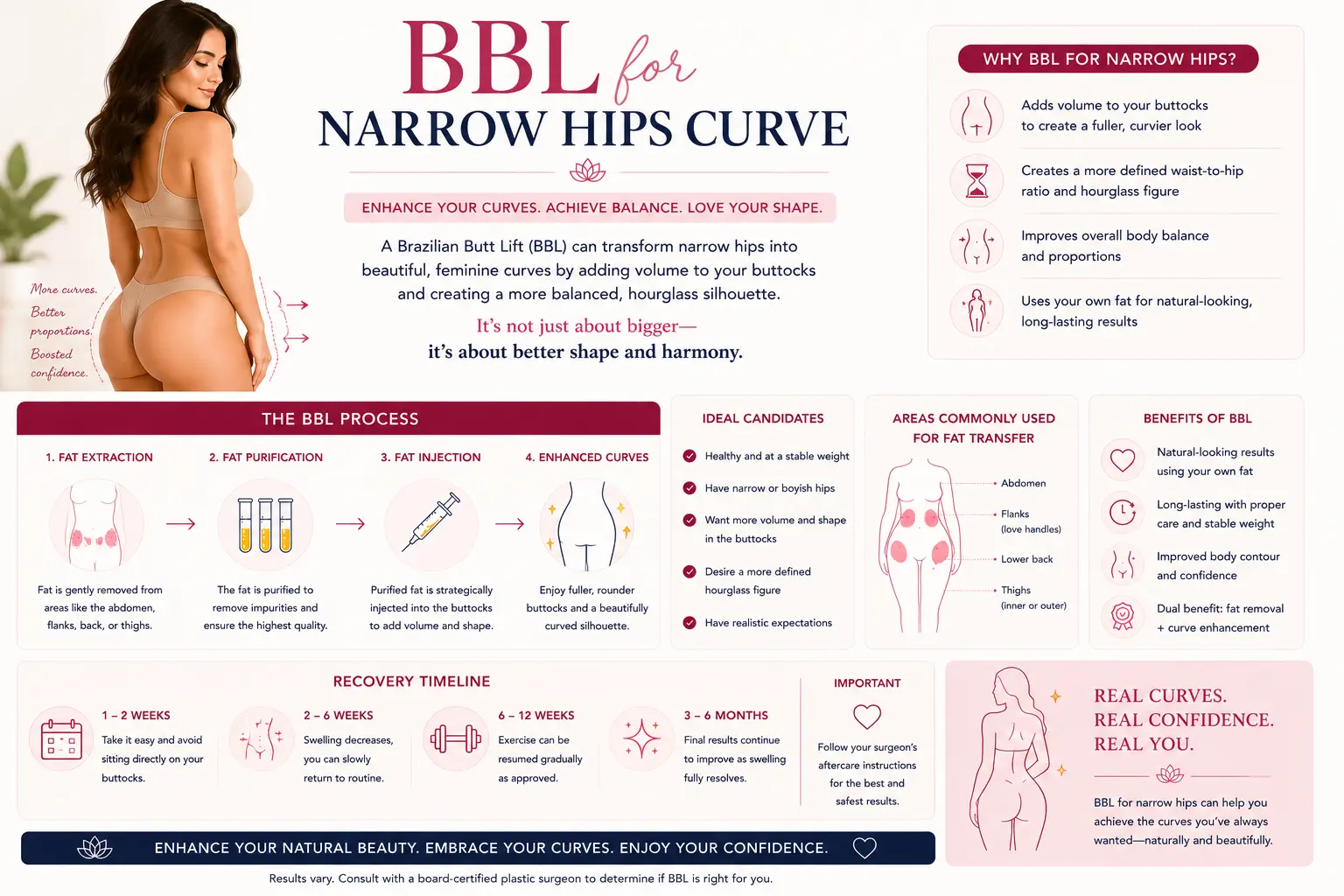
A BBL can create curves on narrow hips by combining Lipo 360 waist sculpting with strategic fat transfer to the lateral hips, buttocks, and hip-dip zones. Surgeons typically transfer 300-600 ml per side; fat survival rates run 60-70%, per ASPS and ISAPS guidelines (2023).
Most patients with a BMI of 18-32 and at least 4-5 kg of transferable donor fat are suitable candidates. This guide covers candidacy, technique, BBL shape selection for straight frames, and what to expect from results.
What Does a BBL Do for Narrow Hips?
A BBL creates curves on narrow hips via two mechanisms: Lipo 360 sculpts the waist, and fat grafting adds volume to the lateral hips and buttocks. This combination typically widens the waist-to-hip ratio by 6-12 cm on average. Surgeons transfer 300-600 ml per side, with 60-70% surviving long-term.
Whether a narrow-framed patient qualifies depends on donor fat availability — roughly 4-5 kg of harvestable fat is typically needed. Patients below this threshold may be candidates for a skinny BBL or a fat-and-implant combination. Current safety standards require subcutaneous placement, with real-time ultrasound guidance increasingly used at high-volume centres.
Carely Clinic Istanbul offers all-inclusive BBL packages from £3,200-£4,800 (approximately $4,000-$6,000 / €3,800-€5,600), serving patients from the UK, US, and EU.
Why Trust This Guide
This guide draws on guidance and research from the American Society of Plastic Surgeons (ASPS), the International Society of Aesthetic Plastic Surgery (ISAPS), and the British Association of Aesthetic Plastic Surgeons (BAAPS)
It was medically reviewed by Op. Dr. Alirza Jahangirov, a Plastic, Reconstructive & Aesthetic Surgeon at Carely Clinic in Istanbul. Content is educational and does not replace a personalised surgical consultation.
Why Narrow Hips Respond Well to BBL
The architecture of narrow hips. Patients with H-shaped or straight body frames — where the waist and hip measurements are within 5 cm of each other — are among the most common BBL candidates worldwide. They typically carry usable fat reserves in the abdomen, lower back, and flanks, even if they appear slim overall.
The transformation is proportional, not just volumetric. A well-planned BBL for narrow hips does not simply enlarge the buttocks. It creates an architectural relationship between a sculpted waist and wider lateral hips that makes the entire silhouette appear more curved — from the front, back, and side profile simultaneously.
The Waist-Narrowing Effect
Lipo 360 is half the result. Removing 600-1,200 ml of fat from the flanks, lower back, and abdomen creates a narrower waist that visually amplifies the curves added by fat grafting. The Lipo 360 and body contouring component of a BBL is frequently what patients notice most in their before-and-after comparisons.
Many patients with narrow hips have disproportionate waist-to-hip ratios because fat accumulates in the midsection while the lateral hips remain lean. Liposuction corrects the midsection; fat grafting corrects the hips. The two steps work in tandem.
Hip Dip Correction
Hip dips are structural, not fat-related — but BBL addresses them anyway. The trochanteric depression, clinically known as trochanteric depression and colloquially as “violin hips,” is an inward curve between the ilium and the hip socket. Genetics and pelvic bone width determine its depth.
Fat grafting into this zone during a BBL fills the indentation and creates a smoother S-curve from waist to thigh. BBL fat grafting fills the trochanteric depression, creating a smoother lateral hip contour. For deeper structural dips, a combination approach with hip implants may produce more consistent results.
How Much Fat Do You Need for a BBL with Narrow Hips?
Fat availability is the primary candidacy filter for narrow-framed patients. Most surgeons require approximately 4-5 kg of harvestable donor fat across the abdomen, flanks, and thighs. ISAPS technical guidance notes 400-600 ml of purified fat per side is needed for a visible result.
Donor fat is extracted from multiple sites. Common harvest zones for narrow-framed patients include the lower abdomen and flanks (love handles), the lower back (banana rolls), the inner and outer thighs, and — in some cases — the upper arms. Multiple smaller zones add up, even on leaner frames.
The Skinny BBL Option
Patients with BMI 18-22 are not automatically excluded. A skinny BBL transferring 200-400 ml per side produces modest, proportional curves that suit smaller frames. Experienced surgeons can harvest adequate fat from lean patients using VASER liposuction, which is gentler on tissue and preserves more viable fat cells for grafting.
Surgeons at Carely Clinic who routinely perform skinny BBL procedures on international patients — including many from the UK who have leaner northern European body types — typically recommend patients gain 3-5 kg before surgery if donor reserves are borderline. This pre-operative weight gain is then used as the harvest material.
Expert Insight
“Using VASER liposuction rather than standard tumescent liposuction for lean patients preserves 15-20% more viable fat cells for grafting, directly increasing the volume available for transfer to the hips and buttocks. The technique selection matters as much as the patient’s starting weight.”
— Reflecting current clinical practice in body contouring procedures
5 Factors That Determine How Much Curve a BBL Creates
How dramatic your results are depends on anatomy, not simply the procedure. Five variables interact to determine the final outcome.
1. Starting waist-to-hip ratio. Patients with a waist-to-hip ratio above 0.85 — where the waist and hips are closer in measurement — see the most dramatic relative improvement. The further the gap widens post-surgery, the more pronounced the curve appears.
2. Donor fat volume and quality. Not all fat is equal. Centrifuge-processed fat with high cell viability produces better survival rates than fat processed quickly or poorly. Surgeons using closed-loop centrifuge systems report survival rates at the upper end of the 60-70% range.
3. Fat injection zone selection. Injecting to the lateral hips (hip zone) creates a natural, gradual curve. Injecting to the lats (upper buttock, below the waist) creates a sharper projection — the “shelf” look. For narrow-hipped patients seeking hourglass curves rather than projection, lateral hip zone injection is typically prioritised.
4. Post-operative fat survival protocol. Patients who avoid sitting on the buttocks for 2 full weeks and wear a compression garment for 6-8 weeks retain significantly more of the transferred fat. Fat cells that lose blood supply before establishing vascular connections are reabsorbed within 3 months.
5. Weight stability. Transferred fat cells behave identically to native fat — they grow with weight gain and shrink with weight loss. Patients who maintain weight within 5 kg of their surgical weight preserve results longest. Plastic surgery societies consistently recommend stable weight maintenance as the most important long-term factor for preserving BBL results.
Which BBL Shape Suits a Narrow or H-Shaped Body?
The H-shaped frame — straight from shoulder to hip — benefits most from a targeted injection strategy. Choosing the wrong injection focus produces a disproportionate result. The following table maps body shape to optimal BBL approach.
| Body Frame | Recommended BBL Shape | Injection Focus | Key Benefit |
|---|---|---|---|
| H-Shape (straight/square) | Shelf / Lats-focused | Upper buttock + lateral hips | Creates visible projection and hip width simultaneously |
| V-Shape (shoulder-wider) | Slope / Hips-focused | Middle and lower hips | Adds lower-body volume to balance broader shoulders |
| A-Shape (narrower top) | Slope or Curvy | Lower hips + hip dip zone | Enhances existing pear proportion into classic hourglass |
| O-Shape (round/barrel) | Curvy / Heart | Buttock + waist definition | Sculpts waist to create hourglass proportion |
Clinical evidence supports lateral placement as most effective for improving hourglass ratio in straight-framed patients. For narrow H-shaped bodies, combining lats injection with Lipo 360 waist sculpting amplifies the visual width contrast between waist and hip.
Lateral Hip Volume vs Buttock Projection
Not all BBL patients want the same result. Patients seeking natural, proportional curves rather than dramatic projection should prioritise lateral hip volume (the hip and slope injection zones) over lats-focused shelf injections. This is a key discussion to have at the pre-operative consultation, ideally with visual references showing your desired shape.
Clinical observation shows that the majority of European and UK patients seeking BBL for narrow hips request a natural, athletic hourglass — not a shelf projection — which shifts the injection focus decisively toward lateral hip volume and hip dip correction rather than maximum upper-buttock projection.
Who Is NOT a Good Candidate for BBL with Narrow Hips?
Narrow hips do not disqualify a patient from BBL — but several medical and anatomical factors do. Understanding contraindications before booking a consultation protects both safety and realistic expectations.
Absolute Contraindications
These conditions prevent BBL from being performed safely:
- Insufficient donor fat (BMI below 17-18): Patients without harvestable fat cannot undergo fat transfer BBL safely. Surgeons typically require at least 300-400 ml of purified, transferable fat per side minimum. Implant-based augmentation may be discussed instead.
- Active smoking within 4-6 weeks of surgery: Nicotine constricts blood vessels and dramatically reduces fat cell survival rates. Most surgeons require cessation for a minimum of 4 weeks pre- and post-operatively.
- Uncontrolled cardiovascular conditions: Hypertension, arrhythmia, or recent cardiac events increase anaesthesia and surgical risk to unacceptable levels. Medical clearance is required.
- Active blood clotting disorders: BBL carries DVT risk; patients on anticoagulants or with clotting disorders require specialist evaluation before proceeding.
Relative Contraindications
These factors may be manageable with optimisation:
- BMI 18-20 with limited donor fat: These patients may qualify for a skinny or mini BBL after a supervised pre-operative weight gain period of 2-3 months. Surgeons will map donor sites during consultation.
- Significant skin laxity: Patients who have lost large amounts of weight may need a combined tummy tuck and BBL to avoid loose skin worsening after liposuction removes supporting fat.
- Grade II-III cellulite: Deep fibrotic cellulite can respond inconsistently to fat grafting. A pre-operative radiofrequency treatment followed by multi-stage grafting may be recommended.
- Severe structural hip dips: Very deep bone-structure-related trochanteric depressions may not fully resolve with fat transfer alone, and silicone hip implants in combination with BBL may produce a more reliable result.
Managing Expectations
The most satisfied patients understand the anatomy. A BBL does not change the underlying bone width of the pelvis. It changes the visual perception of width by sculpting the surrounding soft tissue. Patients with very narrow iliac crests can achieve meaningful curve improvement, but the degree of change is proportional to the available fat and the starting anatomical gap.
Warning Signs to Watch For After BBL
Most BBL recoveries are straightforward — but certain symptoms require immediate medical attention. Patients who recognise these warning signs early and act promptly protect both their results and their health.
| Warning Sign | What It May Indicate | Action Required |
|---|---|---|
| Fever above 38.5°C (101.3°F) | Wound infection or systemic sepsis | Contact surgical team immediately; attend emergency if above 39°C |
| Sudden sharp pain in one or both calves | Deep vein thrombosis (DVT) | Attend A&E or ER without delay; do not massage the area |
| Shortness of breath or chest pain | Pulmonary embolism or fat embolism | Call emergency services (999 / 911) immediately |
| Wound opening or fluid discharge | Wound dehiscence or seroma | Contact clinic; do not attempt to close wound yourself |
| Hard irregular lumps in injected areas | Fat necrosis | Book a follow-up assessment; typically managed conservatively |
| Increasing redness and warmth at incision site | Localised infection or cellulitis | Contact surgical team within 24 hours; antibiotics may be required |
How This Applies in Turkey
Turkey is among Europe’s leading destinations for BBL surgery by volume, with all-inclusive Istanbul packages typically 60-70% cheaper than UK or US equivalents at JCI-accredited hospitals.
Turkey is consistently among the leading global destinations for BBL surgery by procedure volume. Turkish plastic surgeons complete comprehensive specialisation training and many hold international society memberships. High procedural volumes translate directly into refined technique: surgeons working at high-volume centres develop pattern recognition and surgical artistry over time.
JCI-accredited hospitals in Istanbul follow internationally recognised safety standards consistent with the JCI accreditation framework used globally. Standard protocols include subcutaneous fat placement (the established safety standard), VASER or power-assisted liposuction, centrifuge-based fat processing, DVT prevention protocols, and structured follow-up care. Ultrasound guidance is increasingly used at high-volume centres.
For international patients travelling from the UK or US, the typical Istanbul BBL package includes: surgery at a JCI-accredited hospital, 1 night hospital stay, 7-9 nights hotel accommodation, airport and clinic transfers, 2 compression garments, a BBL pillow, and 2-3 in-person follow-up appointments before departure.
At Carely Clinic, Op. Dr. Jahangirov’s anatomical training informs precise fat placement relative to the fascial layers — a technical consideration that matters for both safety and result quality in BBL. International patients from the UK and US receive a dedicated patient coordinator, translation support, and a telemedicine follow-up programme once they return home. All-inclusive packages at Carely range from £3,200-£4,800 ($4,000-$6,000 / €3,800-€5,600), representing 60-70% savings compared to UK BBL costs of £8,000-£12,000 or US costs of $10,000-$15,000.
Learn more about BBL at Carely Clinic Istanbul.
When Can You Fly After BBL?
Most patients can fly 10-14 days after surgery, subject to surgeon clearance. This minimum waiting period is widely recommended to reduce DVT and pulmonary embolism risk on long-haul flights. During any flight after surgery, patients should wear Class 2 compression stockings, walk the aisle every 45-60 minutes, stay well hydrated, and avoid alcohol for the duration of the journey.
Patients travelling from the UK to Istanbul should plan a 10-14 night stay minimum. Patients flying from the US (longer flights, higher DVT risk) should discuss their specific travel plans with their surgeon and may be advised to wait the full 14 days or longer before boarding.
Frequently Asked Questions
Can a BBL widen narrow hips?
Yes — a BBL can widen the apparent hip measurement by 6-12 cm through fat transfer and liposuction. Lipo 360 narrows the waist while lateral fat grafting adds hip volume, Lipo 360 narrows the waist while lateral fat grafting adds hip volume, creating a wider apparent waist-to-hip ratio. The result is a wider waist-to-hip ratio, even when the underlying pelvic bone structure is narrow.
How much fat do you need for a BBL with narrow hips?
Most surgeons require approximately 4-5 kg of harvestable donor fat across the abdomen, flanks, and thighs.ISAPS technical guidance notes 400-600 ml of purified fat per side is needed for a visible result. Patients with a BMI below 18 may not have sufficient donor fat and should discuss implant alternatives.
Will a BBL fix my hip dips?
A BBL can significantly reduce hip dips by injecting fat into the trochanteric depression zones bilaterally. Centre for Surgery (UK, 2025) notes BBL fills the trochanteric depression, creating a smoother lateral hip contour. Results depend on the depth of the dip — structural bone-related dips may respond better to implant-fat combinations.
What is the difference between a BBL and hip augmentation for narrow hips?
A BBL adds buttock projection using your own fat; hip augmentation adds lateral width using silicone implants. Plastic surgery literature notes BBL produces more natural results but requires adequate donor fat, unlike implant-based methods. Narrow-hipped patients often combine both procedures to achieve fuller buttock projection alongside wider lateral hip width.
Can you get a BBL if you’re skinny?
A skinny BBL transferring 200-400 ml per side is viable for patients with a BMI of 18-22. Experienced surgeons can harvest adequate fat from lean patients using VASER liposuction. Patients should gain 3-5 kg before surgery if current donor fat reserves are insufficient for the desired volume.
What BBL shape is best for a narrow or H-shaped body?
For H-shaped frames, surgeons recommend a shelf BBL that concentrates fat in the lateral upper hip zone. Clinical evidence supports lateral placement most effectively improves hourglass ratio in straight-framed patients. Pairing lats injection with Lipo 360 waist sculpting amplifies the visual width contrast between waist and hip.
How long do BBL results last on narrow hips?
BBL results are permanent once transferred fat cells establish a blood supply, typically by 3-6 months post-surgery. Clinical literature consistently reports 60-70% of transferred fat survives long-term once cells establish vascular connections post-surgery. Significant weight fluctuations alter results — maintaining a stable weight within 5 kg protects long-term curve definition.
What is the BBL recovery like for narrow-framed patients?
Standard BBL recovery prohibits sitting directly on the buttocks for 2 weeks to protect transferred fat cells. Most surgeons advises wearing a compression garment for 6-8 weeks to support healing and shape final contours. Most patients return to desk work within 2-3 weeks and resume full exercise by week 10-12 post-surgery.
How much does a BBL for narrow hips cost in Turkey?
All-inclusive BBL packages in Turkey cost approximately £3,200-£4,800 ($4,000-$6,000 / €3,800-€5,600) in 2026.Turkish packages cost 60-70% less than UK prices of £8,000-£12,000 or US prices of $10,000-$15,000. Packages typically include surgery, hospital stay, accommodation, transfers, compression garments, and early follow-up appointments.
How soon can you fly after a BBL?
Most surgeons recommend waiting 10-14 days after a BBL before flying to reduce the risk of blood clots. Standard practice advises wearing compression stockings and walking regularly during any flight post-surgery. Patients flying from the UK or US to Istanbul should plan a minimum 10-night stay before returning home.
Is a BBL safe for narrow-hipped patients?
BBL is safe for narrow-hipped patients when performed by a board-certified surgeon using ultrasound-guided subcutaneous fat placement. Published mortality data estimate mortality at 1 in 14,000-20,000 at accredited centres using subcutaneous-only technique. Risks increase significantly when fat is placed intramuscularly or when performed at non-accredited facilities without ultrasound guidance.
What happens if I don’t have enough fat for a BBL?
Patients with too little donor fat have three options: pre-surgery weight gain, a mini BBL, or hip implants. A mini BBL of 200-300 ml per side still produces visible curve improvement in slim patients. Your surgeon will assess donor sites — abdomen, flanks, lower back, and thighs — at the pre-operative consultation.
Conclusion
A BBL can create meaningful curves on narrow hips when a surgeon combines Lipo 360 waist sculpting with targeted fat grafting to the lateral hips and hip-dip zones.
For patients with a straight or H-shaped frame, the evidence supports a clear surgical strategy: harvest from the flanks, lower back, and abdomen; inject to the lateral hips and lats zone; aim for 300-600 ml per side with a 60-70% long-term survival rate. The waist-narrowing component alone often provides more visual impact than the fat addition. When donor fat is limited, skinny BBL options, pre-operative weight gain, or a combination with hip implants extend candidacy to leaner patients.
Istanbul is the most cost-effective destination for this procedure at accredited quality, with all-inclusive packages at £3,200-£4,800 representing 60-70% savings versus UK or US equivalents at JCI-accredited facilities.
Explore your options with a free consultation at Carely Clinic, or review our all-inclusive plastic surgery packages for pricing and inclusions.
Individual outcomes vary. This guide provides general medical education based on international guidelines and published research. Consult qualified medical professionals for personalised advice.
Medical Review: Op. Dr. Alirza Jahangirov