
Quick Summary
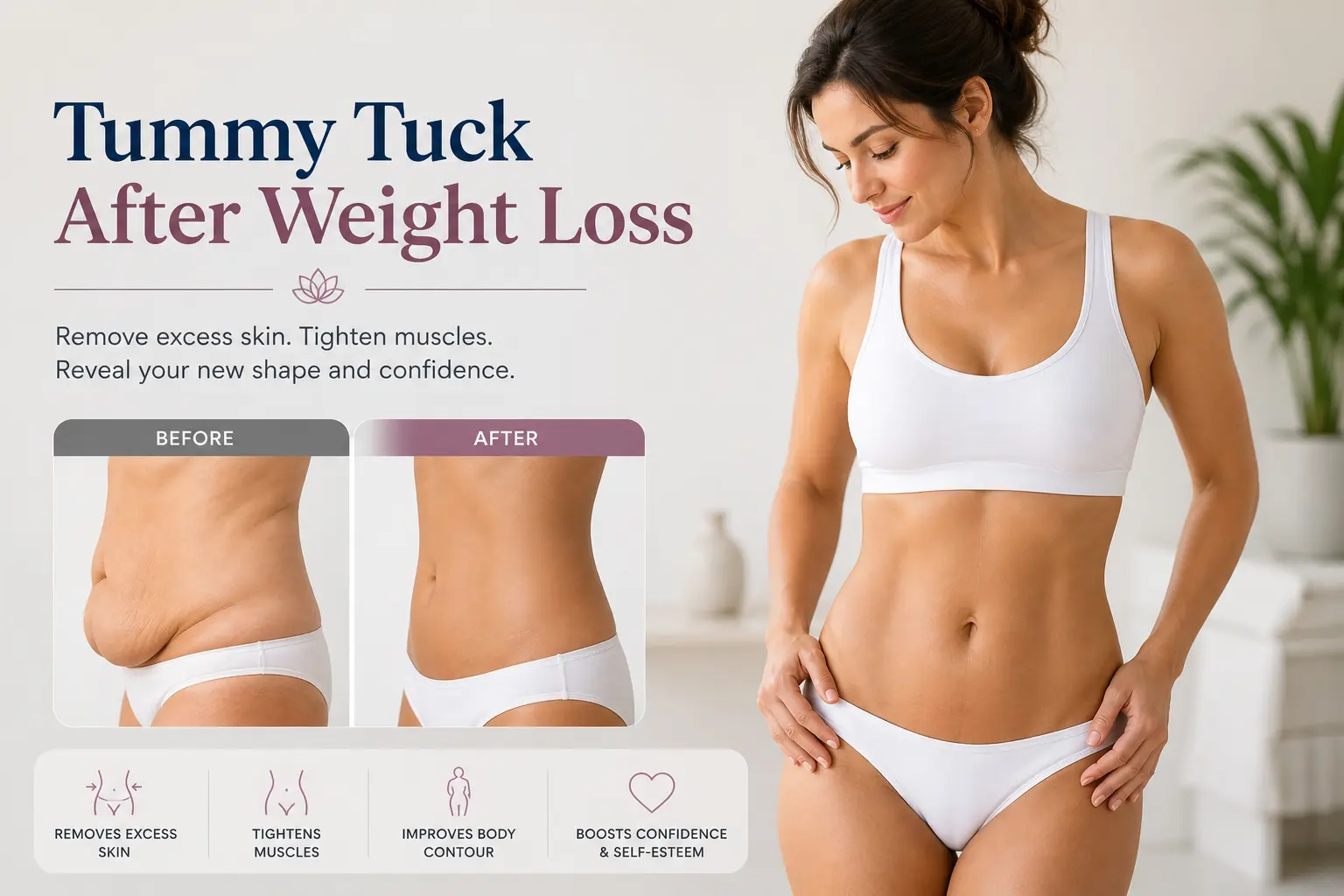
A tummy tuck after weight loss (abdominoplasty) removes excess skin and repairs separated abdominal muscles that diet and exercise cannot correct.
Most surgeons advise waiting 6 to 18 months after reaching a stable goal weight — 12 to 18 months for post-bariatric patients. In 2023, ASPS member surgeons performed more than 170,000 abdominoplasties in the US alone.
What Is a Tummy Tuck After Weight Loss?
A tummy tuck after weight loss is an abdominoplasty that removes excess sagging skin and repairs diastasis recti (separated abdominal muscles) after major weight reduction. According to 2023 ASPS statistics, more than 170,000 abdominoplasties were performed in the US — the majority following significant weight loss or pregnancy. Surgeons recommend reaching a stable weight for 6 to 18 months before scheduling surgery.
Significant weight loss — whether achieved through bariatric surgery, GLP-1 medications such as semaglutide, or lifestyle change — can leave behind excess skin that has permanently lost its elasticity. Below the navel especially, skin stretched over months or years cannot retract on its own, regardless of how much core exercise a patient undertakes.
What abdominoplasty corrects ? Surgery addresses three distinct problems: excess and overhanging abdominal skin, separated rectus abdominis muscles (diastasis recti), and lower abdominal fat deposits that resist diet and exercise. A tummy tuck is not a weight loss procedure — it is a body contouring procedure that refines the shape of a body that has already undergone transformation.
Post-bariatric patients — including those who lost weight with gastric sleeve, gastric bypass, or GLP-1 medications — typically wait 12 to 18 months to allow full weight stabilisation and recovery from nutritional deficiencies. Turkey is among the world’s leading countries for abdominoplasty volume, offering all-inclusive packages at £2,900 to £4,200 (€3,400 to €5,000 / $3,600 to $5,300) compared to £5,000 to £10,000 in the UK. Procedure type — mini, full, extended, or fleur-de-lis — depends on the amount of excess skin and whether upper abdominal correction is required.
Why Trust This Guide
This guide draws on data from the American Society of Plastic Surgeons (ASPS), the British Association of Aesthetic Plastic Surgeons (BAAPS), peer-reviewed research published in Plastic and Reconstructive Surgery, and ISAPS global procedure statistics.
It has been medically reviewed by Op. Dr. Alirza Jahangirov, a Plastic, Reconstructive & Aesthetic Surgeon at Carely Clinic in Istanbul. This content is educational and does not replace a personalised surgical consultation.
How Long Should You Wait Before Getting a Tummy Tuck?
Timing is the single most important variable in post-weight-loss abdominoplasty outcomes. Most surgeons require 6 to 12 months of weight stability for lifestyle-loss patients, and 12 to 18 months for patients after bariatric surgery. Operating too early significantly increases revision rates and complication risk.
The weight stability rule. Weight stability is not simply about reaching a goal number — it means the body has fully adjusted, skin has contracted as much as it will naturally, and nutritional markers have normalised. Standard surgical practice is that operating on a patient who is still actively losing weight risks poor skin excision planning, asymmetry, and the need for revision surgery.
Bariatric surgery patients require a longer wait. Gastric sleeve and gastric bypass patients lose weight over 12 to 24 months. The 12-to-18-month minimum wait ensures the nadir (lowest stable weight) has been reached and that deficiencies in vitamin B12, iron, and vitamin D — common after bariatric procedures — have been corrected. These nutritional gaps directly affect wound healing, anaesthetic risk, and recovery speed.
GLP-1 patients (Ozempic, Wegovy, semaglutide). ASPS plastic surgery trend data has noted a recent surge in post-weight-loss body contouring demand linked to semaglutide and tirzepatide use. The same 6-to-12-month stability window applies. GLP-1-related weight loss can be rapid, leaving significant skin laxity in patients who may still be relatively young with otherwise good health profiles — making them strong candidates once stable.
Which Type of Tummy Tuck Is Right After Weight Loss?
The correct abdominoplasty technique depends on how much weight was lost, where excess skin collects, and whether upper abdominal skin requires correction. Patients after massive weight loss frequently need extended or fleur-de-lis techniques that standard post-pregnancy patients do not.
Mini, Full, Extended, and Fleur-de-Lis: Which Do You Need?
The four primary tummy tuck variants each address a different extent of skin excess — choosing the wrong type is the most common cause of under-correction after major weight loss.
Choosing the right technique requires an assessment of where excess skin is located. Most post-weight-loss patients have skin laxity both above and below the navel, which rules out a mini tummy tuck.
| Technique | Best For | Incision | Muscle Repair? | Typical Weight Lost |
|---|---|---|---|---|
| Mini tummy tuck | Small amount of sub-navel skin only | Short, hip to hip low | No | Under 15 kg |
| Full abdominoplasty | Above and below navel skin excess | Hip to hip + navel incision | Yes | 15–40 kg |
| Extended abdominoplasty | Abdomen plus flanks and lower back | Extended beyond hips | Yes | 30–60 kg |
| Fleur-de-lis abdominoplasty | Massive weight loss, vertical skin excess | Horizontal + vertical (T-shape) | Yes | 50+ kg |
The fleur-de-lis technique adds a vertical midline incision to the standard horizontal incision, forming a T- or anchor-shaped scar. It is the preferred approach for bariatric patients with significant horizontal skin excess that cannot be fully corrected with a standard full abdominoplasty. Learn more about body contouring options at Carely Clinic.
5 Factors That Affect Your Results After Weight Loss
Five variables determine how successful your tummy tuck will be: weight stability, skin location and extent, age and skin elasticity, nutritional status, and the method by which the weight was originally lost. Understanding each helps set realistic expectations before surgery.
Weight Stability
The single factor most predictive of a lasting result is maintaining a stable weight for at least 6 months before surgery.
Operating on a patient still losing weight leads to under-resection of skin. If weight continues to drop post-operatively, remaining skin may loosen again. Most surgeons consider a weight change of no more than 10 pounds over 6 months as stable for surgical planning purposes.
Amount and Location of Excess Skin
Surgeons assess whether excess skin is located below the navel only, across the entire abdomen, or extending to the flanks before selecting a technique.
Patients who lost weight evenly across their body may have lower skin volume than those who carried most weight in the abdominal region. A thorough in-person or video consultation — including photographic assessment — determines the correct technique and surgical plan.
Age and Skin Elasticity
Younger patients retain more dermal collagen and may see better skin retraction, while patients over 50 are more likely to require extended techniques.
Skin elasticity is influenced by age, sun exposure, smoking history, and genetics. Patients who lost weight rapidly — including those on GLP-1 medications — tend to have more significant skin laxity than those who lost weight gradually over several years.
Nutritional Status Before Surgery
Vitamin B12, iron, and vitamin D deficiencies are common after bariatric surgery and must be corrected before abdominoplasty to ensure safe healing.
Pre-operative blood panels are mandatory for post-bariatric patients. Nutritional deficiencies impair collagen synthesis, increase infection risk, and slow wound closure. Most surgeons require haemoglobin levels above 11 g/dL and confirmed vitamin D sufficiency before scheduling surgery. Patients supplementing iron or B12 should allow 8 to 12 weeks of correction before their surgical date.
How the Weight Was Lost
Bariatric surgery, GLP-1 medication use, and dietary-only weight loss each create different skin profiles requiring different surgical approaches.
Bariatric patients frequently have circumferential skin excess extending to the back and inner thighs. GLP-1 patients may have significant facial volume loss alongside abdominal laxity, often prompting combined procedures. Lifestyle-only patients with slower weight loss may retain better skin tone with less need for extended techniques.
Expert Insight
“Among patients travelling to Istanbul for abdominoplasty, the most commonly underestimated pre-operative factor is correcting nutritional deficiencies after bariatric surgery — particularly B12 and vitamin D. Operating before these are normalised significantly increases wound healing risk.”
— Reflecting current clinical practice on post-bariatric body contouring nutrition
Who Is NOT a Good Candidate for a Tummy Tuck After Weight Loss?
Several absolute and relative contraindications prevent safe abdominoplasty. Patients with active medical conditions, uncorrected nutritional deficits, or BMI above 40 require optimisation before surgery can be considered. Understanding these criteria protects patient safety.
Absolute Contraindications
These conditions make abdominoplasty unsafe regardless of patient motivation or surgical technique, and surgery must not proceed until they are resolved.
Surgery cannot be performed in these cases:
- Active smoking within 6 to 8 weeks of surgery: Nicotine impairs microvascular circulation and dramatically increases skin necrosis risk. Most surgeons require confirmed smoking cessation before abdominoplasty. The prohibition applies to nicotine patches and e-cigarettes as well as cigarettes.
- BMI above 40: Patients with a BMI above 40 face significantly elevated anaesthetic and wound complication risk. Most surgeons recommend that these patients achieve weight reduction to below 40 BMI — ideally below 35 — before proceeding.
- Uncorrected coagulopathy or bleeding disorder: Active anticoagulant therapy (excluding low-dose aspirin with surgeon approval) and unmanaged bleeding disorders increase haematoma and DVT risk to unacceptable levels.
- Recent major abdominal surgery within 6 months: Active healing of prior abdominal incisions compromises blood supply to planned excision sites.
Relative Contraindications
These cases may allow surgery after medical optimisation — the surgeon and patient work together to reduce risk to acceptable levels before proceeding.
These cases may allow the procedure after optimisation:
- BMI 35 to 40: Surgery is possible with medical clearance and thorough anaesthetic assessment. Expect longer operative time and a potential cost increase of £400 to £600.
- Uncorrected nutritional deficiencies: Haemoglobin below 11 g/dL, vitamin D deficiency, or severe B12 deficiency requires 8 to 12 weeks of correction before surgery. Most post-bariatric patients will need a correction window built into their planning timeline.
- Poorly controlled diabetes: HbA1c above 8.0% impairs wound healing. Patients with controlled type 2 diabetes (HbA1c 7.5% or below) can typically proceed safely with close peri-operative monitoring.
- Future planned pregnancies: Abdominal stretching during pregnancy reverses the muscle repair. Most surgeons recommend completing childbearing before abdominoplasty for optimal long-term results.
Managing Expectations
A tummy tuck removes excess skin and repairs muscle — it is not a weight loss tool, and scars require 12 months to fully mature and fade.
Results are visible at 3 to 6 months, with final contour apparent at 12 months once swelling resolves completely. Scars run along the lower abdomen and are designed to sit below the bikini line — they fade significantly over 12 months with appropriate scar care. Most patients drop one to two clothing sizes. Maintaining weight within 5 to 10 pounds of the surgical weight is the primary determinant of long-term result durability.
What to Expect: Tummy Tuck Recovery Timeline
Abdominoplasty after weight loss requires 2 to 3 weeks of reduced activity, 6 to 8 weeks before full exercise resumes, and 6 to 12 months before final results are visible. Post-bariatric patients may recover more slowly due to reduced protein absorption and prior nutritional compromise.
| Timeframe | What to Expect | Activity Level |
|---|---|---|
| Days 1–3 | Moderate pain managed with prescription medication; drains in place (if used); compression garment worn | Bed rest; assisted walking only |
| Days 4–7 | Drains removed (typically day 3–5); swelling and bruising peak; pain reduces to over-the-counter level | Short walks recommended; no driving |
| Weeks 2–3 | Return to desk work; standing straight improving; compression garment continues | Light daily activity; no lifting over 5 kg |
| Weeks 4–6 | Swelling substantially reduced; scar beginning to mature; energy returning | Light exercise (walking, swimming); no heavy lifting |
| Months 3–6 | Results clearly visible; scar fading; full contour approaching final shape | Full exercise including core work permitted |
| Months 6–12 | Final results visible; scar mature; skin settled to new contour | Unrestricted |
Compression garments are worn continuously for the first 4 to 6 weeks and then during the day for a further 4 to 6 weeks. They reduce seroma risk and support abdominal contour during healing. Post-bariatric patients should maintain their nutritional supplementation programme throughout recovery, as protein intake of at least 60 to 80 g per day supports tissue repair.
Tummy Tuck After Weight Loss: Costs in the UK, US, and Turkey
A full abdominoplasty costs £5,000 to £10,000 privately in the UK, $7,000 to $18,000 in the US, and £2,900 to £4,200 in Turkey on an all-inclusive package basis in 2026. Turkish packages bundle hospital, surgeon, anaesthesia, hotel, and transfers — costs UK and US patients typically pay separately.
| Location | Full Tummy Tuck Cost (2026) | Extended / Fleur-de-Lis | Typically Includes |
|---|---|---|---|
| United Kingdom | £5,000–£10,000 | £8,000–£14,000 | Surgeon fee only; facility and anaesthesia billed separately |
| United States | $7,000–$18,000 | $12,000–$25,000 | Surgeon fee; anaesthesia and facility often add $3,000–$6,000 |
| Turkey (Istanbul) | £2,900–£4,200 / €3,400–€5,000 | £4,500–£6,500 / €5,200–€7,500 | All-inclusive: hospital, surgeon, anaesthesia, hotel (5–7 nights), transfers, compression garment |
Insurance and NHS coverage. Cosmetic abdominoplasty is not covered by the NHS or standard private health insurance in the UK or US. A panniculectomy — skin-fold removal without muscle repair — may qualify for NHS funding or US insurance reimbursement if the overhanging skin causes documented rashes, infections, or functional impairment. Patients should obtain pre-authorisation and compile clinical evidence before applying.
See all-inclusive plastic surgery packages at Carely Clinic for full 2026 pricing and inclusions.
Warning Signs to Watch For After Surgery
Most tummy tuck complications are manageable when identified early. Any sign of infection, abnormal swelling, wound breakdown, or sudden pain should be assessed by a medical professional within 24 hours of onset.
The following signs may indicate a complication requiring immediate medical review. Patients travelling internationally should establish a clear line of communication with their surgical team and identify a local clinic or A&E before flying home.
| Warning Sign | What It May Indicate | Action Required |
|---|---|---|
| Fever above 38.5°C (101.3°F) | Systemic infection or wound infection | Contact surgical team immediately; attend A&E if unable to reach them |
| Wound separation (dehiscence) | Poor healing, tension on incision, or infection | Keep area clean and covered; contact surgeon within 24 hours |
| Rapidly increasing swelling or fluid pocket | Seroma (fluid collection) or haematoma | Contact surgical team; may require aspiration |
| Pus-like or foul-smelling discharge from wound | Surgical site infection | Attend A&E or urgent care; antibiotic treatment will likely be required |
| Calf pain, redness, or swelling in one leg | Deep vein thrombosis (DVT) | Attend A&E immediately; do not massage the area |
| Sudden chest pain or shortness of breath | Pulmonary embolism (PE) | Call emergency services (999/112/911) immediately |
| Sudden worsening of pain after initial improvement | Haematoma, infection, or wound complication | Contact surgical team within 12 hours |
Expert Insight
“Post-bariatric abdominoplasty patients have a higher baseline rate of seroma — fluid collection under the skin — than standard post-pregnancy tummy tuck patients. This is related to the larger surface area of tissue dissection required. Drains significantly reduce this risk, and I use them routinely in extended and fleur-de-lis cases.”
— Established clinical observation in post-bariatric body contouring
How This Applies in Turkey
Turkey is among the world’s highest-volume countries for abdominoplasty surgery. For UK and US patients, Istanbul all-inclusive packages save 50 to 70% compared to private costs at home.
Surgeon training and accreditation. Turkish plastic surgeons complete a comprehensive specialisation programme in plastic, reconstructive, and aesthetic surgery. Many hold international society memberships including ISAPS. JCI-accredited hospitals in Istanbul operate under the internationally recognised Joint Commission International accreditation framework for patient safety standards
Cost comparison for UK and US patients. A full abdominoplasty at a leading Istanbul clinic costs £2,900 to £4,200 (€3,400 to €5,000 / $3,600 to $5,300) in 2026 on an all-inclusive package basis — compared to £5,000 to £10,000 privately in the UK and $7,000 to $18,000 in the US. Turkish packages typically include the surgical procedure, 1 to 2 nights in hospital, anaesthesia, medications, compression garment, hotel accommodation (5 to 7 nights), and airport transfers. Flights from London to Istanbul are available from approximately £150 to £350 return with carriers including Turkish Airlines and EasyJet.
Carely Clinic specifically. Op. Dr. Alirza Jahangirov performs abdominoplasty — including extended and fleur-de-lis techniques for post-bariatric patients — at Carely Clinic’s JCI-accredited partner hospital in Istanbul. Dr. Jahangirov brings a precision-focused approach to tissue excision and muscle repair that is particularly valuable for patients with complex post-weight-loss presentations. UK patients typically arrive on Day 0, have surgery on Day 1 to 2, and receive fit-to-fly clearance between Days 6 and 9. US patients from the East Coast should plan for a 9-to-11-day trip to allow a comfortable recovery buffer. Learn more about tummy tuck surgery at Carely Clinic.
When Can You Fly After Surgery?
Most patients receive fit-to-fly clearance 6 to 9 days after abdominoplasty, once drains are removed and mobility is confirmed by the surgical team.
Flights under 4 hours can typically be taken from Day 6 to 7 with surgeon clearance. Long-haul flights — over 4 hours from Istanbul — require compression stockings, walking every hour in the cabin, and adequate hydration to minimise DVT risk. Patients with prior DVT history or other clotting risk factors should discuss extended anticoagulation with their surgeon before travel. Plan a trip of 7 to 10 days minimum to allow a buffer and avoid additional hotel costs if medical review delays discharge.
If you are considering gastric sleeve surgery before your body contouring journey, Carely Clinic provides a coordinated pathway from bariatric surgery to abdominoplasty with the same surgical team overseeing your care.
Frequently Asked Questions
How long after weight loss should you wait for a tummy tuck?
Most plastic surgeons recommend waiting 6 to 12 months after reaching your goal weight. Post-bariatric patients should wait 12 to 18 months, for body contouring timing longer waiting periods allow skin to contract naturally and nutritional levels to stabilise before surgery.
How much does a tummy tuck cost after weight loss?
In the UK, a full abdominoplasty costs £5,000 to £10,000 at private clinics in 2026. US costs range from $7,000 to $18,000; Turkish all-inclusive packages range from £2,900 to £4,200. Turkish packages typically include hospital fees, surgeon costs, anaesthesia, hotel, and airport transfers.
What type of tummy tuck is best after massive weight loss?
Most massive weight loss patients require a full or extended abdominoplasty to address skin above the navel.Patients with more than 50 kg of weight loss often need a fleur-de-lis technique. A fleur-de-lis adds a vertical midline incision to remove excess skin from both the horizontal and vertical planes.
Who is a good candidate for a tummy tuck after weight loss?
Ideal candidates have maintained a stable weight for 6 to 18 months and have a BMI under 35. Candidates must be non-smokers or have quit at least 6 to 8 weeks before surgery, before surgery. Good overall health and corrected nutritional deficiencies are required before surgery for safe healing.
Will I need a tummy tuck after losing 50 pounds?
Losing 50 pounds or more often leaves excess skin that exercise and diet alone cannot remove. Skin elasticity, age, speed of weight loss, and genetics determine how much skin remains after weight reduction. A consultation with a board-certified plastic surgeon can assess whether surgery is appropriate for your case.
Does a tummy tuck help with loose skin after bariatric surgery?
Yes, abdominoplasty is one of the most common body contouring procedures performed after bariatric surgery. Published research on post-bariatric body contouring has confirmed psychological and quality-of-life benefits, even when some weight regain occurs at long-term follow-up.
Can you lose more weight after a tummy tuck?
Published research suggests that many patients continue losing weight after abdominoplasty, with average post-surgical weight loss often in the 5 to 6 pound range at three to six months. Patients with higher pre-op BMI and those who also had liposuction tend to see greater continued loss.
What is the difference between a panniculectomy and a tummy tuck?
A panniculectomy removes only the overhanging skin fold (pannus) below the navel without muscle repair. A tummy tuck also repairs diastasis recti, repositions the belly button, and contours the entire abdominal wall. Panniculectomy may qualify for NHS or insurance coverage when the skin fold causes rashes or functional impairment.
How much skin can be removed during a tummy tuck?
The amount varies by patient, but surgeons can remove several pounds of skin and fat during abdominoplasty.Massive weight loss patients may lose 2 to 5 kg of tissue depending on the extent of their procedure. Most patients drop 1 to 2 clothing sizes after surgery due to improved abdominal contour and muscle repair.
What are the risks of a tummy tuck after weight loss?
Risks include infection, wound dehiscence, seroma, haematoma, DVT, and prolonged swelling lasting 1 to 3 months. Post-bariatric patients face higher complication rates due to nutritional deficiencies affecting wound healing. Choosing a board-certified surgeon at a JCI-accredited facility significantly reduces the risk of serious complications.
How long is tummy tuck recovery after weight loss?
Most patients return to desk work within 10 to 14 days and resume light activity by weeks 3 to 4. Full recovery takes 6 to 8 weeks, with final results visible at 6 to 12 months once swelling fully resolves. Post-bariatric patients may heal more slowly due to reduced protein absorption and should plan for longer recovery.
Does insurance cover a tummy tuck after weight loss?
Cosmetic abdominoplasty is not covered by the NHS or standard US health insurance as an elective procedure.Panniculectomy may qualify for NHS funding or insurance reimbursement when the skin fold causes medically documented impairment. Patients should obtain pre-authorisation and document skin rashes or infections to support any claim.
Conclusion
A tummy tuck after weight loss delivers the body contour that years of hard work deserve. Timing, weight stability, procedure selection, and nutritional readiness are the four decisions that determine your result.
The evidence is clear: patients who wait for genuine weight stability, correct pre-operative nutritional deficiencies, and choose the right abdominoplasty technique for their skin profile achieve the most durable and satisfying outcomes. Published research has shown that many patients continue to lose weight in the months and years after abdominoplasty — demonstrating that the procedure, far from being a passive cosmetic step, supports ongoing healthy behaviour and weight maintenance.
For UK and US patients, Istanbul offers a compelling combination of experienced plastic surgeons, JCI-accredited hospital infrastructure, and all-inclusive packages at £2,900 to £4,200 — a saving of 50 to 70% against home-market private costs.
Carely Clinic’s Op. Dr. Alirza Jahangirov and his team have guided patients from 47 countries through this journey, from initial consultation and pre-operative nutritional planning through to post-operative follow-up.
Your next step is a free consultation — use it to assess timing, confirm your procedure type, and review your nutritional readiness with a surgeon who can give you a personalised assessment rather than a general estimate.
Individual outcomes vary. This guide provides general medical education based on international guidelines and published research. Consult qualified medical professionals for personalised advice.
Medical Review: Op. Dr. Alirza Jahangirov