
Quick Summary
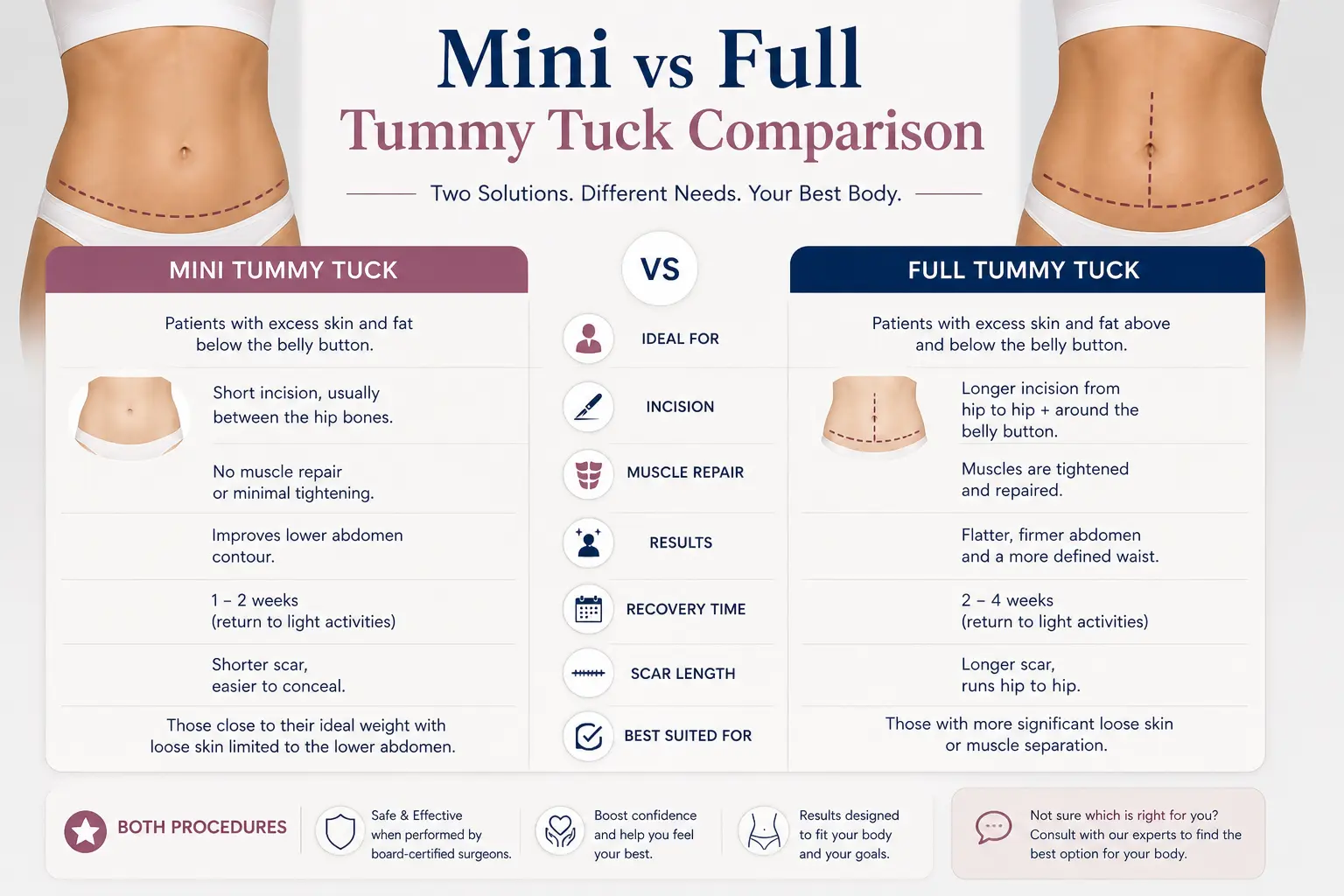
A mini tummy tuck treats only the lower abdomen with a 10-20 cm incision and 1-2 week recovery. A full tummy tuck addresses the entire abdomen, repairs diastasis recti, and repositions the belly button, with a 2-4 week recovery.
What Is the Difference Between a Mini and Full Tummy Tuck?
A mini tummy tuck treats only the lower abdomen through a 10-20 cm incision, with no belly button repositioning and a 1-2 week recovery. A full tummy tuck uses a hip-to-hip incision, repairs diastasis recti, and repositions the navel, with a 2-4 week recovery. The ASPS recorded 171,064 tummy tucks in the US in 2024.
Choosing between the two procedures depends on where your excess skin sits and whether you have diastasis recti.
Research from the NIH shows up to 60% of women develop diastasis recti after pregnancy — a muscle separation that only a full tummy tuck can fully repair.
In Turkey, all-inclusive packages range from £2,900-£3,000 (/$3,600-$3,750/€3,300-€3,450) for a mini to £3,200-£3,800 (/$4,000-$4,750/€3,700-€4,400) for a full, compared to £8,000-£10,000 in the UK.
This guide explains each procedure in detail, compares candidacy criteria, recovery timelines, scar expectations, and costs, so you can make a fully informed decision before your consultation.
Why Trust This Guide
This guide draws on 2024 ASPS statistics (US), NHS abdominoplasty guidance (UK), ISAPS global data, and peer-reviewed literature from the Journal of Plastic and Reconstructive Surgery.
It was medically reviewed by Op. Dr. Alirza Jahangirov, a European Board-Certified Plastic Surgeon with a PhD in Anatomy and 3,500+ procedures performed at Carely Clinic, Istanbul.
Mini Tummy Tuck: What It Does and Who It Is For
A mini tummy tuck removes excess skin below the belly button through a single 10-20 cm incision. It does not reposition the belly button, does not repair upper-abdominal muscle separation, and delivers a faster 1-2 week recovery compared to a full procedure.
The ideal mini tummy tuck candidate is close to their target weight — typically within 5-10 kg — with mild-to-moderate skin laxity confined to the lower abdomen. This profile includes women who have had one or two pregnancies and retained a small lower-abdominal pouch, or patients who have revised a flat-but-loose lower abdomen after moderate weight loss.
Incision and Scar Placement
The mini tummy tuck incision measures 10-20 cm and sits just above the pubic hairline, leaving no scar around the belly button.
Because the incision is shorter than a hip-to-hip cut, scarring is easier to conceal beneath underwear and swimwear. Scar maturation takes 12-18 months. Surgeons can incorporate and revise an existing C-section scar within the same incision zone, which is one reason this procedure appeals to post-partum patients with minimal upper-abdominal concerns.
Muscle Repair (Diastasis Recti)
A mini tummy tuck can tighten lower abdominal muscles but cannot address diastasis recti extending above the belly button.
Diastasis recti is a separation of the rectus abdominis muscles along the midline. NIH-published data reports this condition in up to 60% of postpartum women. If your muscle separation extends above the navel — which a surgeon confirms during physical assessment — a mini tummy tuck will not fully correct it, and a full abdominoplasty is required.
Full Tummy Tuck: What It Does and Who It Is For
A full tummy tuck addresses the entire abdominal wall from the lower ribs to the pubic area. It removes excess skin above and below the navel, repairs diastasis recti through rectus muscle plication, and repositions the belly button in a more natural anatomical position. Recovery takes 2-4 weeks.
Full abdominoplasty is the most common choice for patients who have undergone multiple pregnancies, experienced significant weight loss, or are in the growing post-bariatric and GLP-1 patient group. The operation lasts 2-4 hours under general anaesthesia. A hospital stay of 1-2 nights is standard.
Per a study published in the Journal of Plastic and Reconstructive Surgery, full abdominoplasty with rectus plication can improve back pain and urinary incontinence in postpartum patients in addition to cosmetic outcomes — a functional benefit the mini procedure cannot deliver.
The Post-Pregnancy Patient
Women with diastasis recti, skin above the navel, or a significantly shifted belly button after multiple pregnancies are almost always better suited to the full procedure.
Following multiple pregnancies, the rectus abdominis muscles often separate significantly across the entire midline. Diet and exercise cannot close this gap. A full tummy tuck with muscle plication directly addresses this separation, restoring core stability alongside aesthetics. The Mommy Makeover at Carely Clinic combines abdominoplasty with breast procedures for patients seeking comprehensive post-pregnancy restoration.
The Post-Bariatric or GLP-1 Patient
Patients who have lost 20 kg or more through bariatric surgery or GLP-1 medications typically have excess skin across the full abdomen and require the complete procedure.
With the widespread adoption of GLP-1 receptor agonists such as semaglutide since 2023, a new category of patients is presenting to plastic surgery clinics with significant whole-abdomen skin laxity after rapid weight loss. Per ASPS 2024 data, body contouring procedures following weight loss have risen sharply, and full abdominoplasty with or without liposuction is the standard approach for this group.
Mini Tummy Tuck vs Full Tummy Tuck: 6 Key Differences at a Glance
This table compares both procedures across incision length, treatment zone, muscle repair, navel change, recovery duration, and cost range, enabling a direct, evidence-based comparison before your consultation.
| Factor | Mini Tummy Tuck | Full Tummy Tuck |
|---|---|---|
| Treatment Zone | Below the belly button only | Lower ribs to pubic area (full abdomen) |
| Incision Length | 10-20 cm (above pubic hairline) | Hip-to-hip (35-50 cm) + periumbilical |
| Diastasis Recti Repair | Lower abdomen only | Full midline (rectus plication) |
| Belly Button | Not repositioned | Repositioned and reshaped (neoumbilicoplasty) |
| Surgery Duration | 1-2 hours | 2-4 hours |
| Return to Light Activity | 1-2 weeks | 2-4 weeks |
5 Factors That Determine Which Procedure Is Right for You
The choice between mini and full abdominoplasty is driven by five clinical factors your surgeon assesses at consultation: skin laxity zone, diastasis recti extent, belly button position, weight stability, and future pregnancy plans.
1. Where is your skin laxity? If excess, loose skin is confined entirely below the belly button, a mini tummy tuck may be sufficient. If there is skin laxity above the navel — even a small amount — a full tummy tuck is required to address it.
2. Do you have diastasis recti? A surgeon can assess this through physical examination. Separation of the rectus abdominis muscles extending above the navel cannot be repaired through a mini incision. This single factor rules out the mini procedure for a significant proportion of post-pregnancy patients.
3. Where does your belly button sit? If the navel has migrated downward or is surrounded by loose or stretch-marked skin, it requires repositioning — which is only possible through a full tummy tuck with neoumbilicoplasty.
4. How stable is your weight? Both procedures require weight stability for at least 6 months prior to surgery. Patients whose BMI exceeds 30-32 are advised to reach a stable target weight first. Combined body contouring procedures may be discussed at consultation.
5. Are you planning future pregnancies? ASPS guidelines state explicitly that future pregnancy reverses tummy tuck results by re-stretching skin and muscles. Completing your family before surgery protects the investment of both procedures.
Expert Insight
“Patients frequently request a mini tummy tuck believing it is the safer or simpler option. In my clinical experience, the majority of patients presenting after multiple pregnancies have diastasis recti extending above the navel — making the full procedure the only option that addresses their anatomy completely.”
— Journal of Plastic and Reconstructive Surgery, muscle plication functional outcomes review, 2024
Costs by Country: Mini vs Full Tummy Tuck in £, $ and € (2026)
Turkey offers 60-75% savings versus UK and US prices. All-inclusive Istanbul packages covering surgery, hospital stay, hotel accommodation, and transfers range from £2,900 for a mini to £3,800 for a full tummy tuck in 2026.
| Procedure | Turkey (All-Inclusive) | United Kingdom | United States |
|---|---|---|---|
| Mini Tummy Tuck | £2,900-£3,000 / $3,600-$3,750 / €3,300-€3,450 | £8,900-£10,000 | $8,000-$12,000 |
| Full Tummy Tuck | £3,200-£3,800 / $4,000-$4,750 / €3,700-€4,400 | £10,000-£12,000 | $10,000-$15,000 |
| Full TT + Liposuction | £4,000-£5,000 / $5,000-$6,250 / €4,600-€5,800 | £13,000-£16,000 | $14,000-$20,000 |
Turkey all-inclusive packages typically include: surgery, 1-2 nights hospitalisation, 5-7 nights hotel accommodation, VIP airport transfers, pre-operative tests, compression garment, and post-operative follow-up.
Explore the Carely Clinic tummy tuck package and all-inclusive plastic surgery packages for current pricing.
Recovery Timeline: Mini vs Full Tummy Tuck
Mini tummy tuck recovery spans 1-2 weeks for daily activities and 4-5 weeks for full exercise. Full tummy tuck recovery takes 2-4 weeks before light activity resumes and up to 12 weeks before strenuous exercise. Both require a compression garment for 4-6 weeks.
Mini Tummy Tuck Recovery Week by Week
Most mini tummy tuck patients return to desk work within 7-14 days and resume gentle walking from day 3-5 onward.
- Days 1-3: Rest with elevated positioning. Pain managed with prescribed analgesia. Drains, if placed, are assessed.
- Week 1-2: Showering permitted from day 2-3. Compression garment worn continuously. Short slow walks begin from day 3.
- Week 3-4: Return to office work and light daily activities. Driving resumes when you can perform an emergency stop comfortably.
- Week 5-6: Gentle non-impact exercise resumes. Compression garment worn during exercise.
- Week 8-12: Return to full exercise and gym training.
Full Tummy Tuck Recovery Week by Week
Full tummy tuck patients spend 1-2 nights in hospital, remain in Turkey for 7-10 days for post-operative monitoring, and avoid strenuous exercise for 10-12 weeks.
- Days 1-2 (hospital): 1-2 nights in-patient monitoring. Drains placed; removed on days 3-5.
- Days 3-7 (clinic follow-up): Daily wound checks. Gentle walking encouraged from day 3. Compression garment fitted.
- Week 2-3 (return travel): Most patients fly home between days 7-9 after fit-to-fly clearance.
- Week 3-4: Return to desk work. No lifting over 5 kg.
- Week 6-8: Gentle exercise resumes. Avoid direct abdominal exercise (crunches, planks) for 12 weeks.
- Week 10-12: Full exercise clearance at surgeon’s discretion.
Expert Insight
“Per 2024 ASPS and BAAPS guidance, patients undergoing full abdominoplasty with muscle repair are advised to avoid sit-ups, crunches, and planks for 12 weeks to protect the rectus plication sutures during the critical healing phase.”
— ASPS Body Contouring Recovery Guidelines, 2024
Warning Signs to Watch For After Tummy Tuck Surgery
Contact your surgeon immediately or seek emergency care if you develop fever above 38.5°C, increasing wound pain, redness with warmth, sudden leg swelling, or shortness of breath in the days or weeks following tummy tuck surgery.
Complications from abdominoplasty are uncommon in accredited facilities, but early recognition of warning signs is critical. Most minor discomfort, swelling, and bruising in the first 2-3 weeks is normal. The signs below indicate you need prompt clinical assessment.
| Warning Sign | What It May Indicate | Action Required |
|---|---|---|
| Fever above 38.5°C (101.3°F) | Wound or internal infection | Contact surgeon same day; attend nearest A&E if unavailable |
| Sudden swelling, redness, and warmth at incision site | Local wound infection or haematoma | Urgent surgical review; do not apply heat or massage the area |
| Fluid accumulation under the skin (soft swelling after drain removal) | Seroma (fluid collection) — the most common complication post-abdominoplasty | Contact clinic for drainage assessment within 24-48 hours |
| Wound separation (edges of incision opening) | Dehiscence — may be caused by tension, infection, or poor healing | Cover with a clean dry dressing and contact surgeon immediately |
| Sudden calf pain, leg swelling, or redness in one leg | Deep vein thrombosis (DVT) | Call 999 (UK) or 911 (US) or attend emergency department immediately |
| Sudden chest pain, shortness of breath, or rapid heart rate | Pulmonary embolism (blood clot in lungs) — a surgical emergency | Call emergency services immediately — do not wait for a clinic callback |
Who Is NOT a Good Candidate for a Tummy Tuck?
Tummy tuck surgery — mini or full — is not appropriate for active smokers, patients with unstable weight or BMI above 35, women planning future pregnancies, or those with uncontrolled systemic health conditions. A board-certified surgeon assesses contraindications at your pre-operative consultation. — 37w ✓
Absolute Contraindications
These conditions mean the procedure cannot safely proceed until the underlying issue is resolved or the patient’s health status changes.
Tummy tuck surgery cannot be performed in these circumstances:
- Uncontrolled diabetes (HbA1c above 7.5-8%): Elevated blood sugar significantly impairs wound healing and increases infection risk. Per ASPS guidelines, patients should optimise glycaemic control before being listed for elective surgery.
- Active or recent deep vein thrombosis: A history of DVT or pulmonary embolism within 12 months requires haematology review and clearance before any major body-contouring procedure.
- Severe cardiovascular disease or recent cardiac event: Abdominoplasty under general anaesthesia is an ASA Class III or above procedure in patients with significant cardiac history; cardiology clearance is required.
- Active malignancy: Elective cosmetic surgery is contraindicated in patients currently undergoing treatment for cancer.
- Severe obesity (BMI above 35): Tissue perfusion, wound healing, and anaesthetic risk are all significantly compromised above this threshold.
Relative Contraindications
These factors do not automatically exclude surgery but require optimisation, additional planning, or specialist clearance before proceeding.
These cases may allow the procedure after optimisation:
- Active smoker: Nicotine causes vasoconstriction and significantly impairs flap healing. Surgeons typically require 4-6 weeks of smoking cessation before and after surgery. NHS and ASPS guidelines both list smoking as a major risk modifier for abdominoplasty.
- BMI 30-35: Patients in this range are advised to achieve greater weight stability. Many surgeons set a BMI ceiling of 30 for optimal outcomes. Weight loss of even 5-10 kg before surgery often improves results and reduces complications.
- Autoimmune conditions on immunosuppressants: Medications such as methotrexate or prednisolone can impair healing. A rheumatology or GP review is needed prior to listing.
- Previous abdominal surgery with significant scarring: Prior caesarean sections, laparotomies, or liposuction alter the abdominal blood supply (perforator pattern). Your surgeon uses anatomical assessment to plan incisions accordingly.
Managing Expectations
A tummy tuck improves contour and function but is not a weight-loss procedure and does not prevent future skin changes from weight fluctuation or pregnancy.
Results of both procedures are long-lasting when body weight remains stable. Significant weight gain — typically 10 kg or more — can re-stretch skin and partially reverse outcomes. Scar maturation takes 12-18 months; final results are not fully visible until this period has passed. For patients combining abdominoplasty with liposuction, the dual-procedure approach enhances contour but adds to recovery time.
How This Applies in Turkey
Turkey performs over 45,000 abdominoplasties annually, ranking fourth globally by volume. Istanbul clinics offer all-inclusive mini and full tummy tuck packages at 60-75% below UK and US prices, without compromising European Board certification standards.
Turkey has become one of the highest-volume destinations globally for abdominoplasty, according to ISAPS data. Many Turkish plastic surgeons hold dual credentials: EBOPRAS (European Board of Plastic, Reconstructive and Aesthetic Surgery) and membership of the International Society of Aesthetic Plastic Surgery (ISAPS) — the same international standard applied in the UK and EU. JCI-accredited hospital facilities in Istanbul apply infection control, staffing, and equipment standards comparable to Western European centres.
For UK and US patients, the financial case is significant. An all-inclusive full tummy tuck in Istanbul — covering surgery, 1-2 nights hospitalisation, 5-7 nights hotel accommodation, VIP transfers, pre-operative tests, compression garment, and follow-up — typically costs £3,200-£3,800 (/$4,000-$4,750/€3,700-€4,400). The equivalent procedure in the UK starts from £10,000-£12,000 and in the US from $10,000-$15,000, without the accommodation and transport components included.
Op. Dr. Alirza Jahangirov at Carely Clinic is European Board-Certified with a PhD in Anatomy and 3,500+ procedures performed. His academic background in anatomy allows precise incision planning that optimises scar concealment and tissue perfusion — particularly relevant for patients combining mini or full abdominoplasty with body contouring procedures.
When Can You Fly After Tummy Tuck in Turkey?
Fit-to-fly clearance after a full tummy tuck is typically granted on day 6-9 once drains are removed and mobility is stable. Mini tummy tuck patients are often cleared from day 5. — 24w ✓
All international patients are advised to plan a minimum 7-10 day stay in Istanbul to allow for post-operative monitoring before the return flight. During travel, compression stockings are mandatory and short walks every 1-2 hours are recommended to reduce DVT risk on long-haul flights back to the UK, US, or Europe.
Learn more about Tummy Tuck at Carely Clinic Istanbul.
Frequently Asked Questions
What is the difference between a mini and full tummy tuck?
A mini tummy tuck treats only the lower abdomen through a 10-20 cm incision below the belly button. A full tummy tuck uses a hip-to-hip incision, repairs diastasis recti, and repositions the belly button. The right choice depends on where your skin laxity is and whether muscle separation needs repair.
How do I know if I need a mini or full tummy tuck?
You likely need a full tummy tuck if excess skin or muscle separation extends above your belly button. A surgeon assesses skin laxity zones, diastasis recti severity, and belly button position to determine which procedure fits. A pre-operative assessment with a board-certified plastic surgeon is the definitive way to confirm which procedure suits you.
Is a mini tummy tuck worth it?
A mini tummy tuck delivers real results for patients whose skin concerns are limited to below the navel. Its advantages include a shorter scar (10-20 cm vs hip-to-hip), a 1-2 week recovery, and lower cost. However, patients with upper abdominal laxity or diastasis recti consistently report better outcomes from a full tummy tuck.
How long is recovery from a mini tummy tuck vs full tummy tuck?
A mini tummy tuck recovery typically takes 1-2 weeks for light activity and 4-5 weeks for full exercise. A full tummy tuck needs 2-4 weeks off work and up to 12 weeks before strenuous exercise resumes. Both procedures require wearing a compression garment for 4-6 weeks to minimise swelling and support the healing tissues.
Can a mini tummy tuck fix diastasis recti?
A mini tummy tuck does not repair diastasis recti above the belly button, which is its primary limitation. NIH data shows 60% of postpartum women develop diastasis recti, correctable only through full abdominoplasty with muscle plication. Patients with upper abdominal muscle separation need a full tummy tuck with rectus plication for complete, lasting repair.
Will a mini tummy tuck remove my C-section scar?
A mini tummy tuck can revise or improve a C-section scar, as both incisions sit in the same area. Surgeons remove the scar-bearing skin, replacing it with one flat incision line concealed within the bikini area. Significant upper abdominal skin laxity above the navel requires a full tummy tuck for comprehensive aesthetic improvement.
What are the scars like after a mini vs full tummy tuck?
A mini tummy tuck leaves a 10-20 cm scar just above the pubic line, without any scar around the navel. A full tummy tuck creates a hip-to-hip scar plus a small scar around the repositioned belly button. Both scars mature and fade over 12-18 months and are typically concealed by underwear and swimwear.
How much cheaper is a mini tummy tuck than a full tummy tuck?
In the UK, a mini tummy tuck starts around £8,900, while a full tummy tuck starts from approximately £10,900. In Turkey, all-inclusive packages range from £2,900-£3,000 for a mini to £3,200-£3,800 for a full abdominoplasty. Turkey offers 60-75% savings versus UK and US prices, making Istanbul a popular destination for both procedures.
Can I combine a tummy tuck with liposuction?
Both mini and full tummy tucks are commonly combined with liposuction to refine the flanks, hips, and waist.ASPS reports that liposuction combined with abdominoplasty is among the five most common body-contouring procedure pairings performed. Your surgeon will assess whether combined procedures are safe and appropriate based on your BMI and overall health.
When can I fly after a tummy tuck in Turkey?
Fit-to-fly clearance after a full tummy tuck is typically granted on day 6-9, once drains are removed. Mini tummy tuck patients without drains are often cleared to fly from day 5 post-surgery. Compression stockings and short walks every 1-2 hours are recommended throughout the return flight to reduce DVT risk.
Who is not a good candidate for a tummy tuck?
Patients with BMI above 35, active smokers, and women planning future pregnancies are poor tummy tuck candidates. Per ASPS guidelines, pregnancy after a tummy tuck reverses muscle repair and skin tightening, requiring revision surgery. Uncontrolled diabetes, active heart disease, and severe blood-clotting disorders are absolute medical contraindications for the procedure.
What happens if I get pregnant after a tummy tuck?
Pregnancy after a tummy tuck stretches the repaired skin and muscles, potentially reversing the surgical results.ASPS guidelines recommend completing your family before undergoing abdominoplasty to preserve long-term outcomes. Revision surgery is possible after a post-tummy tuck pregnancy but adds cost, recovery time, and surgical complexity.
Conclusion
Choose based on anatomy, not appeal. A mini suits lower-only laxity; a full tummy tuck addresses diastasis recti and upper skin. Both are available in Istanbul from £2,900-£3,800, with European Board-Certified surgeons and JCI-accredited hospitals.
The decision between a mini and full tummy tuck comes down to three clinical facts: where your skin laxity sits, whether diastasis recti is present, and your recovery tolerance. A mini tummy tuck is an appropriate, effective procedure for patients with mild-to-moderate lower abdominal skin excess and no significant muscle separation. A full tummy tuck is the appropriate procedure for post-pregnancy patients with diastasis recti, patients with upper abdominal laxity, and those who have lost significant weight.
The ASPS recorded 171,064 abdominoplasties in the US in 2024 — a procedure volume that reflects decades of refinement and strong patient satisfaction. Turkey’s Istanbul-based clinics perform these procedures at 60-75% below UK and US costs, within JCI-accredited hospitals, under surgeons holding European Board certification.
Your next step is a consultation with a board-certified plastic surgeon to confirm which procedure matches your anatomy and goals. At Carely Clinic, Op. Dr. Alirza Jahangirov offers free initial consultations — in person in Istanbul or via video call for UK and US patients.
Book your free consultation at Carely Clinic.
Individual outcomes vary. This guide provides general medical education based on international guidelines and published research. Consult qualified medical professionals for personalised advice.
Medical Review: Op. Dr. Alirza Jahangirov