
Quick Summary
Most patients recover from a tummy tuck in 6 weeks for daily function and 3-6 months for final visible results. The first 2 weeks are the most demanding: drains are removed by day 5-7, desk work resumes around day 10-14, and compression garments are worn for 6-8 weeks.
The Aesthetic Society recorded 148,301 US abdominoplasties in 2024, and ASPS (US) alongside NHS guidance (UK) both confirm that adherence to post-operative protocols significantly reduces complication risk.
This guide covers every recovery stage — from day 1 through 12 months — plus warning signs, contraindications, and flying logistics for international patients.
How Long Does Tummy Tuck Recovery Take?
A tummy tuck (abdominoplasty) recovery takes 6 weeks for daily function and 3-6 months for final visible results. The Aesthetic Society recorded 148,301 procedures in the US in 2024, and ASPS ranks abdominoplasty consistently in the top 5 cosmetic surgeries. Most patients return to desk work within 10-14 days and gain full exercise clearance at 6 weeks.
NHS guidance and ASPS both recommend wearing a compression garment for 6-8 weeks post-surgery. For international patients in Istanbul, surgical drains are removed by days 3-5 and fit-to-fly clearance is typically granted between days 7-10, depending on individual healing and drain output.
Recovery speed varies by procedure type, health status, and adherence to post-operative instructions. A full tummy tuck with muscle repair heals more slowly than a mini abdominoplasty.
Why Trust This Guide
This guide draws on 2024-2026 clinical data from the American Society of Plastic Surgeons (ASPS), The Aesthetic Society (US), and NHS guidance (UK), alongside peer-reviewed research published in Plastic and Reconstructive Surgery.
It is medically reviewed by Op. Dr. Alirza Jahangirov, European Board-Certified Plastic Surgeon and PhD in Anatomy at Carely Clinic Istanbul, who has performed 3,500+ procedures. This content provides general education; it does not replace a personalised consultation.
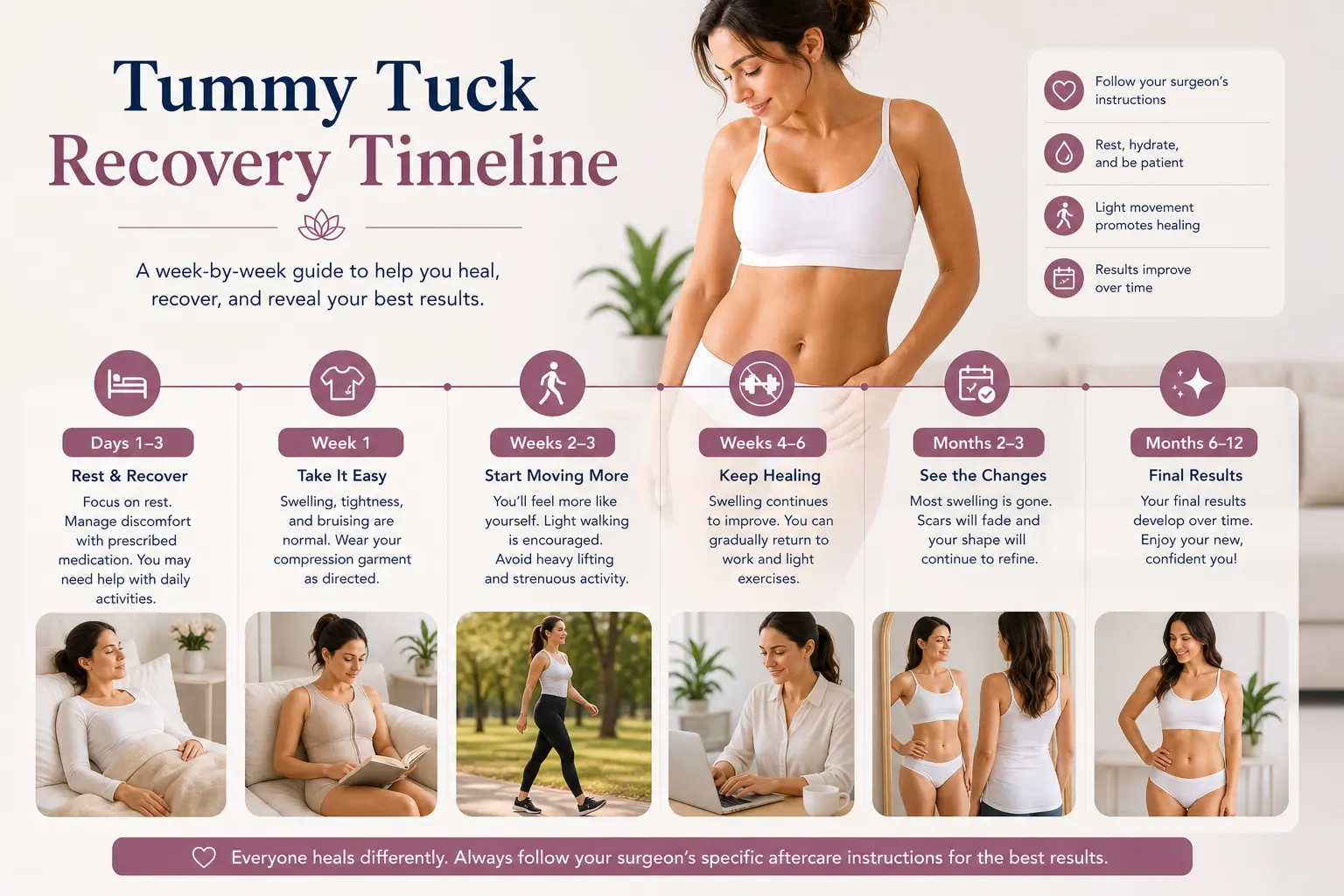
Tummy Tuck Recovery Timeline: Week by Week
Recovery from abdominoplasty follows five distinct phases over 12 months. Each phase brings specific milestones — from drain removal in week 1 to scar maturation at month 12. Understanding each phase helps you plan work leave, travel, and activity resumption with accuracy.
The timeline below applies to a standard full abdominoplasty with muscle plication (diastasis recti repair). Mini tummy tucks follow a faster course; extended or combined procedures may take longer. Your surgeon will confirm a personalised schedule at your pre-operative consultation.
| Phase | Key Milestones | Activity Level | What to Expect |
|---|---|---|---|
| Days 1-3 | Discharge home; drain management begins | Bed rest + short walks only | Peak swelling, bent posture, prescription pain relief |
| Days 4-7 | Drain removal (days 3-5); first follow-up appointment | Light indoor walking | Bruising visible; beginning to stand more upright |
| Weeks 2-3 | Return to desk work (day 10-14); suture removal | Light daily activity; no lifting over 5 kg | Swelling subsides; bruising fades; OTC pain relief adequate |
| Weeks 4-6 | Exercise clearance at week 6; compression garment transition to daytime-only | Walking, light cycling; no core work until week 6 | Contour becomes visible; tightness decreasing; scar forming |
| Months 2-6 | Swelling fully resolved; final shape visible by month 6 | Full exercise including core training | Scar lightening progresses; fitted clothing comfortable |
| Month 12+ | Scar maturation complete; final aesthetic result established | Unrestricted | Incision line pale and flat; results long-term with stable weight |
Days 1-3: Immediate Post-Surgery
Days 1-3 are the most physically demanding, with swelling at its peak and mobility limited to short, supported walks around the home.
What it feels like. You will be discharged home on the day of surgery or the following morning, depending on your procedure complexity. Swelling and bruising are pronounced, and you will naturally adopt a slightly bent posture to avoid tension on the incision line. This is normal and expected — do not attempt to stand fully upright until your body allows it naturally.
Pain management. Prescription analgesics manage discomfort during this window. Swelling peaks around day 3, and most patients describe the sensation as tightness rather than acute pain. Sleeping in a semi-reclined position, with the upper body elevated at 30-45 degrees and knees slightly bent, reduces tension on the abdominal wall.
Circulation is critical. Short, gentle walks beginning on day 1 significantly reduce the risk of deep vein thrombosis (DVT). The Cleveland Clinic confirms that early mobilisation after abdominal surgery is one of the most evidence-based strategies for preventing post-operative blood clots.
Days 4-7: Drain Removal and First Movement
Surgical drains are typically removed between days 3-5 when output drops below the threshold set by your surgeon, usually below 30 ml per 24 hours.
Drain removal marks a significant comfort milestone. Movement becomes easier, and the bent posture begins to ease. Your first formal follow-up appointment usually occurs during this window, during which wound integrity, drain sites, and swelling are assessed.
International patients at Carely Clinic planning to return home should be aware that fit-to-fly clearance cannot be issued until drains are removed and the wound is deemed stable. Most patients receive this clearance between days 7-10.
Weeks 2-3: Returning to Light Activity
Weeks 2-3 bring a marked improvement in comfort: bruising fades, swelling reduces significantly, and most patients transition to over-the-counter pain relief by day 10.
Patients in desk-based roles typically return to work during this phase, working from home where possible for added comfort. Driving is usually permitted from weeks 2-3, once the patient can perform an emergency stop without hesitation and is no longer taking prescription opioids.
Lifting restrictions remain. Nothing heavier than 5 kg (11 lbs) should be lifted during weeks 2-3. This applies equally to shopping bags, children, and pets. Premature lifting is among the most common causes of seroma formation — fluid accumulation under the skin that may require drainage.
Weeks 4-6: Shape Emerges and Exercise Begins
Between weeks 4-6, residual swelling continues to resolve and the new abdominal contour becomes increasingly visible, motivating many patients as they near full activity clearance.
By week 4, most patients are walking upright comfortably and feel close to their pre-surgery self in daily function. Scar tissue forms visibly at this stage — scars will appear pink and slightly raised, which is normal. The incision line sits below the bikini line and typically measures hip-to-hip for a full abdominoplasty.
Exercise clearance at week 6. Per ASPS post-operative guidelines, core exercises, abdominal planks, and weight training are typically cleared at the 6-week mark. Light cardio, such as walking and swimming, is usually approved earlier if healing is progressing well. Always seek explicit clearance from your surgeon before resuming any specific exercise.
Months 2-6: Final Results and Scar Maturation
By months 2-6, residual swelling has fully resolved for most patients, revealing the final abdominal contour — including tightened muscle repair and improved waistline definition.
Per data published in Plastic and Reconstructive Surgery, approximately 90% of post-operative swelling resolves by the 3-6 month mark. Patients report feeling comfortable in fitted clothing and swimwear during this phase.
Scar management. Silicone gel sheets, scar massage, and high-SPF sun protection on the incision line are the three most evidence-supported strategies for minimising long-term scar visibility. Scar lightening continues for 12-18 months following surgery as collagen remodelling completes.
5 Factors That Affect Your Recovery Speed
Recovery from a tummy tuck is not a fixed timeline — five key variables directly influence whether your healing progresses faster or slower than the average. Understanding them allows you to optimise your recovery from the moment you book your surgery.
Procedure Type (Full vs Mini vs Extended)
A mini tummy tuck targets only the lower abdomen with no muscle repair, resulting in a shorter recovery of 3-4 weeks compared to 6 weeks for a full abdominoplasty.
A mini tummy tuck requires 3-4 weeks of recovery; a full abdominoplasty with muscle repair typically requires 6 weeks before full activity is resumed.
An extended tummy tuck, which addresses the flanks and lateral hips in addition to the central abdomen, carries the longest healing curve — typically 8 weeks or more for full functional recovery. Combination procedures, such as a tummy tuck performed alongside liposuction or a mommy makeover, also extend recovery duration and require more complex post-operative care.
Muscle Repair (Diastasis Recti Correction)
Repairing separated abdominal muscles (diastasis recti) adds meaningful recovery complexity, as the repaired muscles must heal before any core exercise or heavy lifting is safe.
Diastasis recti — separation of the rectus abdominis muscles following pregnancy or significant weight gain — is corrected via plication (internal suturing) during a full tummy tuck. This muscle repair is responsible for much of the tightness and mobility restriction in weeks 1-3. It also means that core exercise clearance at week 6 must be respected strictly, regardless of how well you feel.
BMI and Skin Condition at Time of Surgery
Patients closer to their goal weight at the time of surgery heal faster, with reduced seroma risk and better skin retraction than patients with significantly elevated BMI.
ASPS recommends that patients undergoing abdominoplasty be at or near a stable goal weight. Active weight loss after surgery can compromise results, while significant excess weight at the time of surgery is associated with higher rates of wound complications, seroma formation, and prolonged swelling. Skin quality, elasticity, and thickness also affect how quickly the tissue redrapes and heals post-operatively.
Smoking and Medication Status
Smoking significantly impairs wound healing by reducing tissue oxygenation — most surgeons require complete cessation at least 6 weeks before and after abdominoplasty.
Cleveland Clinic and ASPS both categorise smoking as a major modifiable risk factor for tummy tuck complications, including tissue necrosis, wound dehiscence, and delayed healing. Blood thinners, NSAIDs, and certain herbal supplements also affect bleeding risk and should be reviewed with your surgeon at least 2 weeks before surgery.
Post-Operative Compliance
Patients who follow all post-operative instructions, including garment wear, activity limits, and follow-up attendance, heal faster and achieve better results than those who do not.
The most common compliance failures are premature lifting, neglecting compression garment wear, and returning to exercise before clearance. Each of these increases the risk of seroma, wound tension, and delayed scar maturation.
At Carely Clinic, every patient receives a written post-operative protocol before discharge, and a clinical coordinator is available around the clock to answer recovery questions via WhatsApp.
What to Expect from Drains and Compression Garments
Two post-operative tools have the greatest direct impact on your comfort and healing speed: surgical drains, which remove fluid accumulation in the first week, and compression garments, which support healing tissue for 6-8 weeks following surgery.
Surgical Drains: What They Do and When They Come Out
Surgical drains prevent seroma (fluid accumulation) by evacuating fluid from the surgical site during the first 3-5 days after abdominoplasty.
Drains are small, flexible tubes placed under the skin during surgery. They exit through small incisions near the main wound and connect to a collection bulb. You or your carer will empty these bulbs 1-2 times daily and record the output. Drain removal occurs when output drops below the threshold set by your surgeon — typically 25-30 ml per 24 hours — and usually takes place between days 3-5 post-surgery.
Some surgeons use “progressive tension sutures” (PTS), a technique that eliminates the need for drains by closing the tissue in layers to prevent fluid space formation. Ask your surgeon whether this technique is appropriate for your anatomy.
Compression Garments: Protocol and Duration
A medical-grade compression garment reduces swelling, prevents seroma, and supports the healing abdominal wall throughout the 6-8 week post-operative period.
NHS recovery guidance and ASPS both recommend wearing a supportive compression garment to reduce swelling and support the healing abdominal wall. The standard protocol at Carely Clinic follows a two-stage approach: 24-hour wear for the first 3 weeks, then daytime-only wear through week 8. Medical-grade two-stage garments, costing approximately £80-£120 ($100-$150), are included in all Carely Clinic abdominoplasty packages.
Expert Insight
“Compression garment compliance is the single most controllable factor in swelling management after abdominoplasty. Patients who wear their garment consistently — even when it feels uncomfortable — have measurably less seroma risk and better early contour definition.”
— ASPS Post-Operative Care Guidelines, 2024
Warning Signs to Watch For After Abdominoplasty
Most tummy tuck complications are manageable when identified early. Contact your surgeon or seek emergency care immediately if you notice any of the warning signs listed below — do not wait until your next scheduled appointment.
Abdominoplasty has a higher complication rate than many other cosmetic procedures when performed in combination with additional surgeries, as confirmed by a peer-reviewed analysis in Plastic and Reconstructive Surgery. However, major complications remain uncommon in healthy patients treated by board-certified plastic surgeons. Vigilance during the first 2 weeks is the most effective prevention strategy.
| Warning Sign | What It May Indicate | Action Required |
|---|---|---|
| Fever above 38.5°C (101.3°F) | Wound infection or deep tissue infection | Contact your surgeon same day; may require antibiotics or drainage |
| Wound separation or opening | Dehiscence — failure of incision closure | Do not attempt to close yourself; contact clinic immediately |
| Firm, fluctuant swelling under the skin | Seroma (fluid accumulation) or haematoma (blood collection) | Clinic review within 24 hours; may require needle aspiration |
| Increasing redness, heat, or pus at incision | Surgical site infection | Same-day medical review; photograph and send to your surgeon |
| Sudden increase in pain after initial improvement | Haematoma, seroma, or internal bleeding | Emergency clinic contact; do not wait for scheduled appointment |
| Calf pain, swelling, or warmth in one leg | Deep vein thrombosis (DVT) | Emergency department immediately; do not delay |
| Shortness of breath or chest pain | Pulmonary embolism — a medical emergency | Call emergency services (999 / 911 / 112) immediately |
| Tissue discolouration (dark purple or black) at incision | Possible tissue necrosis (compromised blood supply) | Urgent surgical review within hours; photograph and contact clinic |
Who Is NOT a Good Candidate for a Tummy Tuck?
A tummy tuck produces the best outcomes in stable, healthy patients at or near their goal weight. Certain medical conditions and lifestyle factors create contraindications that must be assessed and addressed before surgery can proceed safely.
Absolute Contraindications
These conditions make abdominoplasty unsafe at any point; surgery cannot proceed without resolution or medical optimisation of the underlying issue.
The procedure cannot be performed in these cases:
- Active smoking within 6 weeks of surgery: Nicotine significantly impairs wound healing by causing microvascular constriction and reducing tissue oxygenation. ASPS and Cleveland Clinic both require complete cessation for a minimum of 6 weeks pre-operatively and 6 weeks post-operatively. Patients who continue smoking face dramatically elevated risks of necrosis, wound breakdown, and infection.
- Active cancer or recent chemotherapy/radiotherapy: Compromised immune function and altered tissue healing make surgery hazardous and outcomes unpredictable. Medical clearance from a treating oncologist is required before any elective surgery can be considered.
- Severe uncontrolled cardiovascular disease: Patients with uncontrolled hypertension, recent myocardial infarction (within 6 months), or unstable angina are not suitable for elective general anaesthesia. A cardiologist assessment and formal clearance are mandatory prerequisites.
- Active blood clotting disorder (unmanaged): Untreated coagulopathies create unacceptable haematoma and DVT risk under general anaesthesia. Medical management must be optimised before any body contouring surgery is undertaken.
Relative Contraindications
These conditions may allow surgery following optimisation — many can be addressed with pre-operative preparation, weight loss, or specialist clearance before booking.
These cases may allow the procedure after optimisation:
- BMI above 35: Significantly elevated BMI is associated with higher rates of wound complications, seroma formation, and anaesthetic risk. ASPS recommends that patients be at a stable weight close to their goal before abdominoplasty. A BMI reduction programme prior to surgery improves outcomes and reduces complication risk. Bariatric surgery may be appropriate for patients with significant excess weight before considering body contouring — explore weight loss surgery options at Carely Clinic.
- Poorly controlled type 2 diabetes: Elevated blood glucose impairs wound healing and increases infection risk. Pre-operative HbA1c optimisation, ideally below 7.5%, is required. With good glucose control, diabetic patients can undergo abdominoplasty safely.
- Previous abdominal surgery with significant scarring: Prior caesarean section, appendectomy, or other abdominal procedures may alter tissue anatomy and blood supply. A board-certified plastic surgeon can assess scar locations and plan incisions to minimise complications, but patients should be counselled that healing may be less predictable.
- Future pregnancy planned: As noted by ASPS, pregnancy after abdominoplasty can partially reverse results by stretching repaired muscles and loosened skin. Surgery is best performed after completing your family.
Managing Expectations
A tummy tuck is a body contouring procedure, not a weight-loss surgery — patients who understand this distinction achieve greater satisfaction with their long-term results.
A tummy tuck removes excess skin and repairs muscle separation; it does not substitute for continued healthy lifestyle habits. Weight gain after surgery can diminish results, and significant fluctuations in body weight — including pregnancy — may necessitate revision surgery. The procedure delivers measurably high satisfaction rates: abdominoplasty has the highest patient-reported satisfaction among the most popular cosmetic procedures in the US, per the Aesthetic Society’s 2022 data.
Op. Dr. Jahangirov notes that among international patients travelling to Istanbul from the UK and USA, the most frequent pre-operative preparation gap is inadequate time allocated for medical optimisation — particularly smoking cessation and weight stabilisation. Patients who arrive at surgery well-prepared with stable weight, no nicotine use, and optimised medical conditions consistently achieve cleaner healing and shorter overall recovery periods.
How This Applies in Turkey
Istanbul is among Europe’s most active abdominoplasty destinations. Packages at Carely Clinic cover surgery, hospital stay, compression garment, transfers, and aftercare, with fit-to-fly clearance issued between days 7-10.
Turkey has become one of the leading international destinations for abdominoplasty, drawing patients from across the UK, USA, and Europe. ISAPS global data consistently places Turkey among the world’s top 5 destinations for cosmetic plastic surgery by volume. Istanbul’s surgical centres perform thousands of abdominoplasties annually for international patients, with surgeons trained to the standards of EBOPRAS (European Board of Plastic Reconstructive and Aesthetic Surgery) and TPCD (Turkish Society of Plastic, Reconstructive and Aesthetic Surgeons).
Cost comparison. A full tummy tuck in London or New York typically costs £10,000-£15,000 ($12,500-$19,000) in private practice. All-inclusive packages in Istanbul for the same procedure range from £3,200-£3,800 ($4,000-$4,800 / €3,450-€4,000), representing a 50-70% saving. Carely Clinic packages include surgery, one night of hospital care, a medical-grade compression garment (valued at £80-£120 / $100-$150), private airport transfers, and a dedicated aftercare coordinator throughout recovery.
What to expect as an international patient. Most patients from the UK and USA fly to Istanbul for a total stay of 7-10 days. Surgery takes place on day 1-2 of the visit. Drains are removed on days 3-5. A formal wound review and fit-to-fly clearance assessment is carried out between days 7-10 before the return journey. Op. Dr. Jahangirov reviews every international patient personally and participates in video consultations pre-operatively to ensure that anatomy, candidacy, and recovery planning are established in advance.
Learn more about tummy tuck surgery at Carely Clinic.
When Can You Fly After a Tummy Tuck?
Most patients travelling to Istanbul receive fit-to-fly clearance between days 7-10 after surgery, following drain removal and a formal wound assessment by their surgeon.
NHS travel guidance and international surgical protocols both recommend compression stockings and regular in-flight walking to reduce DVT risk on long-haul journeys post-surgery. For UK patients flying from Istanbul (approximately 3.5-4 hours), the DVT risk is lower than for transatlantic routes, but compression garment wear and hourly movement from seat during the flight remain standard advice.
Patients flying back to the USA (transatlantic, 10-12 hours) should discuss extended DVT prophylaxis with their surgeon — this may include low-molecular-weight heparin injections for the return journey in higher-risk individuals. Compression stockings rated at 20-30 mmHg are recommended for all post-operative flights.
Expert Insight
“Every patient’s fit-to-fly timeline is individualised. We do not issue clearance based on a calendar date alone — we base it on drain output, wound integrity, mobility assessment, and swelling status. The 7-10 day window covers the majority of our patients, but we have extended stays when the clinical picture requires it.”
— Op. Dr. Alirza Jahangirov, Carely Clinic Istanbul
Frequently Asked Questions
How long does tummy tuck recovery take?
Full functional recovery from a tummy tuck takes approximately 6 weeks for most patients. ASPS data from 2024 confirms that most patients return to desk work within 2 weeks of surgery. Final aesthetic results, including scar maturation, can take 12 months or more to fully develop.
How long does swelling last after a tummy tuck?
Initial post-operative swelling peaks around day 3 and begins to subside significantly by week 4. Mayo Clinic notes that residual swelling after abdominoplasty can persist for 3-6 months in most patients. Wearing a compression garment for 6-8 weeks, as recommended by ASPS, significantly reduces swelling duration and discomfort.
When can I return to work after a tummy tuck?
Most patients with desk jobs can return to work 10-14 days after a tummy tuck. Physically demanding roles requiring lifting or prolonged standing typically require 4-6 weeks off, per ASPS guidance. Returning earlier than recommended increases the risk of wound complications, including seroma formation and delayed healing.
When can I exercise after a tummy tuck?
Light walking is encouraged from day 1 post-surgery to reduce the risk of blood clots. Per ASPS post-operative guidelines, core exercises and weight training are cleared at approximately 6 weeks after surgery. High-impact activities, such as running, should be reintroduced gradually with the explicit approval of your surgeon.
What is the most painful stage of tummy tuck recovery?
Days 1-3 post-surgery are the most uncomfortable, with swelling and abdominal tightness peaking around day 3.Cleveland Clinic confirms prescription pain medication is generally required only during the first 5-7 days post-surgery. By week 2, most patients manage discomfort with over-the-counter analgesics and report significantly improved mobility.
How long do you wear a compression garment after a tummy tuck?
Most surgeons prescribe a compression garment for a minimum of 6 weeks following tummy tuck surgery. NHS recovery guidance recommends wearing a supportive compression garment to reduce swelling and support the healing abdominal wall. Medical-grade two-stage garments, costing approximately £80-£120 ($100-$150), are commonly included in all-inclusive surgical packages.
What are warning signs of complications after a tummy tuck?
Fever above 38.5 degrees C, sudden increased pain, or wound separation all require immediate medical attention after abdominoplasty. Cleveland Clinic identifies haematoma, seroma, and deep vein thrombosis as the most serious early post-operative complications. Sudden shortness of breath or calf swelling after tummy tuck surgery requires same-day emergency medical assessment.
When can you fly after a tummy tuck?
Most surgeons issue fit-to-fly clearance between 7-10 days after tummy tuck surgery for international patients.NHS travel guidance recommends compression stockings and regular in-flight walking to reduce DVT risk on long-haul journeys post-surgery. Planning a 7-10 day stay in Istanbul allows for drain removal, wound assessment, and formal fit-to-fly clearance.
How long until you see tummy tuck results?
Early tummy tuck results become visible around weeks 3-4 as initial swelling subsides and contour definition improves. Per Plastic and Reconstructive Surgery journal data, approximately 90% of residual swelling resolves by the 3-6 month mark. Incision scars continue lightening and flattening for 12-18 months as collagen remodelling completes after abdominoplasty.
What should I avoid during tummy tuck recovery?
Avoid lifting anything heavier than 5 kg (11 lbs) for the first 4-6 weeks following tummy tuck surgery. ASPS post-operative guidelines advise against smoking, alcohol, and strenuous activity during the first 6 weeks of recovery. Stomach sleeping and sun exposure on the incision are both contraindicated for the first 6-8 weeks post-abdominoplasty.
Does tummy tuck recovery hurt?
Most patients experience moderate discomfort, typically rated 4-6 out of 10, during the first 5-7 days post-surgery.Cleveland Clinic confirms that most patients transition from prescription pain medication to over-the-counter analgesics by day 7 post-surgery. Abdominal tightness and a pulling sensation often persist for several weeks as repaired muscles and tissues gradually heal.
Can you have a tummy tuck if you plan to have more children?
Most plastic surgeons advise completing your family before undergoing a tummy tuck for the best long-term results. ASPS notes that pregnancy after abdominoplasty can stretch repaired muscles and loosen skin, potentially reversing results. Abdominoplasty does not affect fertility, but results should be reassessed 6-12 months postpartum if pregnancy occurs afterwards.
Conclusion
Tummy tuck recovery follows a predictable 6-week functional timeline and a 3-6 month aesthetic timeline. Preparation, compression garment compliance, and early gentle walking are the three factors that most influence your outcome.
The practical milestones are clear: drain removal by days 3-5, desk work by days 10-14, full exercise clearance at week 6, and final visible results by months 3-6. Scar maturation continues for 12-18 months. The 2024 data from The Aesthetic Society confirms abdominoplasty delivers the highest patient-reported satisfaction of any major cosmetic surgical procedure — and that outcome is largely determined by recovery quality, not surgery alone.
For international patients choosing Istanbul, the 7-10 day stay model at Carely Clinic is designed to cover every critical milestone before you fly home: drain removal, wound checks, compression garment fitting, and formal fit-to-fly clearance. Op. Dr. Jahangirov reviews every patient at each post-operative assessment to ensure your recovery is on track.
If you are considering a tummy tuck and want to understand whether you are a good candidate, request a free consultation at Carely Clinic — consultations include a personalised recovery plan and estimated timeline before you commit to surgery.
Individual outcomes vary. This guide provides general medical education based on international guidelines and published research. Consult qualified medical professionals for personalised advice.
Medical Review: Op. Dr. Alirza Jahangirov