
Quick Summary:
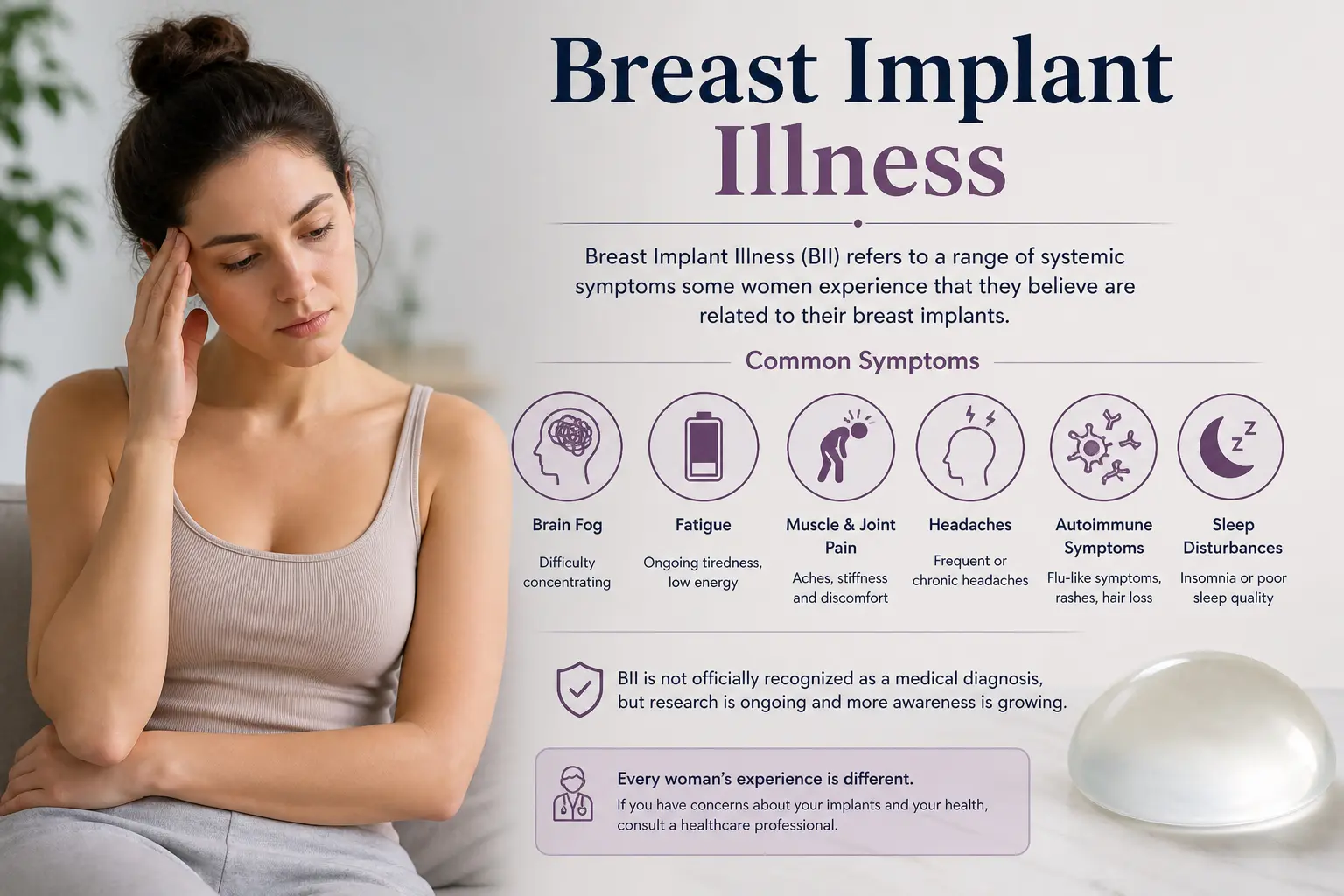
Breast implant illness (BII) describes a cluster of systemic symptoms — including fatigue, brain fog, joint pain, and hair loss — that some people report after receiving breast implants. BII affects any implant type and is not yet a formal medical diagnosis. A 2025 meta-analysis across 33 studies and 6,048 patients found that most women who undergo explant surgery report symptom improvement. This guide covers symptoms, causes, diagnosis, treatment options, and what to expect from explant surgery.
Quick Comparison Table: BII vs BIA-ALCL
| Feature | Breast Implant Illness (BII) | BIA-ALCL |
|---|---|---|
| Nature | Syndrome of systemic symptoms (not a cancer) | Rare cancer of the immune system |
| Formal diagnosis? | No — not currently in ICD-10 | Yes — confirmed lymphoma diagnosis |
| Implant types linked | All types (saline, silicone, smooth, textured) | Primarily textured implants (no confirmed smooth-only cases as of March 2025) |
| Key symptoms | Fatigue, brain fog, joint pain, hair loss, rashes | Sudden unilateral breast swelling, fluid around implant, breast mass |
| Prevalence | Uncertain — estimated 10–33% of implant patients report symptoms | 1,619 confirmed cases worldwide (ASPS, March 2025) |
| Treatment | Watchful waiting or explant surgery | Explant + full capsulectomy; chemotherapy in advanced cases |
| Urgent action needed? | Monitor and consult a surgeon | Yes — seek immediate medical evaluation |
Why Trust This Guide
This guide draws on the 2025 Ferreira et al. systematic review published in Aesthetic Plastic Surgery (6,048 patients across 33 studies), FDA Medical Device Reports data, a 2025 JNCI multicenter cohort study on BII after breast reconstruction, and peer-reviewed articles from Plastic and Reconstructive Surgery and the Journal of Plastic, Reconstructive and Aesthetic Surgery.
Carely Clinic’s editorial team reviews all content for clinical accuracy and updates articles when major evidence changes. This is medical education content — not a substitute for personalised surgical consultation.
What Is Breast Implant Illness (BII)?
BII describes a broad range of whole-body symptoms reported by people with breast implants — including fatigue, joint pain, brain fog, and hair loss — that appear unrelated to any other identifiable medical condition and are attributed by patients to their implants.
The term has been used since at least the 1980s, though it gained significant medical attention from 2019 onwards. The FDA began requiring manufacturers to include systemic symptom warnings on breast implant packaging in 2021, acknowledging the patient-reported link between implants and whole-body effects.
BII is not currently listed in the ICD-10 (the international medical classification system) as a formal diagnosis. This creates a practical challenge: there are no universally accepted diagnostic criteria, no specific laboratory test, and no formal treatment guidelines from major medical societies. Despite this, the condition is increasingly recognised by surgeons and researchers as clinically significant, with the Aesthetic Surgery Journal averaging six original research papers per year on the subject since 2021.
What Are the Symptoms of Breast Implant Illness?
BII produces a wide, variable symptom profile that differs from person to person, making it one of the most difficult implant-related concerns to identify and evaluate clinically.
Symptoms can appear immediately after breast augmentation or emerge years later. According to FDA Medical Device Report data across 10,318 submissions, the average time from implantation to symptom onset is 5.6 years, though the range spans 0 to 42.5 years.
Physical Symptoms
Joint and muscle pain is the most commonly reported BII symptom, affecting 34% of patients in a 2025 systematic review of 6,048 cases.
Specific physical symptoms include persistent fatigue or exhaustion that interferes with daily life, joint and muscle aches, skin rashes, hair loss, headaches, chest pain, chills, and gastrointestinal disturbances. Some patients also report Raynaud’s phenomenon, where fingers or toes go numb or change colour in response to cold, as well as hormonal disruptions and unexplained weight changes.
Cognitive and Mental Health Symptoms
Brain fog — affecting 95% of self-identified BII patients in one population-based survey — involves difficulty concentrating, memory lapses, and a feeling of persistent mental haziness.
Cognitive symptoms extend to word-finding difficulties, slowed thinking, and an inability to retain new information. Mental health symptoms including anxiety and depression are also frequently reported, though researchers note these may be bidirectional — existing anxiety may influence symptom perception, or they may arise as a consequence of chronic, undiagnosed illness. Either way, both are clinically relevant and should be discussed with a healthcare provider.
Expert Insight
“BII is a cluster of symptoms that don’t fit into any other classic disease diagnosis. There is a real minority of patients susceptible to BII — when you put a breast implant in their body, it triggers what is most likely an autoimmune or inflammatory response.”
— Dr. Jessica Erdmann-Sager, MD, FACS, Brigham and Women’s Hospital / Harvard Medical School
What Causes Breast Implant Illness?
No single, confirmed cause of BII has been established. Current research points to several overlapping mechanisms that may act individually or in combination in susceptible patients.
Immune and Inflammatory Response
The leading hypothesis is that BII results from the body’s immune system reacting to breast implants as foreign objects — triggering a systemic inflammatory response that extends beyond the local breast tissue.
Studies have found elevated anti-silicone IgG antibodies in some women with implants compared to those without, suggesting measurable immune activity directed at implant materials. Researchers at institutions including Brigham and Women’s Hospital describe this as a probable autoimmune or inflammatory trigger in a subset of genetically susceptible individuals. Individual genetics and pre-existing immune system variations are thought to determine who is most vulnerable — which explains why the majority of implant recipients remain symptom-free.
Biofilm and Microbial Colonisation
A 2020 hypothesis published in Plastic and Reconstructive Surgery Global Open proposed that BII symptoms may be driven by bacterial biofilm forming on the implant surface, triggering chronic, low-grade infection and inflammation.
Biofilm — a thin layer of microorganisms that adheres to implant surfaces — is difficult for the immune system to clear and may sustain a prolonged inflammatory response. Laboratory analysis of explanted capsules from BII patients has detected bacteria and fungi in some cases, lending support to this theory. It does not, however, explain all BII presentations, and most researchers view it as one contributing factor rather than the sole cause.
Implant Material Sensitivity
Some patients may have specific sensitivity to chemical components within breast implants, including silicone elastomer (used in the outer shell of both saline and silicone devices), cohesive gel fill, or trace heavy metals identified in implant materials.
Saline implants have the same silicone elastomer shell as silicone-gel implants — which is why BII symptoms occur across both types. Material sensitivity may manifest as skin reactions, inflammatory responses, or systemic symptoms, though this pathway is poorly characterised in the current literature.
How Is Breast Implant Illness Diagnosed?
There is no single blood test, imaging study, or biopsy that confirms BII — diagnosis is reached by a process of exclusion and careful clinical history.
A physician will typically take a detailed medical history, noting when symptoms began relative to the timing of breast augmentation or replacement. Blood panels, rheumatological assessments, and imaging may be ordered to rule out conditions that share BII’s symptom profile: lupus, rheumatoid arthritis, Hashimoto’s thyroiditis, fibromyalgia, Lyme disease, and Epstein-Barr virus infection.
If no other cause is identified and the patient’s symptoms cluster around fatigue, brain fog, joint pain, and hair loss in the context of breast implants, many surgeons and physicians consider a consultation with a plastic surgeon appropriate. Some practitioners test for antinuclear antibodies (ANA), which are elevated in a proportion of BII patients, though a positive ANA result alone is not diagnostic of BII.
For patients in the UK, reaching a BII diagnosis can be especially challenging, as the NHS does not currently list BII as a clinical condition, and few GPs are trained to recognise it. Many patients find their way to diagnosis only after ruling out multiple other conditions — often over several years.
If you suspect BII, our breast surgery consultation team at Carely Clinic can review your symptom history and advise on appropriate next steps including assessment and treatment planning.
What Are the Treatment Options for BII?
Two broad approaches exist: non-surgical symptom management while monitoring, or surgical explant (removal of the implants).
Watchful Waiting and Symptom Management
For patients with mild symptoms and no urgent clinical concern, watchful waiting involves monitoring symptoms over time while addressing them individually — using anti-inflammatory strategies, rheumatological review, or mental health support.
This approach does not address the underlying implant as a potential trigger but may be appropriate for patients who are uncertain about surgery, wish to gather more information, or have complicating medical factors that make surgery inadvisable. It is the standard starting point for patients who have been recently augmented and want time to assess whether symptoms stabilise or worsen.
Explant Surgery (Implant Removal)
Explant surgery — removal of the breast implants — is the primary treatment for BII and results in symptom improvement in the majority of cases.
A population-based study found that 97% of women who underwent explant reported some degree of relief, with 23% achieving complete resolution and 74% partial improvement. A 2025 meta-analysis confirmed that symptom improvement occurred regardless of whether capsulectomy (removal of the surrounding scar tissue) was also performed, meaning that most patients do not require more extensive surgery to benefit from explantation.
For patients interested in understanding all their options, our guide to breast implant removal and revision at Carely Clinicexplains the full process and what to expect.
Explant Surgery: What to Expect
Explant surgery is typically performed under general anaesthesia and takes 1–2 hours depending on complexity. It is a day-case or single overnight-stay procedure at most accredited facilities.
Simple Removal vs. Capsulectomy
Simple removal takes out the implant only, leaving the fibrous capsule (scar tissue) in place; capsulectomy removes the capsule as well and adds surgical time and complexity.
Research published in the Aesthetic Surgery Journal (2024) by the ASERF (Aesthetic Surgery Education and Research Foundation) found that symptom improvement rates were comparable between patients who had simple removal and those who had various forms of capsulectomy. This challenges the widely held patient belief — often circulated on social media — that capsulectomy is essential for BII recovery.
En Bloc Removal
En bloc explant removes the implant and its surrounding capsule as one intact unit and is specifically recommended for confirmed or suspected BIA-ALCL — not as routine BII treatment.
En bloc surgery is technically more complex, takes significantly longer (up to 2 hours per side), requires longer incisions, typically involves drain placement, and carries a higher risk than simple removal. Major academic centres and health systems generally do not support elective en bloc procedures for BII symptoms absent an oncological indication. Patients should be cautious of clinics that market en bloc as the only appropriate BII treatment, as current evidence does not support this position.
Recovery After Explant
Most patients return to light daily activities within 5–10 days and resume normal activity at 4–6 weeks, with full breast tissue settling over 3–6 months.
Symptom improvement, when it occurs, may begin within days of surgery or take up to several months to fully manifest. Patients should have a realistic discussion with their surgeon about timeline and the possibility that not all symptoms will resolve, particularly if a long period has elapsed between symptom onset and explant.
Expert Insight
“These patients have real symptoms — they are not hypochondriacs. Our study showed symptoms improved after implant removal regardless of the type of capsulectomy performed, which is good news: patients don’t need an en bloc procedure to benefit.”
— Dr. Patricia McGuire, MD, ASERF BII Systemic Symptoms Study
BII vs BIA-ALCL: Understanding the Difference
BII and BIA-ALCL are entirely separate conditions that are frequently confused, and distinguishing between them is clinically critical because BIA-ALCL requires urgent treatment.
BII involves diffuse, whole-body symptoms (fatigue, brain fog, joint pain) that may develop gradually and are not caused by a detectable disease process. BIA-ALCL is a confirmed, rare lymphoma that develops in the fluid or scar tissue around the implant — typically presenting as sudden, unexplained swelling or a lump in one breast, often years after implantation.
As of March 2025, the ASPS has recorded 1,619 confirmed BIA-ALCL cases worldwide. All confirmed cases involve textured implants; there have been no confirmed BIA-ALCL cases in patients who have only had smooth implants. If you notice sudden, unilateral breast swelling, seek urgent medical evaluation — do not wait for a scheduled review.
Early-stage BIA-ALCL, when caught before it spreads beyond the capsule, is treated with explant and full capsulectomy and typically does not require chemotherapy. It has a favourable prognosis when detected early.
BII Symptom and Treatment Summary Table
| Category | Details |
|---|---|
| Top physical symptoms | Joint/muscle pain (34%), fatigue (24%), hair loss, rashes, headaches, chest pain, chills |
| Top cognitive symptoms | Brain fog (95% in survey-based studies), concentration difficulties, memory lapses, anxiety, depression |
| Implant types affected | All types — saline, silicone, smooth, textured, round, teardrop |
| Average symptom onset | 5.6 years post-implantation (FDA MDR data, range 0–42.5 years) |
| Formal diagnosis available? | No — diagnosed by exclusion; no ICD-10 code |
| Primary treatment | Explant surgery (implant removal) |
| Symptom improvement rate | 97% report some improvement post-explant; 23% complete resolution |
| En bloc required for BII? | No — research shows similar improvement with or without full capsulectomy (2024 ASERF study) |
| Explant cost (UK) | £4,000–£8,000; rarely covered by NHS for BII symptoms |
| Explant cost (Turkey) | €2,000–€4,500 all-inclusive at JCI-accredited centres |
How This Applies in Turkey
Turkey performs more breast implant procedures than any EU country, with explant surgery available at €2,000–€4,500 all-inclusive — 50–70% below UK and US costs — at JCI-accredited Istanbul hospitals.
According to 2024 ISAPS data, Turkey performed 48,179 breast augmentation procedures that year, making it one of the world’s busiest markets for breast surgery. This volume translates into experienced plastic surgery teams who regularly manage both implant placement and explant cases — including patients presenting with BII-related concerns. Turkish plastic surgeons who specialise in aesthetic breast surgery typically hold European Board of Plastic Reconstructive and Aesthetic Surgery (EBOPRAS) certification or equivalent international credentials.
Explant surgery in Istanbul is generally performed in hospitals accredited by the Joint Commission International (JCI) — the same global standard used to accredit leading hospitals in the UK, US, and Europe. Surgery is conducted under general anaesthesia, with patients typically staying one night in hospital and a further 5–7 nights in nearby hotel accommodation before receiving a fit-to-fly assessment.
All-inclusive explant packages in Turkey typically range from €2,000–€4,500, covering surgeon fees, hospital admission and theatre costs, anaesthesia, post-operative medications, compression garments, airport transfers, and hotel accommodation for the recovery period.
At Carely Clinic in Istanbul, our plastic surgery team has managed international patients from the UK and EU presenting with BII-related symptoms, including patients seeking straightforward implant removal and those requiring capsulectomy where clinically indicated. Pre-operative consultations are conducted via video call before travel, and all relevant pre-operative blood work and imaging can be completed on arrival day to minimise your total time in Istanbul.
Post-operative follow-up continues remotely via our patient coordination team for 12 months after surgery, ensuring continuity of care once you return home.
Learn more about explant and breast implant revision at Carely Clinic.
Frequently Asked Questions
What are the symptoms of breast implant illness?
The most commonly reported BII symptoms are fatigue, brain fog, joint and muscle pain, and hair loss, with a 2025 meta-analysis of 6,048 patients finding that 34% reported joint pain and 24% reported fatigue as their primary complaints. Other symptoms include rashes, headaches, sleep disturbances, anxiety, depression, and gastrointestinal issues — a broad spectrum that makes diagnosis challenging. Symptoms can develop immediately after surgery or emerge years later, with the FDA reporting an average onset time of 5.6 years post-implantation across 10,318 Medical Device Reports.
How do you know if you have breast implant illness?
Breast implant illness is diagnosed by exclusion — no single test exists, so doctors rule out conditions with overlapping symptoms including lupus, rheumatoid arthritis, Hashimoto’s thyroiditis, and Lyme disease using blood panels, imaging, and rheumatological assessment. If no other cause is found and symptoms developed or worsened after augmentation, a consultation with a board-certified plastic surgeon is the appropriate next step. The FDA recommends patients report suspected BII symptoms via MedWatch and discuss implant concerns directly with their treating surgeon.
Can saline implants cause breast implant illness?
Yes — BII symptoms have been reported with all types of breast implants, including saline-filled, silicone gel, smooth surface, textured surface, round, and teardrop shapes, according to the FDA. A 2025 systematic review across 33 studies confirmed that BII is not restricted to silicone implants, though silicone implants were present in 70% of cases given their higher overall usage rates. The outer shell of both saline and silicone implants is made from silicone elastomer, which may play a role in triggering immune responses regardless of fill material.
Does breast implant illness go away after explant?
Most BII patients experience significant symptom improvement after explant surgery — a population-based study found 97% reported relief, with 23% achieving complete resolution and 74% partial improvement. A 2025 meta-analysis of 6,048 patients confirmed that improvement occurred regardless of whether capsulectomy was performed alongside removal, meaning full capsule excision is not required to achieve benefit. Improvement is not guaranteed and can take weeks to months — patients should discuss realistic expectations with a board-certified surgeon before proceeding.
What is the difference between BII and BIA-ALCL?
BII (breast implant illness) refers to systemic, whole-body symptoms such as fatigue and brain fog, while BIA-ALCL (breast implant-associated anaplastic large cell lymphoma) is a rare but confirmed cancer of the immune system linked specifically to textured implants. As of March 2025, the ASPS has recorded 1,619 confirmed BIA-ALCL cases worldwide, whereas BII affects a much broader (though unquantified) population and is not a cancer. BIA-ALCL typically presents as sudden breast swelling or a fluid collection around the implant and requires immediate medical evaluation — it is not the same condition as BII.
How long does it take for breast implant illness symptoms to appear?
BII symptoms can appear at any point after surgery, but the FDA’s analysis of 10,318 Medical Device Reports found an average onset time of 5.6 years after implantation, with a range of 0 to 42.5 years. Some patients notice symptoms within weeks of surgery, while others remain symptom-free for decades before developing complaints. The wide variability in onset timing is one reason why connecting symptoms to breast implants can be difficult without careful medical history review.
Is breast implant illness an official diagnosis?
BII is not currently recognised in the ICD-10 or any major diagnostic classification system, meaning there are no standardised criteria, no specific insurance billing codes, and no formal treatment guidelines from bodies such as ASPS or ASAPS. The FDA acknowledged the link between implants and systemic symptoms in 2021 by requiring manufacturers to include whole-body symptom warnings on breast implant packaging — a significant regulatory step even without a formal diagnosis. Clinical research has accelerated, with the Aesthetic Surgery Journal averaging six original papers per year on BII since 2021.
What is en bloc explant surgery?
En bloc explant surgery is a technique in which the implant and its surrounding scar tissue capsule are removed as one intact unit, without opening the capsule during surgery. It is the most extensive form of explantation and is formally recommended by surgical guidelines only when there is a confirmed or suspected case of BIA-ALCL — not as a routine BII treatment. A 2024 ASPS-affiliated study found that symptom improvement after explantation was similar whether or not en bloc capsulectomy was performed, suggesting standard implant removal is sufficient for most BII patients.
How much does explant surgery cost?
Explant surgery in the United States costs $3,000–$10,000 depending on whether capsulectomy is included, and in the UK the cost typically ranges from £4,000–£8,000 — most health insurance plans do not cover the procedure for BII-related symptoms. In Turkey, all-inclusive explant packages are available for €2,000–€4,500, covering surgery at a JCI-accredited hospital, anaesthesia, hotel accommodation, and airport transfers. The cost rises at the upper range when explant is combined with a breast lift to address skin laxity following implant removal.
Can breast implant illness cause autoimmune disease?
A large multicenter JNCI study published in 2025, following breast cancer survivors for a median of nearly 14 years, found no statistically increased risk of systemic or autoimmune symptoms in women with silicone implants compared to unexposed women. Some BII patients do test positive for antinuclear antibodies (ANA) — a marker associated with autoimmune activity — at elevated rates, though a positive ANA result alone does not establish a causal link to implants. Experts describe the relationship as likely involving individual immune sensitivity and genetic factors rather than a direct implant-to-disease mechanism.
What does breast implant illness brain fog feel like?
Brain fog in BII is described by patients as difficulty concentrating, memory lapses, mental haziness, word-finding difficulties, and a general inability to think clearly — often interfering with work and daily tasks. In the survey-based population study, cognitive dysfunction was the single most-reported BII symptom, cited by 95% of respondents who identified as having BII. Unlike neurological conditions such as dementia, BII brain fog typically improves after explant surgery in the majority of patients, with improvement noted within 30 days to several months post-removal.
Is breast implant removal covered by insurance?
Most private health insurers in the UK, US, and Europe do not cover explant surgery performed specifically for BII-related symptoms, as BII is not a formally recognised diagnosis. Coverage may be available when explantation is medically necessary due to confirmed implant rupture, capsular contracture causing significant deformity, or a confirmed BIA-ALCL diagnosis. Patients considering explant for BII should obtain pre-authorisation from their insurer, request an itemised quote from their surgeon, and clarify what follow-up costs are included or excluded.
Conclusion
BII is not a formal diagnosis, but symptoms are real for many patients — fatigue, brain fog, and joint pain being most reported — with the majority experiencing improvement after explant surgery.
The 2025 Ferreira et al. meta-analysis, drawing on 6,048 patients across 33 studies, confirms that symptom improvement occurs following explantation across diverse patient populations and is not dependent on whether full capsulectomy is performed. The FDA’s ongoing Medical Device Report monitoring and its 2021 mandatory packaging requirement signal growing regulatory recognition that implant-related systemic symptoms deserve serious clinical attention.
For patients experiencing unexplained fatigue, cognitive difficulties, or joint pain after breast augmentation, the recommended path forward is a systematic medical workup to exclude other causes, followed by a consultation with a board-certified plastic surgeon experienced in BII evaluation and explant surgery.
Individual requirements and outcomes vary. This guide provides general information based on published research, FDA data, and peer-reviewed clinical studies. Consult qualified medical professionals for personalised advice.
Medical Review: Dr. Alirza Jahangirov