
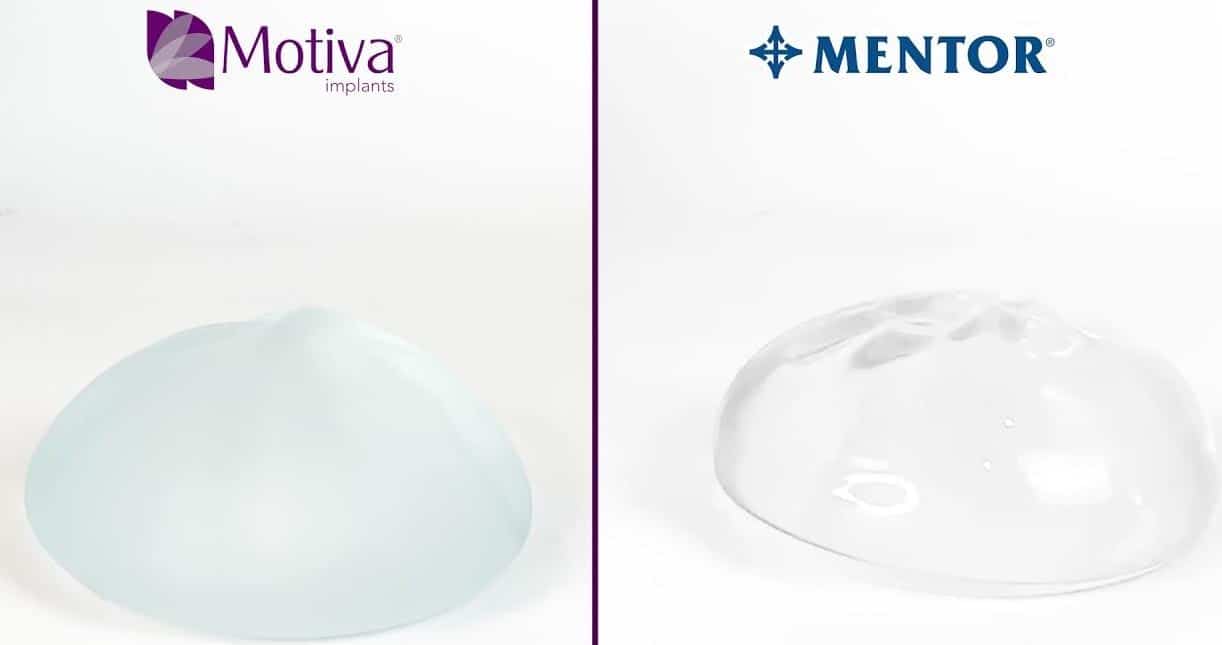
Quick Summary:
Motiva offers cutting-edge ProgressiveGel technology with FDA approval granted in September 2024, while Mentor provides 50+ years of clinical history and the largest long-term rupture dataset of any brand. Both are premium silicone implants.
Both carry similar 3-year rupture rates of ~0.5%; Mentor has published 10-year data showing a 24% cumulative rupture rate, while Motiva’s equivalent long-term data is still maturing.
This guide compares technology, safety, feel, cost, and which brand suits your goals.
Quick Comparison Table
Motiva and Mentor differ most on gel technology and data maturity — Motiva leads on innovation, Mentor leads on long-term clinical evidence.
| Factor | Motiva | Mentor |
|---|---|---|
| Manufacturer | Establishment Labs (Costa Rica) | Mentor Worldwide LLC / Johnson & Johnson (USA) |
| FDA Approval | ✅ Approved September 2024 | ✅ Long-standing approval |
| Gel Technology | ProgressiveGel / ProgressiveGel Ultima | MemoryGel / MemoryGel Xtra |
| Shell Surface | SmoothSilk® nanosurface | Smooth or SILTEX micro-texture |
| Signature Product | Ergonomix® (positional movement) | MemoryGel Xtra (upper pole fullness) |
| Saline Option | ❌ Silicone only | ✅ Silicone + saline available |
| 3-Year Rupture Rate | ~0.5% | ~0.5% |
| 10-Year Data | Still maturing | Published (24% cumulative rupture rate) |
| Safety Indicator | BluSeal® barrier layer + RFID chip | No equivalent indicator |
| Warranty | Free standard + paid extended | Free lifetime rupture coverage + paid extended |
| Relative Cost | Higher (premium for technology) | Moderate (widely competitive) |
| Best For | Natural movement, minimal tissue, active patients | Upper pole fullness, long-term track record priority |
Why Trust This Guide
This guide draws on the Motiva FDA Clinical Trial published in Aesthetic Surgery Journal (November 2024), Mentor’s 10-year Core Study data, 2024 ISAPS Global Procedure Statistics, and peer-reviewed meta-analysis data from the Journal of Clinical Medicine (2023).
Carely Clinic’s editorial team reviews all content for clinical accuracy and updates articles when major regulatory changes occur. This is medical education content — not a substitute for personalized surgical consultation.
Technology and Shell Design
Motiva uses ProgressiveGel technology and a SmoothSilk nanosurface; Mentor uses cohesive MemoryGel with a choice of smooth or SILTEX micro-textured shells.
These surface differences are clinically significant. Motiva’s SmoothSilk shell is engineered at the nanoscale to minimize the body’s inflammatory response — a key mechanism behind capsular contracture formation. Mentor’s smooth shell option follows decades of established safety data, and most surgeons today default to the smooth version rather than SILTEX following post-2019 BIA-ALCL discussions.
Motiva adds a proprietary BluSeal® barrier layer between the gel and the outer shell. This additional layer is designed to reduce gel diffusion (also called “gel bleed”) and signals shell integrity to surgeons visually during placement. Mentor does not have an equivalent indicator layer.
Motiva implants also include an optional Q Inside Safety Technology™ RFID chip. This allows surgeons and radiologists to identify implant details without requiring documentation, useful during follow-up imaging years after surgery. Mentor relies on traditional serialization and documentation for implant identification.
Motiva’s TrueMonoBloc® Design
Motiva’s TrueMonoBloc® fills the shell 100% to capacity, so the gel and shell move as a single unit.
In conventional implants, gel can shift within the shell. Motiva’s 100%-filled design reduces internal fold fatigue — the mechanical stress that causes micro-cracking over time — and minimises visible rippling, particularly in thin-tissue patients where rippling is most visible.
Mentor’s MemoryGel Cohesivity System
Mentor offers two gel firmness levels: Cohesivity I (softer) and Cohesivity II (firmer, more upper-pole fullness).
This dual-cohesivity system gives surgeons more precise control over aesthetic outcomes. Cohesivity II is particularly popular for patients seeking prominent upper-pole projection and a lifted appearance. Explore our breast augmentation options at Carely Clinic to learn which implant profile suits your anatomy.
Natural Feel and Movement
Motiva’s ProgressiveGel Ultima is widely described as the softest implant gel available, while Mentor’s MemoryGel offers a firmer feel with consistent upper-pole shape.
Side-by-side assessments by surgeons who have used both brands consistently indicate that Motiva’s softest options feel slightly firmer than Mentor’s softest MemoryGel — a counterintuitive finding, since Motiva’s gel is softer overall. This is because Motiva’s TrueMonoBloc® shell creates more structural resistance to external touch, even while the gel itself is highly elastic.
For patients prioritising dynamic movement — the way an implant shifts and falls naturally when changing position — Motiva’s Ergonomix® line is specifically engineered to replicate this behaviour. Participants in Motiva’s FDA Clinical Trial reported high satisfaction with natural positioning in both upright and reclining postures.
Motiva Ergonomix® Movement
Ergonomix implants adapt posturally, shifting subtly when lying down and resuming a rounder appearance when upright, mimicking natural breast behaviour.
This positional adaptation is driven by ProgressiveGel Ultima’s high elasticity. Patients who are physically active, lean, or have minimal natural breast tissue benefit most — the implant adapts rather than remaining static, reducing the “implant visible” look that fixed-form devices can produce.
Mentor MemoryGel Xtra Feel
MemoryGel Xtra delivers consistent upper-pole fullness and maintains a lifted contour, preferred by patients seeking a fuller, more sculpted result.
Mentor’s Cohesivity II gel holds shape under physical movement rather than shifting, making it a popular choice for patients who prefer predictable projection and defined cleavage. The trade-off is that dynamic softness in varying positions is less pronounced than with Motiva Ergonomix®.
Safety and Capsular Contracture
Both Motiva and Mentor have strong safety records, but Motiva’s nanosurface shows lower capsular contracture rates in intermediate follow-up studies compared to Mentor’s SILTEX textured option.
Capsular contracture — where fibrous scar tissue tightens around the implant — remains the most common complication of breast augmentation, affecting 1–10% of patients depending on technique and implant surface. Surface type is the most modifiable risk factor. A 2023 systematic review and meta-analysis published in the Journal of Clinical Medicine found complication rates with Motiva’s SmoothSilk surface were low across primary augmentation studies.
Motiva’s mechanism of action is straightforward: the SmoothSilk nanosurface minimises the inflammatory foreign-body response, so the body forms little to no visible capsule in most patients. Surgeon observations from the US FDA trial note that Motiva-augmented breasts feel notably softer at follow-up — consistent with reduced capsule formation.
Mentor’s smooth shell (the version currently favoured by most surgeons) carries a well-documented capsular contracture risk profile. For context, the 2019 Allergan BIOCELL recall shifted the industry firmly toward smooth shells; Mentor’s smooth option is now the standard recommendation over SILTEX.
Expert Insight
“Motiva’s SmoothSilk surface is engineered to reduce the inflammatory response that drives capsular contracture — early clinical data suggests this translates to a measurable reduction in Baker Grade III/IV contracture rates compared to standard smooth silicone implants.”
— Journal of Clinical Medicine, Systematic Review and Meta-Analysis, March 2023
BIA-ALCL Risk
BIA-ALCL is exclusively linked to textured implant surfaces — smooth implants from both Motiva and Mentor carry no confirmed BIA-ALCL association.
The FDA has tracked over 1,000 BIA-ALCL reports globally, with the overwhelming majority linked to highly textured surfaces. Motiva’s SmoothSilk is classified as a nanosurface — not aggressive texturing — and no confirmed BIA-ALCL cases have been linked to it. Mentor’s smooth shell carries the same zero-confirmed-case status. For this reason, most surgeons now default to smooth or nano-surface implants. See our full breast implant safety guide for BIA-ALCL risk context.
Rupture Rates and Long-Term Data
Both implants show ~0.5% rupture rates at 3 years; only Mentor has published 10-year data, showing a 24% cumulative rupture rate across all patients.
This is the single most important data asymmetry between the two brands. Mentor’s 10-year Core Study provides the most rigorous long-term rupture dataset available for any breast implant brand. A 24% cumulative rupture rate at 10 years reflects an aging population of implants across varying surgical eras — not necessarily predictive of modern implant performance.
Motiva’s FDA trial followed patients for 4 years, not 10. Rupture and re-operation rates were very low during that window, but the absence of decade-long data is a genuine consideration for patients wanting the fullest possible evidence base before choosing a brand.
Expert Insight
“The 10-year rupture data for Mentor reflects older manufacturing generations. Current cohesive gel implants show materially lower rupture rates — but without equivalent long-term data for Motiva, patients and surgeons are making an inference, not a comparison.”
— Based on Mentor 10-Year Core Study, Plastic and Reconstructive Surgery, 2021
Motiva 3- and 4-Year Data
Motiva’s published FDA trial found rupture and capsular contracture rates below 1% at 3-year follow-up, with high re-operation-free survival.
The Motiva FDA trial (published November 2024 in Aesthetic Surgery Journal) followed patients through primary and revisional augmentation. The short-term safety profile is compelling. Whether this holds at 8 and 10 years is the open question that only time and ongoing post-market surveillance will answer.
Mentor 10-Year Core Study
Mentor’s 10-year study reported a 24% cumulative rupture rate and a re-operation rate of approximately 20–25% across the studied population.
These figures should be read with context: many ruptures were silent (no symptoms), and patients with ruptured implants often had no complications other than requiring replacement surgery. Modern MemoryGel cohesive gel is designed to remain localised within the capsule even if the shell fails, significantly reducing gel migration risk.
Available Shapes and Product Lines
Motiva offers Round, Ergonomix, and TrueFixation Anatomical lines; Mentor offers Round (MemoryGel, MemoryGel Xtra) and teardrop (CPG/MemoryShape) options.
Motiva Product Lines
Motiva’s Ergonomix is its most differentiated product — a positional implant that behaves like both round and teardrop in different postures.
The Ergonomix line fills the market gap between fixed-form anatomical implants and standard round implants. Patients who want natural ptosis (droop) when lying flat, combined with round upper-pole appearance when upright, favour this option. The TrueFixation Anatomical implant uses adhesion technology to prevent rotation — addressing the primary risk associated with teardrop devices.
Mentor Product Lines
Mentor MemoryGel Xtra is its highest-projection round implant, designed for patients seeking maximum upper-pole fullness and cleavage definition.
The CPG (Contour Profile Gel) teardrop uses SILTEX texturing to prevent rotation. Given current BIA-ALCL surface discussions, most surgeons now reserve Mentor’s teardrop line for reconstructive cases with documented clinical indication rather than routine cosmetic augmentation. Mentor also remains the only major brand offering a saline implant option for patients who prefer saline for personal or medical reasons. Learn more about choosing the right implant profile at Carely Clinic.
Warranty Coverage
Both brands include a free standard warranty covering rupture replacement; Mentor additionally offers lifetime rupture coverage in most markets, while Motiva offers extended paid upgrades.
Both manufacturer warranties cover implant replacement at no charge if rupture is confirmed. Key differences emerge in duration and financial assistance. Mentor provides lifetime rupture replacement coverage (with conditions, and limited financial assistance for surgery costs) in most markets. Motiva’s standard warranty covers rupture replacement and provides the option to purchase enhanced coverage for additional complications including capsular contracture.
For international patients — including those travelling to Turkey for surgery — it is essential to confirm that warranty registration is completed by your clinic team before you return home. At Carely Clinic, implant warranty registration is completed as a standard part of the post-operative process for every patient.
Who Should Choose Motiva
Motiva suits patients prioritising natural movement, minimal capsule formation, and advanced safety technology over decades of long-term outcome data.
Motiva is typically the stronger choice if you:
- Have minimal natural breast tissue and want to minimise visible rippling
- Are physically active and want an implant that adapts posturally
- Are particularly concerned about capsular contracture and want the best current nanosurface technology
- Want RFID chip identification for long-term implant tracking
- Are comfortable with a brand whose long-term (10-year) data is still accumulating
Motiva Ergonomix® is especially popular for slim, athletic patients and those undergoing primary augmentation who want an undetectable result in all positions. The slightly higher cost — typically €200–€400 more than equivalent Mentor devices in Turkish packages — is a factor worth weighing against the technology advantages.
Who Should Choose Mentor
Mentor suits patients prioritising decades of peer-reviewed safety data, lifetime rupture warranty coverage, and the most extensively documented long-term outcome record of any breast implant brand.
Mentor is typically the stronger choice if you:
- Want the most comprehensive long-term rupture and safety dataset available
- Prefer a brand manufactured under Johnson & Johnson quality standards
- Are seeking saline implant options (Motiva does not offer saline)
- Want pronounced upper-pole projection and defined cleavage
- Prioritise lifetime rupture warranty coverage
Mentor MemoryGel Xtra is the go-to for patients who want a sculpted, full look with reliable projection. Its cohesive gel provides consistent shape maintenance. For patients replacing older implants, surgeons often recommend Mentor when the existing capsule and pocket geometry suit Mentor’s profile ranges.
How This Applies in Turkey
Turkey performs over 35,000 breast augmentations annually, with both Motiva and Mentor widely available at JCI-accredited Istanbul hospitals — making it one of the few medical tourism destinations where patients can access either premium brand at significantly reduced all-inclusive pricing.
Istanbul’s high-volume surgical centres offer a level of surgeon specialisation rarely matched in single-specialty UK or US practices. Surgeons performing 300–500 augmentations annually develop nuanced brand preference based on direct outcome comparison — a meaningful clinical advantage for patients choosing between Motiva and Mentor.
Breast augmentation packages in Turkey typically range from €3,000–€5,500 all-inclusive, depending on implant brand and model chosen. Motiva packages generally sit at the higher end of this range (€4,000–€5,500) compared to Mentor packages (€3,000–€4,500), reflecting the difference in implant device cost.
At Carely Clinic in Istanbul, we offer both Motiva and Mentor to patients from the UK, EU, and beyond. Our surgical team will guide brand selection based on your anatomy, tissue characteristics, aesthetic goals, and budget — not a fixed preference for either manufacturer.
All-inclusive packages at Carely Clinic cover surgery at a JCI-accredited hospital, anaesthesia, 1-night inpatient stay, airport transfers, 4-night hotel accommodation, and implant warranty registration.
Post-operative remote follow-up is provided through our patient coordination team for all international patients returning home after surgery.
Learn more about breast augmentation at Carely Clinic
Motiva vs Mentor Summary Table
This table summarises the nine most clinically relevant decision factors across both brands for straightforward comparison.
| Decision Factor | Motiva Advantage | Mentor Advantage |
|---|---|---|
| Natural movement | ✅ Ergonomix® positional adaptation | — |
| Long-term data | — | ✅ 10-year Core Study published |
| Capsular contracture | ✅ Minimal capsule formation (SmoothSilk) | — |
| Upper pole fullness | — | ✅ MemoryGel Xtra Cohesivity II |
| Safety indicators | ✅ BluSeal® + RFID chip | — |
| Warranty coverage | — | ✅ Lifetime rupture replacement |
| Saline option | — | ✅ Saline + silicone available |
| Price (Turkey) | — | ✅ Typically €200–€400 less per package |
| Thin tissue / rippling risk | ✅ TrueMonoBloc® reduces fold rippling | — |
Frequently Asked Questions
Which is better, Motiva or Mentor breast implants?
Neither brand is objectively superior — the better choice depends entirely on your priorities. Motiva leads on innovation, natural movement, and capsular contracture reduction via SmoothSilk nanosurface technology. Mentor leads on long-term published data, with a 10-year Core Study that Motiva cannot yet match. A board-certified surgeon assessing your tissue, goals, and anatomy is the most important factor in the final recommendation.
Are Motiva implants FDA approved?
Yes — Motiva SmoothSilk Round and Ergonomix implants received FDA approval on September 26, 2024, making Motiva the fourth FDA-approved silicone gel implant manufacturer in the United States alongside Allergan, Mentor, and Sientra. Prior to this date, Motiva was available under CE Mark in Europe and widely used internationally, including in Turkey, but lacked US clearance. International patients should confirm current regulatory status in their home country.
How long do Motiva implants last compared to Mentor?
Both Motiva and Mentor implants are not lifetime devices and may require replacement. Mentor’s published 10-year Core Study shows a 24% cumulative rupture rate at decade follow-up — largely silent ruptures requiring surgical replacement. Motiva’s equivalent 10-year data has not yet been published; the FDA trial followed patients to 4 years with very low rupture rates. Most surgeons recommend imaging every 5–10 years regardless of brand to detect silent ruptures early.
Do Motiva implants feel more natural than Mentor?
Most surgeons who use both brands describe Motiva’s Ergonomix as offering superior positional movement and a softer overall appearance in varying postures. Interestingly, Motiva’s softest gel options feel slightly firmer to direct touch than Mentor’s softest MemoryGel — because the TrueMonoBloc® shell adds structural resistance. For patients prioritising dynamic, posture-adaptive movement, Motiva Ergonomix has a measurable advantage; for patients prioritising consistent upper-pole projection and shape stability, Mentor MemoryGel Xtra performs better.
What is the capsular contracture rate for Motiva vs Mentor?
Motiva’s SmoothSilk nanosurface is associated with minimal to no capsule formation in most patients, based on FDA trial observations and a 2023 meta-analysis in the Journal of Clinical Medicine. Mentor’s smooth shell carries a capsular contracture risk broadly in the range of 2–8% at 3–5 years, consistent with other major smooth silicone brands. Motiva’s nanosurface mechanism — reducing the inflammatory foreign-body response — appears to produce meaningfully lower Baker Grade III/IV contracture rates, though long-term comparative data is still accumulating.
Are Motiva implants worth the extra cost?
Motiva typically costs €200–€400 more than equivalent Mentor devices within Turkish all-inclusive packages. Whether the premium is justified depends on your individual risk profile and priorities. Patients with minimal breast tissue (higher rippling and contracture risk), those prioritising natural movement, or those concerned about capsular contracture are most likely to benefit from Motiva’s technology advantages. Patients primarily valuing long-term data confidence and lifetime warranty may find Mentor delivers equivalent peace of mind at lower cost.
What is the difference between Motiva Ergonomix and standard round implants?
Motiva Ergonomix is engineered to adapt to body posture — round when upright, shifting naturally when lying flat — unlike standard round implants which maintain a fixed shape regardless of position. This is achieved through ProgressiveGel Ultima, a highly elastic gel that moves as a single unit with the shell due to the TrueMonoBloc® design. Standard round implants, including Mentor MemoryGel, maintain consistent projection in all positions. The Ergonomix line suits patients wanting the most natural positional behaviour, typically slimmer or more athletic body types.
Do both Motiva and Mentor implants come with a warranty?
Yes — both brands include a free standard warranty covering confirmed implant rupture replacement at no additional charge. Mentor also provides lifetime rupture replacement coverage in most markets, which Motiva’s standard warranty does not match. Both offer paid enhanced warranty programmes covering additional complications. For international patients having surgery in Turkey, implant warranty registration must be completed by the clinical team before you return home — confirm this is included in your clinic’s post-operative process.
Can I get Motiva or Mentor implants in Turkey?
Yes — both Motiva and Mentor are widely available at JCI-accredited hospitals in Istanbul, and Turkey is one of the most accessible destinations globally for both brands. All-inclusive packages including either brand typically range from €3,000–€5,500 depending on implant model and clinic. Both brands maintain valid warranties for implants placed in Turkey, provided registration is properly completed. Turkish surgeons working at high-volume centres typically have extensive experience with both brands, making brand selection based on clinical fit rather than availability.
What is the rupture rate for Motiva vs Mentor?
At 3 years, both Motiva and Mentor show similar rupture rates of approximately 0.5% — roughly 1 in 200 implants. The divergence appears over time: Mentor’s 10-year Core Study records a 24% cumulative rupture rate across the studied population, while Motiva’s 10-year equivalent data is not yet published. Most 3-year ruptures are silent and asymptomatic, detected only on MRI or ultrasound during routine surveillance imaging, making regular post-augmentation imaging important regardless of implant brand.
Which implant brand is safer, Motiva or Mentor?
Both Motiva and Mentor are FDA-approved silicone implants with strong safety records. Neither brand has confirmed BIA-ALCL cases linked to their smooth or nanosurface options. Mentor has a longer published safety record spanning decades; Motiva has promising short-term and intermediate safety data, including notably low capsular contracture rates in the FDA clinical trial. The most significant safety advantage Motiva holds is its SmoothSilk nanosurface reducing contracture risk. The most significant advantage Mentor holds is the depth and duration of published safety surveillance data.
What is the difference between Motiva SmoothSilk and Mentor SILTEX?
Motiva SmoothSilk is a nanosurface — engineered at the microscopic level to be extremely low-texture, reducing the inflammatory response and minimising capsule formation. Mentor SILTEX is a micro-textured surface originally designed to grip tissue and reduce rotation, but it is now used less frequently following industry-wide re-evaluation of texturing and BIA-ALCL associations. Most Mentor surgeons today choose smooth shells rather than SILTEX. Motiva’s SmoothSilk occupies a middle ground between traditional smooth and micro-texture, offering the handling benefits of slight grip with the safety profile of a non-aggressive surface.
Conclusion
Motiva and Mentor are both premium FDA-approved breast implant brands with strong safety records and comparable 3-year rupture rates of ~0.5%. The core trade-off is innovation versus evidence depth: Motiva’s ProgressiveGel and SmoothSilk technology deliver superior natural movement and lower capsular contracture rates in intermediate-term data, while Mentor’s 10-year published outcomes and lifetime rupture warranty offer patients the most comprehensive long-term evidence base available.
For patients prioritising dynamic, posture-adaptive feel and minimal capsule formation, Motiva Ergonomix is the leading option in 2026. For patients prioritising long-term data certainty, upper-pole projection, or lifetime warranty coverage, Mentor MemoryGel Xtra remains one of the most well-evidenced choices in breast augmentation.
Both brands are available at Carely Clinic in Istanbul within all-inclusive packages, and your surgeon will guide brand selection based on your anatomy, aesthetic goals, and individual risk profile — not a blanket preference for either manufacturer.
Individual outcomes and risks vary. This guide provides general information based on published clinical data, FDA documentation, and international breast surgery guidelines. Consult a qualified plastic surgeon for personalized advice before any surgical decision.
Medical Review: Dr. Alirza Jahangirov Last Updated: April 2026 Next Review: July 2026