
Quick Summary:
Round implants deliver uniform upper-pole fullness and account for roughly 80% of augmentations worldwide, while teardrop implants offer a natural slope preferred for slim patients and reconstruction cases. Round devices cost £400–£600 less on average and use smooth surfaces.
The FDA has tracked 1,380 BIA-ALCL cases globally, with 73% linked to textured surfaces — required on every teardrop implant — making surface texture a key safety variable alongside shape.
This guide compares shape, feel, safety data, rotation risk, cost, and ideal candidate profiles.
Quick Comparison Table
Round and teardrop implants differ across 8 key factors — shape, surface, safety profile, rotation risk, cost, and candidacy — with round devices preferred for most cosmetic augmentations and teardrop reserved for specific indications.
| Factor | Round Implants | Teardrop Implants |
|---|---|---|
| Shape | Symmetrical disc — equal fullness all poles | Wide base, tapered top — natural slope |
| Surface | Smooth or textured available | Textured only — required to prevent rotation |
| Fill | Saline or silicone gel options | Highly cohesive silicone (gummy bear) only |
| Rotation risk | None — symmetrical, rotation invisible | 1–8% over 10 years — visible distortion |
| BIA-ALCL association | No confirmed cases (smooth surface) | Linked via textured surface — 73% of FDA reports |
| Cost (UK) | £4,500–£9,000 | £5,000–£10,000 (£400–£600 premium) |
| Cost (Turkey) | €3,500–€5,000 all-inclusive | €4,000–€5,500 all-inclusive |
| Best for | Most cosmetic augmentation patients | Slim frames, reconstruction, tuberous correction |
| Global market share | ~80% of all augmentations | ~20% — declining post-2019 recall |
Why Trust This Guide
This guide draws on the 2024 ISAPS Global Survey of 3,000 board-certified surgeons, FDA Medical Device Reports on BIA-ALCL updated through 2024, and peer-reviewed studies from Plastic and Reconstructive Surgery, including a 2024 matched-pair outcomes comparison of round versus anatomical devices.
Carely Clinic’s editorial team reviews all content for clinical accuracy and updates articles when major guidelines or FDA guidance changes. This is medical education content — not a substitute for personalised surgical consultation.
What Is the Difference Between Round and Teardrop Implants?
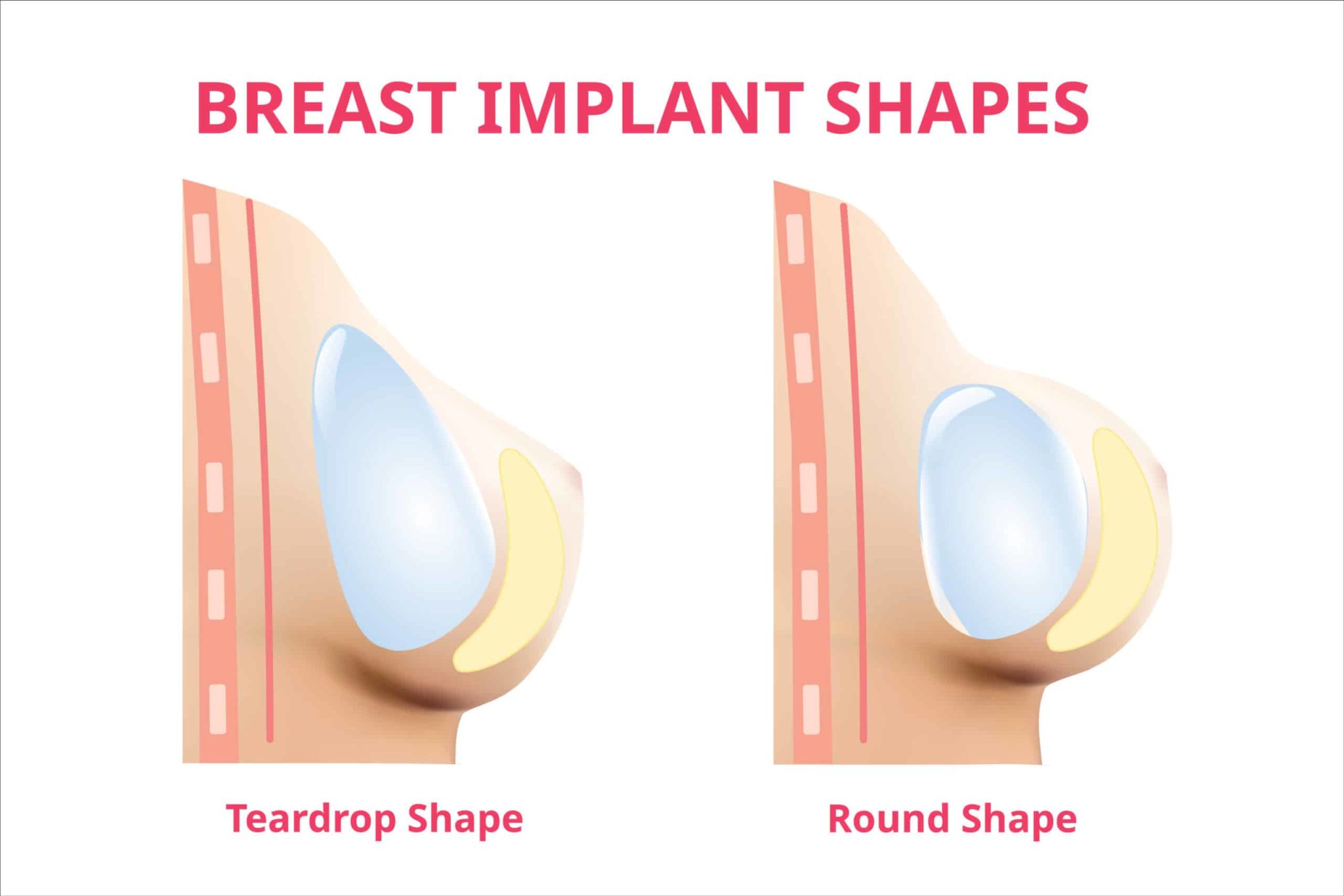
The main difference is shape: round implants are symmetrical discs delivering uniform fullness at all poles, while teardrop implants are wider at the base and taper toward the top, producing a naturally sloped breast contour.
Round implants are the global standard, selected in approximately 80% of all breast augmentation procedures according to 2023 ISAPS survey data. They are available in smooth or textured surfaces, saline or silicone fill, and a broad range of profiles — from low to ultra-high projection.
Teardrop implants — also called anatomical implants in clinical literature — are always filled with highly cohesive silicone gel (commonly called “gummy bear” fill) and always use a textured surface. The texturing is not cosmetic: it creates friction between the implant shell and the surrounding tissue capsule, preventing the shaped device from rotating out of position.
This surface requirement is the single most important clinical distinction between the two options, because textured surfaces have been linked to breast implant-associated anaplastic large cell lymphoma (BIA-ALCL), a rare form of lymphoma. For more on how this affects the decision, see our breast augmentation safety guide.
Shape and Aesthetic Outcome
Round implants produce cleavage and upper-pole fullness; teardrop implants produce a natural slope with more lower-pole volume — each delivering a distinctly different silhouette suited to different body types and aesthetic goals.
Round Implant Aesthetics
Round implants create uniform upper-pole fullness and visible cleavage, with the silicone settling downward in the standing position to produce a soft, natural-looking slope.
The perceived “roundness” is most visible in patients with minimal existing tissue, particularly in the lying position, where gravity no longer pulls the fill toward the lower pole. Patients with moderate existing breast tissue often find that round implants produce a result that is visually indistinguishable from teardrop devices once natural tissue softens the implant edges.
Profile selection — low, moderate, or high — changes the projection and width far more than shape alone. A moderate-profile round implant in a patient with good tissue coverage frequently looks more natural than a high-projection teardrop device placed in a patient with very thin skin.
Teardrop Implant Aesthetics
Teardrop implants replicate the natural breast slope: more volume at the lower pole, minimal upper-pole projection, and a gradual taper — ideal for slim patients with little native tissue.
This shape is particularly valued in breast reconstruction following mastectomy, where recreating a natural contour without pre-existing tissue is the primary goal. It is also the preferred choice for correcting tuberous breast deformity, where the lower pole requires structured volume that a shaped device can provide predictably.
The aesthetic advantage of teardrop is most pronounced on slim, narrow-chested patients and least pronounced on patients with C-cup or larger existing tissue, where the natural breast already provides the slope that the anatomical device is designed to replicate.
Feel and Movement
Round implants with silicone gel fill closely mimic natural breast tissue in feel and movement, while teardrop gummy bear fill is firmer and more form-stable — a difference patients notice most during physical activity.
How Round Implants Feel
Round silicone gel implants feel soft and move naturally with the body, with ripple visibility dependent on placement — submuscular placement reduces palpable edges by roughly 40% compared to subglandular.
Saline-filled round implants are firmer and more prone to visible rippling, particularly in thin patients, which is why silicone gel is now selected in over 90% of round augmentation procedures in the UK and Europe, per 2024 ISAPS data. Dual-plane and submuscular placement further improves the tactile result by adding muscle coverage over the upper implant pole.
How Teardrop Implants Feel
Teardrop gummy bear implants feel firmer than round silicone gel devices, maintaining their form-stable shape rather than moving freely with the body.
The high cohesiveness of gummy bear fill — which gives the device its rotation-resistant structural integrity — is also the reason patients sometimes describe teardrop implants as feeling “more solid” than expected. This characteristic is generally better tolerated in reconstruction patients, who prioritise shape stability over natural movement, than in cosmetic augmentation patients seeking a soft, mobile result.
Safety: BIA-ALCL, Textured Surfaces, and Rotation Risk
The overall complication rate for both shapes is 2–4% at accredited centres, but teardrop implants carry an additional surface-related risk: every teardrop device requires the textured shell linked to 73% of global BIA-ALCL cases.
BIA-ALCL and Textured Surfaces
The FDA has recorded 1,380 BIA-ALCL Medical Device Reports globally as of 2024, with 73% involving textured implant surfaces — the only surface type used on teardrop devices.
BIA-ALCL is not a breast cancer — it is a rare lymphoma arising in the fluid or capsule surrounding a textured implant, with an estimated incidence of 1 in 2,000 to 1 in 86,000 textured implant recipients depending on device brand and surface macro-texture grade. The 2019 Allergan BIOCELL recall removed the highest-risk macro-textured product line from global markets, and remaining textured devices use lower-grade texturing with a lower associated incidence.
Smooth round implants have no confirmed BIA-ALCL cases in FDA Medical Device Report data. For patients who prioritise minimising all implant-related oncological risk, smooth round devices are the only option currently meeting that criterion.
Expert Insight
“BIA-ALCL risk is primarily a surface question, not a shape question — but because every teardrop device requires a textured surface, the two risks are inseparable in anatomical implant selection. This is the central informed-consent discussion for any patient considering shaped devices.”
— Based on FDA Medical Device Report data and ASPS BIA-ALCL Clinical Practice Guidance, 2024
Rotation Risk
Teardrop implant rotation occurs in 1–8% of cases over 10 years and typically requires surgical revision to correct the visible breast contour distortion.
Round implants carry zero visible rotation risk because their symmetrical shape means any degree of rotation produces no visible change in breast shape or position. This makes round devices particularly advantageous for active patients, athletes, and patients who anticipate high physical activity that could stress the tissue-implant interface and allow device movement within the pocket.
Cost Comparison: Round vs Teardrop Implants
Teardrop implants cost £400–£600 more than round in the UK, reflecting the premium for gummy bear fill and textured shell; Turkey closes this gap significantly, with round packages from €3,500 and teardrop from €4,000 all-inclusive.
| Country | Round Implants | Teardrop Implants | Notes |
|---|---|---|---|
| UK | £4,500–£9,000 | £5,000–£10,000 | Variable by surgeon grade and clinic location |
| USA | $6,000–$12,000 | $7,000–$14,000 | Excludes anaesthesia, facility, post-op |
| Australia | AUD 10,000–AUD 18,000 | AUD 11,000–AUD 20,000 | Medicare rebate may apply for reconstruction |
| Turkey | €3,500–€5,000 | €4,000–€5,500 | All-inclusive: surgery, hotel, transfers, follow-up |
The cost premium for teardrop implants reflects manufacturing complexity: highly cohesive gummy bear silicone requires more precise calibration during production, and textured shells undergo additional quality control processes compared to smooth surfaces. This adds approximately 15–25% to device procurement costs, which surgeons and clinics pass through to final package pricing.
Turkish all-inclusive packages for both shapes include implant cost, surgical fees, anaesthesia, JCI-accredited hospital theatre fees, 5–7 nights hotel accommodation, airport transfers, pre-operative blood work, and 12-month remote follow-up — items typically billed separately in UK and US pricing. For more detail on what international packages cover, see our breast augmentation cost guide.
Who Should Choose Round Implants?
Round implants are the best choice for most cosmetic augmentation patients — particularly those seeking cleavage, upper-pole fullness, or enhanced size without the rotation risk or BIA-ALCL surface association of teardrop devices.
Ideal Candidates for Round Implants
Round implants suit patients with moderate existing breast tissue, those seeking upper-pole fullness or cleavage, and anyone prioritising minimal long-term revision risk.
Specifically, round devices are the preferred option for patients who are physically active (where rotation risk is a real concern), patients with sufficient tissue coverage to disguise the implant edges, patients who want saline fill as an option, and patients who have reviewed FDA BIA-ALCL data and prefer smooth-surface devices.
Round implants are also the practical default for revision surgery after teardrop rotation, and for patients undergoing implant exchange who want to simplify long-term maintenance. The 2024 ISAPS survey confirmed that over 70% of board-certified surgeons recommend round smooth implants as their primary option for standard cosmetic augmentation.
Who Should Choose Teardrop Implants?
Teardrop implants are best suited for slim patients with minimal existing tissue, breast reconstruction patients, and cases requiring structured lower-pole volume — where the anatomical shape provides benefits round devices cannot replicate.
Ideal Candidates for Teardrop Implants
Teardrop implants benefit slim patients with little native tissue, reconstruction cases post-mastectomy, and patients with tuberous breast deformity requiring shaped volume correction.
Outside of these specific indications, most plastic surgeons in high-volume centres recommend round smooth implants for cosmetic augmentation — reserving teardrop for cases where shaped volume distribution is clinically required rather than merely preferred. Patients choosing teardrop devices should receive full informed consent covering BIA-ALCL incidence, rotation rates, and the implications of the textured surface requirement before proceeding.
Expert Insight
“For the vast majority of cosmetic augmentation patients, a well-chosen round silicone gel implant in submuscular or dual-plane placement delivers natural aesthetics with lower surface-related risk and no rotation concern. Teardrop implants have genuine clinical value — but primarily in reconstruction and specific anatomical indications, not as a default ‘more natural’ upgrade.”
— Based on 2024 ISAPS Global Survey findings and ASPS clinical practice recommendations
How This Applies in Turkey
Turkey performs over 40,000 breast augmentations annually, ranking 5th globally per 2023 ISAPS data, with round smooth implants now the dominant choice following the 2019 textured implant safety reviews.
Turkish plastic surgeons predominantly trained under European Board of Plastic, Reconstructive and Aesthetic Surgery (EBOPRAS) pathways, with Istanbul’s high-volume centres performing 400–800 breast procedures annually — surgeon specialisation levels comparable to major London and New York practices.
Round smooth implant augmentation in Turkey costs approximately €3,500–€5,000 all-inclusive. Teardrop packages run €4,000–€5,500. Both include implant device costs, anaesthesia, theatre fees at JCI-accredited hospitals, airport transfers, and 5–7 nights hotel accommodation — items typically invoiced separately in UK and US clinics.
At Carely Clinic in Istanbul, our surgical team performs over 600 breast augmentations annually. For cosmetic augmentation, we default to smooth round silicone gel implants from Mentor or Motiva to eliminate BIA-ALCL surface risk, with teardrop options offered for reconstruction and documented clinical indications following full informed-consent discussions using current FDA data.
Our international patient pathway handles pre-operative blood work and surgical assessment on arrival day rather than requiring multiple trips — a significant practical advantage for patients travelling from the UK, Ireland, or Australia. Remote follow-up is managed through our patient coordination team for 12 months post-surgery.
Learn more about breast augmentation at Carely Clinic.
Carely Clinic’s Approach
Carely Clinic performs 600+ breast augmentations annually, defaulting to smooth round Mentor or Motiva implants to eliminate textured-surface BIA-ALCL risk for cosmetic patients.
Summary Comparison Table
Round and teardrop implants compare across shape, surface, safety, rotation, cost, and candidacy — this table consolidates the key clinical and practical differences for informed decision-making.
| Factor | Round | Teardrop | Advantage |
|---|---|---|---|
| Natural slope | Good with tissue coverage | Excellent, especially slim frames | Teardrop (slim patients) |
| Upper-pole fullness | High — uniform | Minimal — tapered | Round (cleavage goal) |
| Surface type | Smooth or textured | Textured only | Round (more options) |
| BIA-ALCL risk | None (smooth) | Low but present | Round |
| Rotation risk | None | 1–8% over 10 years | Round |
| Softness / movement | Soft, natural movement | Firmer, form-stable | Round (cosmetic feel) |
| Reconstruction suitability | Moderate | Excellent | Teardrop (reconstruction) |
| Cost (Turkey, all-incl.) | €3,500–€5,000 | €4,000–€5,500 | Round (lower cost) |
| Global surgeon preference | ~80% cosmetic cases | ~20%, mainly reconstruction | Round (mainstream) |
Frequently Asked Questions
What is the difference between round and teardrop breast implants?
Round implants have a symmetrical disc shape that creates uniform fullness across the entire breast, while teardrop (anatomical) implants are wider at the base and narrower at the top, mimicking the natural breast slope. Round devices use smooth or textured surfaces; teardrop devices always require a textured surface to resist rotation, which links them to a slightly higher BIA-ALCL association. Round implants account for approximately 80% of augmentations performed globally, according to 2023 ISAPS data.
Are teardrop implants more natural looking than round?
Teardrop implants produce a more naturally sloped upper pole with greater lower-pole projection, which many patients and surgeons consider closer to an unaugmented breast appearance — particularly on slim frames with minimal natural tissue. Round implants can also appear natural in the standing position, as gravity causes the silicone fill to settle toward the lower pole, reducing visible upper-pole overfilling. The difference is most visible in patients with very little pre-existing breast tissue, where round implants may show more upper fullness.
Do round implants look natural?
Round implants look natural for the majority of patients, especially those with moderate existing breast tissue that softens the implant edges and creates a gradual transition. In the upright position, round silicone gel implants settle with gravity, mimicking the natural teardrop slope without the rotation risk of anatomical devices. Patients with very little breast tissue or particularly tight skin may show more upper-pole fullness, which some consider a cosmetic rather than unnatural result.
What happens if a teardrop implant rotates?
If a teardrop implant rotates — typically by 30 degrees or more — the wider base shifts upward, creating an asymmetrical breast contour that often requires surgical revision to correct. Rotation rates in published studies range from 1% to 8% over 10 years, depending on implant brand, surgical pocket technique, and patient activity levels. Because round implants are symmetrical, rotation has no visible effect and does not require revision surgery.
Are teardrop implants safer than round implants?
No — overall complication rates for both shapes are comparable at 2–4% at accredited centres, but teardrop implants carry an additional consideration: every teardrop device requires a textured surface, which is associated with BIA-ALCL. The FDA has recorded 1,380 BIA-ALCL Medical Device Reports globally as of 2024, with 73% linked to textured devices; smooth round implants have no confirmed BIA-ALCL cases. Both shapes are considered safe options, but smooth round implants offer a marginal safety advantage on surface-related risk.
How much more do teardrop implants cost than round?
Teardrop implants cost £400–£600 more per pair than comparable round implants in the UK, reflecting higher manufacturing costs for form-stable gummy bear fill and textured shell engineering. In Turkey, round augmentation runs approximately €3,500–€5,000 all-inclusive, while teardrop packages typically range €4,000–€5,500, a narrower gap in absolute terms due to lower operating costs. Globally, the price premium for anatomical implants has remained consistent at 15–25% above equivalent round devices since 2020.
Which implant shape is best for small breasts?
For patients with minimal existing breast tissue and a slim frame, teardrop implants are frequently recommended because the tapered upper pole reduces the risk of an obviously augmented appearance and provides proportional lower-pole volume. However, many high-volume surgeons achieve equally natural results with round silicone gel implants by selecting a lower profile and moderate projection suited to a narrow chest width. The choice ultimately depends on chest measurements, existing tissue, skin elasticity, and desired projection — not breast size alone.
Can you switch from round to teardrop implants?
Yes — implant exchange surgery can replace round with teardrop implants (or vice versa) during a secondary augmentation procedure, typically under general anaesthesia with a 45–90 minute operative time. Switching to teardrop may require pocket modification to ensure a snug fit that minimises rotation risk, which adds surgical complexity compared to a straightforward round-to-round exchange. Recovery mirrors primary augmentation at 1–2 weeks for desk work and 4–6 weeks for full activity resumption.
What is the difference between teardrop and anatomical implants?
Teardrop and anatomical implants are the same device — “anatomical” is the clinical term used in surgical literature and device classification, while “teardrop” is the colloquial patient-facing name describing the shape. Both refer to implants that are taller at the base and taper toward the upper pole, always manufactured with a textured shell and highly cohesive (gummy bear) silicone fill to maintain their orientation. The terms are interchangeable in both UK and international clinical practice.
Which implant lasts longer — round or teardrop?
Both round and teardrop implants carry a similar expected lifespan of 10–20 years, with modern devices from manufacturers such as Mentor, Allergan, and Motiva warranted against shell rupture for life in many product lines. Round implants have a marginal practical advantage because rotation — a failure mode unique to teardrop devices — can necessitate revision surgery before the shell itself fails. Neither shape requires routine replacement if there are no symptoms of rupture, capsular contracture, or implant malposition.
Do surgeons prefer round or teardrop implants?
The 2023 ISAPS Global Survey found that round implants are preferred by the majority of board-certified plastic surgeons for standard cosmetic augmentation, with smooth round devices selected in over 70% of primary augmentation cases worldwide. Teardrop implants remain the preference for breast reconstruction following mastectomy, correction of tuberous breast deformity, and augmentation in patients with significant breast ptosis requiring shaped volume distribution. Surgeon preference has shifted further toward round smooth devices since the 2019 Allergan BIOCELL textured implant recall raised BIA-ALCL awareness.
Are textured implants banned?
Textured implants are not universally banned, but regulatory action has varied significantly by country since the 2019 Allergan BIOCELL recall, which removed one specific textured product line linked to higher BIA-ALCL rates from global markets. France banned all textured implants in 2019; the FDA and UK MHRA have not issued blanket bans but require enhanced informed consent disclosing BIA-ALCL risk for all textured devices. Smooth implants remain unrestricted in all major markets, and most surgeons in high-volume centres have shifted toward smooth round devices for elective augmentation.
Conclusion
Round implants suit the majority of cosmetic augmentation candidates; teardrop devices offer a natural slope for slim frames and reconstruction, but carry rotation risk and a textured-surface BIA-ALCL association. Surgeon volume and accreditation are the strongest outcome predictors.
For most patients seeking cosmetic augmentation, smooth round silicone gel implants deliver natural aesthetics, lower surface-related risk, and no rotation concern — making them the evidence-supported default at high-volume centres. Teardrop devices remain the preferred choice for reconstruction post-mastectomy, tuberous breast correction, and specific slim-frame cases where shaped lower-pole volume is clinically required.
Whichever shape you are considering, the most important factors are surgeon experience and facility accreditation, not implant brand or shape alone. Surgeons performing 400+ breast procedures annually show demonstrably lower complication rates than low-volume practitioners, per 2024 ASPS quality improvement data.
Individual requirements and outcomes vary. This guide provides general information based on international guidelines and published research. Consult qualified medical professionals for personalised advice.
If you are considering breast augmentation and want to discuss which implant shape suits your anatomy, contact Carely Clinic for a no-obligation consultation with our Istanbul-based surgical team.
Medical Review: Dr. Alirza Jahangirov