
Quick Summary
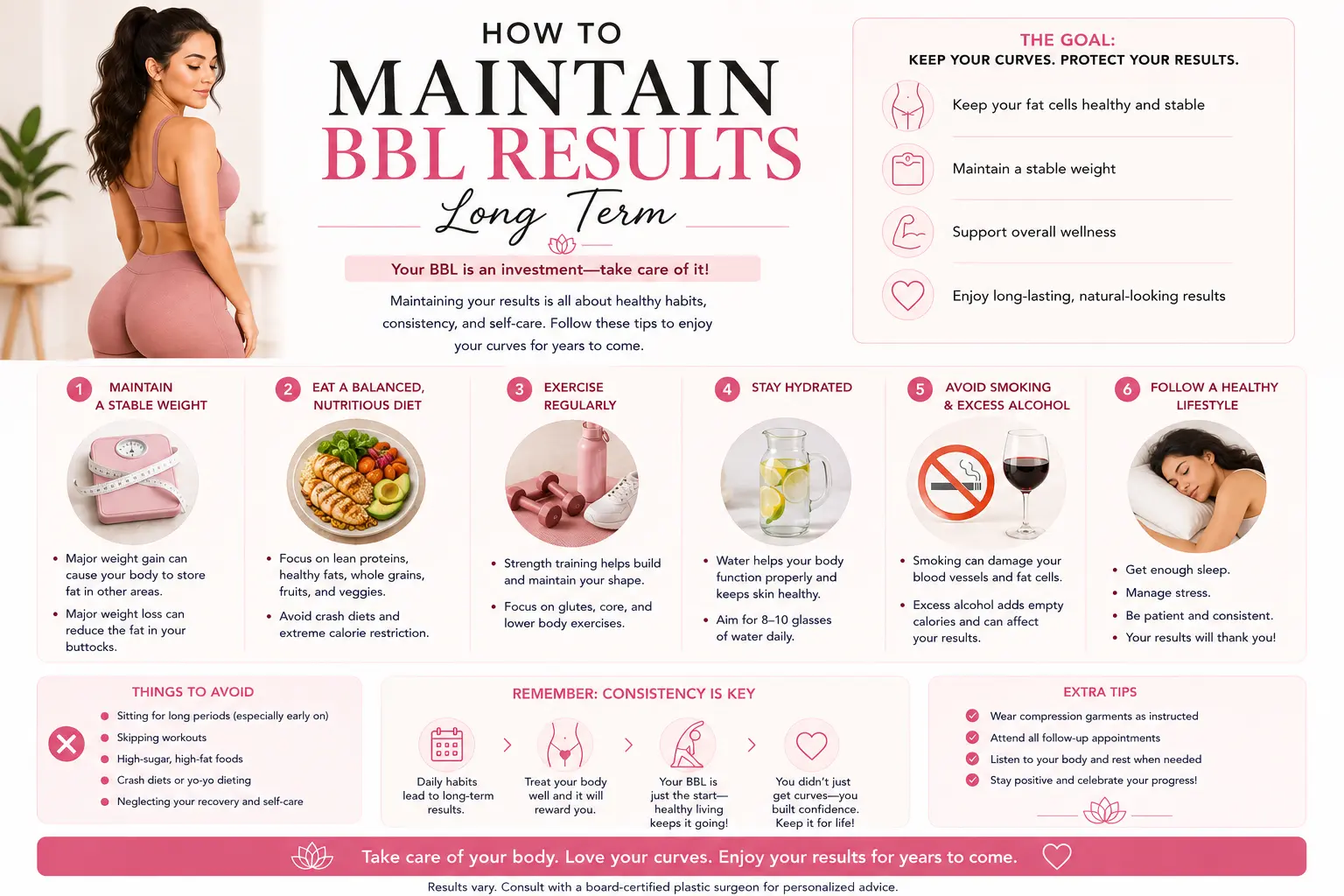
BBL results can last 10 years or more when fat survival reaches 60-80% of transferred volume. Published research and clinical data consistently identify stable weight and proper post-operative care as the two strongest predictors of long-term success.
This guide covers fat survival science, the 6-week critical window, glute training, nutrition, warning signs, and flying clearance for international patients.
How to Maintain BBL Results Long Term
Maintaining BBL results long term requires stable weight, targeted glute training, and strict adherence to the 6-week post-operative care window. Published research indicates 60-80% of transferred fat survives permanently once neovascularisation is complete at around 6 weeks. ASPS data shows the procedure has grown steadily, with 28,638 BBLs performed by member surgeons in 2022 alone — reflecting high patient satisfaction when maintenance protocols are followed.
For UK and US patients travelling to Turkey, the same principles apply regardless of where surgery is performed. Istanbul is one of the most active BBL destinations worldwide. Weight fluctuations above 10-15 lb (4.5-7 kg) are the single most common reason results change after the initial 6-month stability point.
This guide covers everything — fat science, exercise, nutrition, warning signs, and international flying clearance — in one clinical reference.
Why Trust This Guide
This guide draws on published research on fat graft survival, ASPS statistics, ISAPS global data, and safety guidelines from the ASERF Multi-Society Gluteal Fat Grafting Task Force. It is medically reviewed by Op. Dr. Alirza Jahangirov, Plastic, Reconstructive & Aesthetic Surgeon at Carely Clinic in Istanbul.
How Fat Survival Works: The Science Behind BBL Longevity
Once fat grafts establish a blood supply at 6 weeks, 60-80% of transferred volume survives permanently. The cells then behave exactly like native body fat — responding to weight changes, ageing, and lifestyle habits for the rest of your life.
What neovascularisation means for your results. During a BBL, your surgeon removes fat via liposuction, purifies it, and injects it into the subcutaneous tissue of the buttocks. The transferred fat has no blood supply for the first days to weeks.
During this period, it survives through a process called plasmatic imbibition — absorbing nutrients from surrounding fluid. Over weeks 2 to 6, new blood vessels grow into the grafted fat (neovascularisation). Fat that successfully vascularises becomes permanent living tissue. Fat that does not is reabsorbed by the body.
Why surgeons overfill. Surgeons typically inject 20-30% more volume than the final desired result to compensate for predictable early reabsorption. The result you see at 6 months, once all swelling has resolved and reabsorption is complete, closely represents your permanent baseline. Read more about BBL surgery at Carely Clinic.
Why the First 6 Weeks Are the Most Critical
The first 6 weeks determine permanent fat survival; pressure, movement, and blood flow all directly influence how many grafted cells vascularise successfully.
Transferred fat cells are under the most stress during weeks 1 to 6. Pressure from sitting, tight clothing, or sleeping on your back disrupts the capillary ingrowth process. Avoiding direct pressure on the buttocks is the single most evidence-backed action you can take to protect your investment in this window.
The 6-Week Critical Window: What You Must Do Right After Surgery
The first 6 weeks post-BBL are when permanent fat survival is determined. Compression garment compliance, pressure avoidance, controlled nutrition, and walking (not running) together determine whether you retain 60% or 80% of transferred volume.
Compression Garments: Duration and Protocol
Compression garments worn for 6 to 8 weeks reduce swelling, support the liposuction donor sites, and improve overall contouring results during the healing phase.
Most surgeons recommend a two-stage approach: a primary garment for weeks 1 to 4 and a lighter second-stage garment for weeks 4 to 8. Do not remove the garment except for showering. Loose or incorrect sizing reduces its protective benefit.
Sitting and Sleeping Positions
Avoid sitting directly on your buttocks for at least 2 to 3 weeks; use a BBL pillow or sit on the thighs only to protect newly grafted tissue.
The BBL pillow rule. When you must sit — at meals, for work, during transit — use a BBL pillow (also called a donut pillow) positioned so your thighs bear the weight and the buttocks hang free. Sleeping on your stomach or side during weeks 1 to 6 prevents nocturnal pressure. A body pillow helps maintain side-lying position through the night.
6 Factors That Affect How Long Your BBL Lasts
Fat survival rate, weight stability, surgical technique, compression compliance, smoking status, and exercise timing are the six factors with the strongest evidence for determining long-term BBL outcome quality and duration.
1. Fat survival rate. Determined primarily by surgical technique — specifically subcutaneous-only injection, which was formalised as the standard of care in the 2022 ASPS/ASAPS/ISAPS Joint Practice Advisory. Surgeons who inject fat into the correct plane achieve superior survival rates.
2. Weight stability. The most controllable long-term factor. Fat cells expand and contract with weight changes throughout your life. Patients who maintain their surgical weight within 10 lb (4.5 kg) report the most consistent long-term results. Combining liposuction with your BBL further sculpts donor areas for enhanced overall body proportion.
3. Surgical technique. Purification method (centrifugation vs. washing vs. decanting), injection volume per pass, and graft placement depth all influence how much fat survives. Choosing a board-certified surgeon trained in ISAPS or ASPS-compliant protocols is non-negotiable for results longevity.
4. Compression garment compliance. Incomplete or early discontinuation of compression garments is associated with higher rates of seroma formation and uneven contour at the donor sites.
5. Smoking status. Smoking reduces peripheral blood flow and is directly associated with reduced fat graft survival. Most surgeons advise smoking cessation at least 4 weeks before surgery and throughout the recovery period.
6. Exercise timing and type. Returning to high-impact activity too early puts shear forces on newly vascularising fat cells. The evidence supports no high-impact exercise for 6 to 8 weeks, followed by gradual reintroduction of resistance training from weeks 8 to 12.
Nutrition and Weight Management for Long-Term BBL Success
Adequate protein supports tissue healing in the first 3 months; long-term caloric stability within 200-300 kcal of your surgical maintenance intake is the most reliable approach to protecting transferred fat volume.
Protein targets for recovery. In the first 3 months post-BBL, aim for 0.7 to 1.0 g of protein per pound of body weight daily. Lean proteins — chicken, fish, eggs, legumes, Greek yoghurt — provide the amino acids required for tissue repair and fat cell membrane integrity. Avoid extreme caloric restriction during this period, as crash dieting accelerates fat reabsorption.
Long-term weight maintenance. The transferred fat cells behave exactly like native fat throughout your life. Weight fluctuations above 10 to 15 lb (4.5 to 7 kg) visibly alter your BBL result. A sustainable maintenance approach — whole foods, adequate fibre, stable caloric intake — is more protective than any specific diet plan.
Hydration. Adequate hydration supports skin elasticity and lymphatic drainage. Aim for 2 to 2.5 litres of water daily. Alcohol and high-sodium foods cause temporary fluid retention that can make post-operative swelling more pronounced and prolonged.
Expert Insight
“In fat grafting procedures, the quality of the graft environment matters as much as the volume transferred. A patient who is nutritionally replete, at a stable weight, and non-smoking presents a significantly more favourable vascularisation environment than one who is calorically depleted.”
— Reflecting current clinical practice in fat grafting outcomes
The Best Exercises to Maintain and Enhance BBL Results
Resistance training from week 8 onward builds the gluteal muscles beneath transferred fat, improving projection and shape permanence. Excessive cardio in the first 3 to 6 months risks accelerating fat loss from donor and recipient areas.
Glute-Targeted Exercise Protocol
Hip thrusts, Romanian deadlifts, and Bulgarian split squats are the three most evidence-supported exercises for post-BBL gluteal development and shape maintenance.
Building muscle beneath the fat. Strength training cannot enlarge transferred fat cells, but gluteal hypertrophy beneath them adds projection, definition, and structural support. The following programme is appropriate from week 8 to 12 onward, with surgeon clearance.
| Exercise | Week to Introduce | Sets x Reps | Notes |
|---|---|---|---|
| Glute bridges (bodyweight) | Week 6-8 | 3 x 15-20 | Surgeon clearance required first |
| Hip thrusts (barbell) | Week 10-12 | 4 x 8-12 | Primary BBL maintenance exercise |
| Romanian deadlift | Week 10-12 | 3 x 10-12 | Builds posterior chain support |
| Bulgarian split squat | Week 12+ | 3 x 8-10 per leg | Unilateral load protects symmetry |
| Cable kickbacks | Week 12+ | 3 x 12-15 per side | Isolation for upper glute development |
| Lateral band walks | Week 8+ | 3 x 20 steps per side | Activates gluteus medius for hip width |
Cardio: How Much Is Too Much?
Low-impact cardio from week 4 is safe; high-intensity cardio before week 8 risks accelerating fat reabsorption from recently transferred areas.
Excessive cardio — daily HIIT, high-mileage running — within the first 3 to 6 months can drive overall body fat reduction and shrink your BBL result. Balance 2 to 3 glute-focused strength sessions per week with 2 to 3 low-impact cardio sessions (incline walking, cycling, elliptical). This combination maintains cardiovascular health without sacrificing BBL volume.
Clinical observation suggests that excessive cardio in the first 3 months can contribute to greater-than-expected volume reduction. The current shift toward an athletic, natural-proportioned aesthetic supports a balanced glute-strength approach over high-volume cardio alone.
Warning Signs to Watch For After a BBL
Most BBL complications present within the first 6 weeks. Fever, localised hardness, wound changes, or sudden limb pain after a BBL require same-day or emergency medical evaluation — not watchful waiting at home.
In line with the 2022 multi-society Practice Advisory on gluteal fat grafting and general clinical guidance, the following warning signs require immediate escalation.
Read more about BBL safety at Carely Clinic.
| Warning Sign | What It May Indicate | Action Required |
|---|---|---|
| Fever above 38.5°C (101.3°F) beyond day 3 | Wound infection, deep abscess | Contact surgeon same day |
| Localised hard lump in buttock (not uniform swelling) | Fat necrosis, seroma, haematoma | Surgeon review within 48 hours |
| Wound separation or discharge at liposuction incision sites | Wound dehiscence, infection | Contact surgeon same day |
| Sudden calf pain, swelling, or redness in one leg | Deep vein thrombosis (DVT) | Emergency department immediately |
| Shortness of breath, chest pain, or rapid heart rate | Pulmonary embolism | Call emergency services immediately |
| Increasing pain after week 2 (pain should be decreasing) | Infection, fat necrosis, haematoma | Surgeon review within 24 hours |
| Skin colour change (blue, purple, or dark red areas) | Compromised blood supply, necrosis | Contact surgeon same day |
Who Is NOT a Good Candidate for Long-Term BBL Maintenance?
Patients with significant weight instability, active smoking, BMI above 40, or inadequate donor fat cannot reliably maintain BBL results regardless of lifestyle compliance. Candidacy assessment before surgery determines maintenance prognosis as much as aftercare.
Absolute Contraindications
These conditions prevent safe fat transfer or eliminate the biological conditions necessary for fat survival and long-term result maintenance.
Certain patients are not suitable candidates for a BBL regardless of motivation or budget:
- Insufficient donor fat: Patients with very low body fat percentage (BMI below 18) lack the fat volume needed for meaningful transfer. There is no substitute donor material in a standard fat transfer BBL.
- Active or recent infection: Systemic infection or active skin infection near donor or recipient sites prevents safe surgery and increases graft failure risk.
- Bleeding disorders or anticoagulant therapy: These significantly elevate the risk of haematoma formation around fat grafts, compromising survival.
- Severe cardiopulmonary disease: General anaesthesia carries elevated risk; most surgeons require specialist clearance from a cardiologist or pulmonologist before proceeding.
Relative Contraindications
These conditions require optimisation before surgery and affect the post-operative maintenance window but do not absolutely prevent the procedure with medical management.
These cases may proceed after specific optimisation steps:
- BMI above 35-40: Higher BMI is associated with greater anaesthetic risk and higher fat embolism risk. Most surgeons recommend weight loss to below BMI 35 before elective fat grafting where possible.
- Active smoking: Nicotine must be ceased at least 4 weeks before surgery. Patients who resume smoking post-operatively face a measurable reduction in fat survival rates.
- Significant weight instability: Patients who have fluctuated more than 20 lb (9 kg) in the 12 months before surgery are likely to experience rapid post-operative weight changes that compromise results. Stabilisation for 3 to 6 months is recommended first.
- Poorly controlled diabetes: Affects wound healing and fat cell viability. Glycaemic control (HbA1c below 7.5-8%) is typically required before clearance for elective cosmetic surgery.
Managing Expectations
BBL results improve continuously for 6 months and then stabilise; patients who understand this timeline and the role of lifestyle are the most satisfied long term.
Fat grafting is a partnership between surgical technique and patient behaviour. No surgeon can guarantee a specific retention percentage — published research shows a range of 60-80% across different patient populations, techniques, and compliance levels. Realistic expectations — that results are durable with effort, not effortless and permanent — are the strongest predictor of patient satisfaction at both the 1-year and 10-year mark.
When Should You Consider a BBL Touch-Up?
A revision BBL is appropriate 6 to 12 months after primary surgery once results have stabilised; candidates are those who experienced higher-than-expected fat loss, asymmetry, or significant post-operative weight change.
A second BBL uses the same fat transfer technique to restore lost volume or correct asymmetry. Costs in the UK typically range from £4,000 to £8,000 ($5,000 to $10,000 / €4,600 to €9,200) for a revision, compared to primary procedures in Turkey at £2,500 to £4,000 ($3,000 to $5,000 / €2,800 to €4,500) all-inclusive.
Revision is most common in patients who experienced significant post-operative weight loss, had suboptimal primary technique, or who simply want additional volume. Patients who followed all maintenance protocols and maintained stable weight rarely require revision within the first 5 years.
Expert Insight
“The decision for a revision BBL should only be made once results are fully stable — no earlier than 6 months post-surgery. Patients who pursue revision after 6 weeks or 3 months are making decisions based on temporary swelling, not permanent outcomes.”
— General clinical guidance on revision timing in fat grafting procedures
How This Applies in Turkey
Turkey is one of the world’s leading countries for aesthetic body contouring procedures by volume. Istanbul plastic surgeons working at established centres deliver fat survival rates consistent with international benchmarks of 60-80%.
Istanbul has become one of the world’s highest-volume BBL destinations, with demand from UK, US, European, and Middle Eastern patients growing year-on-year. Turkey ranks among the leading countries globally for body contouring procedures. Surgeons operating within accredited Istanbul facilities follow the same 2022 ASPS/ASAPS/ISAPS Joint Practice Advisory on subcutaneous-only fat placement that governs safe BBL technique internationally.
Cost comparison. A BBL package in Istanbul — including surgery, anaesthesia, 1 to 2 nights hospital stay, compression garments, and airport transfers — typically costs £2,500 to £4,000 ($3,000 to $5,000 / €2,800 to €4,500). Comparable procedures in the UK range from £6,000 to £10,000 ($7,500 to $12,500 / €7,000 to €11,500) and in the US from $8,000 to $15,000 (£6,400 to £12,000 / €7,400 to €13,800). The price difference reflects lower operating costs and the all-inclusive structure of Turkish medical tourism packages, not a difference in protocol or safety standard.
Carely Clinic specifically. Op. Dr. Alirza Jahangirov is a Plastic, Reconstructive & Aesthetic Surgeon at Carely Clinic with experience in body contouring procedures. Carely Clinic operates in JCI-accredited hospital facilities. The all-inclusive programme includes pre-operative blood work, surgery, hospitalisation, compression garment, 7-day aftercare, and a post-operative summary for your GP or primary care doctor upon return. Learn more about plastic surgery at Carely Clinic.
Frequently Asked Questions
How long do BBL results last?
BBL results typically last 5 to 10 years, with stable weight being the primary factor. Published research indicates, 60-80% of transferred fat survives permanently after the initial 6-week reabsorption phase. Patients keeping weight within 10 lb of their surgical weight consistently report the most durable long-term results.
What happens to a BBL after 10 years?
The surviving fat behaves like natural body fat, responding to weight gain, weight loss, and natural ageing. Long-term follow-up studies show patients with stable weight retain most of their enhanced volume after a decade. Skin laxity from ageing may soften shape slightly, but volumetric improvement over pre-surgery baseline typically remains visible.
How do I keep my BBL results from shrinking?
Avoid weight loss greater than 10 lb after surgery, as BBL fat cells shrink with overall body fat. Wearing a compression garment for 6 to 8 weeks supports graft integration and reduces early volume loss. Glute-targeted strength training 2 to 3 times per week after recovery helps preserve shape and underlying muscle tone.
Can exercise make your BBL bigger?
Strength training cannot directly enlarge transferred fat cells, but it builds gluteal muscle beneath them, enhancing projection and shape. Hip thrusts, Romanian deadlifts, and Bulgarian split squats are the three most effective moves for gluteal development post-BBL. Most surgeons clear patients for progressive resistance training at 8 to 12 weeks, once fat grafts have vascularised.
What should you not do after a BBL long term?
Avoid sitting directly on the buttocks for 2 to 3 weeks and avoid extreme weight fluctuations long term. Smoking reduces blood flow to fat grafts and increases reabsorption rates significantly, High-impact activities should be avoided for 6 to 8 weeks to protect newly vascularising fat cells after transfer.
Does gaining weight after a BBL ruin results?
Gaining 5 to 10 lb may increase BBL volume temporarily, as transferred fat expands like normal body fat. Gains exceeding 15-20 lb often cause uneven fat distribution, making results look disproportionate rather than enhanced. Significant weight gain should ideally occur before surgery, giving the surgeon more donor fat while protecting final shape.
How much fat survives after a BBL?
Published research shows 60-80% of transferred fat survives long term once the initial reabsorption phase is complete. Surgeons typically overfill by 20-30% to compensate for predictable reabsorption in the first 6 weeks post-operation. Technique quality, fat purification method, injection plane, and patient compliance all directly affect the final survival rate.
When can I start working out after a BBL?
Most patients can start light walking within 24 hours and progress to low-impact cardio at 4-6 weeks. Strenuous activities and lower body resistance training should wait until 6-8 weeks post-surgery. Always confirm exercise readiness with your surgeon before resuming structured workouts.
Can you have a second BBL touch-up?
A revision BBL is typically possible at 6 to 12 months once initial results have fully stabilised. The same fat transfer technique can add volume or correct asymmetry, provided sufficient donor fat remains available. Most patients who follow maintenance protocols do not require revision; touch-ups are most common after significant weight changes.
Does losing weight shrink a BBL?
Yes, weight loss reduces transferred fat cells just as it reduces fat throughout the rest of the body. Losses of 5 to 10 lb cause moderate volume reduction; losses exceeding 20 lb can significantly alter BBL results. Maintaining weight within 10 lb of your surgical weight is the most reliable strategy for long-term BBL preservation.
How do I know if my BBL fat is dying?
Normal reabsorption causes gradual even volume reduction over 6 weeks; fat necrosis produces localised lumps or skin discolouration. Fever above 38.5°C, increasing pain after week 2, or wound changes all require immediate medical evaluation. Most minor fat necrosis cases resolve without intervention, but a surgeon review within 48 hours is always advisable.
When can you fly after BBL surgery?
Most surgeons recommend waiting 5 to 7 days for short-haul flights and 10 to 14 days for long-haul travel. DVT risk rises significantly on flights over 4 hours; compression stockings, hydration, and regular movement are mandatory precautions. UK and US patients returning from Istanbul should carry their post-operative summary and consult their GP upon arrival.
Conclusion
BBL results can last a decade or longer because transferred fat is living tissue. Weight stability, targeted training, and post-operative compliance are the three factors that determine whether 6-month results still hold at 10 years.
The science is consistent: published research confirms 60-80% fat survival when technique and aftercare standards are met. Clinical data shows that patients who maintain stable weight, follow the 6-week pressure avoidance protocol, and begin a structured glute training programme from week 8 onward achieve the best 5- and 10-year outcomes. Avoiding smoking, managing weight within 10 lb (4.5 kg) of surgical weight, and attending regular follow-up appointments are the three behaviours most strongly associated with durable results across all patient populations.
If you are considering a BBL or are in the post-operative phase, the maintenance strategies in this guide are the same ones your surgeon will recommend — beginning with the 6-week critical window and continuing through years of lifestyle habit. Book a free consultation with Op. Dr. Alirza Jahangirov at Carely Clinic to discuss your specific goals, candidacy, and long-term maintenance plan.
Individual outcomes vary. This guide provides general medical education based on international guidelines and published research. Consult qualified medical professionals for personalised advice.
Medical Review: Op. Dr. Alirza Jahangirov