
The Doctor Places Every Graft
Dr. Yeşim Güner designs the hairline and places every graft with the implanter pen herself. Her team assists with extracting the grafts and loads the pens.
A DHI hair transplant in Turkey is an FUE hair transplant in which the grafts are placed with an implanter pen, often called a Choi pen, instead of forceps. At Carely Clinic in Istanbul it costs €1,800 all-inclusive, the same as FUE, and Dr. Yeşim Güner places every graft with the pen herself.
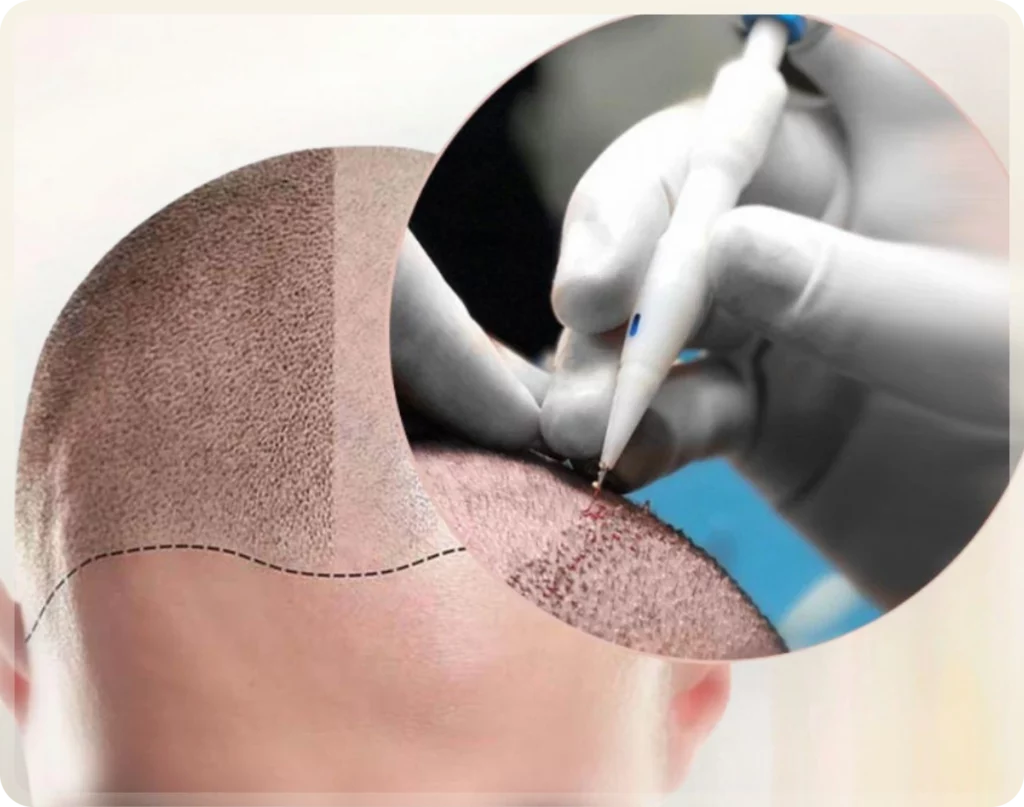
A DHI (direct hair implantation) hair transplant at Carely Clinic costs €1,800 all-inclusive until December 2026, with no graft cap and no per-graft charge. The grafts are taken out one by one, as in FUE, and placed with an implanter pen under local anaesthesia. The procedure takes 6 to 8 hours, and you stay 4 days and 3 nights in Istanbul. New hair usually starts to appear after 4 months, and the full result takes 10 to 18 months (NHS).
| Quick Facts | Details |
|---|---|
| 💰 Price | €1,800 all-inclusive, valid until December 2026. Same price as FUE |
| 🔬 Technique | FUE extraction, then placement with an implanter (Choi) pen |
| 👩⚕️ Who performs it | Dr. Yeşim Güner designs the hairline and places every graft with the pen. Her team assists with extracting the grafts and loads the pens |
| 📍 Where | in Istanbul, under local anaesthesia |
| ⏱️ Procedure duration | 6–8 hours |
| 🧮 Grafts | No graft cap, no per-graft charge |
| ✂️ Shaving | Donor area is shaved. The area receiving the grafts depends on your case |
| 🗓️ Stay in Istanbul | 4 days / 3 nights in a 5-star hotel |
| 📦 Package includes | Procedure, blood tests, PRP, hotel, VIP transfers, medications, aftercare kit |
| 📲 Follow-up | 12 months on WhatsApp, with photo reviews |
| 📱 Contact | WhatsApp: +90 531 912 5591 |
| Quick Navigation |
|---|
| • What Is a DHI Hair Transplant? |
| • DHI Cost in Turkey |
| • Who Places the Grafts |
| • Advantages and Limits |
| • Risks |
| • Recovery and Results |
| • DHI vs FUE vs Sapphire FUE |
| • Your 4-Day Trip |
| • Your Doctor |
| • FAQ |
| • Book Now → |
DHI stands for direct hair implantation. It is the name many clinics give to an FUE hair transplant in which the grafts are placed with an implanter pen. The follicles are taken out one by one from the back and sides of the head, exactly as in FUE. Only the placement step is different.
The International Society of Hair Restoration Surgery (ISHRS) describes forceps and implanters as the two techniques for placing grafts. It is direct about the name: it says DHI is not a hair transplant method in its own right and should not be marketed as one (ISHRS, A Guide to Hair Transplant Surgery). We use the term because patients search for it. At Carely Clinic it means FUE extraction with placement by implanter pen, and it is one of the two techniques we use for hair transplants in Turkey.
It is the tool that places the graft. The ISHRS describes an implanter as a device in which the graft is loaded into a channel and a plunger then inserts it into the skin. A sharp implanter makes the incision and places the graft in one movement. A dull implanter places grafts into incisions that were made beforehand. The device goes back to Choi and Kim, who published the “Choi hair transplanter” in 1992, which is why implanter pens are often called Choi pens.
In three steps, on one day:
The whole procedure is done under local anaesthesia and takes 6 to 8 hours.
We found no source showing that it is. The one advantage the ISHRS states for implanters is that the bulb of the graft is not handled directly, so it is potentially subject to less trauma than a graft held with forceps. A study in the ISHRS journal followed 15,147 grafts placed with sharp implanters in seven men and found 99.5% of the follicles it examined unchanged after placement. Its authors still wrote that endorsing one method over the other is not possible, because they did not compare implanters with forceps (Hair Transplant Forum International, 2017).
Our guide to FUE vs DHI goes through the evidence point by point.
Anyone who is a good candidate for a hair transplant. We found no published criteria that separate DHI candidates from FUE candidates, so the general ones apply:
Most often for hairline work and smaller areas, and for adding density between existing hair. There is no fixed rule. She decides case by case, first from your photos and then at your assessment in Istanbul, and your written treatment plan states which technique is proposed. Both cost the same at Carely Clinic, so the choice is a medical one.
If you have Afro-textured or tightly curled hair, read our guide to Afro hair transplants in Turkey.
At Carely Clinic, €1,800 all-inclusive, whatever the number of grafts, and the same as FUE. We found no survey that prices DHI separately in Turkey. For FUE, a survey published in April 2025 found an average of £1,464 for 1,500 grafts across Istanbul clinics, against £4,820 at UK clinics shown the same photos.
No official body publishes hair transplant prices for Turkey, and the ISHRS says the cost of FUE is too broad to publish. The figures below therefore come from named, dated sources, and only ours is specific to DHI. A lower price is the main reason people travel, and it is not proof of quality either way. Our guide to why people go to Turkey for hair transplants sets out the reasons and the downsides, and the cost page explains what moves a price.
Not at Carely Clinic: both are €1,800, with no graft cap and no per-graft charge. Some clinics price DHI above FUE. If a clinic does, ask what the difference pays for, and who places the grafts.
| Where | Published figure | Source and date |
|---|---|---|
| Carely Clinic, Istanbul: DHI | €1,800 all-inclusive, no graft cap | Our price, valid until December 2026 |
| Carely Clinic, Istanbul: FUE | €1,800 all-inclusive, no graft cap | Our price, valid until December 2026 |
| Istanbul clinics, average (FUE) | £1,464 for 1,500 grafts (quotes from £850 to £2,490) | Survey of 87 clinics by Wimpole Clinic, a UK clinic, published April 2025 |
| UK clinics, average (FUE) | £4,820 for 1,500 grafts | Same survey, 104 clinics |
| UK, any technique | £1,000 to £30,000 | NHS, page reviewed September 2023 |
| US, average (FUE) | $11,229 | RealSelf, 1,574 patient reviews, July 2023 |
The UK and US figures cover the procedure alone, while Turkish prices usually include the hotel and transfers. The full list of what our price covers is on the All-Inclusive DHI Hair Transplant Turkey Package page. For country comparisons, see the UK vs Turkey, Turkey vs the US and Mexico vs Turkey.

Dr. Yeşim Güner designs the hairline and places every graft with the implanter pen herself. Her team assists with extracting the grafts and loads the pens.
This is the first question to ask any clinic that offers DHI, because the pen makes the incision as it places the graft. The ISHRS lists placing grafts with sharp implanters among the steps that only the surgeon should perform, and loading the implanters among the steps that technicians may do (ISHRS, Before you choose a surgeon).
Five questions, before you pay anything:
Our own answers are on this page: Dr. Güner places every graft, the hairline is designed with you on day 1, the price is fixed at €1,800 whatever the graft count, the inclusions are listed below, and follow-up runs for 12 months.
You send photos of your hair and donor area on WhatsApp. Dr. Güner reviews them, and our team replies within 24 hours with a written treatment plan that states the technique, the hairline plan and the fixed price.
The procedure, pre-operative blood tests, a PRP session, 3 nights in a 5-star hotel, VIP airport transfers, medications, the first wash at the clinic, an aftercare kit and 12 months of follow-up. There is no graft cap and no per-graft charge. Flights are not included. The price is valid until December 2026.
As many as your donor area can safely give in one session. We found no source that sets a lower graft limit for placement with a pen: what limits the number is the donor hair, not the tool. The number is written in your plan, and because the price does not change with it, there is no reason to inflate it. Our graft calculator guide explains how the number should be reached.
The stated advantage is gentler handling: the graft is pushed in by a plunger, so its bulb is not gripped. The limit is that we found no study showing that this changes the result you see in the mirror.
The same as for an FUE hair transplant, because the extraction is the same, and we found no source that lists separate risks for placement with a pen. The NHS describes a hair transplant as generally a safe procedure, with a small risk, as with any operation.
When the hair loss is still changing, or a scalp condition is active. StatPearls advises delaying or avoiding a transplant when:
It also names smoking, diabetes, high blood pressure and heart disease as conditions to discuss before surgery. Tell us about your health and your medicines when you send your photos.
Dr. Güner reviews your photos before you travel, designs the hairline with you on day 1 and places the grafts herself. Blood tests are done before the procedure, the first wash is done at the clinic on day 3, and follow-up continues for 12 months. These steps lower the risk. They do not remove it.
Recovery after DHI follows the same published timeline as FUE: you may need 1 to 2 weeks off work, new hair usually starts to appear after 4 months, and the full result takes 10 to 18 months (NHS). We found no source that gives a faster recovery for placement with a pen.
Our results timeline shows each stage month by month.
Follow-up continues on WhatsApp for 12 months, with photo reviews at 1 week and at 1, 3, 6 and 12 months. For washing and care at home, follow the written instructions you are given at the clinic.
The difference is in how the grafts are placed, not in how they are taken out. In DHI the implanter pen makes the incision and places the graft together. In FUE the incisions are made first, with a steel or a sapphire blade, and the grafts are then placed with forceps. Carely Clinic offers DHI and FUE with sapphire blades at the same price.
| Step | DHI | Sapphire FUE |
|---|---|---|
| Extraction | DHI: One by one with a small punch | Sapphire FUE: Same |
| Incisions | DHI: Made by the implanter pen as each graft is placed | Sapphire FUE: Made first, with a sapphire blade |
| Placement | DHI: With the implanter pen, in one movement | Sapphire FUE: With forceps, into the incisions |
| Who does it at Carely Clinic | DHI: Dr. Güner places every graft with the pen | Sapphire FUE: Dr. Güner makes the incisions. Her team assists with placing the grafts |
| Donor area | DHI: Shaved | Sapphire FUE: Shaved |
| Recovery and results | DHI: Same published timeline (NHS) | Sapphire FUE: Same published timeline (NHS) |
| Price at Carely Clinic | DHI: €1,800 all-inclusive | Sapphire FUE: €1,800 all-inclusive |
We found no study showing that one of these gives better results than the other. Our guides to FUE vs DHI and Sapphire FUE compare them in detail.
Related procedures: FUE Hair Transplant Turkey • Beard Transplant Turkey • Eyebrow Transplant Turkey
Four days and three nights. Carely Clinic arranges the airport transfers and the hotel, and both are included in the price.
| Day | What happens |
|---|---|
| Day 1 - Arrival | VIP airport pickup, hotel check-in, blood tests, assessment and hairline design |
| Day 2 - Procedure | DHI procedure at the clinic under local anaesthesia (6-8 hours) and a PRP session, then back to the hotel |
| Day 3 - First wash | First wash at the clinic, aftercare kit and written instructions |
| Day 4 - Departure | Hotel checkout and airport transfer |
* Included: 3 nights in a 5-star hotel, VIP airport transfers, medications and the aftercare kit. Flights are not included.
Follow-up continues on WhatsApp for 12 months. We ask for photos at 1 week and at 1, 3, 6 and 12 months. Dr. Güner’s team reviews them and answers your questions about washing, medications and daily care.
DHI at Carely Clinic is led by Dr. Yeşim Güner. She reviews your photos before you travel, designs the hairline with you on day 1, and places every graft with the implanter pen herself. Her team assists with extracting the grafts and loads the pens.
You can read about her training on her page, and see the whole team on our doctors.
Step 1: Send your photos. Send photos of your hair and donor area on WhatsApp (+90 531 912 5591), with your age, your health conditions and the medicines you take.
Step 2: Get your written plan. Dr. Güner reviews your photos, and our team replies within 24 hours with a written treatment plan that states the technique, the hairline plan and the fixed price.
Step 3: Choose your dates. Send us your flight details and we arrange the hotel and the airport transfers to match.
Step 4: Travel. You are met at the airport on day 1. Blood tests, assessment and hairline design take place the same day, and the procedure is on day 2.
Contact: WhatsApp +90 531 912 5591
Email: carelyclinic@gmail.com
DHI Hair Transplant Turkey Price Valid Until: December 2026
Medical Disclaimer: This page provides general information and is not medical advice. Results vary from person to person, and every surgical procedure carries risks. Whether a hair transplant is suitable for you depends on an individual assessment.
Sources: the ISHRS patient guides (updated 2024 and September 2026), the NHS page on hair transplants (reviewed September 2023), the StatPearls reference Hair Transplantation (updated August 2025) and a study in Hair Transplant Forum International (2017), linked in the text and read in November 2026. Prices come from a survey by Wimpole Clinic, a UK clinic, published in April 2025, and from RealSelf patient reviews, which we name but do not link. Carely Clinic is in Istanbul, so we are not neutral, and we quote no success rate we could not trace to a source.
Written by Carely Clinic Medical Team · Last updated: November 2026
Dr. Yeşim Güner designs the hairline and places every graft with the implanter pen herself. Her team assists with extracting the grafts and loads the pens.
DHI and FUE both cost €1,800 at Carely Clinic, so the technique in your plan is a medical choice.
The price does not change with the number of grafts, and there is no per-graft charge.
Hair transplants are performed under local anaesthesia. You go back to your hotel the same day.
Procedure, blood tests, PRP, 3 nights in a 5-star hotel, VIP transfers, medications and aftercare kit. Valid until December 2026. Flights not included.
Follow-up on WhatsApp, with photo reviews at 1 week and at 1, 3, 6 and 12 months.
Fill out the form below and our team will get back to you within 24 hours
At Carely Clinic a DHI hair transplant costs €1,800 all-inclusive until December 2026, with no graft cap and no per-graft charge. That is the same price as FUE. We found no survey that prices DHI separately in Turkey. For FUE, a survey of 87 Istanbul clinics published in April 2025 found an average of £1,464 for 1,500 grafts.
The NHS describes a hair transplant as generally a safe procedure, with a small risk of bleeding, infection or an allergic reaction to the anaesthetic. DHI carries the same risks as FUE, because the extraction is the same. In Turkey, as anywhere, the main safeguard is knowing who places the grafts. At Carely Clinic, Dr. Yeşim Güner places every graft herself.
The €1,800 DHI price at Carely Clinic covers the procedure with the implanter pen, pre-operative blood tests, a PRP session, 3 nights in a 5-star hotel, VIP airport transfers, medications, the first wash at the clinic, an aftercare kit and 12 months of follow-up. There is no graft cap and no per-graft charge. Flights are not included.
Ask who holds the implanter pen. The ISHRS lists placing grafts with sharp implanters among the steps that only the surgeon should perform. Then ask for the price in writing, with what it includes and whether it changes with the number of grafts. At Carely Clinic, Dr. Yeşim Güner places every graft herself, and the price is fixed at €1,800.
The number depends on your donor area and the area to be covered, not on the pen. We found no source that sets a lower graft limit for DHI. Your number is set after your photos are reviewed and written in your treatment plan. At Carely Clinic the price is the same whatever the number.
According to the NHS, the transplanted hair often falls out after a few weeks, new hair usually starts to appear after 4 months, and the full result should be seen after 10 to 18 months. We found no source that gives a faster timeline for DHI than for FUE.
We found no source showing that it is. The ISHRS says an implanter does not handle the bulb of the graft directly, which is potentially less traumatic, and it also says DHI is not a separate hair transplant method. We found no published study that compares the results of the two head to head. At Carely Clinic both cost the same.
Only the placement step. In both, follicles are taken out one by one from the donor area. In FUE the incisions are made first and the grafts are placed into them with forceps. In DHI each graft is loaded into an implanter pen, often called a Choi pen, that makes the incision and places the graft in one movement.
The donor area at the back of the head is shaved so the grafts can be taken. Whether the area receiving the grafts also needs to be shaved depends on your case, and Dr. Güner tells you at your hairline design assessment. The ISHRS says non-shaved FUE may be performed in select cases, but takes much more labour and time.
It is done under local anaesthesia, so you are awake but should not feel pain during the procedure, which takes 6 to 8 hours at Carely Clinic. Afterwards, the NHS says it is common to have a tight, achy and swollen scalp for a few days.
WhatsApp us