
Quick Summary
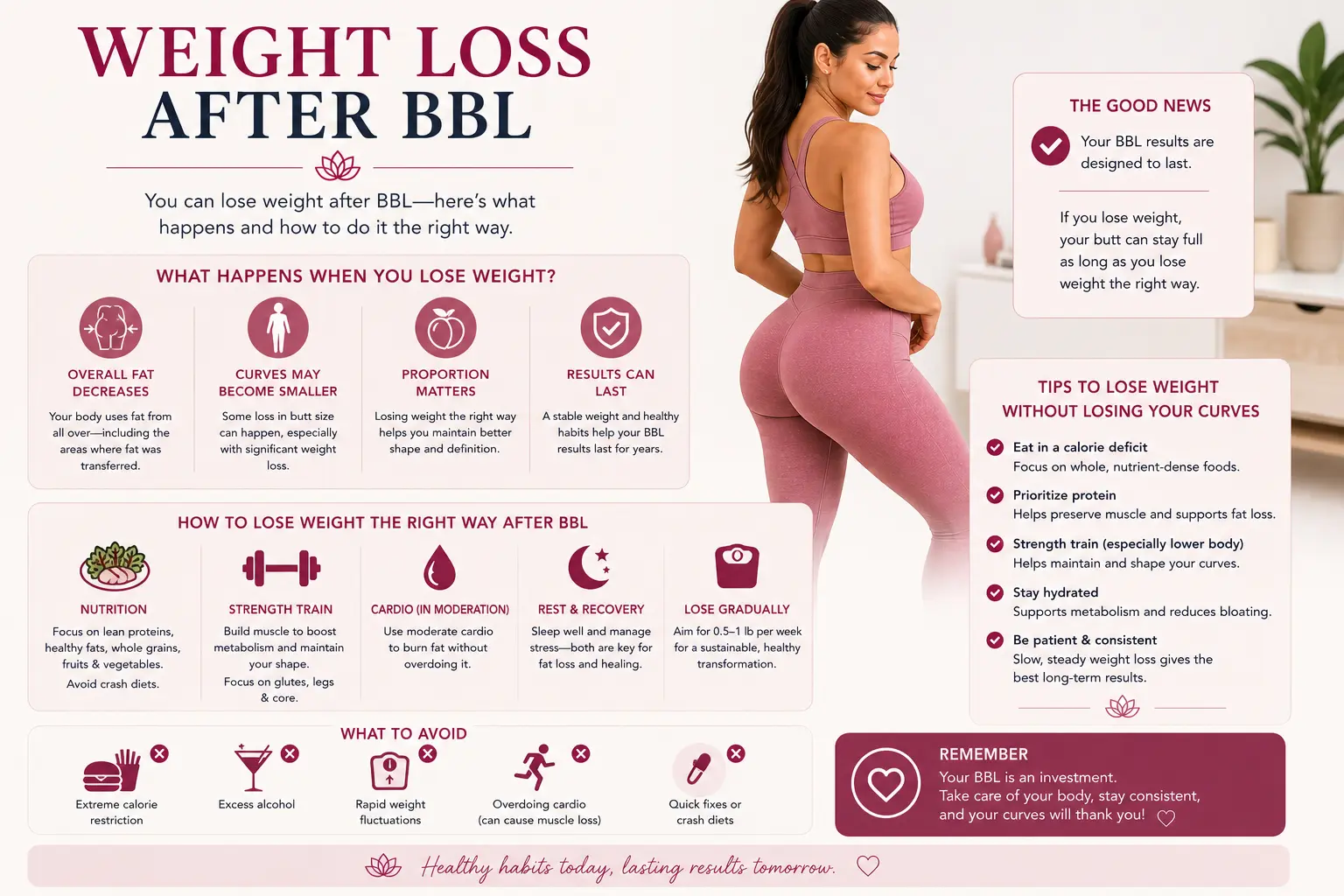
Weight loss after a BBL affects your results, but proportionally — transferred fat cells shrink the same way as fat elsewhere in your body. Losing fewer than 10-15 lbs rarely causes noticeable changes; losing 20-30+ lbs can significantly reduce buttock volume.
What Actually Happens to Your BBL When You Lose Weight?
Losing weight after a BBL affects your results, but not catastrophically. Transferred fat cells behave exactly like native fat — shrinking with weight loss, expanding with weight gain. Minor fluctuations under 10-15 lbs rarely cause visible changes. Losses of 20 lbs or more can meaningfully reduce buttock volume, per ASPS body contouring guidelines.
Gradual, supervised weight loss after month 6 carries the lowest risk to results. The critical window is the first 3-6 months post-surgery. During this period, newly grafted fat cells are establishing blood supply and are especially vulnerable. Turkey is among the leading global destinations for BBL procedures, with patients from the UK and US making up a significant portion of medical tourists. Gradual, supervised weight loss after month 6 carries the lowest risk to your outcome.
This guide covers safe weight-loss timelines, weekly milestones, warning signs to watch, and how to protect your BBL results long term.
Why Trust This Guide
This guide draws on ISAPS Global Survey data, ASPS post-operative guidance, BAAPS patient safety information, and peer-reviewed literature on autologous fat grafting outcomes.
It is medically reviewed by Op. Dr. Alirza Jahangirov, a Plastic, Reconstructive & Aesthetic Surgeon at Carely Clinic in Istanbul. This content is educational and does not replace a personalised consultation with a qualified surgeon.
Do Fat Cells Die When You Lose Weight After a BBL?
Fat cells shrink when you lose weight after a BBL — they do not die, which means volume can be partially recovered if weight is later regained.
This is an important distinction. Clinical understanding of fat grafting confirms that post-BBL weight loss causes fat cell contraction, not fat cell death. The grafted fat cells behave identically to fat cells in their original donor location. If your abdominal fat was historically the last place you lost weight before surgery, those grafted cells will also resist loss when redistributed to your buttocks.
The implications are positive. Even if you lose volume temporarily due to weight loss, patients who regain weight — whether intentionally or naturally — often see partial or full restoration of their BBL result, provided the fat cells survived the initial graft survival window of 3-6 months.
How Much Weight Loss Will Affect Your BBL Results
The volume impact of weight loss on BBL results is directly proportional to the amount lost — minor fluctuations cause minimal change, while losses above 20 lbs produce noticeable and potentially significant volume reduction.
Understanding where your specific result sits on this spectrum helps set realistic expectations and guides decisions about post-operative dieting.
Minor Weight Loss (Under 15 lbs)
Minor weight loss under 15 lbs is unlikely to produce visible changes to your BBL result in most patients.
The proportional nature of fat-cell shrinkage means that a small overall reduction distributes across your entire body, including your buttocks. The relative shape and projection of your result should remain largely intact. Fluctuations in this range are within the normal expected variance of post-operative body composition changes.
Moderate Weight Loss (15-20 lbs)
Losing 15-20 lbs falls into a variable zone where some patients see noticeable changes and others do not.
Body composition, the donor fat source, and the initial volume transferred all influence outcomes at this range. Patients with higher starting weight, greater overall fat mass, or fat transferred from “stubborn” areas (flanks, lower back) tend to retain more BBL volume. Patients with less fat-to-volume ratio or leaner starting points will see more obvious reduction. At this threshold, most surgeons recommend a consultation before proceeding with further weight loss.
Significant Weight Loss (20-30+ lbs)
Losing 20 or more pounds will measurably reduce buttock volume and may visibly alter the shape of your BBL result.
At 20-30+ lbs lost, the following changes are commonly reported:
- Reduced projection: The buttocks lose fullness and anterior-posterior projection.
- Shape change: Symmetry may be affected if fat loss is uneven between sides.
- Skin laxity: Particularly in patients over 35 or with reduced skin elasticity.
- Loss of waist-to-hip ratio: The sculpted hourglass effect may diminish as surrounding areas also slim.
Patients in this range are suitable candidates for revision BBL procedures, provided their weight is stable for at least 6-12 months before the revision.
5 Factors That Determine How Much Weight Loss Impacts Your BBL
Five variables determine whether weight loss will significantly reduce your BBL result: fat donor site, volume transferred, speed of loss, time since surgery, and your individual genetics. Not all patients respond the same way.
Factor 1: Where Your Fat Was Harvested From
The donor site of your transferred fat determines how it behaves with weight loss after BBL.
Fat cells carry the metabolic “memory” of their original location. If the surgeon harvested fat from areas where you historically struggle to lose weight — the lower back, flanks, or inner thighs — that fat will be similarly resistant to loss once transferred to your buttocks. The clinical consensus is that fat cells behave the same in their new location as they did in the original donor site.
Factor 2: How Much Fat Was Transferred
Higher-volume fat transfers provide a larger buffer against weight-loss-related volume reduction.
A patient who received 600cc per side will retain more visible projection after a 15 lb loss than a patient who received 300cc per side. This is not a reason to over-correct during surgery — overfilling carries its own risks — but it contextualises why outcomes vary between patients who lose the same amount of weight post-operatively.
Factor 3: Speed of Weight Loss
Rapid weight loss is far more damaging to BBL results than gradual weight loss.
Crash dieting, extreme caloric restriction, or aggressive exercise programmes accelerate the rate at which fat cells contract and reduce. This rapid contraction is more likely to cause asymmetry and disproportionate loss. A gradual reduction of 1-2 lbs per week after the 6-month mark gives the fat cells time to adapt in proportion. Standard surgical guidance explicitly recommends against rapid weight-loss programmes in the first 12 months following fat transfer procedures.
Factor 4: Time Since Surgery
The earlier after surgery you lose weight, the greater the risk to your results.
The first 3-6 months are the most critical. Newly transferred fat cells are establishing their vascularisation — the blood supply that makes them permanently viable. Caloric deficits during this window can compromise the take rate of the graft, reducing both the number of surviving cells and the final volume of your result. After 6 months, fat cells that survived are considered established and respond to weight changes the same as all other body fat.
Factor 5: Your Genetics and Fat Distribution Pattern
Your individual genetic fat distribution pattern influences where your body preferentially loses weight first.
Some patients naturally lose weight from the gluteal region first; others lose it last. If your genetic pattern means your buttocks are among the first areas to slim down during weight loss, you will see more rapid changes to your BBL after dieting. Conversely, patients whose bodies shed fat from the abdomen and face first often find their BBL result is the last thing to visibly change. Your surgeon can advise on your individual pattern based on your pre-operative anatomy.
The Safe Weight-Loss Timeline After BBL (Week by Week)
The first 6 months post-BBL are the highest-risk period for weight loss. A week-by-week framework helps patients understand what dietary and exercise activities are safe at each stage of recovery.
The table below summarises standard clinical guidance for complication monitoring after BBL.
| Time Post-Surgery | Diet Guidance | Exercise Permitted | Weight-Loss Goal? |
|---|---|---|---|
| Weeks 1-2 | High-protein, low-sodium diet. Adequate calories to support healing. No caloric deficit. | Light walking only (5-10 min, 2-3x daily). No strenuous activity. | No. Body requires full caloric support. |
| Weeks 3-6 | Balanced diet with lean protein, healthy fats, and whole grains. Continue adequate caloric intake. | Low-impact walking increased. No sitting directly on buttocks. No cardio. | No. Fat cells still establishing blood supply. |
| Weeks 6-12 | Healthy balanced diet. May reduce processed foods and alcohol. No aggressive dieting. | Low-impact cardio (swimming, cycling) with surgeon clearance. Begin glute resistance work. | No intentional dieting. Minor natural fluctuations acceptable. |
| Months 3-6 | Healthy maintenance diet. Avoid crash diets or extreme caloric restriction. | Full exercise after surgeon clearance. Moderate cardio permitted. Avoid excessive fat-burning HIIT. | Caution. Consult surgeon before beginning weight loss. |
| 6+ Months | Gradual weight loss of 1-2 lbs per week is safe if medically supervised. | All exercise types permitted. Prioritise glute resistance training over high-volume cardio. | Yes, with gradual approach and surgeon awareness. |
Warning Signs to Watch For After BBL
Certain symptoms after BBL require immediate medical attention. While most complications are rare, patients should know the signs of fat necrosis, infection, deep vein thrombosis, and pulmonary embolism — especially during the first 6 weeks.
The table below is based on ASPS (US) and BAAPS (UK) complication monitoring guidelines for post-BBL patients.
Among international patients who travel home after surgery, asymmetric swelling that develops after return travel is a commonly missed early warning sign. Any new swelling or hardening in one buttock after flying home should be assessed by a surgeon promptly.
| Warning Sign | What It May Indicate | Action Required |
|---|---|---|
| Fever above 38.5°C (101.3°F) | Systemic infection or early sepsis | Seek emergency medical care immediately |
| Hard, painful lump in buttock | Fat necrosis (non-viable transferred fat) | Contact your surgeon within 24 hours |
| Increasing redness, warmth, or discharge at incision sites | Wound infection | Contact your surgeon; may require antibiotics |
| Sudden calf pain, redness, or swelling | Deep vein thrombosis (DVT) | Seek emergency care immediately; risk of pulmonary embolism |
| Shortness of breath, chest pain, or rapid heart rate | Pulmonary embolism (PE) or fat embolism | Call emergency services (999/112/911) immediately |
| Worsening asymmetry or sudden volume loss in one side | Uneven fat cell survival or seroma | Contact your surgeon within 48 hours |
| Fluid accumulation or unusual bulging near donor site | Seroma or haematoma at liposuction site | Contact your surgeon; may require drainage |
Who Should NOT Attempt Weight Loss in the First 6 Months After BBL?
Intentional weight loss is contraindicated for all BBL patients in the first 3-6 months post-surgery. Certain medical conditions, histories, and surgical circumstances make this restriction absolute.
Absolute Contraindications to Post-BBL Weight Loss
These patients must not attempt intentional weight loss until fully cleared by their plastic surgeon:
- Patients in the first 6 months post-surgery: Fat cell vascularisation is incomplete. Caloric deficits can compromise graft take rates and final volume outcomes. This applies universally across post-operative fat transfer care.
- Patients with active post-operative complications: Infection, seroma, haematoma, or fat necrosis require the body’s full healing resources. Dieting during active complications delays recovery and increases risk.
- Patients with BMI below 22 at time of surgery: Patients with limited fat reserves who received a high-volume fat transfer are at greater risk of disproportionate volume loss from even modest weight reduction.
Relative Contraindications (Proceed Only With Surgeon Approval)
These patients may be able to manage gradual weight loss after 6 months, but require personalised guidance:
- Patients with metabolic conditions (type 2 diabetes, PCOS, hypothyroidism): Metabolic variation affects how and where weight is lost. A medically supervised approach ensures weight loss does not disproportionately affect gluteal fat stores.
- Patients planning pregnancy within 12-18 months: Pregnancy will significantly alter body composition and BBL results regardless of weight management efforts. Timing of any weight-loss programme should factor in family planning.
- Patients who received revision or touch-up BBL: A second fat transfer involves a smaller, more vulnerable graft volume. The stabilisation window after revision should be treated as equivalent to the original procedure.
Managing Expectations
No weight management strategy can guarantee unchanged BBL results indefinitely. Body composition shifts with age, hormonal changes, and lifestyle factors that no surgical procedure fully controls. The goal is proportional preservation — ensuring that any weight changes you experience result in even, symmetrical changes to your overall shape, rather than disproportionate loss in the buttocks.
How to Maintain Your BBL Results Long Term
Long-term BBL maintenance requires three parallel commitments: weight stability within 15 lbs of your surgery baseline, targeted glute training after recovery, and regular follow-up with your plastic surgeon.
Weight stability is non-negotiable. The most effective single strategy for maintaining BBL results is staying within 10-15 lbs of the weight you were on the day of surgery. This range allows for normal fluctuation while protecting the structural integrity of your result. Dr. Cat Plastic Surgery (2025) published data suggesting that well-maintained BBLs can last 10 or more years with consistent lifestyle habits.
Diet Recommendations to Maintain BBL Results
A Mediterranean-pattern diet rich in lean protein, healthy fats, and whole grains supports BBL maintenance without triggering fat-cell depletion.
Specific dietary principles recommended by body contouring surgeons for post-BBL patients include adequate daily protein (1.2-1.6g per kg of body weight) to preserve muscle mass, omega-3 fatty acids from sources such as salmon, avocado, and olive oil for skin elasticity, and consistent hydration of 2-2.5 litres daily. Alcohol should be limited to no more than one drink daily, as excess alcohol consumption is associated with both fat redistribution and impaired skin quality over time.
Glute training enhances your results. From week 8 onward, resistance exercises targeting the gluteal muscles — including hip thrusts, cable kickbacks, step-ups, and resistance band squats — build muscle beneath the transferred fat layer. This adds definition and lift that complement your surgical result and, in many patients, actually improves their BBL appearance over time compared to their immediate post-operative result.
Learn more about Brazilian Butt Lift at Carely Clinic or explore our guide to post-BBL recovery.
Frequently Asked Questions
Will my BBL go away if I lose weight?
Your BBL will not disappear entirely, but losing 20 or more pounds reduces buttock volume. Transferred fat cells shrink proportionally with weight loss, the same as all body fat. Maintaining a stable weight within 10-15 lbs of your surgery weight best preserves results long term.
How much weight can I lose after a BBL without losing results?
Most surgeons agree that losing up to 10-15 lbs causes minimal change in BBL results.
How long after a BBL can you lose weight?
Most plastic surgeons advise waiting at least 3-6 months before beginning intentional weight loss. Clinical consensus confirms fat cells stabilise and establish blood supply in this window. After month 6, gradual loss of 1-2 lbs weekly carries the lowest risk to graft survival.
Does losing weight after a BBL affect the transferred fat cells?
Losing weight shrinks transferred fat cells, but does not destroy them once the grafting process is complete.Fat cells shrink rather than die, so partial volume recovery is possible if weight is later regained. Rapid weight loss in the first 6 months poses the greatest risk to your final BBL outcome.
Can I diet after a BBL?
Yes, but not in the first 3-6 months, when transferred fat cells are still establishing a blood supply. A low-sodium, high-protein diet is typically recommended during recovery to support healing and reduce inflammation. After stabilisation, a moderate 300-500 calorie daily deficit is considered safe by most board-certified surgeons.
What happens if I lose 20 pounds after a BBL?
Losing 20 lbs will noticeably reduce buttock volume and projection, as transferred fat cells shrink significantly.Skin laxity can also develop in patients over 35 with lower initial skin elasticity. A revision BBL procedure can restore lost volume by transferring additional fat once your weight stabilises again.
Will exercise after a BBL shrink my results?
Exercise alone will not shrink your BBL, but high-cardio routines causing significant fat loss may reduce volume.Glute resistance training after week 8 can enhance your BBL by adding muscle beneath the transferred fat. Avoid high-impact cardio and fat-burning workouts for at least 6 months post-surgery.
How do I maintain my BBL results long term?
Maintaining a stable weight within 10-15 lbs of your surgery weight is the single most effective strategy. With stable weight and consistent exercise habits, a BBL can last 10 or more years after surgery. Glute-strengthening exercises, adequate protein intake, and annual surgeon follow-up appointments all support long-term result preservation.
When can I start working out after a BBL?
Light walking is safe from week 2; low-impact exercise resumes at weeks 4-6 per. High-impact cardio, running, and heavy lifting should wait until the 8-12 week mark and surgeon clearance. Glute squats, lunges, and resistance band exercises are recommended after full recovery to enhance and support results.
Will my BBL get bigger if I gain weight?
Yes, the transferred fat cells will expand with weight gain, increasing buttock volume above your surgical result.However, weight gain also increases fat in all other body areas, which can affect your overall proportions. Gains of 5-10 lbs can enhance fullness; gains above 15-20 lbs may alter your overall body proportions.
Can I get a revision BBL if I lose too much weight?
A revision BBL is a viable option for patients who lose significant volume due to post-surgical weight loss. Your weight must stabilise at a maintainable level before additional fat transfer can be safely performed. Revision procedures are typically performed 12 or more months after original surgery once weight is confirmed stable.
How long does a BBL last?
A well-maintained BBL can last 10 or more years when weight remains stable and lifestyle habits are consistent. At 6 months, fat graft vascularisation is complete and the surviving cells are considered permanently established. Significant weight fluctuations, pregnancy, and smoking are the most common factors that reduce BBL longevity over time.
Conclusion
Losing weight after a BBL will not erase your results if you respect the 3-6 month stabilisation window, avoid rapid dieting, and maintain weight within 15 lbs of your surgery baseline.
The core principle is straightforward: transferred fat behaves like native fat. This works in your favour when weight is stable — your result is naturally maintained — and it works against you only when rapid or significant weight loss compresses fat cells faster than the body can adapt proportionally. Losses under 15 lbs rarely alter your result meaningfully. Losses above 20-30 lbs will reduce volume, but even then, the cells survive and revision options exist.
The most important steps you can take are: wait at least 6 months before pursuing intentional weight loss, keep any reduction gradual at 1-2 lbs per week, prioritise glute resistance training over high-volume cardio, and maintain regular follow-up appointments with your surgeon throughout the first year.
For patients travelling from the UK or US to Istanbul for their BBL, the same principles apply — plus the additional consideration of flying clearance, compression garment compliance during travel, and coordinating post-operative care across countries.
Individual outcomes vary. This guide provides general medical education based on international guidelines and published research. Consult a qualified medical professional for personalised advice.
Medical Review: Op. Dr. Alirza Jahangirov