
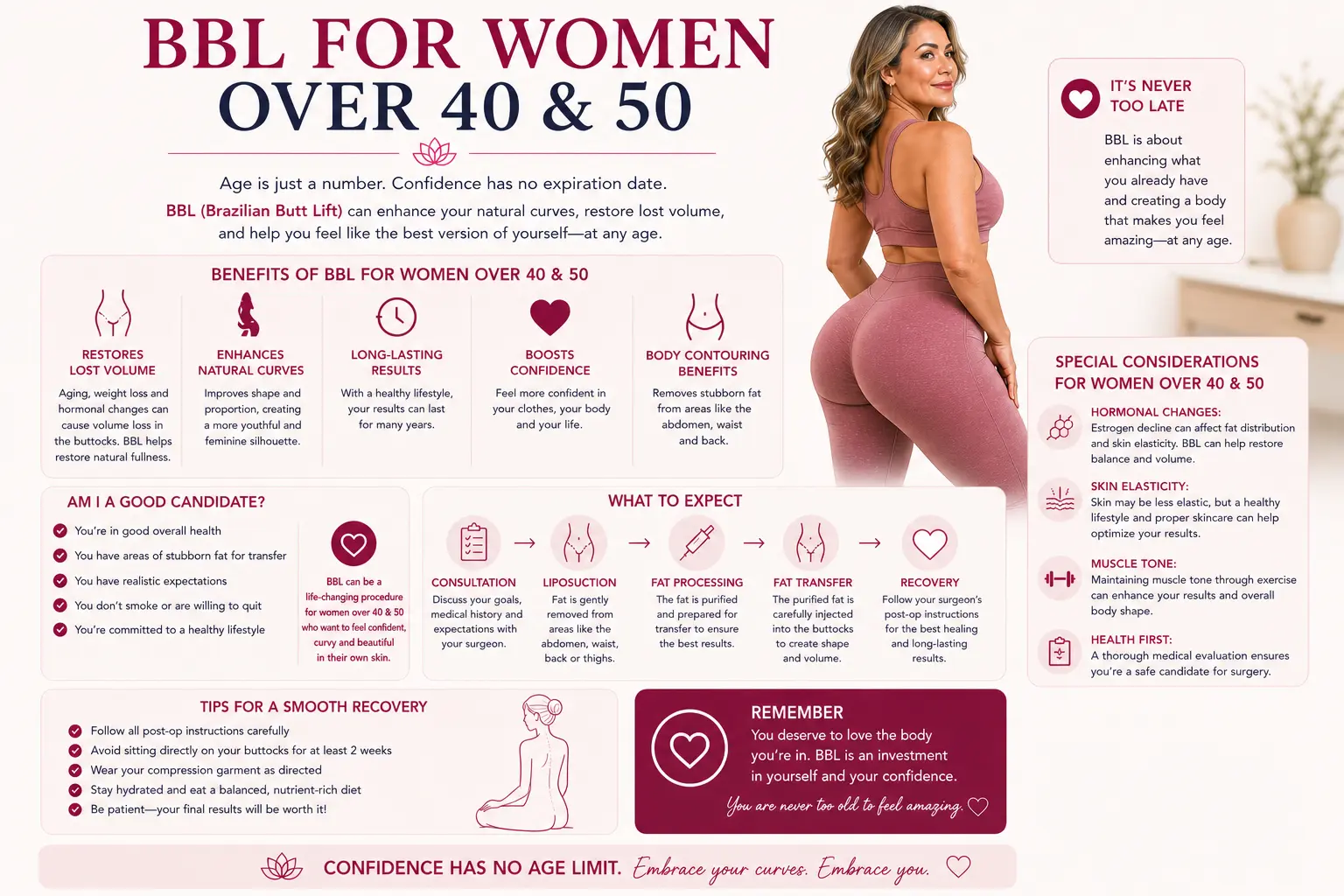
Quick Summary:
Age itself does not disqualify a patient from a BBL — biology does. Women in their 40s and 50s can undergo the procedure safely when BMI falls between 18 and 32, cardiovascular health is assessed, and surgical design is adjusted for reduced skin elasticity. Per 2022 ASPS and ISAPS joint guidelines, subcutaneous-only fat injection remains the non-negotiable safety standard regardless of patient age.
This guide covers candidacy criteria, biological changes by decade, contraindications, recovery, and what the procedure looks like in Turkey.
Is BBL Safe After 40? What the Data Actually Shows
Age alone does not determine BBL safety. The 2022 ASPS and ISAPS joint Practice Advisory formalised subcutaneous-only fat injection as the non-negotiable standard — a protocol that applies equally to patients at 25 and at 55. What changes after 40 is surgical design, not the fundamental safety framework.
Women over 40 and 50 can be suitable BBL candidates — but age introduces biological factors that change both candidacy criteria and surgical design. The critical variables are skin elasticity, BMI (ideally 18-32), cardiovascular health, and smoking status, not chronological age alone. Per the 2022 ASPS and ISAPS Practice Advisory on Gluteal Fat Grafting, subcutaneous-only fat injection above the gluteal muscle is the current safety standard for all age groups.
Mortality rates have dropped from 1 in 3,000 before 2017 to approximately 1 in 14,952 following mandatory technique reform, according to 2020 ASERF research published in the Aesthetic Surgery Journal. For patients over 40, experienced surgeons modify the procedure — using smaller transfer volumes and more conservative projection — to account for reduced skin recoil and age-related fat behaviour. BAAPS 2024 data confirms body contouring procedures remain in steady demand among UK women aged 40-55.
A thorough pre-operative medical assessment, including cardiovascular screening and skin quality evaluation, is the baseline requirement for any patient over 40 considering a BBL.
Why Trust This Guide
This guide draws on the 2022 ASPS/ISAPS/ASAPS joint Practice Advisory on Gluteal Fat Grafting (US and global), ASERF mortality research published in the Aesthetic Surgery Journal (2020), and 2024 BAAPS data on cosmetic surgery trends in the UK. It was medically reviewed by Op. Dr. Alirza Jahangirov, a Plastic, Reconstructive & Aesthetic Surgeon at Carely Clinic in Istanbul. This content is educational. It is not a substitute for a personalised surgical consultation.
How Your Body Changes at 40 and 50 — and What That Means for a BBL
Two biological turning points define BBL candidacy in midlife: the early 40s, when skin elasticity and fat behaviour begin to shift, and the early 50s, when those shifts accelerate. Understanding each decade lets patients and surgeons set realistic goals before surgery.
These are not reasons to avoid a BBL — they are reasons to plan it differently.
BBL at 40: A Turning Point, Not a Cutoff
At 40, the body begins a gradual biological transition that makes surgical planning more important, not surgery less possible.
Skin elasticity decreases modestly, collagen production slows, and perimenopause begins to influence fat distribution. Fat survival after transfer can be slightly reduced. Surgeons account for this by transferring conservative volumes targeting shape, not size — and by planning for how results will evolve as skin continues to change. A well-designed BBL at 40 typically produces proportionate, natural-looking results that age well.
BBL at 50: What Changes and What Doesn’t
At 50, skin recoil is more limited, fat behaviour differs, and the risk of future sagging increases — but the procedure remains viable for healthy candidates.
What does not change at 50 is the safety protocol. Subcutaneous-only fat injection, ultrasound guidance, and JCI-accredited facilities are equally required for the 50-year-old patient. What does change is the surgical conversation: the best outcomes at this age typically prioritise lifted contour and improved waist-to-hip ratio over maximum volume.
The table below summarises key biological changes and their surgical implications by decade.
| Age Group | Key Biological Change | Surgical Implication |
|---|---|---|
| 40-44 | Mild collagen decline; early perimenopause in some patients; fat redistribution begins | Conservative volume; emphasis on shape over size; long-term aging planned into design |
| 45-49 | Perimenopausal hormonal shifts; reduced skin recoil; slower healing | Thorough cardiovascular screening; possible skin laxity assessment; smaller injection volumes |
| 50-54 | Postmenopausal fat behaviour; significant elastin loss; slower metabolic healing | Stricter BMI ceiling (ideally under 30); consider body lift combination for lax skin |
| 55+ | Significant skin laxity; reduced cardiovascular reserve; higher anaesthesia sensitivity | Full cardiology clearance required; highly conservative design; body lift often more appropriate |
5 Factors That Determine BBL Candidacy After 40
Five clinical variables determine whether a woman over 40 is a suitable BBL candidate. Each can be assessed at a pre-operative consultation. None of them is age itself — though age influences all five to varying degrees.
BMI and Donor Fat Availability
Sufficient donor fat and a healthy BMI are the first screening criteria for any BBL candidate, regardless of age.
Most surgeons require a BMI between 18 and 32. The optimal window of 24-30 provides enough donor fat from the abdomen, flanks, or thighs while keeping anaesthesia and wound-healing risks manageable. Patients over 40 with BMI above 35 are typically asked to reduce weight before surgery. Learn more about how VASER liposuction at Carely Clinicis used to harvest donor fat safely.
Cardiovascular Health and Anaesthesia Risk
Cardiovascular fitness becomes the most critical non-anatomical criterion for BBL candidacy in women over 40.
Hypertension, previous cardiac events, arrhythmia, and uncontrolled diabetes all increase anaesthesia risk. Most surgeons request an electrocardiogram (ECG) and basic blood panel before approving surgery in this age group. Controlled hypertension that is stable on medication is typically a relative, not absolute, contraindication.
Skin Elasticity and Tissue Quality
Skin quality determines how well the overlying tissue will remodel around transferred fat and hold the new shape long-term.
Surgeons assess skin laxity manually and sometimes with imaging. Patients with moderate laxity may still achieve good results with conservative volume; those with significant excess skin may be better served by a body lift in combination with, or instead of, a BBL.
Smoking, Medications, and Healing Capacity
Smoking is a near-absolute disqualifier for BBL candidacy at any age — its impact on fat graft survival and wound healing is severe after 40.
Nicotine constricts blood vessels and dramatically reduces transferred fat survival rates. Most surgeons require 6 weeks of complete cessation before and after surgery. Blood thinners, hormone replacement therapy, and certain supplements also require a management plan before surgery.
Weight Stability
Weight fluctuations of more than 5-7 kg after a BBL directly affect the result — fat cells expand or shrink with body weight changes.
Patients planning significant weight loss after surgery are generally advised to reach their goal weight first. Women over 40 who are mid-weight-loss journey typically achieve better long-term results by completing that journey before booking surgery.
How Surgeons Modify BBL Technique for Patients Over 40
A BBL performed on a 48-year-old patient is not the same operation as one performed on a 28-year-old. The safety protocol is identical, but the design strategy changes across volume targets, fat placement priorities, and outcome framing.
The core technique remains constant: VASER liposuction harvests donor fat, the fat is purified, and it is injected exclusively in the subcutaneous layer above the gluteal muscle — never into or beneath the muscle. This subcutaneous-only protocol, mandated by the 2022 ASPS/ISAPS Practice Advisory, is what eliminated the primary cause of BBL-related fatalities.
What changes after 40 is the volume, projection goal, and design philosophy:
- Volume: Smaller transfer amounts preserve proportion as skin changes over time.
- Projection: Moderate, lifted projection ages better than maximum volume at this stage.
- Waist contouring: 360 liposuction of the abdomen, flanks, and back creates proportional enhancement even with smaller buttock volume.
- Fat placement: Emphasis on upper pole fullness, which counteracts the gravitational changes that come with reduced skin elasticity.
Expert Insight
“Clinical experience across plastic surgery practice shows that patients over 40 consistently achieve their most satisfying results when the goal is a proportionate, lifted silhouette rather than dramatic volume increase. Anatomy-first planning allows surgeons to design results that will still look natural as the patient’s body continues to evolve.”
— General clinical consensus on age-appropriate BBL design
Who Is NOT a Good Candidate for BBL After 40?
A subset of patients over 40 should not undergo BBL surgery. Contraindications divide into absolute categories — where the procedure cannot safely proceed — and relative categories, where optimisation may make surgery possible. Both require honest surgical assessment.
Absolute Contraindications
Absolute contraindications are conditions where BBL surgery cannot safely proceed under any circumstances.
The following conditions represent absolute disqualifiers:
- Active cancer or recent chemotherapy: Compromised immune response and healing capacity make fat transfer surgery unsafe. A minimum 2-year remission period is typically required by most surgeons before elective cosmetic procedures.
- Uncontrolled diabetes (HbA1c above 8.0): Severely impaired wound healing and elevated infection risk make BBL surgery inadvisable until glycaemic control is achieved.
- Active deep vein thrombosis or pulmonary embolism history: The position-related nature of BBL recovery (avoiding sitting) and the fat embolism risk profile make any active clotting pathology a disqualifier.
- Serious heart disease: Significant cardiac conditions, including recent myocardial infarction, active arrhythmia, or unstable angina, present unacceptable anaesthesia risk.
- Insufficient donor fat: Patients with very low body fat who cannot provide enough viable adipose tissue from the abdomen, flanks, or thighs are not suitable candidates for fat transfer. BMI under 18 typically falls into this category.
Relative Contraindications
Relative contraindications are conditions that require optimisation before surgery can be safely approved — they are not automatic disqualifiers.
These cases may proceed after medical review and stabilisation:
- Controlled hypertension: Blood pressure stable on medication, cleared by a cardiologist, is not a disqualifier. An ECG and anaesthesia assessment are standard requirements.
- BMI 32-35: Surgeons may recommend weight loss of 5-10 kg before surgery to bring BMI into the safer window and improve donor fat quality.
- Smoking cessation under 6 weeks: Patients who quit smoking fewer than 6 weeks before surgery may be asked to delay. Complete cessation for 6 weeks before and after surgery is standard protocol.
- Hormone replacement therapy (HRT): Some forms of HRT affect coagulation. A haematology review and, in some cases, a temporary medication change may be required before surgery.
- History of DVT (resolved, treated): A resolved clotting history requires haematological clearance and an intra-operative and post-operative anticoagulation plan.
Managing Expectations
Realistic expectations are a clinical prerequisite, not a cosmetic preference — patients with unrealistic goals have higher dissatisfaction rates regardless of technical outcome.
Results evolve over 6-12 months. Approximately 20-40% of transferred fat is reabsorbed in the first 3 months; the remainder typically remains permanent with stable weight. For patients over 40, natural aging will gradually affect the skin around the result. A well-designed BBL planned with this in mind will still look proportionate and natural 5-10 years later.
Warning Signs to Watch For After BBL Surgery
Most BBL complications, when identified early, are manageable. The danger comes from delayed response. Patients over 40 should know these warning signs by name before they leave the clinic — and have a direct contact number for their surgical team.
These warning signs apply at all ages. Patients over 40 may notice some — particularly healing-related signs — more frequently due to slower tissue recovery.
| Warning Sign | What It May Indicate | Action Required |
|---|---|---|
| Fever above 38.5°C (101.3°F) persisting beyond day 3 | Surgical site infection or systemic infection | Contact your surgical team immediately. Do not wait for a scheduled appointment. |
| Wound separation or opening at incision sites | Wound dehiscence, more common in patients over 45 | Cover with a sterile dressing and seek same-day clinical review. |
| One calf or leg significantly more swollen than the other, with pain | Possible deep vein thrombosis (DVT) | Go to the nearest emergency department immediately. DVT is a medical emergency. |
| Sudden shortness of breath, chest pain, or racing heartbeat | Possible pulmonary embolism or fat embolism | Call emergency services immediately. This is life-threatening and requires immediate care. |
| Fluid accumulation under the skin (seroma) — firm or fluctuant swelling | Seroma formation, more common after extensive liposuction | Contact your surgeon for drainage assessment. Most seromas resolve with aspiration. |
| Sudden worsening of pain after initial improvement (days 5-10) | Possible delayed infection or haematoma | Do not increase pain medication independently. Contact your surgical team on the same day. |
BBL Recovery After 40: Timeline and What to Expect
BBL recovery follows the same core milestones regardless of age, but patients over 40 typically experience slower tissue settling and should plan for the longer end of each window. The 2-3 week no-sitting rule is non-negotiable at any age.
Recovery in the first week centres on pain management, compression garment use, and strictly avoiding pressure on the buttocks. Short walks from day 1 are recommended by most surgeons to reduce DVT risk — this applies particularly to patients over 40 who may have additional cardiovascular risk factors.
By weeks 2-4, swelling reduces by approximately 40-50% and the initial shape becomes visible. The 20-40% fat reabsorption rate during this period is normal; the result at 3 months is not the final result. Most patients return to desk work in 2-3 weeks.
By month 3, the majority of swelling has resolved. The “fluffing” phase — where remaining fat matures and skin relaxes — occurs between months 3 and 6. Final results stabilise at 12 months.
Patients over 40 who also underwent 360 liposuction may experience more widespread swelling across multiple body areas. BBL pillows are essential when sitting is unavoidable and must be used for a full 8 weeks.
Explore the full body contouring recovery process at Carely Clinic for detailed post-operative guidance.
How This Applies in Turkey
Turkey is one of the world’s leading countries for BBL volume, alongside major markets including the United States and Brazil. Istanbul’s JCI-accredited clinics offer full candidacy screening and age-appropriate surgical planning for UK and US patients over 40 at a fraction of home-country costs.
Turkey has a significant number of JCI-accredited hospitals, with the majority located in Istanbul. Turkish plastic surgeons complete comprehensive specialisation training, with many holding international society memberships and performing high case volumes through the country’s active aesthetic surgery sector. This volume — combined with structured pre-operative candidacy screening — makes Istanbul one of the most experienced BBL destinations globally.
For patients over 40, this matters particularly because age-appropriate technique modification requires a surgeon with broad BBL experience, not just technical competency.
BBL in Turkey 2026 — Cost Comparison:
- Turkey (Istanbul, all-inclusive): £3,200-£4,800 / $4,000-$6,000 / €3,300-€5,500
- United Kingdom: £8,000-£14,000 (NHS does not fund this procedure)
- United States: $10,000-$15,000 before adding anaesthesia and facility fees
Carely Clinic’s all-inclusive BBL package covers surgery at a JCI-accredited hospital, 5-star hotel accommodation for 6 nights, all ground transfers, pre-operative tests, medications, compression garments, and lifetime aftercare support.
For patients over 40, candidacy screening at Carely Clinic includes cardiovascular assessment, BMI evaluation, skin quality review, and a frank surgical design conversation — the same pre-operative depth UK and US patients would expect at home.
Learn more about BBL at Carely Clinic and read our guide to BBL safety standards.
When Can You Fly After BBL Surgery?
Most patients receive flying clearance 10-14 days after BBL surgery, once wounds are stable and no DVT indicators are present.
UK patients flying back from Istanbul and US patients on transatlantic routes should factor a minimum 10-day stay into their travel planning. Long-haul flights carry an elevated DVT risk after major surgery. On the return flight, patients must wear medical-grade compression socks, stand and walk every 45 minutes, stay hydrated, and use a BBL pillow to avoid direct pressure on the buttocks. Airlines do not automatically provide DVT guidance for post-surgical passengers — your surgical team will provide a written fit-to-fly letter and a specific compression garment recommendation.
Frequently Asked Questions
Is 40 too old for a BBL?
No, 40 is not too old, but it is a biological turning point requiring surgical adjustments. ASPS guidelines (US) and BAAPS data (UK) confirm age alone does not determine candidacy. Skin elasticity, BMI, cardiovascular health, and smoking status are the deciding clinical factors.
Can a 50 year-old woman get a BBL safely?
Yes, a 50-year-old woman can undergo a BBL safely when pre-operative health screening is thorough. Surgeons at ISAPS-member facilities modify technique at this age, using smaller volumes and conservative projection. The question is not only whether surgery is possible, but whether the design matches long-term aging biology.
What are the age limits for a Brazilian Butt Lift?
There is no fixed upper age limit; most surgeons assess health rather than birth year. The 2022 ASPS and ISAPS joint Practice Advisory sets no chronological cutoff for BBL candidacy. Patients over 55 typically require more detailed cardiovascular, skin quality, and anaesthesia tolerance evaluations.
What body changes after 40 affect BBL results?
After 40, skin elasticity decreases, collagen production slows, and fat cells begin to redistribute differently.Hormonal shifts, particularly perimenopause, affect fat survival rates after transfer, These changes require surgeons to reduce transfer volumes and plan for how results will evolve over time.
What BMI do you need for a BBL over 40?
Most surgeons require a BMI between 18 and 32 for safe BBL candidacy at any age. BMI 24-30 is considered optimal as it provides sufficient donor fat while minimising anaesthesia and healing risks. Patients with BMI over 35 are generally advised to lose weight before surgery to reduce complication rates.
How does skin elasticity affect BBL outcomes after 40?
Reduced skin elasticity after 40 means the skin recoils less around transferred fat, affecting final shape. Surgeons compensate by injecting smaller volumes and targeting a lifted, proportioned silhouette rather than maximum size. Patients with significantly lax skin may achieve better results when BBL is combined with a body lift.
What are the disadvantages of a BBL at older age?
The main disadvantages are reduced fat survival, longer recovery, greater risk of shape changes over time. As skin loses collagen and elastin, larger BBL volumes tend to droop or spread within 5-10 years. Conservative volume goals and a long-term perspective minimise these disadvantages when surgical design is age-appropriate.
How long is BBL recovery for women over 40?
Full BBL recovery typically takes 6-8 weeks, with patients over 40 often needing the longer end. The no-sitting restriction applies for 2-3 weeks regardless of age, with compression garment use for 6 weeks. Slower tissue healing after 40 is normal; surgeons account for this in post-operative care instructions.
What health conditions disqualify you from getting a BBL?
Uncontrolled diabetes, active heart disease, clotting disorders, and active cancer are absolute contraindications for BBL surgery. Any condition that significantly elevates anaesthesia risk disqualifies a candidate. Relative contraindications such as controlled hypertension can often be optimised before surgery with physician clearance.
How long do BBL results last after 40?
Fat that survives the first 3 months post-surgery typically remains permanent, behaving like native fat tissueWeight stability is the single most important factor in maintaining BBL results at any age.
Is BBL safe for women in their 50s?
BBL is safe for women in their 50s when performed at an accredited facility by a board-certified surgeon. The 2020 ASERF study showed mortality rates of approximately 1 in 14,952 using subcutaneous-only injection technique. Thorough pre-operative screening for cardiovascular health and donor fat quality is especially important in this age group.
When can you fly after a BBL?
Most surgeons clear patients to fly 10-14 days after BBL surgery, once wounds are stable. UK and US patients travelling to Turkey should plan a minimum 10-day stay before their return flight. During the flight, wearing compression socks and walking regularly helps reduce DVT risk on long-haul journeys.
Conclusion
Age is not the enemy of a good BBL result. The right medical profile, realistic expectations, and a surgeon who modifies technique for maturity are what determine outcomes after 40 and 50.
What this guide has established: There is no fixed upper age limit for a BBL. Candidacy is assessed across five clinical variables — BMI, cardiovascular health, skin elasticity, smoking status, and weight stability. Surgery after 40 and 50 is safe when protocol is followed, but it requires a different design philosophy: smaller volumes, conservative projection, and a result planned to evolve gracefully with the body.
The safety data is clear. Following multi-society safety reforms and mandatory subcutaneous-only injection technique, published mortality data shows dramatic improvement — applicable to patients at every age when protocol is followed.
Your next step is a personalised consultation with Op. Dr. Alirza Jahangirov, where your BMI, skin quality, cardiovascular status, and aesthetic goals are reviewed before any surgical recommendation is made. Video consultations are available for UK and US patients ahead of travel.
Individual outcomes vary. This guide provides general medical education based on international guidelines and published research. Consult qualified medical professionals for personalised advice.
Medical Review: Op. Dr. Alirza Jahangirov