
Quick Summary
Natural breast augmentation uses your own harvested fat — not implants — to add breast volume. Fat is removed via liposuction from the abdomen or thighs, purified, and injected into the breasts, typically increasing size by half to one cup. Fat survival rates range from 50–80% at six months, according to peer-reviewed data. Costs in Turkey run €2,800–€4,000 all-inclusive, versus £7,000–£10,000 in the UK and $9,000–$12,000 in the US.
| Factor | Natural Breast Augmentation (Fat Transfer) | Implant Augmentation |
|---|---|---|
| Material | Your own body fat | Silicone or saline shell |
| Max size increase | ½–1 cup per session | 1–4+ cups |
| Look and feel | Completely natural | Natural to firm depending on type |
| Scarring | Minimal (2–4mm injection points) | Small incision scar (3–5cm) |
| Rupture risk | None | Possible — ~1% per year |
| Capsular contracture | Not possible | 3–5% within 10 years |
| Longevity | Permanent (surviving fat) | 10–15 years before replacement |
| Body contouring benefit | Yes — slims donor site | No |
| Turkey cost (all-inclusive) | €2,800–€4,000 | €3,400–€5,200 |
| Recovery time | 1–2 weeks to desk work | 2–3 weeks to desk work |
| Requires donor fat | Yes — sufficient supply needed | No |
Why Trust This Guide
This guide draws on the 2024 systematic review published in Plastic and Reconstructive Surgery, the 2023 Annals of Plastic Surgery SVF fat grafting study (384 patients, 18-month follow-up), and procedural statistics from ASPS and ISAPS.
Carely Clinic’s editorial team reviews all content for clinical accuracy and updates articles when research or guidelines change. This is medical education content — not a substitute for a personalized surgical consultation.
What Is Natural Breast Augmentation?
Natural breast augmentation is an implant-free surgical technique that uses your own body fat — not silicone or saline — to increase breast volume, with typical results of half to one cup size per session and no foreign material placed in the body.
The procedure is also called fat transfer breast augmentation, breast fat grafting, autologous fat transfer, or lipofilling. All terms refer to the same technique: liposuction removes unwanted fat from a donor site, that fat is purified, then injected precisely into breast tissue to add volume and improve shape.
According to ASPS, breast augmentation remains the most performed cosmetic surgical procedure in the United States. Fat transfer to the breast represents the fastest-growing subset of that category, driven by increasing patient awareness of implant alternatives and growing availability of skilled fat grafting surgeons.
How Does the Procedure Work?
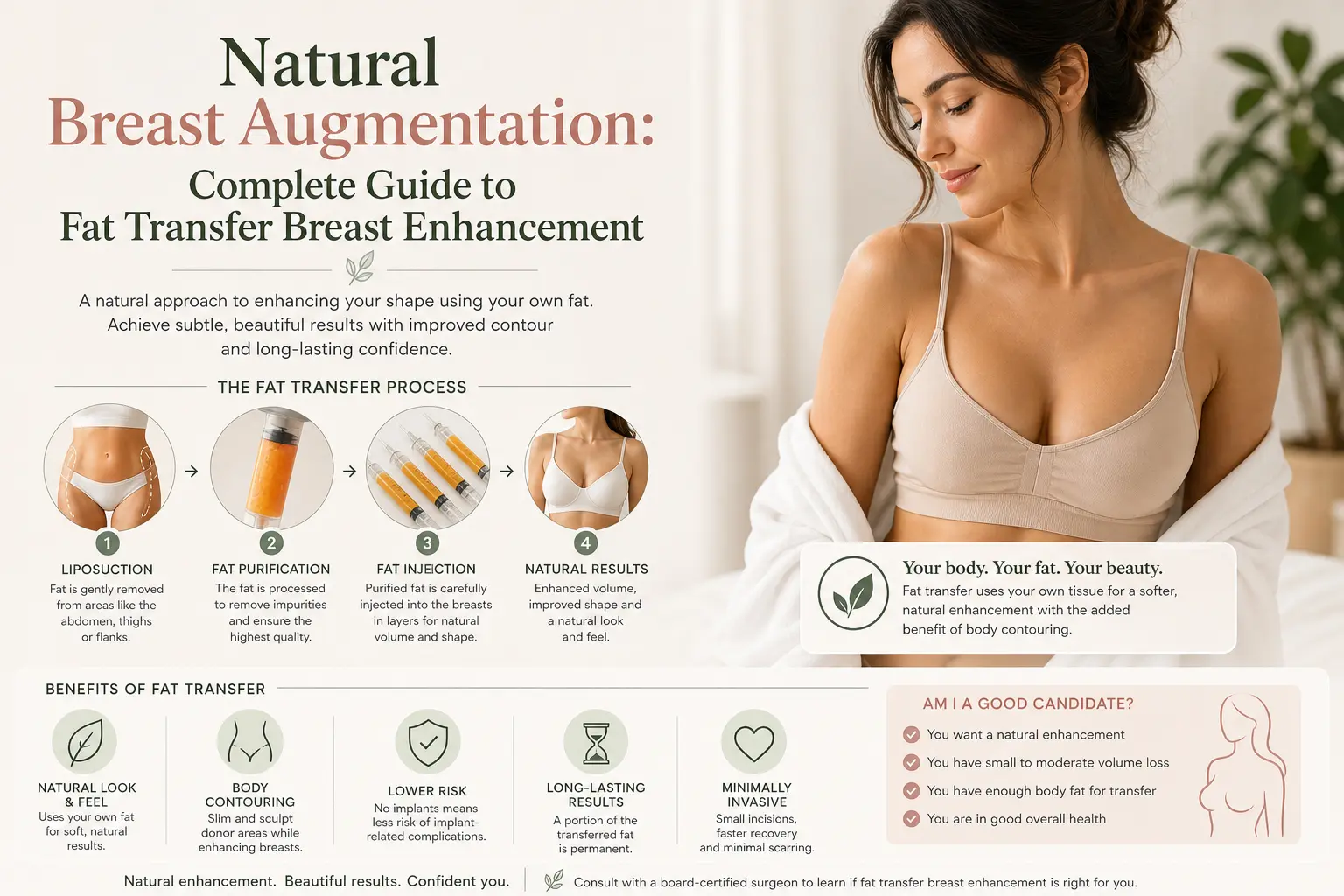
The three-stage fat transfer process — liposuction harvesting, centrifugation purification, and micro-injection — takes 2–3 hours as an outpatient procedure under general anaesthesia, with no implants and incisions under 4mm.
Step 1: Fat Harvesting via Liposuction
Surgeons remove fat from the abdomen, thighs, or flanks using a narrow cannula under 4mm, with tumescent or VASER-assisted liposuction preserving maximum fat cell viability.
The donor site is selected based on where you have adequate fat reserves and where you would benefit from contouring. Most patients choose the abdomen or flanks. VASER ultrasound-assisted harvesting is increasingly favoured at high-volume centres because it reduces mechanical trauma to fat cells, which directly supports higher post-operative retention rates.
Step 2: Fat Purification and Processing
Harvested fat is processed in a closed sterile system — centrifuged or filtered — to remove blood, oil, lidocaine, and non-viable cells before only healthy adipocytes are retained for injection.
This step is one of the most technically variable aspects of the procedure. Different centres use centrifugation, filtration, washing, or combinations of these. A 2024 network meta-analysis published in PubMed found that both platelet-rich plasma (PRP)-enhanced and cell-assisted lipotransfer (CAL) techniques produced higher fat survival than conventional methods alone, though technique selection still depends on individual patient anatomy and surgeon experience.
Step 3: Fat Injection Into the Breast
Purified fat is injected in multiple small passes through a fine cannula into different tissue planes of the breast, building volume gradually in thin layers that maximise contact with blood supply.
Injecting fat in small droplets across multiple tissue planes is the critical technical difference between experienced fat grafting surgeons and less specialised ones. Overly large deposits lack adequate blood supply contact, increasing the risk of fat necrosis. Volumes of 300–500 ml per breast are typical in a single session.
Who Is a Good Candidate?
Ideal candidates are healthy, non-smoking women with sufficient donor fat — typically enough to harvest 300–500 ml per breast — who want a modest, natural-looking enhancement of half to one cup without foreign materials.
Ideal Candidates
Patients seeking subtle enhancement, those with adequate fat reserves at the abdomen or thighs, and those preferring zero implant-related risk are the strongest candidates.
Additional factors that support candidacy include: realistic expectations about size increase (under one cup per session), willingness to undergo liposuction of the donor site, no active breast disease, and stable body weight. Women who have lost upper breast volume after pregnancy or breastfeeding, or who have mild asymmetry, are frequently excellent candidates.
Who Is Not a Good Candidate?
Women with insufficient donor fat, those wanting more than one cup size increase, or those with significant sagging requiring a breast lift are better served by implants or a combined approach.
Smoking significantly reduces fat graft survival by impairing circulation and oxygen delivery to the transferred cells. Patients with a personal history of breast cancer should discuss the procedure with both their oncologist and plastic surgeon before proceeding, as the relationship between adipose-derived stem cells and breast tissue requires careful evaluation in that context.
How Much Can It Increase Breast Size?
Most patients achieve half to one full cup size per session, with 300–500 ml injected per breast — final size is smaller than initial post-operative volume because 20–50% of fat is reabsorbed within the first six months.
Volume Increase Per Session
A single fat grafting session produces approximately half to one cup size of lasting enhancement, with final stable volume visible at three to six months once reabsorption plateaus.
This is the most important limitation to communicate clearly. Unlike implants, which provide immediate and predictable size, fat transfer results depend on how much fat survives. The initial post-operative breast will appear larger than the final result. Swelling also temporarily inflates early results. Stable, permanent volume becomes apparent once the surviving fat has established vascularisation.
When a Second Session Is Needed
Patients wanting one full cup size reliably, or those with lower fat survival rates, may benefit from a second fat transfer session six to twelve months after the first.
A second session costs less than the initial procedure at most centres because the donor site has already been mapped and the breast tissue has been expanded. At Carely Clinic, we discuss staged planning upfront during consultation so patients can set realistic milestones rather than feel surprised by post-reabsorption volume.
Fat Survival Rates: What the Research Shows
Published data shows conventional fat grafting achieves 50–80% fat survival at six months, while advanced techniques using stromal vascular fraction (SVF) or PRP enhancement consistently produce retention rates above 75% at 18 months.
The most rigorous recent data comes from a 2023 study published in the Annals of Plastic Surgery, which tracked 384 women who underwent SVF-enhanced breast fat grafting. The study recorded retention rates of 78.6% at three months, 77.2% at six months, and 77.5% at 18 months — demonstrating that SVF-enhanced results are stable long-term, not progressively declining.
For comparison, conventional (non-enhanced) fat grafting typically achieves 50–70% retention at six months in the broader literature. A 2024 systematic review in Plastic and Reconstructive Surgery, which analysed 12 studies using a network meta-analysis framework, confirmed that both CAL and PRP-assisted techniques produce higher survival than standard lipotransfer, though the optimal strategy still varies by patient anatomy and technique combination.
Expert Insight
“Advances in fat processing, enrichment, and administration — including the use of PRP and stem cell-enriched fractions — have increased volumetric outcomes from approximately 30% retention to nearly 80% in experienced hands.”
— Breast Fat Grafting: 10-Year Clinical Experience, SAGE Journals (Aesthetic Surgery, 2024)
A key practical implication: surgeons who perform high volumes of fat grafting procedures and use closed sterile harvesting systems consistently report retention rates at the upper end of published ranges. This is why volume of surgeon experience matters as much as technique choice when selecting a centre for fat transfer breast augmentation.
Pros and Cons of Natural Breast Augmentation
Fat transfer offers completely natural results, no implant-related risks, and simultaneous body contouring — but is limited to half to one cup per session, requires adequate donor fat, and carries a 20–50% reabsorption rate in the first six months.
Benefits of Fat Transfer Augmentation
The procedure eliminates every implant-specific risk: no rupture, no capsular contracture, no BIA-ALCL association, no replacement surgery at 10–15 years, and no foreign material in the body.
Additional advantages include a dual cosmetic benefit — liposuction of the donor site slims the waist, flanks, or thighs simultaneously. Incisions are minimal (under 4mm), scarring is virtually absent, and because no muscle dissection is required, pain and recovery time are generally lower than implant surgery. Breast and nipple sensation remain intact in most cases.
Drawbacks and Limitations
The procedure cannot reliably achieve more than one cup size per session, results vary based on how much fat survives, and patients who gain or lose significant weight post-surgery may see changes in breast volume.
Additional drawbacks include the requirement for sufficient donor fat — very lean patients may not be candidates. The cost can be comparable to or slightly higher than implants in some markets because it involves two simultaneous procedures (liposuction + injection). Multiple sessions may be required for optimal results, extending both recovery time and total cost.
Natural Breast Augmentation vs. Implants
Fat transfer and implants differ most critically in size range — fat transfer is limited to one cup per session while implants can increase size dramatically — but fat transfer wins on natural feel, longevity without replacements, and absence of implant-specific complications.
For patients wanting a subtle, natural result who have available donor fat and realistic expectations about modest enhancement, fat transfer is often the better choice. For those wanting to go up two or more cup sizes, correct significant sagging, or achieve more predictable results, implants or a combined implant-plus-fat approach produces superior outcomes.
The two techniques are not mutually exclusive. Many surgeons now offer composite augmentation — implants for primary volume with fat grafting used to soften edges, improve upper-pole fullness, and disguise implant outlines. This hybrid approach is increasingly requested by patients who want size but also prioritise a natural appearance.
Learn more about breast implant options at Carely Clinic and how they compare with fat transfer for your anatomy.
Mammogram Safety: What You Need to Know
Fat transfer to the breasts can create benign calcifications visible on mammograms, but current radiological guidance confirms trained radiologists can reliably distinguish fat graft calcifications from malignant findings — making the procedure safe for women who undergo routine breast screening.
The ASPS temporarily discouraged breast fat grafting in 1987 due to concerns that fat-derived calcifications would obscure cancer detection on mammograms. That position was reversed as mammogram technology and radiologist training advanced substantially over subsequent decades.
Modern mammography protocols, combined with radiologists’ familiarity with the appearance of fat graft calcifications (typically smooth, rounded, and benign-appearing), have made the concern largely obsolete. However, you should always inform your radiologist and GP that you have had fat grafting to the breast before your next mammogram, so they can interpret findings in the correct clinical context.
Can Fat Transfer Be Combined With Implants?
Yes — fat grafting and implants are frequently combined in composite augmentation, where implants provide primary volume and fat is used to soften contours, improve upper-pole fullness, or correct asymmetry — producing more natural-looking results than either technique alone.
This combined approach is also used in explantation cases, where a patient removes existing implants and uses fat grafting during a simultaneous breast lift to maintain some volume without new implants. According to ASPS member surgeons, the combination is increasingly popular as more women request implant removal and natural alternatives.
Fat can also be used to improve the appearance of visible implant edges in slim patients with minimal natural breast tissue, where the implant outline might otherwise be detectable. In these cases, fat is injected over the upper and lateral aspects of the implant to create a smoother, more natural transition.
Natural Breast Augmentation Cost by Country
Fat transfer breast augmentation costs €2,800–€4,000 all-inclusive in Turkey in 2026, versus £7,000–£10,000 in the UK and $9,000–$12,000 in the US — representing savings of 60–70% without compromising surgeon certification or facility standards.
How Costs Compare by Country
| Country | Cost Range | Typical Inclusions |
|---|---|---|
| Turkey (Istanbul) | €2,800–€4,000 | Surgery, anaesthesia, hospital stay, transfers, hotel, follow-up |
| United Kingdom | £7,000–£10,000 | Surgery only — accommodation and transfers separate |
| United States | $9,000–$12,000 | Surgeon fee, facility, anaesthesia; aftercare often extra |
| Australia | A$13,000–A$17,000 | Variable — usually surgery + hospital only |
Natural breast augmentation in Turkey is typically priced £200–£400 below the equivalent implant augmentation package, because no implant cost is involved — though the liposuction component means it does not represent the lowest-cost breast procedure overall.
What Turkish All-Inclusive Packages Include
Istanbul packages for fat transfer breast augmentation typically cover surgery, general anaesthesia, pre-operative blood tests, 1–2 nights hospital stay, compression garments, airport transfers, hotel accommodation for 5–7 nights, and 12-month remote follow-up via WhatsApp or video consultation.
A second session (if needed for volume top-up after reabsorption) typically costs €1,800–€2,400 as a standalone procedure, significantly less than the initial surgery. This should be factored into total cost planning at the outset for patients who want reliable one-cup-size results.
Recovery Timeline
Most patients return to desk work within 1–2 weeks and resume full physical activity by week 4–6 after natural breast augmentation, with final stable results visible at 3–6 months once fat reabsorption plateaus.
| Timeframe | What to Expect |
|---|---|
| Days 1–3 | Hospital or recovery stay; significant swelling at both donor and breast sites; compression garments fitted; light walking encouraged |
| Days 4–7 | Rest at hotel or home; first follow-up dressing change; swelling peaks; most patients cleared to fly day 7–8 after surgery in Turkey |
| Weeks 1–2 | Resume desk work; avoid lifting over 3–4 kg; garments worn 23 hours daily; bruising resolves |
| Weeks 3–6 | Light exercise permitted at week 3; full physical activity at week 6; garments transitioned to daytime only |
| Months 1–3 | Breast volume settles as fat reabsorption occurs; donor site contour refines; final result becoming visible |
| Months 3–6 | Stable final result; surviving fat behaves as permanent breast tissue; reassess if second session desired |
One key recovery advantage of fat transfer over implant surgery is the absence of muscle dissection. Implant placement beneath the pectoralis muscle requires cutting through muscle tissue, which is the primary driver of post-operative pain and longer return-to-activity timelines. Fat transfer is entirely subcutaneous and subglandular, meaning patients typically experience less pain and less restricted movement during healing.
How This Applies in Turkey
Turkey performed 48,179 breast augmentation procedures in 2024 according to ISAPS, more than any other European nation, with fat transfer costs of €2,800–€4,000 all-inclusive — a 60–70% saving versus the UK and US.
Istanbul is the primary destination for fat transfer breast augmentation within Turkey, with the highest concentration of EBOPRAS-certified plastic surgeons and JCI-accredited hospitals in the country. Many senior Turkish surgeons completed subspecialty training at European and US institutions and return to practices that perform 400–600+ breast procedures annually — a volume associated with lower complication rates and more consistent fat grafting outcomes.
Fat transfer breast augmentation in Turkey costs €2,800–€4,000 all-inclusive in 2026. That compares with £7,000–£10,000 in the UK and $9,000–$12,000 in the US for comparable procedures. The cost differential is driven by Turkey’s lower operating costs and favourable exchange rates, not differences in surgeon credentials or equipment.
At Carely Clinic in Istanbul, our plastic surgeons perform fat transfer breast augmentation using VASER-assisted harvesting to preserve fat cell viability, combined with closed-system processing to minimise contamination. We use staged planning to set realistic volume expectations from the first consultation and discuss second-session costs upfront for patients targeting a full cup size.
Our all-inclusive packages cover surgery at a JCI-accredited Istanbul hospital, general anaesthesia, pre-operative blood work, 1–2 nights hospital accommodation, compression garments for donor and breast sites, VIP airport and clinic transfers, hotel stay for 5–7 nights, and 12-month remote follow-up via WhatsApp or video call.
International patients begin with a WhatsApp or video consultation — no travel required — during which we review photos, discuss anatomy, and confirm candidacy. Same-day pre-operative testing on arrival means you are not spending days in Istanbul waiting for clearance.
Frequently Asked Questions
What is natural breast augmentation?
Natural breast augmentation is a surgical procedure that uses your own body fat — harvested via liposuction — to increase breast volume without implants. The fat is typically taken from the abdomen, thighs, or flanks, purified, then injected into the breast tissue in small, precise deposits. According to ASPS, interest in fat transfer breast procedures has grown significantly in recent years as patients seek implant-free alternatives.
How does natural breast augmentation work?
The procedure involves three stages: liposuction to harvest donor fat, centrifugation or filtration to purify viable fat cells, and micro-injection into the breast tissue using a cannula under 3mm. Each session takes approximately 2–3 hours under general anaesthesia and is performed as an outpatient procedure. The purification step is critical — removing blood, oil, and non-viable cells maximises fat survival in the new location.
Who is a good candidate for fat transfer breast augmentation?
Good candidates are healthy non-smokers with sufficient donor fat — typically enough to harvest 300–500 ml per breast — who want a modest increase of half to one cup size. Women who prefer a completely natural result without foreign materials, or who wish to combine breast enhancement with body contouring from the donor-site liposuction, are particularly well suited. Patients with insufficient body fat, those wanting more than one full cup size, or those with significant sagging are generally better served by implants.
How much can natural breast augmentation increase breast size?
Natural breast augmentation typically increases breast size by half to one full cup per session, with 300–500 ml of fat injected per breast depending on available donor supply. Because 20–50% of the transferred fat is reabsorbed within the first six months, final results are smaller than the initial post-operative volume. Patients who want more than one cup size should plan for two sessions or discuss implant-based alternatives with their surgeon.
How long do natural breast augmentation results last?
Once the transferred fat establishes a blood supply — typically within 3–6 months — the surviving cells behave like natural breast tissue and results are considered permanent. A 2023 study in the Annals of Plastic Surgery recorded fat retention rates of 77.5% at 18 months in patients treated with stromal vascular fraction-enhanced grafting. Significant weight changes after surgery can alter results, as transferred fat cells respond to body weight fluctuations just like fat elsewhere.
What are the risks and complications of fat transfer breast augmentation?
The most common complications are fat reabsorption, fat necrosis, cyst formation, asymmetry, and calcification, with a 2024 systematic review in Plastic and Reconstructive Surgery reporting an overall complication rate of 27.8% across reviewed studies — though most were minor. Fat necrosis, where transplanted cells die and form scar tissue, is the most clinically significant risk and occurs more often when large volumes are injected in a single session. Choosing a high-volume surgeon using closed-system fat harvesting and layered micro-injection technique significantly reduces complication risk.
How much does natural breast augmentation cost in Turkey vs the UK and US?
Fat transfer breast augmentation in Turkey costs €2,800–€4,000 all-inclusive in 2026, compared to £7,000–£10,000 in the UK and approximately $9,000–$12,000 in the US for the same procedure. Turkish packages typically include surgery, general anaesthesia, pre-operative tests, hospital stay, airport transfers, hotel accommodation, and 12-month remote follow-up. The cost difference is driven by lower operating costs and favourable exchange rates — not differences in surgeon training, technique quality, or facility standards.
Is natural breast augmentation safe?
Natural breast augmentation is considered safe because it uses the patient’s own tissue, eliminating risks of implant rupture, capsular contracture, and foreign-body reactions. The 2024 Plastic and Reconstructive Surgery systematic review found the procedure carries no increased risk of breast cancer recurrence, a concern raised by earlier studies. As with any surgical procedure involving general anaesthesia and liposuction, risks of infection, haematoma, seroma, and asymmetry exist and should be discussed with a board-certified plastic surgeon.
What is the fat survival rate after breast fat transfer?
Fat survival rates for standard breast fat grafting range from 50–80% of transferred volume at six months, according to published peer-reviewed literature. A 2023 study in Annals of Plastic Surgery using stromal vascular fraction (SVF) enhancement achieved retention rates of 77–78% at 3 and 6 months, improving to 77.5% at 18 months. Advanced techniques including VASER-assisted harvesting, PRP supplementation, and cell-assisted lipotransfer (CAL) are associated with higher retention in current clinical experience.
Can natural breast augmentation affect mammograms?
Fat transfer to the breasts can create calcifications or oil cysts visible on mammograms, which may occasionally be mistaken for suspicious findings — a concern that led ASPS to temporarily discourage the procedure in 1987. Modern radiologists are trained to differentiate fat graft calcifications from malignant calcifications, and current ASPS guidance confirms the procedure does not obscure breast cancer detection on modern imaging. Patients should inform their radiologist about any prior fat grafting procedures before scheduling a mammogram.
Can fat transfer be combined with breast implants?
Yes — surgeons increasingly use fat grafting alongside implants to soften edges, improve upper-pole fullness, and correct minor asymmetry, a technique sometimes called composite augmentation. Fat transfer is also used after explantation (implant removal) to add volume during a breast lift, reducing the need for new implants. According to ASPS member surgeons, combining fat with implants allows for more personalised shaping than either technique achieves alone.
What is the recovery time after natural breast augmentation?
Most patients return to desk work within 1–2 weeks and resume light physical activity at 3–4 weeks after natural breast augmentation, which has a shorter recovery than implant surgery due to smaller incisions and no muscle dissection. Compression garments are worn over both the donor and breast sites for 4–6 weeks to support healing and optimise fat retention. Final results — including stable volume after fat resorption — are typically visible by 3–6 months post-procedure.
Conclusion
Natural breast augmentation with fat transfer offers implant-free enhancement of half to one cup size, with 50–80% fat survival at six months and no risk of rupture or capsular contracture.
Fat transfer is the right choice for patients who want a completely natural result, have realistic expectations about modest size increase, and can benefit from simultaneous liposuction contouring. It eliminates the implant replacement cycle and all associated revision costs over a lifetime. The 2024 systematic literature confirms it does not increase breast cancer risk and does not interfere with modern mammographic screening when disclosed appropriately.
For patients wanting more than one cup size reliably, a combined implant-plus-fat approach or traditional augmentation remains more predictable. Consulting a board-certified plastic surgeon who performs both techniques at high volume is the most important step in identifying which option suits your anatomy and goals.
Individual requirements and outcomes vary. This guide provides general information based on international guidelines and published research. Consult qualified medical professionals for personalized advice.
Ready to find out if you are a candidate for natural breast augmentation? Contact Carely Clinic for a free WhatsApp or video consultation — no travel required.
Medical Review: Dr. Alirza Jahangirov