
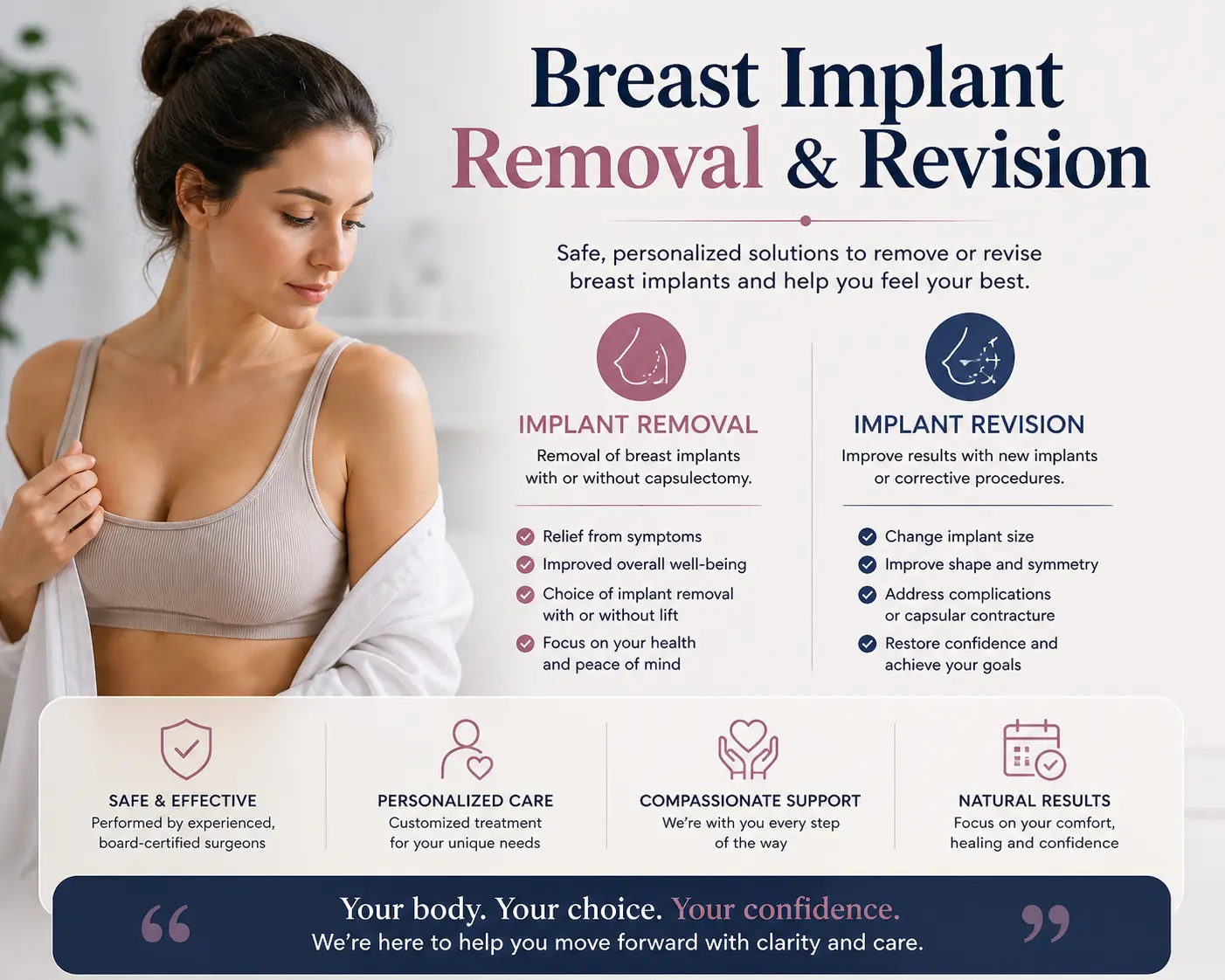
Quick Summary
Breast implant removal (explant) and revision surgery address implant rupture, capsular contracture, breast implant illness, or the desire to resize or go implant-free. Most implants require exchange or removal within 10–20 years; the FDA recommends MRI screening for silicone implants starting at 5–6 years post-surgery.
This guide covers every removal and revision option — from simple exchange to en bloc capsulectomy — with costs, recovery, and what to expect after explant.
Why Do Patients Choose Breast Implant Removal or Revision?
The four most common clinical reasons for removal or revision are capsular contracture, implant rupture, breast implant illness, and aesthetic change — each requiring a different surgical approach and level of capsule management.
Implants are not permanent devices. According to the ASPS, breast implant removals increased by 9% between 2022 and 2023 as more patients reached the 10–20 year maintenance window or sought changes aligned with life stage. Understanding your reason for surgery is the critical first step toward choosing the right procedure.
Capsular Contracture
Capsular contracture is the most common breast implant complication, affecting up to 18.9% of silicone augmentation patients and 20.8% of saline patients within 10 years, per AAFP data.
The body normally forms a thin layer of scar tissue — called a capsule — around any implant. When this capsule thickens and tightens abnormally, it squeezes the implant, causing it to harden, distort, and in severe cases become painful. Graded on a scale of I (soft, normal) to IV (hard, painful, and visibly deformed), Grade III and IV contracture typically requires surgical intervention.
Treatment involves removing the implant along with the hardened capsule. If the patient wishes to continue with implants, the new device is placed in a repositioned or refreshed pocket to reduce recurrence risk.
Implant Rupture or Leakage
Saline implant rupture is immediately visible — the breast deflates within hours to days as the saline is safely absorbed — while silicone implant rupture is often silent, requiring MRI or ultrasound to detect.
The FDA recommends MRI screening for silicone gel implants starting at 5–6 years post-surgery and every 2–3 years thereafter. Silent silicone ruptures may show no symptoms initially, but gel can migrate into the capsule or surrounding tissue over time. Once rupture is confirmed, removal and replacement (or removal alone) is recommended to prevent further gel migration and tissue changes.
Breast Implant Illness (BII)
Breast implant illness is a patient-reported cluster of symptoms — fatigue, joint pain, brain fog, hair loss, and autoimmune-like reactions — that some women attribute to their implants, though no peer-reviewed study has confirmed a systemic causal link.
The ASPS is actively designing formal clinical studies to investigate BII further. Many patients report meaningful improvement in symptoms following explant surgery, which has driven a significant rise in elective removal requests. Patients concerned about BII are advised to discuss en bloc capsulectomy at consultation, alongside appropriate medical evaluation to exclude other causes of their symptoms.
As of March 2025, the ASPS reports awareness of 1,619 BIA-ALCL (Breast Implant-Associated Anaplastic Large Cell Lymphoma) cases worldwide, all linked to textured implants. There have been zero confirmed cases involving smooth-only devices.
Size or Aesthetic Change
Life changes — including significant weight fluctuation, pregnancy, menopause, and natural aging — alter the breast envelope around an implant, often prompting patients to resize or remove entirely.
According to ASPS data, approximately 37% of women undergoing revision choose a larger implant, while many others downsize for comfort or switch from saline to silicone for a more natural feel. A desire to return to a natural breast appearance — without new implants — is also an increasingly common presentation, sometimes combined with fat transfer or mastopexy to optimize results.
Breast Implant Removal vs. Revision: What Is the Difference?
Breast implant removal means removing implants permanently; revision means modifying the existing result — either by exchanging implants, correcting the pocket, or addressing complications — typically in one combined surgical session.
Both procedures are performed under general anaesthesia as outpatient day cases. The complexity and cost vary significantly based on what the surgeon encounters: a simple exchange in a healthy pocket versus a revision involving capsulectomy, pocket reconstruction, and mastopexy are entirely different operations.
Implant Exchange (Replacement)
Implant exchange is the most common revision procedure: the existing implant is removed and a new device — different size, profile, brand, or material — is placed through the same incision with minimal additional work.
Exchange is appropriate when the implant pocket is healthy and the main goal is aesthetic adjustment. It is the fastest and least complex revision option, typically completed in 1–2 hours. Many manufacturer warranties cover the replacement device cost within the warranty period; patients pay for anaesthesia and surgical fees.
For a comprehensive comparison of available implant brands and materials, see our breast augmentation guide at Carely Clinic.
Explant Without Replacement
Explant surgery — implant removal without replacement — leaves the breast to contract and reshape naturally over 6–12 months, with results depending heavily on skin elasticity and the volume that was augmented.
This option suits patients who no longer want implants and are willing to accept a reduction in breast volume. Most surgeons recommend discussing the likelihood of ptosis before proceeding; simultaneous or staged mastopexy is commonly offered to patients with larger implants or significant skin laxity. Fat transfer is a growing alternative for patients who want modest volume without synthetic implants.
Types of Capsulectomy: En Bloc, Total, and Partial Explained
The three capsulectomy types differ in how much capsule is removed and whether the implant and capsule are extracted as a single unit — a distinction that drives complexity, incision length, operative time, and appropriate indications.
Choosing the right technique requires careful assessment of your reason for surgery, implant position (above or below muscle), capsule thickness, and whether rupture or BIA-ALCL is a concern. Your surgeon will advise the most appropriate approach during consultation.
En Bloc Capsulectomy
En bloc capsulectomy removes the implant and the entire surrounding capsule as one intact, unopened unit — preventing any capsule contents from contacting surrounding tissue during extraction.
This is the most technically demanding removal technique. It requires a longer inframammary incision to accommodate removal of the intact capsule-implant unit without cutting into the capsule. When implants are placed submuscularly, the posterior capsule wall is fused to the rib periosteum, which can make en bloc technically impossible without risk of pneumothorax. In such cases, surgeons convert to total capsulectomy for safety. En bloc is most strongly indicated when implant rupture is confirmed or BIA-ALCL is suspected or confirmed.
Total Capsulectomy
Total capsulectomy removes the entire capsule — achieving complete capsule clearance — but does so in sections rather than as a single intact unit.
This technique allows the surgeon to deal safely with capsule walls fused to the chest wall, making it the appropriate choice when en bloc cannot be safely completed. Outcomes for routine removal are equivalent to en bloc; the distinction becomes clinically relevant primarily when implant contents must be isolated due to rupture or suspected lymphoma. Total capsulectomy is the more commonly performed complete-removal technique in high-volume practice.
Partial Capsulectomy
Partial capsulectomy removes only the portion of the capsule causing problems — typically the thickened anterior wall — leaving unaffected capsule tissue in place.
It is used in milder capsular contracture cases where a new implant is being placed and complete capsule removal is not clinically necessary. It carries a shorter operative time and lower complexity than total or en bloc approaches but a higher capsular contracture recurrence risk compared to complete removal.
En Bloc vs. Total Capsulectomy: Comparison Table
Both techniques achieve complete capsule removal but differ in method, indications, and complexity — understanding these differences helps patients ask the right questions at consultation.
| Factor | En Bloc Capsulectomy | Total Capsulectomy | Partial Capsulectomy |
|---|---|---|---|
| Method | Implant + entire capsule removed as single intact unit | Entire capsule removed in sections | Part of capsule removed; remainder left in place |
| Capsule Opened? | No — remains intact throughout | Yes — implant removed first, then capsule in pieces | Yes — selective removal only |
| Primary Indication | Ruptured implant, BIA-ALCL confirmed/suspected, BII concerns | Complete removal when en bloc not safely possible; BII; Grade III–IV contracture | Mild–moderate contracture with new implant placement |
| Operative Time | 2–4 hours | 1.5–3 hours | 1–2 hours |
| Incision | Longer inframammary incision required | Standard inframammary incision | Original augmentation incision reused |
| Submuscular Limitation | May not be possible if posterior capsule fused to ribs — converted to total | Feasible in all placements | Feasible in all placements |
| Recovery | More complex; drains common; 6–12 weeks full | Similar to en bloc; 4–8 weeks full | Comparable to primary augmentation; 3–6 weeks |
| Cost (Turkey) | £3,000–£5,500 all-inclusive | £2,500–£4,500 all-inclusive | Included in implant exchange from £2,000 |
Expert Insight
“En bloc capsulectomy is not a simple procedure — in many cases it is more physically demanding than microsurgery, requiring meticulous attention to avoid capsule perforation. When submuscular placement makes intact removal impossible, I convert to total capsulectomy rather than risk lung injury. Both achieve the goal of complete capsule clearance.”
— Adapted from board-certified plastic surgeon commentary, American Board of Plastic Surgery resources, 2025
What Happens to Your Breasts After Implant Removal?
Breast tissue contracts and softens progressively after explant surgery, with most women reaching a stable final shape between 6–12 months post-procedure — outcomes vary significantly based on implant size, time in place, and skin elasticity.
Understanding realistic post-removal appearance is one of the most important — and least well-covered — aspects of the decision process. This section addresses the top patient concerns before surgery.
Skin Elasticity and Ptosis After Removal
Patients with larger implants worn for 10+ years face the highest risk of post-explant ptosis, as prolonged skin stretching reduces elasticity and the natural tissue cannot fully retract.
Younger patients and those with smaller implants typically experience better skin retraction. Surgeons assess ptosis grade — measured by nipple position relative to the inframammary fold — at consultation to determine whether a simultaneous or staged mastopexy is advisable. Mild laxity cases are often observed for 6 months before a lift decision is made, allowing tissue to recontract naturally.
Fat Transfer After Explant
Autologous fat transfer to the breast is a viable option for explant patients who want to retain modest volume without synthetic implants, using liposuction-harvested fat from the abdomen, thighs, or flanks.
Fat transfer adds 1–2 cup sizes of natural volume while simultaneously providing body contouring at the donor site. It is not a direct replacement for large implants but offers a natural alternative for patients downsizing from moderate implant volumes. Results are permanent for the fat cells that establish a blood supply, with approximately 60–80% of transferred fat surviving long-term.
For patients considering a combined explant and body contouring procedure, our tummy tuck and body contouring guidecovers what to expect when combining procedures.
The Breast Implant Removal & Revision Procedure: Step by Step
Breast implant removal and revision procedures follow a standardised sequence regardless of technique — the key variables are capsule management strategy, whether new implants are placed, and any additional procedures such as mastopexy or fat transfer.
All procedures are performed under general anaesthesia in an accredited surgical facility. Standard operative duration is 1–4 hours depending on complexity; virtually all cases are managed as outpatient day surgery.
Step 1 — Pre-operative assessment: Blood tests, implant history review, MRI or ultrasound (for silicone rupture screening), and surgical planning. At high-volume centres, all pre-operative workup is typically completed in a single pre-surgery day.
Step 2 — Anaesthesia: General anaesthesia is administered by a board-certified anaesthesiologist. Local anaesthetic infiltration is also used to reduce post-operative pain.
Step 3 — Incision: In most cases, the original augmentation incision is reused — typically inframammary (under the breast fold). En bloc capsulectomy requires a longer inframammary incision to accommodate intact capsule-implant unit removal.
Step 4 — Implant and capsule management: The surgeon removes the implant and performs the planned capsulectomy (en bloc, total, or partial). If rupture is present, careful clearance of escaped gel is performed. If a new implant is being placed, pocket assessment and any necessary reconstruction occur at this stage.
Step 5 — New implant placement (if applicable): The replacement implant is inserted into the prepared pocket. Pocket adjustment — including capsule suturing to correct malposition — is performed as needed.
Step 6 — Drain placement: Surgical drains are typically placed in capsulectomy cases to manage post-operative fluid. They are usually removed at the 5–10 day follow-up appointment.
Step 7 — Closure: Incisions are closed in layers with dissolvable sutures, and a surgical bra or compression garment is applied immediately post-operatively.
Recovery After Breast Implant Removal or Revision
Recovery after breast implant revision follows a similar arc to the original augmentation for simple exchanges, with more complex capsulectomy procedures requiring 2–4 extra weeks of restricted activity and drain management.
Week 1–2: Immediate Recovery
Most patients are discharged the same day with surgical drains, compression garments, and oral analgesics to manage discomfort over the first 5–10 days.
Expect swelling, bruising, and breast tightness in this phase. Drains are typically removed at a clinic visit between days 5 and 10. Sleeping on your back with upper body elevated reduces swelling. Light walking is encouraged within 48 hours; lifting, overhead movement, and strenuous activity are restricted.
Weeks 2–6: Intermediate Recovery
Most patients return to desk-based work by week 2 and resume light daily activities by weeks 3–4, provided no drains remain and no complications have occurred.
Dissolvable sutures are typically fully absorbed by 3–4 weeks. Underwire bras are usually restricted until 6–8 weeks post-surgery. For patients who underwent combined mastopexy or pocket reconstruction, the activity restriction timeline extends by 2–4 weeks relative to a simple exchange. Scar management with silicone sheets can begin at week 4–6 once incisions are fully healed.
Months 2–6: Full Recovery
Final breast shape stabilises progressively from month 2 onward, with implant settlement (for exchange patients) and skin retraction (for explant patients) typically complete by month 6.
For patients who had implants removed without replacement, the breast tissue continues to firm and recontract during this phase — with most reaching their stable final result between 6–12 months post-surgery. Residual scar fading continues for up to 12–18 months. High-impact exercise is cleared at 6–8 weeks for simple exchanges and 10–12 weeks for complex capsulectomy cases.
Cost of Breast Implant Removal & Revision
Breast implant revision and removal costs vary substantially by procedure type, country, and what is included in the quote — with Turkey offering all-inclusive packages at 40–60% below equivalent UK and US pricing.
| Procedure | UK | USA | Turkey (all-incl.) |
|---|---|---|---|
| Simple implant exchange (no capsulectomy) | £4,000–£7,000 | $5,000–$9,000 | £2,000–£3,500 |
| Explant (removal only, partial capsulectomy) | £3,000–£6,500 | $4,000–$8,000 | £2,000–£3,500 |
| Explant + total capsulectomy | £5,000–£9,000 | $7,000–$14,000 | £2,500–£4,500 |
| En bloc capsulectomy | £6,000–£10,000 | $9,000–$16,000 | £3,000–£5,500 |
| Revision + mastopexy (breast lift) | £7,000–£12,000 | $10,000–$21,000 | £4,000–£7,000 |
What UK prices typically include: surgeon fee, anaesthesia, facility. What Turkish all-inclusive packages typically add: hospital stay, hotel accommodation, airport transfers, pre-operative tests, compression garments, post-operative medications, and 12-month remote follow-up.
Note that UK insurance rarely covers cosmetic removal unless medical necessity is confirmed (rupture, BIA-ALCL, or significant functional impairment from contracture). US PPO policies may cover medically indicated removal; confirm in writing with your insurer before booking.
Breast Implant Removal & Revision in Turkey
Turkey performs thousands of breast revision procedures annually, with all-inclusive packages typically costing 40–60% less than equivalent surgery in the UK or US.
Turkey ranks among the world’s top five countries by annual aesthetic surgery volume according to ISAPS global data. Istanbul alone hosts multiple JCI-accredited hospital facilities performing high volumes of breast revision surgery, with European Board-certified plastic surgeons who hold EBOPRAS membership and TPRECD registration. The combination of high procedure volume and lower operating costs — not compromised standards — drives the price differential.
For breast implant removal and revision specifically, Turkish all-inclusive packages range from £2,000–£7,000 depending on procedure complexity. Simple explant starts at approximately £2,000–£3,500; en bloc capsulectomy and combined mastopexy procedures reach £4,000–£7,000. These figures include surgery, anaesthesia, hospital stay, hotel accommodation, transfers, and post-operative medications — costs that are itemised and billed separately in the UK and US.
At Carely Clinic in Istanbul, breast revision is performed by surgeons with EBOPRAS certification and dedicated breast surgery subspecialisation. Our pre-operative protocol for international revision patients includes same-day arrival testing — blood work, ECG, and anaesthesiology consultation — completed in a single day before surgery, avoiding the 2–4 week pre-operative waiting period typical in the NHS or UK private sector.
Carely Clinic’s international revision packages include 6-night hotel accommodation, 24/7 WhatsApp coordination, and 12-month remote post-operative follow-up. For patients travelling from the UK, this streamlined pathway means a total travel commitment of 7–10 days for all but the most complex combined procedures.
Learn more about breast implant revision at Carely Clinic and how to begin your consultation.
Frequently Asked Questions
When should you get breast implants removed?
You should consider breast implant removal if you experience capsular contracture, implant rupture, persistent pain, significant asymmetry, or symptoms you associate with breast implant illness. The FDA recommends MRI or ultrasound screening for silicone implants starting at 5–6 years post-surgery and every 2–3 years thereafter to detect silent ruptures. Even without complications, most implants require removal or exchange within 10–20 years as manufacturer warranties typically cover the device but not reoperation costs beyond year 10.
What happens to your breasts after implant removal?
After implant removal, the breast tissue contracts and softens over 6–12 months, with final shape determined by factors including skin elasticity, original breast tissue volume, implant size, and how long implants were in place. Patients who had larger implants or extensive skin stretching may experience ptosis (sagging) and may benefit from a simultaneous or staged mastopexy (breast lift). Fat transfer to the breast is a growing option for patients who want to maintain some volume without new implants.
Is breast implant removal surgery painful?
Most patients describe breast implant removal as less uncomfortable than the original augmentation, with pain typically managed with oral analgesics rather than prescription narcotics in straightforward cases. Procedures involving capsulectomy — particularly en bloc removal — are more complex and may involve greater post-operative discomfort, swelling, and drain management for 1–2 weeks. Most patients return to light activity within 1–2 weeks, with full recovery taking 4–6 weeks for simple removal and up to 8–12 weeks for combined procedures with a breast lift.
How long does breast implant removal surgery take?
Simple implant removal without capsulectomy takes approximately 1–2 hours under general anaesthesia; procedures involving en bloc capsulectomy take 2–4 hours due to the precision required to remove the implant and capsule as a single intact unit. Combined procedures that include a breast lift or fat transfer add further time to the operative plan. All breast implant surgery is typically performed as a day-case procedure, with most patients discharged the same day.
What is the difference between en bloc and total capsulectomy?
En bloc capsulectomy removes the implant and the entire scar tissue capsule as one intact unit without opening the capsule, preventing any contents from contacting surrounding tissue — the most thorough method and preferred when rupture or BIA-ALCL is confirmed or suspected. Total capsulectomy removes the entire capsule but does so in sections, which is often necessary when the back wall of the capsule is fused to the rib cage or chest muscle. Both procedures achieve complete capsule removal; en bloc is more technically demanding and requires a longer incision.
Do I need a breast lift after implant removal?
Whether a breast lift is needed after implant removal depends on the degree of skin laxity, original implant size, and how long implants were in place — patients with larger implants worn for many years are most likely to benefit. A surgeon will assess skin elasticity and ptosis grade during consultation; mild laxity often resolves as tissue retracts over 6–12 months. Combining explant and mastopexy in a single procedure avoids a second general anaesthetic and is commonly performed at high-volume breast surgery centres.
How much does breast implant removal cost in the UK?
Breast implant removal in the UK costs £3,000–£6,500 for simple explant and rises to £7,000–£12,000 when combined with capsulectomy and breast lift, with most figures covering surgeon fees, anaesthesia, and facility costs but rarely including post-operative garments or follow-up imaging. By contrast, all-inclusive packages for breast implant removal or revision in Turkey range from £2,000–£5,500 depending on complexity, typically covering surgery, hospital stay, accommodation, transfers, and aftercare. The 40–60% cost difference primarily reflects Turkey’s lower operating costs, not differences in implant quality or surgical accreditation.
Can breast implants cause illness (BII)?
Breast implant illness (BII) describes a spectrum of reported symptoms — including fatigue, joint pain, brain fog, hair loss, and autoimmune-like reactions — that some patients attribute to their implants, though no peer-reviewed study has established a confirmed causal link between implants and systemic disease. The ASPS is actively designing clinical studies to investigate BII further, and many patients report symptom improvement following explant surgery. Patients concerned about BII are advised to consult a board-certified plastic surgeon to discuss explant options, including en bloc capsulectomy, alongside appropriate medical evaluation.
What is capsular contracture and how is it treated?
Capsular contracture occurs when the scar tissue capsule that normally forms around a breast implant hardens and tightens excessively, distorting the implant’s shape and causing firmness or pain — it is the most commonly reported complication after breast augmentation. Ten-year follow-up data cited by AAFP shows capsular contracture rates of 18.9% for primary silicone augmentation and up to 20.8% for saline augmentation, with higher rates in reconstruction. Surgical treatment involves removing the implant and the hardened capsule (capsulectomy) and, if desired, replacing the implant in a new pocket with lower contracture recurrence risk.
How long is recovery after breast implant revision?
Recovery after breast implant revision typically follows a similar timeline to the original augmentation: most patients return to desk work within 1–2 weeks, resume normal daily activities at 4–6 weeks, and complete full recovery by 3–6 months. Complex revisions involving capsulectomy, pocket repair, or simultaneous mastopexy extend recovery timelines, with greater swelling and drain management required in the first 2 weeks. Final aesthetic results — including implant settlement and scar fading — are typically visible at 3–6 months post-surgery.
Does insurance cover breast implant removal?
Most private health insurance policies in the UK and US consider breast implant removal a cosmetic procedure and will not cover it unless the surgery is deemed medically necessary — for example, in cases of confirmed implant rupture, severe infection, BIA-ALCL, or significant capsular contracture causing functional impairment. Patients with PPO insurance in the US may have better coverage options for medically indicated removal, particularly for complications linked to a reconstructive procedure. Always confirm policy terms in writing with your insurer before surgery, as coverage rules vary significantly between providers.
Can I replace my breast implants at the same time as removal?
Yes — simultaneous implant exchange is the most common form of breast revision surgery and is performed in a single anaesthetic session, with the surgeon removing the existing implant, addressing any capsule or pocket issues, and placing new implants. According to ASPS data, approximately 37% of women undergoing revision choose a larger size, while many others switch brands, profiles, or from saline to silicone. Combining removal and replacement avoids a second recovery period and is appropriate for most medically stable candidates, provided no active infection or severe pocket damage requires staged correction.
Conclusion
Breast implants are not lifetime devices; most require removal or revision within 10–20 years. Procedure choice — exchange, total capsulectomy, or en bloc — depends on your reason for surgery and individual anatomy.
The most important takeaways from this guide: capsular contracture is the most common revision driver, affecting up to 18.9% of silicone augmentation patients within 10 years; en bloc capsulectomy is the most thorough removal technique but cannot always be completed safely when implants are placed submuscularly; and post-removal breast appearance depends heavily on skin elasticity, implant size, and time in place — with mastopexy and fat transfer as viable options for patients seeking shape correction.
Whether you are considering a simple implant exchange, a complete explant for BII concerns, or a combined revision with mastopexy, the first step is a consultation with a board-certified plastic surgeon who performs high volumes of revision surgery and can assess your individual anatomy, implant history, and goals.
Individual requirements and outcomes vary. This guide provides general information based on international guidelines and published research. Consult qualified medical professionals for personalised advice.
If you would like to explore your breast implant removal or revision options, contact Carely Clinic to schedule a no-obligation consultation with our Istanbul-based surgical team. International patients receive a WhatsApp pre-consultation and personalised procedure plan before committing to travel.
Medical Review: Dr. Alirza Jahangirov
Sources:
- American Society of Plastic Surgeons (ASPS) — Breast Implant Revision Procedure Information: https://www.plasticsurgery.org/cosmetic-procedures/breast-implant-revision
- American Academy of Family Physicians — Breast Implants: Common Questions and Answers (2021): https://www.aafp.org/pubs/afp/issues/2021/1100/p500.html
- The Aesthetic Society — Breast Implant Revision Detailed Procedure Information: https://www.theaestheticsociety.org/procedures/breast/breast-revision/detailed-procedure-information
- ASPS News — What You Need to Know About Breast Implant Revisions (March 2025): https://www.plasticsurgery.org/news/articles/what-you-need-to-know-about-breast-implant-revisions
- Breast Implant Illness Community Resources — Questions to Ask Explant Surgeons (as of March 2025, noting 1,619 BIA-ALCL cases worldwide): https://www.breastimplantillness.com/explant-questions/
- ISAPS Global Statistical Report 2023/2024 — International Society of Aesthetic Plastic Surgery: https://www.isaps.org/medical-professionals/isaps-global-statistics/
- FDA — Breast Implant Safety and Monitoring Guidance: https://www.fda.gov/medical-devices/breast-implants