
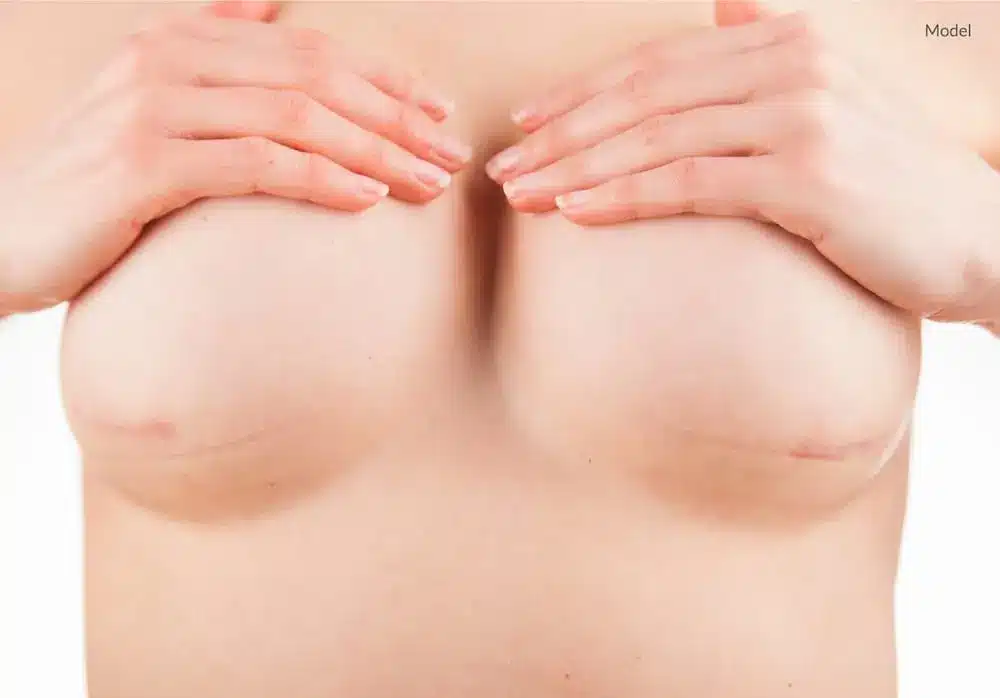
Quick Summary:
Breast augmentation scars are permanent but typically fade to thin, pale lines within 12–18 months. Scar location depends entirely on incision type: inframammary (under the breast fold) is most common and easily concealed; periareolar and transaxillary offer further camouflage.
Silicone sheets and gels have the strongest clinical evidence for reducing scar thickness and redness. Genetics, skin tone, surgeon technique, and post-operative care determine final scar appearance.
This guide covers all four incision types, the scar healing timeline, and evidence-ranked treatments.
Why Trust This Guide
This guide draws on ASPS patient education data, the 2024 ISAPS Global Survey, Cleveland Clinic scar management guidelines, and a 2024 PMC study on postoperative laser scar therapy.
Carely Clinic’s editorial team reviews all content for clinical accuracy and updates articles when major guidelines change. This is medical education content — not a substitute for personalised surgical consultation.
What Are Breast Augmentation Scars?
Every breast augmentation procedure creates scars because any incision that penetrates the dermis triggers the body’s collagen-repair response, forming fibrous scar tissue. With careful surgical technique and structured aftercare, most patients end up with scars that are fine, flat, and effectively concealed.
When the skin is cut during surgery, specialised cells called fibroblasts migrate to the wound site and produce collagen to close the gap. This new collagen is structurally different from surrounding skin — denser, less elastic, and initially more vascular — which explains why fresh scars appear red and raised.
The reassuring reality is that this remodelling process continues for up to 18 months. As excess collagen is gradually broken down and blood vessels recede, the scar softens, flattens, and lightens. The final result for most patients is a thin, pale line — often barely distinguishable from surrounding tissue.
Breast Augmentation Incision Types and Scar Locations
The four main incision approaches each produce a different scar location, length, and concealment profile — understanding the differences is fundamental to setting realistic expectations before surgery.
Inframammary Incision (Under the Breast Fold)
The inframammary incision produces a 3–5 cm horizontal scar in the breast fold, making it invisible in all but the most revealing swimwear.
This is the most frequently used approach globally, favoured by surgeons for its direct access to the implant pocket and compatibility with the widest range of implant types and sizes — including large cohesive gel (gummy bear) implants that require slightly longer incisions. The scar sits in the natural crease where breast tissue meets the chest wall.
Because the fold creates a natural shadow, the scar is effectively self-concealing even without clothing. Most patients and surgeons consider this the optimal balance of surgical precision and discreet scarring.
Periareolar Incision (Around the Areola)
The periareolar incision traces the lower semicircle of the areola, producing a scar that blends with the natural colour border between darker areolar skin and lighter breast skin.
This approach is particularly useful when augmentation is combined with a periareolar breast lift, as the same incision serves both purposes. Scar camouflage is generally excellent, especially in patients with strong colour contrast between areola and surrounding skin.
One clinical consideration: this approach involves partial disruption of milk ducts, which may reduce breastfeeding capacity and carries a slightly higher risk of nipple sensitivity changes than the inframammary approach. Surgeons using this method typically recommend it only when the anatomy and goals specifically justify it.
For more on incision technique decisions, see our breast augmentation incision types guide.
Transaxillary Incision (Armpit)
The transaxillary incision is placed in the natural armpit crease, leaving no scar on the breast itself — a significant advantage for patients concerned about breast-surface marks.
However, this approach involves a more remote access point to the implant pocket, which limits the precision of implant positioning and is associated with higher revision rates in some series. The armpit scar — approximately 2–3 cm — can be partially visible with arms raised in certain sleeveless garments and swimsuits. Surgeons typically recommend this approach selectively.
Transumbilical Incision (Belly Button)
The TUBA (transumbilical breast augmentation) leaves a scar inside the navel and is the rarest incision type, with only a small number of surgeons trained in this technique.
Because implants must be tunnelled considerable distance from the belly button to the breast pocket, precise positioning is more challenging, and the technique is generally limited to saline implants only. Most board-certified plastic surgeons outside of specialist centres do not perform TUBA. It is mentioned here for completeness, but patients should have a frank discussion about revision risk before selecting this approach.
Incision Type Comparison Table
Side-by-side, the four incision types differ across seven clinically relevant factors that directly affect scar visibility, concealment, and long-term satisfaction.
| Incision Type | Scar Location | Scar Length | Concealment in Swimwear | Implant Compatibility | Breastfeeding Impact | Revision Accessibility |
|---|---|---|---|---|---|---|
| Inframammary | Under breast fold | 3–5 cm | Excellent — hidden in fold | All types and sizes | Minimal | Excellent — can reuse incision |
| Periareolar | Areola border (lower half) | 2–4 cm | Excellent — blends with areola | Most silicone; all saline | Moderate — partial duct disruption | Good |
| Transaxillary | Armpit crease | 2–3 cm | Variable — may show with raised arms | Mainly saline; some silicone | None (no breast incision) | Limited — revision often via new incision |
| Transumbilical (TUBA) | Inside navel | 1–2 cm | Excellent — inside belly button | Saline only (primarily) | None | Poor — revision requires new incision |
What Do Breast Augmentation Scars Look Like Over Time?
Breast augmentation scars pass through three biologically distinct phases, each with a predictable appearance — understanding this progression helps patients distinguish normal healing from cause for concern.
In the first weeks after surgery, scars are visibly red, slightly raised, and tender to the touch. This initial appearance often surprises patients who expected minimal scarring — but this is entirely normal inflammation, not a sign of poor outcome.
By months 3–6, the scar begins its transition: redness fades to pink, the raised profile softens, and the texture becomes less firm. Most patients first begin to feel confident about scar concealment during this phase.
At full maturity — typically 12–18 months — most breast augmentation scars are thin, flat, and either pale pink, near-skin-tone, or faintly lighter (hypopigmented) compared to surrounding tissue. Patients with darker skin tones may retain some mild hyperpigmentation but can often address this with targeted treatments.
Expert Insight
“Scars often look slightly red at 2–3 months and then pale purple, fading to white in 8–12 months in most patients — this is the expected maturation pattern, not a complication.”
— Stephen McCulley, FRCS(Plast), Consultant Plastic Surgeon
Scar Healing Timeline: Week by Week
Each stage of scar healing has a distinct visual appearance and a specific window for the most effective interventions.
The Inflammatory Phase (Weeks 1–2)
Immediately after surgery, the incision site appears red, swollen, and firm as the body initiates collagen production and vascular growth.
During this phase, the incisions are delicate and must be protected from tension, moisture, and any pressure. Stitches are typically removed at 7–14 days. No scar treatment products should be applied yet — the priority is keeping incisions clean, dry, and supported.
Patients should wear their surgical support bra continuously during this window. Reaching above shoulder height and lifting more than 2 kg should be avoided to prevent the incision line from stretching, which would widen the final scar.
The Proliferative Phase (Weeks 3–8)
Collagen fibres accumulate rapidly during weeks 3–8, causing the scar to become firmer, more raised, and often itchier — a sign the healing mechanism is active.
This is the critical window for introducing active scar management. Once a surgeon confirms the incisions are fully sealed (typically around week 2–3), silicone sheets or silicone gel should begin daily application. Gentle scar massage can usually commence from week 4–6 with surgeon clearance.
Sun exposure must be avoided entirely during this phase. UV radiation causes melanocytes in healing skin to overproduce pigment, resulting in persistently dark or brown scars that are far more visible than those that healed with consistent sun protection.
The Maturation Phase (Months 3–18)
From month 3 onward, the scar progressively flattens, softens, and fades as excess collagen is broken down and vascularity decreases.
Most of the visible improvement patients notice occurs between months 3 and 12. Silicone-based therapy should continue for this entire period — not just the first few weeks. By 12 months, the scar reaches a stable appearance; any residual concerns (persistent redness, raised texture, hyperpigmentation) can then be assessed for clinical treatment options.
Full scar maturation is not complete until 18 months, which is why surgeons consistently advise against assessing final outcomes before this point.
Factors That Affect Scar Appearance
Scar outcome is determined by a combination of patient biology, surgical precision, and post-operative behaviour — some factors are controllable, others are not.
Genetics and Skin Tone
A patient’s genetic predisposition to fibrous healing is the single most influential factor outside of surgical technique, with darker skin tones more prone to hypertrophic and hyperpigmented scarring.
Individuals of African, Asian, South Asian, and Pacific Islander ancestry tend to have higher melanin levels and a stronger collagen-proliferative response, increasing the likelihood of raised or darkened scars. This does not mean poor outcomes are inevitable — but it does mean earlier, more rigorous scar management is especially important. A consultation with a surgeon who has experience treating patients with your skin type is strongly advisable.
Surgeon Technique and Incision Placement
A layered tension-free closure — where wound edges are supported by deep sutures before the outer skin is closed — produces significantly finer scars than closures under tension.
The use of implant insertion funnels (such as the Keller Funnel) reduces the incision length needed by allowing implants to be inserted without manual stretching of the wound edges. Meticulous haemostasis (control of bleeding within the pocket) also reduces inflammatory swelling around the incision, which correlates with reduced hypertrophic scar formation.
Patients evaluating surgeons should ask specifically about closure technique and whether funnel insertion tools are standard practice.
How to Minimise Breast Augmentation Scars
Effective scar minimisation begins before surgery and continues for 12–18 months — it is a structured protocol, not a single product applied once.
Before surgery: Quit smoking at least 4 weeks prior. Nicotine causes vasoconstriction, reducing blood supply to healing tissue and significantly increasing the risk of wound complications and wider scars. Avoid blood-thinning supplements (vitamin E, fish oil, certain herbal products) as directed by your surgeon.
Weeks 1–3: Focus entirely on incision protection. Wear the surgical support bra as instructed (often 24/7 for 6 weeks). Do not expose incisions to water beyond gentle showers. Avoid all physical exertion that increases tissue tension.
Week 3 onward: Begin silicone gel or silicone sheet therapy as soon as surgeon-confirmed incision sealing. This is the most evidence-backed intervention available and should continue daily for a minimum of 3–6 months. Apply SPF 50+ to any area that may receive sun exposure.
Week 4–6 onward: With surgeon clearance, introduce gentle circular scar massage for 10 minutes daily to break down excess collagen and encourage flat, pliable scar tissue.
Ongoing: Maintain rigorous sun protection for the first 12 months. Even brief UV exposure during active scar maturation can permanently darken an otherwise healing scar.
See our breast augmentation recovery guide for the complete post-surgical care protocol, including activity restrictions and returning to exercise.
Evidence-Ranked Scar Treatments
Not all scar treatments carry equal clinical evidence — this hierarchy helps patients prioritise the interventions most likely to make a measurable difference.
Silicone Sheets and Silicone Gel
Medical-grade silicone is the most evidence-backed topical scar intervention, with clinical studies showing significant reductions in scar height, redness, and firmness compared to untreated scars.
Silicone works by hydrating the stratum corneum and creating a low-oxygen microenvironment that regulates fibroblast activity and reduces excess collagen production. Both silicone sheets (self-adhesive, worn for 12+ hours daily) and silicone gel (applied twice daily where sheets are impractical) have demonstrated efficacy. Sheets are generally preferred for flat incision areas because they maintain consistent contact and compression.
Products should begin at week 2–3 post-surgery and continue for at least 3 months — with 6 months being more effective for optimal outcomes.
Scar Massage
Gentle daily massage from week 4–6 (with surgeon approval) disrupts collagen cross-linking, softens the scar matrix, and improves local circulation to support more orderly tissue remodelling.
Use two fingers to apply firm but comfortable circular pressure directly on the scar for 10 minutes per session, twice daily. This technique is cost-free, safe when timing guidelines are followed, and consistently recommended across ASPS and leading clinic post-operative protocols. Do not start massage before the incision has fully sealed.
Sun Protection
UV exposure during active scar maturation permanently triggers hyperpigmentation, and this darkening does not fade with normal healing. SPF 50+ must be applied to any visible scar for a minimum of 12 months.
Where incision sites are covered by clothing, sun protection is less critical — but the inframammary scar may be exposed during swimming or sunbathing, and the transaxillary scar is highly vulnerable in sleeveless clothing. Physical (mineral) sunscreens are generally preferred over chemical formulations on recently healed surgical skin.
Laser Therapy
Fractional and pulsed-dye laser treatments are effective second-line interventions for scars that remain raised, red, or discoloured after 12 months of primary scar care.
A 2024 PMC study on postoperative laser scar therapy confirmed earlier improvement in both erythema (redness) and tissue firmness in laser-treated patients compared to controls — supporting its use for persistent post-surgical scarring. Multiple sessions are typically required (most patients need 3–6 treatments). Laser does not erase scars but can significantly improve texture, colour, and profile.
Steroid Injections
Corticosteroid injections directly into hypertrophic or keloid scar tissue can flatten and soften raised scars by reducing the inflammatory drive that sustains excess collagen production.
This intervention is specifically indicated for abnormally elevated scars rather than as routine post-operative care. It is generally administered by a plastic surgeon or dermatologist and may require repeat injections at 4–6 week intervals. There is a small risk of local skin atrophy or depigmentation with this treatment.
Expert Insight
“Although many patients believe vitamin E oil reduces scarring, Cleveland Clinic notes there is not enough evidence to support its effectiveness — and some data suggest it may worsen scar appearance. Silicone-based products are strongly preferred.”
— Cleveland Clinic Scar Management Guidelines
Abnormal Scars: Hypertrophic and Keloid
Most patients heal with normal, progressively fading scars — but approximately 5–10% develop abnormal scarring that requires targeted clinical management.
Hypertrophic Scars
A hypertrophic scar is a raised, red, firm ridge confined strictly to the original incision line — it does not spread beyond the wound borders.
These scars develop in the first few months of healing and may cause mild itching or tightness. Unlike keloids, hypertrophic scars often improve spontaneously over 12–24 months. Treatment with silicone sheeting, steroid injections, or laser therapy typically accelerates this improvement significantly.
Keloid Scars
A keloid grows beyond the original incision boundary, extending into surrounding normal skin as an irregular, raised, often shiny mass.
Keloids are more common in individuals with darker skin tones and represent an overactive healing response rather than a surgical error. They do not self-resolve and require active treatment — options include steroid injections, cryotherapy, laser therapy, and in some cases surgical revision combined with steroid injections. Patients with a personal or family history of keloid formation should discuss this with their surgeon before proceeding with any breast augmentation.
Will Scars Be Visible in a Bikini or During Intimacy?
For the majority of patients, incision type and placement means breast augmentation scars are invisible in standard swimwear and bras, with the exception of certain transaxillary scar positions.
Inframammary scars sit in the fold beneath the breast and are covered by virtually all bikini bottoms, one-piece swimsuits, bralettes, and underwired bras. The scar is only visible when the breast is lifted — for example, during a physical examination. Most patients report complete confidence at the beach or pool within 12 months of surgery.
Periareolar scars are positioned at the natural colour boundary of the areola and are effectively invisible at normal viewing distance, even without clothing. The contrast between areolar and breast skin provides natural camouflage.
Transaxillary scars require more consideration. With arms resting, the armpit crease conceals the scar effectively. With arms raised — in a wide-neck one-piece, certain sports bras, or halter tops — the scar may be partially visible. Patients who regularly wear such styles should factor this into incision selection discussions.
During intimacy, all four scar types are essentially imperceptible once healing is complete — particularly after 12+ months. At Carely Clinic, the overwhelming majority of patients with inframammary or periareolar scars report no self-consciousness about scar visibility in daily social or intimate settings.
How This Applies in Turkey
Turkey performed an estimated 48,179 breast augmentations in 2024 according to ISAPS — making it one of the highest-volume markets globally, with Istanbul surgeons routinely using inframammary incisions to deliver discreet, easily concealed scars.
Turkey’s position in the ISAPS 2024 Global Survey places it firmly among the top five countries globally for breast augmentation volume, reflecting both local demand and a substantial international patient population from the UK, Germany, and the Netherlands. High surgical volume directly correlates with incision precision and closure quality — both critical determinants of final scar appearance.
Istanbul plastic surgeons certified by TSPRAS (Turkish Society of Plastic, Reconstructive and Aesthetic Surgeons) and EBOPRAS (European Board of Plastic, Reconstructive and Aesthetic Surgery) are trained in the same evidence-based incision and closure protocols used in UK and EU centres. The standard approach at JCI-accredited Istanbul hospitals is inframammary incision with layered closure under minimal tension — the technique associated with the finest and most discreet final scar lines.
Post-operative scar care protocols in Turkish clinics routinely include medical-grade silicone gel and sheets from week 2–3, with structured follow-up. International patients receive written scar management plans they can continue at home.
All-inclusive breast augmentation packages in Turkey typically range from €3,400–€5,200, covering surgery, hospital stay, transfers, and post-operative care — compared to £7,000–£12,000 in the UK. Scar management products and follow-up consultations are generally included in the package, removing a common post-surgery afterthought cost.
At Carely Clinic in Istanbul, our surgical team uses Mentor and Motiva implants with inframammary or periareolar incisions as standard for the majority of augmentations. We provide patients with a structured 12-month scar care protocol at discharge, including silicone product guidance, sun protection recommendations, and massage instruction.
Learn more about breast augmentation at Carely Clinic or explore our breast augmentation recovery guide for the complete post-operative timeline.
FAQ
Do breast augmentation scars go away?
Breast augmentation scars do not disappear completely but fade significantly to thin, pale lines within 12 to 18 months in most patients. According to ASPS patient education data, fully matured scars become barely noticeable, particularly when placed in the inframammary fold or periareolar border. Final scar appearance depends on genetics, skin tone, sun exposure, and consistency of silicone-based scar care during the 12 month maturation window.
How long does it take for breast augmentation scars to fade?
Breast augmentation scars fade in three stages: red and raised for 2 to 3 months, lightening from months 3 to 6. According to Cleveland Clinic scar guidelines, full maturation reaches near-skin-tone between 6 and 18 months, with significant individual variation expected. Patients with darker skin tones often experience longer pigmentation change, while those with lighter skin typically see faster colour normalisation overall.
What do breast augmentation scars look like after they heal?
Fully healed breast augmentation scars appear as thin, flat, pale lines measuring 3 to 5 cm depending on incision type and implant size. Inframammary scars sit in the breast fold, periareolar scars blend with the areola border, and transaxillary scars sit in the armpit crease. Some patients develop subtle hypopigmentation, while those with darker skin may retain mild hyperpigmentation that responds well to targeted laser treatment.
Where are the scars from breast augmentation?
Breast augmentation scars are located at one of four incision sites: inframammary, periareolar, transaxillary, or transumbilical (TUBA). The inframammary fold is the most commonly used location globally, offering direct surgical access, broad implant compatibility, and a self-concealing scar. Scar length ranges from approximately 3 to 5 cm for inframammary incisions down to 2 to 3 cm for transaxillary approaches.
What is the least scarring incision for breast augmentation?
The transaxillary incision leaves no scar on the breast itself because the entry point is in the armpit crease, approximately 2 to 3 cm long. This approach carries clinical limitations: reduced precision for implant positioning, higher revision rates, and potential scar visibility in certain sleeveless garments. For scars on the breast itself, periareolar incisions are often considered most discreet due to natural colour camouflage at the areola border.
How do you minimise breast augmentation scars?
Apply medical-grade silicone sheets or gel for 12 hours daily from week 2 to 3 post-surgery, the most evidence-backed scar intervention available. Combine this with rigorous UV protection (SPF 50+) for 12 months and gentle scar massage from weeks 4 to 6 with surgeon approval. Avoiding nicotine before and after surgery is critical, as smoking impairs wound healing and significantly increases the risk of hypertrophic scar formation.
Can you get laser treatment on breast augmentation scars?
Yes, laser therapy is an effective second-line treatment for breast augmentation scars that remain raised, red, or discoloured after 12 months. Fractional and pulsed-dye lasers stimulate collagen remodelling and reduce erythema, with most patients requiring 3 to 6 sessions for visible improvement. A 2024 PMC study on postoperative laser scar therapy confirmed earlier improvement in erythema values compared to controls, supporting its clinical use.
Will breast implant scars be visible in a bikini?
Inframammary scars sit in the breast fold and are effectively hidden by virtually all bikini tops and bras. Periareolar scars are similarly concealed by the natural colour variation at the areola border and remain invisible in standard swimwear. Transaxillary scars in the armpit may be partially visible with arms raised in certain swimsuit styles, a practical incision selection consideration.
What does a hypertrophic scar look like after breast augmentation?
A hypertrophic scar appears as a raised, firm, red or pink thickened ridge confined strictly within the original incision boundaries. Unlike keloids, which extend beyond wound margins, hypertrophic scars develop within the first months of healing and may cause mild itching. Treatment with silicone sheeting, corticosteroid injections, or laser therapy typically produces significant improvement within 6 to 12 months of consistent application.
Do breast augmentation scars hurt?
Breast augmentation scars are typically tender and sensitive for the first 4 to 8 weeks after surgery as normal healing progresses. Itching is common during the proliferative phase from weeks 3 to 8, when collagen fibres are actively forming and the scar matures. Persistent pain, significant burning, or pain that worsens after initial recovery should be reported to a surgeon as it may indicate complications.
How do I treat my breast augmentation scars?
Begin scar treatment 2 to 3 weeks post-surgery with medical-grade silicone sheets worn for 12 hours daily, the most evidence-backed topical intervention. After week 4 to 6 with surgeon approval, add gentle daily scar massage to break down excess collagen and flatten the tissue. For scars that remain raised or discoloured after 12 months, seek clinical evaluation for laser resurfacing, corticosteroid injections, or surgical revision.
Conclusion
Breast augmentation scars fade to thin, pale lines within 12–18 months in the majority of patients; incision choice, silicone-based scar therapy, and sun protection are the three strongest predictors of outcome.
The inframammary incision remains the gold standard for most augmentations — it offers the widest implant compatibility, the most reliable surgical access, and a scar that is self-concealing in the breast fold. Periareolar and transaxillary approaches offer distinct concealment advantages for specific anatomies and goals, each with trade-offs that are worth understanding before surgery.
Scar minimisation is a 12–18 month protocol, not a 3-week effort. Medical-grade silicone sheets applied from week 2–3, consistent sun protection, and surgeon-approved massage produce measurably better outcomes than passive healing. For the minority of patients who develop hypertrophic or persistent scars, laser therapy and corticosteroid injections are effective clinical options once scar maturation is complete.
If you are researching breast augmentation and want to discuss incision options, scar management protocols, and what to realistically expect from surgery and recovery, our team at Carely Clinic in Istanbul is available for a no-obligation consultation.
Individual requirements and outcomes vary. This guide provides general information based on international guidelines and published research. Consult qualified medical professionals for personalised advice.
Book a consultation with Carely Clinic or explore breast augmentation incision types in detail to continue your research.
Medical Review: Dr. Alirza Jahangirov