
Quick Summary:
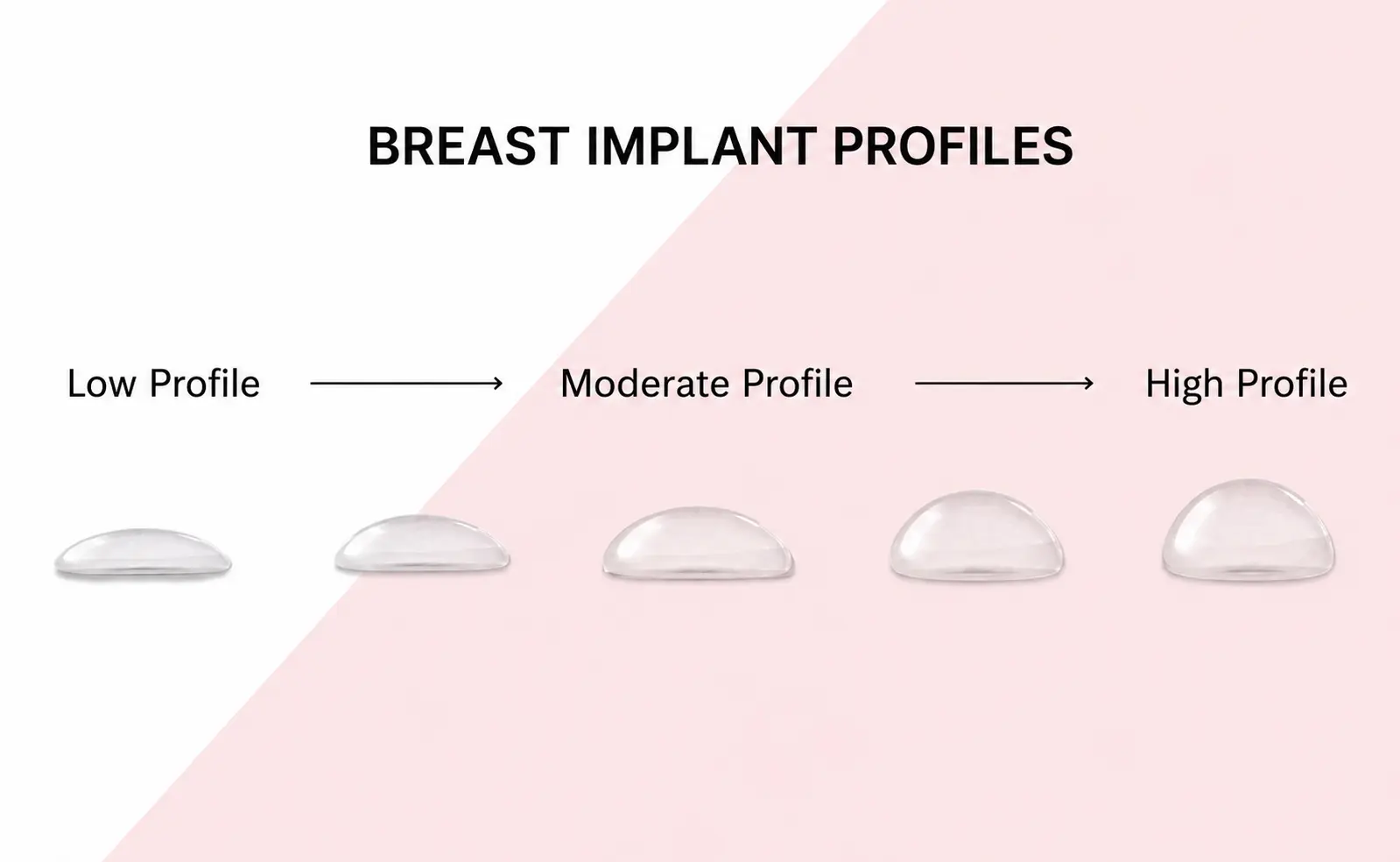
Breast implant profiles — low, moderate, moderate plus, high, and ultra-high — determine how far an implant projects forward from the chest wall relative to its base width. Two implants with identical volume can look completely different depending on profile. Moderate plus is the most commonly selected option for average frames. Profile is not standardised across manufacturers: Mentor offers five tiers, Motiva four, and Polytech three.
This guide explains each profile, how surgeons select them, and what to expect in Turkey.
What Is a Breast Implant Profile?
Breast implant profile describes the ratio between an implant’s base width and its forward projection from the chest wall, determining how far the breast extends outward when standing — independent of volume in cubic centimetres.
Most patients focus on volume when planning breast augmentation, but two implants filled to the same 300 cc can look dramatically different depending on profile. A wide-based implant distributes volume broadly across the chest, producing a gently sloped result. A narrow-based implant concentrates the same volume into less lateral space, projecting further forward with a rounder, more prominent silhouette.
According to the American Society of Plastic Surgeons (ASPS), profile is one of the most commonly misunderstood characteristics of breast implants — and one of the most influential in determining whether results appear natural or augmented.
How Profile Differs From Implant Size
Profile and volume are independent variables that work together to create your final breast shape; changing one without changing the other produces a different aesthetic outcome on the same body.
Volume — measured in cubic centimetres — sets the total amount of fill in the implant. Profile — determined by the ratio of base diameter to projection — sets the shape that fill takes on your chest wall. A peer-reviewed paper published in Plastic and Reconstructive Surgery (PMC) makes an important clinical distinction most consumer guides miss: implant “profile” is a vendor-driven descriptor of overall silhouette, while “projection” is a precise quantitative anterior-to-posterior measurement. These terms are not interchangeable, and profile categories are not standardised across manufacturers.
This matters practically. A “moderate” implant from Mentor, a “natural” profile from Motiva, and a “medium” profile from Polytech B-Lite are not necessarily equivalent in base width or projection despite occupying the same tier label. Always confirm specific dimensions — base diameter in centimetres and projection in centimetres — directly from manufacturer data during consultation, rather than relying on tier names alone.
The Five Breast Implant Profile Types
All five profiles are available in both round and anatomical (teardrop) shapes, in silicone and saline fill, and across most major brands — though tier names and exact measurements vary by manufacturer.
Low Profile
Low profile implants have the widest base diameter of all profile types, projecting minimally forward from the chest wall for a gently sloped, subtle result.
The wide base distributes volume across the full breast footprint, creating fullness primarily in the lower and outer breast rather than the upper pole. This produces a natural slope from chest to nipple when viewed from the side. Low profile implants are best suited to patients with a broad chest frame and a wide natural breast base who want modest enhancement that remains proportionate to their width. They are the least commonly selected profile in cosmetic augmentation because many patients seeking breast augmentation are seeking noticeable improvement, and the low profile’s subtlety can disappoint those with smaller or medium frames.
Moderate Profile
Moderate profile implants offer a balanced base width with proportionate forward projection, creating a natural breast contour that closely mimics the shape and slope of natural breast tissue.
ASPS describes moderate profile as most commonly yielding the most natural-looking results, with the wider base filling the breast footprint without leaving lateral gaps and the moderate projection creating gentle upper-pole fullness without appearing artificially round. Moderate profile suits patients with small to average-width chest frames seeking noticeable but natural enhancement. Women who prioritise versatility in clothing, long-term tissue health, and sustained comfort through active lifestyles frequently find moderate profile the best match. The wider base also provides greater implant stability within the pocket compared to higher-profile options.
Moderate Plus Profile
Moderate plus profile sits between moderate and high, offering a slightly narrower base diameter and slightly more forward projection than standard moderate — producing a fuller result while maintaining a proportionate silhouette.
This profile is widely reported as the most commonly selected in breast augmentation practices serving average body types. It achieves what many patients describe as the “happy medium”: noticeable projection and upper-pole fullness without the obvious roundness of a high profile implant. Note that moderate plus is a Mentor product designation and is not available under that exact name from all manufacturers — Motiva and Allergan Natrelle use different tier labels that may align approximately to this range. Confirm the specific base diameter and projection figures at consultation.
High Profile
High profile implants have a narrow base diameter designed to maximise forward projection, producing a more rounded, prominent silhouette with enhanced upper-pole fullness and defined cleavage.
The narrow base means high profile implants sit primarily in the central breast, leaving more lateral chest wall exposed. This can look proportionate and flattering on petite patients with narrow chest walls and limited natural breast tissue — on these frames, high profile concentrates volume centrally to match a naturally narrow footprint. On patients with wider chest frames, however, the same high profile implant may leave lateral gaps and appear less integrated with natural tissue. ASPS notes that high profile implants yield the fullest and most rounded results but may appear less natural on some patients. High-fill saline implants at this profile can also feel firmer than cohesive silicone gel options, which is a comfort consideration for physically active patients.
Ultra-High Profile
Ultra-high profile implants carry the narrowest base of all categories, delivering maximum forward projection and the most dramatic, rounded breast silhouette available in standard implant catalogues.
These implants are chosen for patients with very narrow chest walls who want significant volume without any lateral spread, and for certain reconstructive applications where maximising projection in a constrained footprint is clinically appropriate. For cosmetic augmentation, ultra-high profile requires careful consideration: concentrated projection on thin soft-tissue coverage can make implant edges more visible, particularly in the upper pole. A PMC review of implant selection noted that universal caution against ultra-high profile should be reconsidered on a case-by-case basis — the concern is not projection alone but whether base diameter and projection are both proportionate to the patient’s tissue dimensions.
Profile by Body Type: Matching Your Frame
Chest width, existing breast tissue, skin elasticity, and aesthetic goal together determine the appropriate profile range — there is no universal “best” profile, only the best fit for a specific anatomy and outcome.
Wide Chest Frame
Wide-frame patients are best served by low or moderate profiles, where the broader base diameter fills the natural breast footprint without lateral overflow.
A wide-based implant on a wide chest creates a smooth, natural transition from chest to breast that appears integrated rather than augmented. High profile implants on broad frames tend to leave visible gaps at the sides of the breast, which can appear unnatural. If a wide-frame patient desires more projection, moderate plus offers increased forward projection while still providing a base width appropriate to a larger footprint.
Average / Medium Frame
Moderate and moderate plus are the standard starting points for average frames, where the base width matches typical breast footprints and projection lands in the natural to moderately enhanced range.
Most breast augmentation consultations for patients with medium frames conclude with a moderate or moderate plus selection, which is why these two tiers dominate global procedure data. They provide sufficient upper-pole fullness for a noticeable improvement while maintaining comfort during physical activity and versatility across clothing styles.
Narrow Chest or Petite Frame
Petite patients with narrow chest walls are the primary candidates for high profile, where the narrower base matches their natural breast footprint and forward projection creates volume without unwanted lateral spread.
Without a high profile, a petite frame receiving a moderate implant large enough for their volume goals might exceed their natural base width, producing visible lateral bulging or armpit fullness. High profile keeps volume central and forward, which is proportionate on a narrow frame. Ultra-high profile is occasionally appropriate for very narrow bases seeking maximum projection, but should be assessed against available soft-tissue coverage.
Minimal Breast Tissue
Patients with minimal breast tissue — less than 2 cm of upper-pole pinch thickness — require careful profile selection because thin coverage makes implant edges, transitions, and surface texture more visible.
According to peer-reviewed PMC data, a soft-tissue pinch test result below 2 cm typically indicates the need for dual-plane implant placement (partially under the pectoralis muscle) to provide additional coverage in the upper pole. In these patients, highly cohesive silicone gel implants at a moderate or moderate plus profile generally provide the best long-term camouflage, as the cohesive gel holds shape without migrating toward visible edges. Smooth-surface implants in this setting reduce BIA-ALCL surface risk while cohesive fill reduces rippling.
Expert Insight
“Implant profile is not the same as projection. Profile is a vendor-driven descriptor of silhouette combining base diameter, projection, and volume — and it is not standardised across manufacturers. Surgeons selecting implants primarily by profile tier rather than by specific dimensional measurements risk selecting implants that differ between manufacturers even when labelled similarly.”
— PMC / Plastic and Reconstructive Surgery (peer-reviewed)
How Surgeons Select the Right Profile
Tissue-based planning — measuring breast base width, soft-tissue thickness, and nipple-to-fold distance before selecting any implant — is associated with significantly lower reoperation rates than selection based on patient preference or volume alone.
Breast Base Width Measurement
Breast base width is the horizontal span of the natural breast footprint, measured in centimetres, and it sets the primary constraint on implant base diameter.
An implant whose base diameter exceeds the patient’s breast base width will produce lateral overflow into the armpit or unnatural transition lines at the sides of the breast. Conversely, an implant base too narrow for the footprint leaves empty lateral space that appears ptotic (drooping). Published data from a revised High Five tissue-based planning system reported only 3% reoperations in 1,664 breast augmentations at 7-year follow-up — a significantly lower rate than approaches that do not anchor implant selection to base width measurements.
The Soft-Tissue Pinch Test
The soft-tissue pinch test measures upper-pole tissue thickness at the medial breast and guides both implant placement and the choice of gel cohesivity.
A pinch result of 2 cm or more indicates adequate tissue coverage for subfascial or subglandular placement. Below 2 cm, dual-plane placement under the pectoralis is typically required for adequate coverage and a smooth upper-pole contour. Tissue thickness also influences gel selection: thinner tissue generally benefits from a more cohesive gel to reduce edge visibility and rippling, while thicker natural tissue may allow softer gel options with comparable aesthetic results.
Patient Aesthetic Goals
After anatomy establishes the dimensional range, the surgeon and patient discuss whether a natural, moderately enhanced, or dramatically enhanced outcome is preferred.
This is where profile selection — within the anatomically appropriate range — becomes collaborative. A patient with an average frame whose base width supports moderate or moderate plus has a choice: moderate for a proportionate natural enhancement or moderate plus for a fuller, more prominent result. Both are valid and safe within her anatomy. The surgeon’s role is to communicate which options fall within tissue-safe dimensions and present realistic simulations of each.
Profile Options by Implant Brand
Profile terminology is not standardised — the same anatomical implant profile may carry different names and slightly different dimensional specifications across Mentor, Motiva, Allergan Natrelle, and Sientra catalogues.
| Brand | Profile Tiers Available | No. of Tiers | Key Note |
|---|---|---|---|
| Mentor (J&J) | Low, Moderate, Moderate Plus, High, Ultra-High | 5 | Moderate Plus is Mentor’s most-selected tier |
| Motiva (Establishment Labs) | Natural, Demi, Full, Boost | 4 | Tier names differ — confirm dimensions, not labels |
| Allergan Natrelle (AbbVie) | Low, Moderate, Moderate Plus, High, Ultra High | 5 | INSPIRA range includes additional fill-level variation within tiers |
| Sientra | Low, Moderate, High, Ultra High | 4 | No moderate plus designation; moderate-high gap is broader |
| Polytech B-Lite | Low, Medium, High | 3 | Lightweight implant (up to 30% lighter); fewer profile subdivisions |
This variation is one reason surgeons experienced in multiple brands are valuable: they can map your dimensional requirements to specific implant models rather than being limited to one catalogue. At Carely Clinic, our surgical team works with Mentor and Motiva implants, both of which are FDA-approved and CE-marked, selecting the brand and profile tier that best fits each patient’s tissue-based measurements. Learn more about breast augmentation at Carely Clinic.
Breast Implant Profile Comparison Table
Each of the five profiles differs across six clinically relevant dimensions — understanding these differences at a glance helps patients prepare for consultation conversations with their surgeon.
| Profile | Base Width | Projection | Appearance | Best Candidate | Common Use |
|---|---|---|---|---|---|
| Low | Widest | Least | Subtle, flat slope | Wide chest, subtle goal | Least common cosmetically |
| Moderate | Wide | Moderate | Natural contour | Small to average frame | Very common; natural result |
| Moderate Plus | Medium-wide | Medium-high | Fuller, natural | Average frame, fuller goal | Most popular overall |
| High | Narrow | High | Round, prominent | Petite / narrow chest | Popular for petite patients |
| Ultra-High | Narrowest | Maximum | Most dramatic | Very narrow frame / recon | Least common; niche use |
How This Applies in Turkey
Turkey performed 48,179 breast augmentations in 2024 according to ISAPS, ranking among the world’s top destinations, with Istanbul clinics offering all five implant profiles across FDA-approved and CE-marked brands.
Istanbul’s high-volume surgical environment means surgeons routinely work with the full profile spectrum across multiple major brands, rather than being limited to one manufacturer’s catalogue. Clinics accredited by JCI and affiliated with ISAPS- and EBOPRAS-certified surgeons bring international training standards directly to the profile-selection consultation process. When you consult at a reputable Istanbul clinic, your surgeon will take breast base width measurements and perform the soft-tissue pinch test before recommending any profile — the same tissue-based planning methodology described in published ASPS and PMC literature.
Breast augmentation packages in Turkey typically range from €3,500 to €5,500 all-inclusive, compared to £6,500–£9,000 in the UK and $8,000–$12,000 in the United States. Turkish packages generally include the implants themselves (Mentor, Motiva, or Allergan Natrelle), anaesthesia, hospital stay, pre-operative tests, airport transfers, and hotel accommodation. Implant brand and profile selection have no price differential within standard all-inclusive packages — your profile is determined by anatomy and goals, not by cost tier.
At Carely Clinic in Istanbul, our surgeons hold EBOPRAS and ISAPS-affiliated certifications and work exclusively with FDA-approved Mentor and Motiva implants across all five profile tiers. Pre-operative consultations include precise dimensional measurements and a detailed discussion of profile options with visual aids so patients arrive at their surgical plan with full informed consent.
Package inclusions cover surgery, anaesthesia, JCI-accredited hospital stay, transfers, and post-operative follow-up. Remote follow-up is available via our patient coordination team for international patients returning home after their Istanbul procedure. Contact our team to discuss breast augmentation at Carely Clinic or explore our full breast surgery guide.
Frequently Asked Questions
What is a breast implant profile?
Breast implant profile describes how far an implant projects forward from the chest wall in relation to its base width, not its volume in cubic centimetres. Two implants with the same cc volume but different base widths will produce different levels of forward projection from the chest. Profiles are categorised as low, moderate, moderate plus, high, and ultra-high, with the categories varying slightly by manufacturer.
What is the difference between low, moderate, and high profile breast implants?
Low profile implants have the widest base and least projection, creating a subtle, naturally sloped result suited to broader chest frames. Moderate profile offers a balanced base width and projection that mimics natural breast contour, making it the most commonly selected option across body types. High profile implants have the narrowest base and maximum forward projection, producing a rounder, more prominent silhouette preferred by petite patients with narrow chest walls.
Which breast implant profile looks most natural?
Moderate and moderate plus profiles are most consistently associated with natural-looking results because their base width matches the breast footprint without excessive forward projection. According to ASPS, moderate profile implants distribute volume proportionately across the chest, creating a gentle slope that closely mimics natural breast contour. Surgeons performing tissue-based planning typically default to moderate or moderate plus for patients without a documented clinical reason for a higher profile.
Is high profile or moderate profile better?
Neither is universally better — the right profile depends on chest width, tissue coverage, and aesthetic goal. High profile suits petite patients with narrow breast base widths who want significant projection without adding lateral width, while moderate profile suits average frames seeking proportionate fullness. A surgeon using tissue-based planning will measure your breast base width first and select the profile whose base diameter fits your anatomy, rather than choosing by projection preference alone.
What profile breast implants are most popular?
Moderate plus is widely cited as the most popular profile among average body types, as it achieves a balance between the subtle result of moderate and the dramatic projection of high. According to ASPS data and multiple surgical practice audits, moderate and moderate plus together account for the majority of breast augmentation profile selections globally. In 2025, a trend toward natural aesthetics has further reinforced moderate-range profiles, with more than 60% of augmentation candidates requesting moderate-sized or anatomically proportionate outcomes.
Does breast implant profile affect size?
Profile does not change the volume of an implant measured in cubic centimetres, but it significantly changes how that volume appears on the body. A 300 cc implant in a low profile will spread volume across a wider base, producing a subtle, gently sloped result, while the same 300 cc in a high profile concentrates volume into a narrower footprint with much more forward projection. This is why surgeons select profile and volume together rather than choosing volume first.
How do I choose the right breast implant profile for my body type?
A board-certified surgeon starts by measuring your breast base width — the horizontal dimension of your natural breast footprint — and selects an implant whose base diameter fits within that measurement. Tissue coverage is assessed with a soft-tissue pinch test: less than 2 cm of upper-pole tissue typically indicates dual-plane placement is needed, which can influence profile choice. Wider frames generally suit lower profiles; narrower, petite frames typically suit moderate plus or high profiles to achieve proportionate results.
What is the difference between moderate and moderate plus breast implants?
Moderate plus implants have a slightly narrower base diameter and slightly more forward projection than standard moderate implants, falling between the moderate and high profile in both measurements. This option has become the most frequently selected profile in many practices because it adds noticeable projection for women with average frames without creating the very rounded appearance of a high profile implant. Note that moderate plus is a Mentor designation and may not exist under the same name in other manufacturer catalogues — always confirm profile tiers during your consultation.
What is an ultra-high profile breast implant?
Ultra-high profile implants have the narrowest base diameter and the greatest forward projection of any profile category, producing the most dramatic, rounded silhouette. They are chosen for patients with very narrow chest walls who desire significant volume increase without lateral spread, or for specific reconstructive applications. Because of their concentrated projection, ultra-high implants can appear less natural on patients with average or wider frames and typically require the most precise soft-tissue coverage to avoid visible implant edges.
Can I change my breast implant profile in a revision surgery?
Yes — revision surgery to change implant profile is possible and is one of the more common reasons patients undergo a second breast augmentation procedure. Changing from a lower to a higher profile in the same volume shifts projection forward while reducing base width, which may require pocket adjustment by your surgeon. The revision typically carries the same surgical risks as a primary augmentation, including capsular contracture and changes in sensation, and outcomes depend heavily on your existing tissue quality and coverage.
Do high profile implants look fake?
High profile implants can look less natural on patients with wide chest frames or ample breast tissue, where the narrow base leaves gaps laterally and the prominent forward projection appears disproportionate. On petite patients with narrow chest walls and minimal tissue, the same high profile implant can produce a proportionate, flattering result that does not appear obviously augmented. The perception of a “fake” appearance is more closely related to the match between implant dimensions and anatomy than to profile category alone.
What measurements determine which profile is right for me?
The primary measurement is breast base width — the horizontal span of your natural breast — which sets the maximum base diameter of the implant. Surgeons also assess the nipple-to-inframammary fold distance under stretch, soft-tissue pinch thickness in the upper pole, and chest wall curvature, collectively known as tissue-based planning parameters. These measurements together define a narrow range of implant dimensions that fit your anatomy, within which you and your surgeon then select the profile that best achieves your aesthetic goal.
Conclusion
Breast implant profile — the ratio of base width to forward projection — shapes your final result as much as volume, with tissue-based planning delivering reoperation rates as low as 3% at seven years.
Profile selection begins with breast base width measurement, not with the patient’s preferred outcome. Once anatomy defines the appropriate base diameter range, profile choice within that range becomes a conversation about desired projection and silhouette. Moderate and moderate plus profiles are the most commonly selected because they suit the broadest range of frames and aesthetic goals, but high and ultra-high are appropriate — and proportionate — for patients with narrow chest walls and specific volume goals.
The most important practical point for patients comparing surgeons: “moderate profile” at Mentor, Motiva, and Polytech are not the same measurements. Ask your surgeon for the exact base diameter and projection figures in centimetres for the implant they are recommending — not just the profile tier name. This single question substantially improves your ability to evaluate whether an implant is correctly matched to your anatomy.
As of 2026, tissue-based planning is the evidence-supported standard for implant selection, and clinics performing high volumes of breast augmentation — including those in Istanbul — routinely apply it within pre-operative consultations. Patients seeking natural, proportionate results and lower revision risk are best served by surgeons who measure first and select second.
Individual requirements and outcomes vary. This guide provides general information based on international guidelines and published research. Consult qualified medical professionals for personalised advice.
Ready to discuss which profile is right for your anatomy? Contact Carely Clinic for a complimentary consultation with our Istanbul team — we’ll take your measurements and walk you through every profile option with visual aids before you make any decision.
Medical Review: Dr. Alirza Jahangirov