
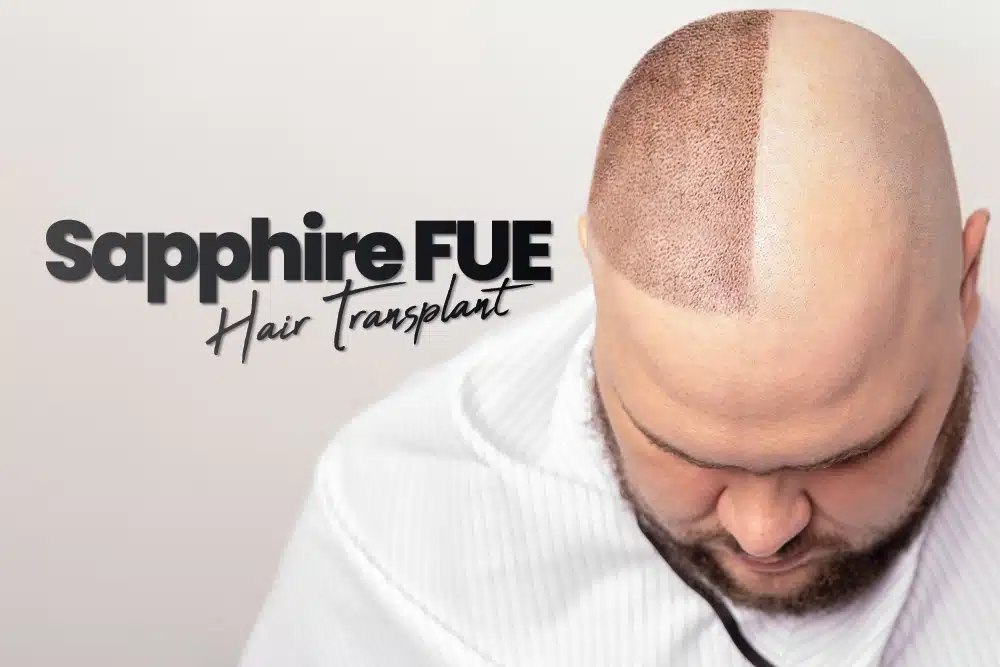
A Sapphire FUE hair transplant is a standard FUE hair transplant with one difference: the surgeon opens the channels for the grafts with a blade made of synthetic sapphire instead of steel. The blade is used for that one step. Taking the grafts out and placing them are done the same way. You will also see it sold as a sapphire blade hair transplant.
Clinics often present it as a separate, better technique. The published evidence is more modest. One large study found higher graft survival with sapphire blades, we found no randomised trial, and who makes the incisions matters more than what the blade is made of.
Quick Summary:
- What it is: FUE in which the recipient-site incisions are made with a sapphire blade
- What it changes: one step out of three. Extraction and graft placement are the same as in any FUE
- The evidence: one observational study of 1,000 patients reported graft survival of 94.7% with sapphire and 88.9% with steel. We found no randomised trial
- What matters more: who makes the incisions, and how well the angle, direction and density are planned
- At Carely Clinic: sapphire blades are standard for FUE at no extra charge, and Dr. Yeşim Güner makes the incisions herself
- Price: €1,800 all-inclusive, valid until December 2026
What Is Sapphire FUE?
Sapphire FUE is follicular unit extraction (FUE) in which the small cuts that receive the grafts are made with a sapphire blade. It is not a different operation. “FUE” describes how the grafts are taken from the donor area, one by one with a small punch. “Sapphire” describes the tool used later, on the other side of the head.
Sapphire is a variety of the mineral corundum, which is 9 on the Mohs hardness scale and, after diamond, the hardest known natural substance (Britannica, corundum). The blades used in surgery are made from synthetic sapphire. The appeal for surgeons is a very hard, very fine edge.
On our site, FUE means FUE performed with sapphire blades, because that is how we do it.
Which Step of the Operation Does the Blade Change?
Only the second of three. A hair transplant by FUE has three stages, and the sapphire blade belongs to one of them.
| Stage | What happens | Does sapphire change it? |
|---|---|---|
| 1. Extraction | Follicular units are removed from the donor area with a small punch | No |
| 2. Recipient-site creation | Small incisions, often called channels, are made where the grafts will go. Their angle, direction, depth and spacing decide how the result looks | Yes. This is where the blade is used |
| 3. Placement | The grafts are placed into the incisions | No |
Steel blades are not the only alternative. The StatPearls clinical reference describes recipient sites made with flat-edged blades or with 19- or 21-gauge needles (StatPearls, Hair Transplantation), and a surgical review of the recipient area says slits can be made with blades or with needles (Marwah and Mysore, Journal of Cutaneous and Aesthetic Surgery). Neither text mentions sapphire blades.
Is Sapphire FUE Better Than Steel-Blade FUE?
Possibly for graft survival, but the evidence is thin. That is the honest state of it in November 2026.
The strongest study we found is a prospective observational study of 1,000 hair transplant patients treated between January 2024 and March 2025. It reported a graft survival rate of 94.7% in the sapphire group and 88.9% in the steel group (Saket, Journal of Maxillofacial and Oral Surgery, 2026).
Its limits matter. Patients were grouped by the blade used, not assigned at random, so other differences between the groups could explain part of the gap. It has a single author. And we could read only the abstract, which does not say how many patients were in each group or how survival was measured.
We found no randomised trial that compares sapphire and steel blades in the same patients. Clinic websites cite a few other small studies. We could not open them, so we do not quote them.
Numbers You Will See Online
Several figures are repeated from one clinic website to the next: healing that is “20 to 25% faster”, follicle damage of “1.8% against 5.6%”, channels “0.25 mm” wide, survival of “97%”. We looked for the studies behind them and could not find or open a published paper for any of them. Until a clinic can show you the source, treat them with caution.
What Is Reasonable to Expect
A harder blade holds a fine edge, and a fine edge makes a clean, small incision. It is reasonable to think that helps, and the one large study points the same way. It is not reasonable to expect the blade to fix a poorly planned operation.
The decisions that shape the result are made by the person holding the blade: how high the hairline sits, the angle and direction of each incision, and how closely the incisions are spaced. Published guidance puts frontal hairs at about 15 to 20 degrees to the skin and an overall target of about 30 follicular units per cm². Our guide to hairline design explains these choices.
Who Makes the Incisions?
It should be the doctor, and it is the question to ask before you ask about the blade. The International Society of Hair Restoration Surgery (ISHRS) lists recipient-site creation among the parts of the operation that a licensed provider should perform, and warns that growing numbers of unlicensed personnel worldwide are performing substantial medical parts of the surgery (ISHRS consumer alert).
A sapphire blade in untrained hands is still an incision made by untrained hands. So ask every clinic that advertises Sapphire FUE who will be holding it.
At Carely Clinic, Dr. Yeşim Güner designs the hairline and makes the recipient-site incisions herself, with sapphire blades. Her team assists with extracting and placing the grafts.
Sapphire FUE vs DHI: What Is the Difference?
The difference is in how the grafts go in. In Sapphire FUE all the incisions are made first, and the grafts are placed into them afterwards. In DHI there are no pre-made incisions: each graft is loaded into an implanter pen, a hollow needle with a plunger, which makes the opening and places the graft in one movement.
Extraction is the same in both. We found no evidence that one gives better results than the other, and the StatPearls reference says only that the most appropriate technique depends on individual factors. Our guide to FUE vs DHI goes through when each is used. At Carely Clinic both cost the same.
Who Is a Candidate for Sapphire FUE?
Anyone who is a candidate for FUE. The blade does not change who is suitable.
- Your hair loss should be stable. Where more than 15% of the hairs in the area are thinning, the published advice is 6 to 12 months of medical treatment first
- The clinical reference says a transplant should ideally be considered only after the age of 25
- You need enough donor hair. A typical safe donor zone holds 65 to 85 follicular units per cm², and what is taken does not grow back
- Your expectations need to fit what a transplant does: it moves hair, it does not create it
Our graft calculator guide explains how the number of grafts is estimated.
What Is Recovery Like After Sapphire FUE?
The same as after any FUE. Published timelines for hair transplants do not distinguish between blades, and we found no reliable evidence that sapphire shortens them.
- First 2 weeks: be very careful with the transplanted hair, because the grafts are not yet secure
- After a few weeks: the transplanted hair often falls out. This is expected (see shock loss)
- After about 4 months: new hair usually starts to appear
- After 10 to 18 months: the full result
These points are from the NHS (NHS, Hair transplant). Our month-by-month results timeline covers each stage.
How Much Does Sapphire FUE Cost in Turkey?
At Carely Clinic, €1,800 all-inclusive, valid until December 2026. Sapphire blades are standard for FUE and there is no extra charge for them.
The price has no graft cap and no per-graft charge. It includes the procedure, pre-operative blood tests, a PRP session, 3 nights in a 5-star hotel, VIP airport transfers, medications, the first wash at the clinic, an aftercare kit and 12 months of follow-up. Flights are not included. The hair transplant cost in Turkey page has the details, and the packages page compares the options.
Clinic websites differ on this. Some list “Sapphire FUE” as a premium tier above standard FUE, and others charge the same for both. If a clinic charges more, ask what the extra pays for. If the answer is only the blade, you now know how much evidence stands behind it.
What Should You Ask a Clinic That Offers Sapphire FUE?
Start with who makes the incisions, and only then ask about the blade.
- Who makes the incisions, and what are their qualifications?
- Is the sapphire blade included in the price, or is it an extra? How much?
- Apart from the blade, what is different from your standard FUE?
- Who designs my hairline, and when do I see and approve it?
- How did you arrive at the number of grafts in my plan?
- How many patients does the doctor treat on the day of my procedure?
- Can I see dated photos of the same patients before surgery and at 12 months?
- Will I get the plan and the price in writing before I travel?
What Carely Clinic Offers
With Carely Clinic, hair transplants are performed in Istanbul under local anaesthesia, led by Dr. Yeşim Güner, using FUE with sapphire blades or DHI with an implanter pen. You send photos of your hair and donor area on WhatsApp, Dr. Güner reviews them, and our team replies within 24 hours with a written treatment plan that states the technique, the hairline plan and the fixed price.
The stay is four days and three nights: arrival, blood tests, assessment and hairline design on day 1, the procedure and a PRP session on day 2, the first wash at the clinic on day 3 and the flight home on day 4. Follow-up continues on WhatsApp for 12 months, with photo reviews at 1 week and at 1, 3, 6 and 12 months.
Learn more about Hair Transplant at Carely Clinic. If you are comparing with clinics at home, read our guides to the UK vs Turkey and Turkey vs the US.
More hair transplant guides: why people go to Turkey for hair transplants, Mexico vs Turkey and Afro hair transplants in Turkey.
Frequently Asked Questions
Is sapphire FUE better than regular FUE?
Possibly for graft survival, but the evidence is limited. One observational study of 1,000 patients reported survival of 94.7% with sapphire blades and 88.9% with steel. Patients were not assigned at random, and we found no randomised trial. Who makes the incisions matters more than the blade material.
Is Sapphire FUE a different technique from FUE?
No. It is FUE in which the recipient-site incisions are made with a sapphire blade instead of a steel blade or a needle. The grafts are extracted and placed in the same way. The name describes a tool used in one step, not a separate operation.
Does sapphire FUE heal faster?
We found no reliable evidence that it does. Figures such as “20 to 25% faster healing” appear on many clinic websites, but we could not find a published study behind them. The recovery timeline published by the NHS applies whichever blade is used: new hair after about 4 months, full result after 10 to 18 months.
Does sapphire FUE leave scars?
Yes, small ones, like any FUE. The ISHRS states that there is no such thing as scarless surgery in hair transplantation. The NHS describes the scars of FUE as lots of tiny scars that will not be very noticeable.
Sapphire FUE or DHI: which is better?
Neither has been shown to give better results. In Sapphire FUE the incisions are made first and the grafts placed afterwards. In DHI an implanter pen makes the opening and places the graft in one movement. The choice depends on your case, and at Carely Clinic both cost the same.
How much does sapphire FUE cost in Turkey?
At Carely Clinic it costs €1,800 all-inclusive, valid until December 2026. Sapphire blades are standard for FUE with no extra charge, and there is no graft cap. Flights are not included. Some clinics list Sapphire FUE as a premium tier, so ask what any extra charge pays for.
Who makes the incisions at Carely Clinic?
Dr. Yeşim Güner designs the hairline and makes the recipient-site incisions herself, with sapphire blades. Her team assists with extracting and placing the grafts. The procedure is done under local anaesthesia.
Is sapphire FUE painful?
The procedure is done under local anaesthesia, so the area is numb while the surgeon works. With Carely Clinic it is performed on day 2 of a four-day stay. Ask your clinic what to expect in the first days afterwards and which medications are included.
When will I see results from sapphire FUE?
On the same timeline as any hair transplant. The transplanted hair often falls out after a few weeks, new hair usually starts to appear after about 4 months, and the full result takes 10 to 18 months. The blade material does not change this.
Who is a good candidate for sapphire FUE?
Anyone who is a good candidate for FUE: stable hair loss, enough donor hair, and realistic expectations. Published guidance says a transplant should ideally be considered after the age of 25, and that unstable hair loss should be treated medically for 6 to 12 months first.
Conclusion
Sapphire FUE is FUE with a better-made blade for one step. That is worth having, and one large study suggests it helps grafts survive. It is not a different operation, and it is not a reason to pay much more or to stop asking questions.
The question that decides the result comes before the blade: who makes the incisions, and how carefully are they planned? A clinic that answers that clearly, in writing, is a better choice than one that only tells you what its blades are made of.
If you are considering a hair transplant, send photos of your hair and donor area on WhatsApp. Dr. Güner reviews them and our team replies within 24 hours with a written treatment plan and the fixed price.
How this guide was written: we looked for the published evidence on sapphire blades and read what we could open in November 2026: one observational study in the Journal of Maxillofacial and Oral Surgery (abstract only), the StatPearls clinical reference, a surgical review in the Journal of Cutaneous and Aesthetic Surgery, the ISHRS consumer alert and the NHS patient page, all linked in the text. We left out every figure we could not trace to a source, including several that are common on clinic websites.
Individual anatomy and results vary. This guide provides general information and is not medical advice. Your own surgeon’s assessment decides what suits you.
Written by Carely Clinic Medical Team · Last updated: November 2026