
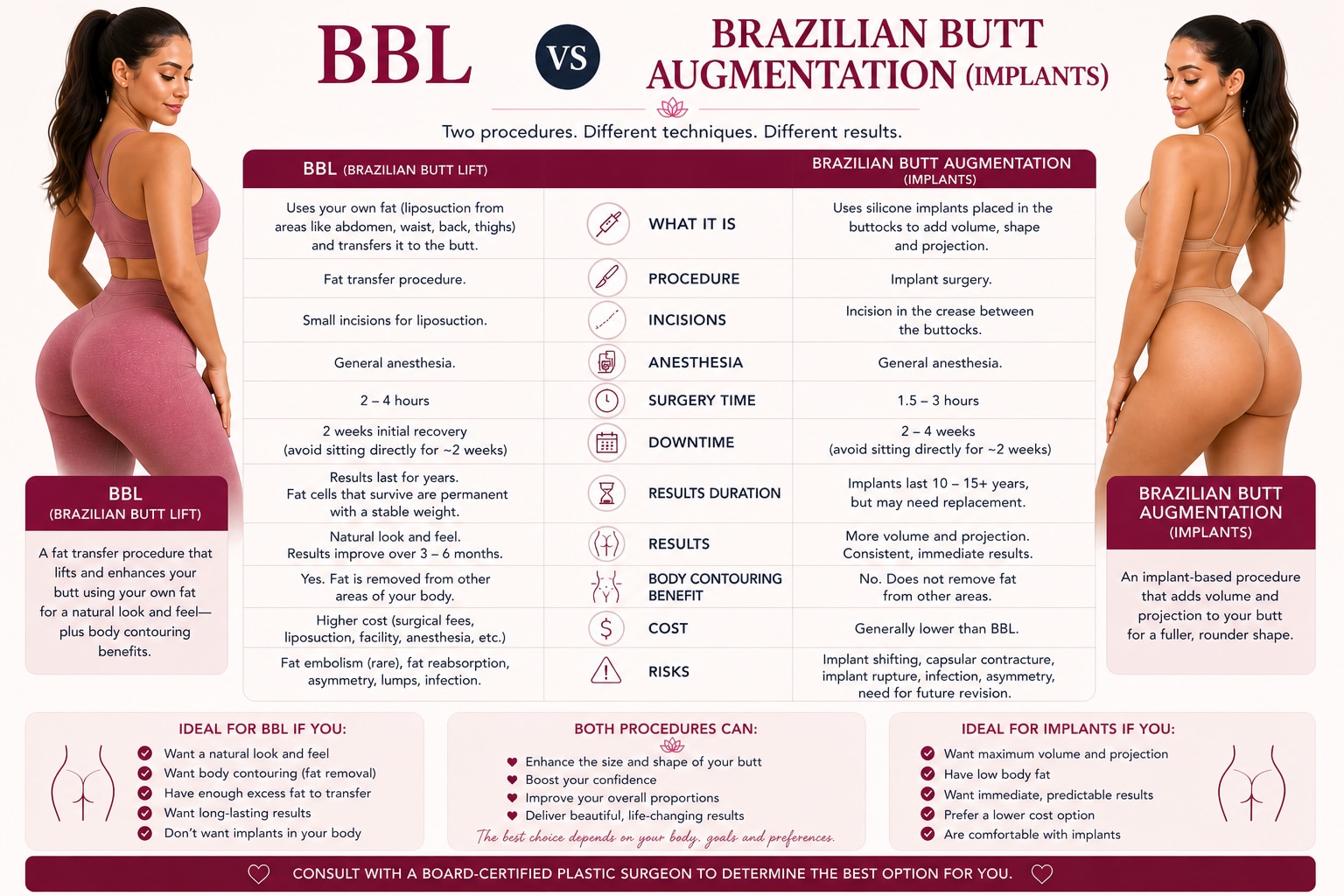
Quick Summary:
BBL (fat transfer) and butt implants are two distinct gluteal augmentation procedures. A BBL harvests your own fat via liposuction and reinjects it into the buttocks; implants use solid silicone prostheses. BBL suits patients with sufficient donor fat and costs £2,500-£4,500 ($3,000-$6,000) in Turkey.
What Is the Difference Between a BBL and Brazilian Butt Augmentation?
BBL and “Brazilian butt augmentation” are often used interchangeably — but they are not always the same thing.In most clinical contexts, BBL (Brazilian butt lift) specifically refers to autologous fat transfer: fat removed via liposuction, purified, and reinjected into the buttocks. “Brazilian butt augmentation” can mean fat transfer OR silicone implants, depending on the surgeon or clinic using the term.
ASPS plastic surgery statistics show high and growing volumes of gluteal fat grafting procedures performed annually in the US, and fat transfer procedures now outpace implant-based buttock augmentation in many markets. The genuine comparison most patients face is BBL fat transfer versus butt implants — and that is the comparison this guide addresses in full.
BBL produces natural-looking results using the patient’s own tissue, avoids implant-related risks, and simultaneously contours donor areas. Butt implants use solid silicone and suit patients lacking sufficient donor fat. Fat-based gluteal procedures now outpace implant augmentation in many international markets.
Both procedures are performed in Turkey at 60-70% lower cost than in the US or UK, with Istanbul as the primary destination.
Why Trust This Guide
This article draws on guidance from the American Society of Plastic Surgeons (ASPS), International Society of Aesthetic Plastic Surgery (ISAPS), British Association of Aesthetic Plastic Surgeons (BAAPS), the Multi-Society Gluteal Fat Grafting Task Force, and peer-reviewed research published in Aesthetic Plastic Surgery and the Aesthetic Surgery Journal. It has been medically reviewed by Op. Dr. Alirza Jahangirov, Plastic, Reconstructive & Aesthetic Surgeon at Carely Clinic in Istanbul.
BBL vs Butt Implants: Key Differences at a Glance
The two most important variables are how volume is added and whether you have sufficient donor fat. Everything else — cost, recovery, risk profile, longevity — follows from that core distinction.
| Feature | BBL (Fat Transfer) | Butt Implants |
|---|---|---|
| Material used | Patient’s own fat | Solid silicone prosthesis |
| Best for | Patients with adequate donor fat (BMI 22+) | Lean patients with insufficient fat |
| Result appearance | Natural, adapts with body weight | More pronounced, consistent shape |
| Dual benefit | Yes — contours donor areas simultaneously | No — buttocks only |
| Risk of rejection | None (own tissue) | Low but possible |
| Longevity | 5-10+ years (weight-dependent) | 10-15 years before likely revision |
| Primary specific risk | Fat embolism (minimised with current safety protocols) | Capsular contracture, displacement |
| Turkey cost (all-inclusive) | £2,500-£4,800 ($3,000-$6,000 / €2,800-€5,500) | £3,000-£5,500 ($3,500-$7,000 / €3,200-€6,400) |
| UK/US cost | £8,000-£12,000 ($10,000-$15,000) | £9,000-£15,000 ($12,000-$18,000) |
| Recovery: no sitting | 2 weeks minimum | 3-4 weeks minimum |
How Each Procedure Works
Understanding what actually happens in the operating theatre helps patients set realistic expectations and ask better questions during consultation.
How a BBL Works (Fat Transfer)
A BBL is a two-stage procedure performed under general anaesthesia over 3-4 hours. Fat is first removed via tumescent or ultrasound-assisted liposuction from donor sites — most commonly the abdomen, flanks, lower back, and thighs. The harvested fat (typically 800-1,200cc per side) is then centrifuged or filtered to remove blood, fluid, and damaged cells. Purified fat is reinjected through small cannulas into the subcutaneous layer of the buttocks at multiple depths and angles to sculpt the desired shape.
The critical safety principle, established by the Multi-Society Gluteal Fat Grafting Task Force, is that fat must be injected into the subcutaneous space only — never into the gluteal muscle, where major blood vessels create embolism risk. Many experienced surgeons now use ultrasound guidance to confirm cannula position in real time, reducing serious complication risk substantially.
How Butt Implants Work
Butt implants are solid silicone prostheses placed either within or above the gluteal muscle via a hidden incision in the natural crease between the buttocks. Solid silicone is used — not gel — because it resists deformation under the pressure of sitting. Implants are available in round, oval, and anatomical shapes, ranging from 200cc to 600cc per side. The surgeon creates a pocket, places the implant, and closes with sutures.
Results are immediate. Unlike BBL, there is no fat absorption phase. Volume remains consistent over time. However, implants are a foreign material and carry the risk of capsular contracture (scar tissue hardening around the implant), displacement, and eventual need for revision.
5 Factors That Determine Which Procedure Is Right for You
No single procedure is universally superior — the right choice depends on five clinical and personal factors.
Factor 1: Available Donor Fat
BBL requires a minimum of approximately 500cc of harvestable donor fat per side. Patients with BMI below 21-22 often lack sufficient donor fat; flanks and lower back are assessed first during consultation
For most patients, the abdomen, flanks, thighs, and lower back together yield enough fat. Even slender patients may qualify — the lower back and flanks often carry fat that is not obvious externally. If after consultation a patient is found to have insufficient fat, implants or a hybrid approach becomes the preferred route.
Factor 2: Desired Volume and Shape
BBL excels at creating a rounded, natural contour; implants deliver more dramatic, consistent projection. Patients seeking a large, pronounced increase typically achieve better volume predictability with implants than with fat transfer.
BBL allows surgeons to sculpt shape by distributing fat precisely — more upper pole for a lifted look, more lateral for hip width. Implants create a central projection that is fixed in shape and size. Patients who want a subtle, proportional enhancement almost universally choose BBL; those who want maximum volume often prefer implants.
Factor 3: Risk Tolerance
Both procedures carry risks, but the risk types differ significantly. BBL’s primary serious risk is fat embolism; implants carry higher rates of long-term complications including capsular contracture and displacement.
Published mortality data indicates fat embolism risk in BBL has dropped substantially with subcutaneous-only injection and ultrasound guidance — ASERF research places mortality at approximately 1 in 14,952 procedures using current technique. Implants carry meaningful long-term complication rates including capsular contracture, requiring revision in a proportion of patients over a decade.
Factor 4: Recovery Time and Lifestyle
BBL’s no-sitting restriction is the single most discussed recovery challenge. Patients who cannot avoid sitting for work reasons may prefer implants, which allow seated recovery using a specialised cushion at week 3.
BBL requires 2 weeks without sitting directly on the buttocks. Implant recovery requires 3-4 weeks of restricted sitting but does not have the same fat survival dependency. Patients who travel by air for long distances should plan for this restriction before booking return flights.
Factor 5: Budget and Long-Term Cost
BBL is typically less expensive upfront and carries no implant replacement cost. Implants may require revision every 10-15 years, making the total lifetime cost higher than a single BBL procedure with stable weight maintenance.
In Turkey, all-inclusive BBL packages range from £2,500-£4,800 ($3,000-$6,000 / €2,800-€5,500). Implant packages start approximately £500-£700 higher due to implant material costs. In the UK and US, both procedures range from £8,000-£15,000 ($10,000-$18,000), with Turkey offering 60-70% savings on both.
Safety and Risks: What the Evidence Shows
BBL and butt implants have distinct risk profiles. Following Multi-Society Task Force safety guidance, subcutaneous BBL injection technique has substantially reduced fat embolism rates. Implants carry higher long-term revision risk.
BBL Safety Profile
The BBL’s historical safety concern — fat embolism — has been dramatically reduced by technique changes. Since the Multi-Society Task Force established subcutaneous-only injection standards, serious BBL complication rates have declined significantly in accredited facilities.
The Multi-Society Task Force — involving ASPS, ISAPS, ASERF, and ASAPS — established that fat must never be injected into the gluteal muscle, where large vessels create embolism risk. Clinics using blunt-tip cannulas, ultrasound guidance, and proper patient positioning now report complication rates substantially lower than figures from older data. In experienced surgical hands, the overall serious complication rate is reported to be below 1%.
Common, less serious BBL complications include temporary asymmetry, bruising, partial fat reabsorption (20-40% in the first 3-6 months per published research), and contour irregularities that typically self-resolve.
Expert Insight
“Fat grafting to the buttocks is now a well-evidenced procedure when performed with subcutaneous technique and ultrasound guidance. The 2018 ASPS-ISAPS safety consensus marked a turning point — properly trained surgeons working in accredited facilities see dramatically lower complication rates than figures cited from older data.”
— Reflecting current clinical consensus on BBL safety standards following the Multi-Society Task Force reforms
Implant Safety Profile
Butt implants carry a different risk profile: lower acute mortality risk, higher long-term revision likelihood. Capsular contracture, implant displacement, and infection are the primary long-term risks, with revision rates reported in published plastic surgery literature over 10-year follow-up periods.
Because solid silicone implants are foreign bodies, the immune system may produce scar tissue around them (capsular contracture), causing firmness, discomfort, or visible distortion. Implant displacement — where the prosthesis shifts from its original position — is another documented risk, particularly in patients who resume high-impact activity too early. Infection, though uncommon in accredited clinics, requires implant removal if it occurs.
Recovery Timeline: BBL vs Butt Implants
BBL and implant recoveries both run 6-8 weeks for full resumption of activities, but differ in week-by-week restrictions. BBL’s fat survival protocol drives most patient behaviour in the first 2 weeks.
| Timeframe | BBL Recovery | Butt Implant Recovery |
|---|---|---|
| Days 1-3 | Rest; compression garment on; sleep on stomach or side | Rest; compression garment; elevated positioning |
| Days 4-7 | Light walking permitted; no sitting on buttocks | Light walking; no sitting directly; pain managed |
| Week 2 | Return to desk work (standing desk); no sitting | Return to light desk work with BBL cushion |
| Weeks 3-4 | Limited sitting with BBL cushion permitted | Sitting with cushion; increasing activity |
| Weeks 5-8 | Normal activity resumption; light exercise | Return to most activities; avoid intense exercise |
| 3-6 months | Final results visible; fat stabilised | Full results established; implant settled |
BBL Recovery Milestones
The single most critical BBL recovery rule is zero direct pressure on the buttocks for the first 2 weeks. Fat cells need uninterrupted blood supply in the first 14 days to survive and integrate; direct pressure compresses new vasculature and reduces fat survival rate.
Patients sleep on their stomach or side. Compression garments are worn for 6-8 weeks to control swelling at liposuction donor sites. Swelling peaks at 2-3 weeks and gradually resolves over 3-6 months. Final results — with retained fat stabilised — are typically visible at 3-6 months.
Butt Implant Recovery Milestones
Implant recovery follows a more conventional surgical pattern, with the primary concern being implant position stability in the first 4-6 weeks. Avoiding high-impact activity for 6 weeks is critical to prevent implant displacement before fibrous tissue anchors the prosthesis in position.
Pain is typically moderate in the first week, managed with prescribed analgesia. The incision site in the gluteal crease requires careful hygiene. Patients can sit with a specialised cushion from week 3 onward. Full activity, including gym training, is typically cleared at 8 weeks.
Among international patients travelling to Istanbul from the UK and USA, the most common recovery challenge with BBL is the no-sitting restriction during the flight home. Planning an appropriate stay length — 7-10 days minimum — and using a BBL cushion for the return journey reduces fat loss risk during travel.
Who Should Choose BBL
BBL is ideal for patients with adequate fat reserves (typically BMI 22-32) who want natural-looking, soft results with the added benefit of body contouring in donor areas like the abdomen and flanks.
The best BBL candidates share several characteristics. First, they have sufficient donor fat — most surgeons recommend having enough fat for liposuction from 2-3 areas to transfer meaningful volume. Second, they prefer natural feel and appearance. Transferred fat integrates with existing tissue, creating results that feel indistinguishable from natural buttock tissue.
BBL offers a unique dual benefit: removing fat from areas where it’s unwanted while adding volume to the buttocks. This body contouring effect creates more dramatic overall transformation than implants alone. Patients seeking an hourglass silhouette with smaller waist and fuller hips often find BBL ideal for achieving this goal.
Consider BBL if you have excess fat in your midsection you’d like removed, prefer soft and natural results over maximum projection, are willing to maintain stable weight post-procedure, and can commit to extended sitting restrictions during recovery.
Who Should Choose Butt Implants
Butt implants suit lean patients without sufficient fat for BBL, those wanting more dramatic projection than fat transfer can achieve, or patients seeking predictable volume unaffected by weight fluctuations.
The ideal implant candidate typically has a naturally lean physique without adequate donor fat for meaningful transfer. Some patients have already undergone liposuction, leaving insufficient fat reserves for BBL. Others maintain very low body fat percentages that wouldn’t yield enough volume even with aggressive harvesting.
Implants provide more predictable volume since the silicone prosthetic doesn’t change. Unlike transferred fat, which can be absorbed unpredictably, implant size remains constant regardless of weight changes. This predictability appeals to patients who want guaranteed results without the uncertainty of fat survival rates.
Some patients prefer the firmer, more projected appearance that implants create. Surgeons can also combine small implants with fat transfer for patients who want both core projection and natural peripheral softness.
Consider implants if you lack adequate body fat for meaningful BBL, want guaranteed predictable volume, prefer firmer projection over soft natural results, or have previously had liposuction leaving insufficient donor sites.
Who Is NOT a Good Candidate for BBL or Butt Implants?
Both procedures require good general health, stable weight, and realistic expectations. BBL has additional candidacy requirements around donor fat volume; implants have fewer body composition requirements but higher anaesthetic complexity.
Absolute Contraindications
These conditions prevent either procedure from being performed safely under current surgical guidelines.
These conditions make gluteal augmentation surgery inadvisable in most clinical settings:
- Active smoking or tobacco use: Nicotine impairs blood flow and fat cell survival in BBL, and delays wound healing in implant surgery. Most surgeons require patients to stop smoking at least 4 weeks before surgery.
- Uncontrolled systemic disease: Uncontrolled diabetes, active cardiac disease, or severe hypertension creates unacceptable anaesthetic and healing risk.
- Active infection anywhere in the body: Systemic infection at the time of surgery dramatically increases post-operative infection risk, particularly for implant procedures.
- Unrealistic expectations: Patients who expect unlimited volume, specific celebrity results, or immunity to weight-related changes are not ready for surgical consultation.
- BMI above 40: Significantly elevated BMI increases DVT, anaesthetic, and wound healing complications for both procedures.
Relative Contraindications
These factors do not automatically exclude surgery but require optimisation and surgical team assessment before proceeding with either procedure.
These cases may proceed after medical optimisation:
- Insufficient donor fat for BBL (BMI under 21-22): Implants or a hybrid approach should be discussed instead.
- Controlled diabetes or hypertension: Surgery can proceed when these conditions are well-managed and cleared by the patient’s GP or primary care doctor.
- Previous liposuction in donor areas: Scar tissue from prior liposuction reduces fat yield. The surgical team assesses usable volume during consultation.
- History of autoimmune conditions (for implants): Patients with autoimmune history require specialist clearance before silicone implant placement.
Managing Expectations
Both procedures improve shape and volume but cannot override genetics, and results change with significant weight fluctuations over time.
BBL results shift with weight changes — weight gain increases volume, weight loss reduces it. Implants maintain consistent volume but are not immune to the effects of ageing and muscle atrophy on surrounding tissue. Patients should aim to be within 5-10% of their goal weight before surgery, and commit to weight stability for at least 12 months post-operatively. Both procedures are repeatable — a top-up BBL or implant revision is possible if desired after full healing.
Warning Signs to Watch For
Both BBL and butt implant patients should monitor for the following warning signs during recovery and contact their surgical team or emergency services immediately if any occur.
Seek immediate medical attention for any of the following. Do not wait for a scheduled follow-up if these signs appear.
| Warning Sign | What It May Indicate | Action Required |
|---|---|---|
| Fever above 38.5°C (101.3°F) | Post-surgical infection or systemic inflammatory response | Contact surgical team immediately; attend clinic within 24 hours |
| Wound opening or separation | Wound dehiscence; possible early implant exposure | Cover with clean dressing; attend clinic or emergency care same day |
| Sudden shortness of breath or chest pain | Pulmonary embolism or fat embolism syndrome | Call emergency services (999 UK / 911 US / 112 EU) immediately |
| Calf swelling, redness, or pain | Deep vein thrombosis (DVT) — a serious post-surgical risk | Attend emergency care immediately; do not massage or compress |
| Increasing pain after day 3 (not improving) | Infection, haematoma, or implant complication | Contact surgical team within 12 hours; pain should be decreasing, not increasing |
| Fluid accumulation under skin (seroma) | Post-liposuction seroma — common but requires monitoring | Report to surgical team; may require aspiration drainage |
| Numbness or asymmetry worsening after week 3 | Nerve compression or uneven fat/implant settling | Report at next follow-up; photograph for surgical team review |
Frequently Asked Questions
What is the difference between a BBL and a Brazilian butt augmentation?
BBL and Brazilian butt augmentation are commonly used interchangeably to describe the same fat transfer procedure, though the terms can also refer to different methods. Both use liposuction to harvest fat, purify it, and reinject it into the buttocks for volume. The real comparison patients face is between fat transfer (BBL) and silicone implants (butt augmentation with implants).
Which lasts longer, a BBL or butt implants?
BBL results last 5-10+ years when the patient maintains a stable weight after surgery. Published research indicates that, 20-40% of transferred fat is reabsorbed in the first 3-6 months. Butt implants are technically permanent but require replacement or revision for most patients within 10-15 years.
How much fat survives after a BBL?
On average, 60-80% of transferred fat survives long-term when subcutaneous injection technique is used correctly.Published research estimates 20-40% fat absorption occurs during healing in the first 3-6 months post-surgery. Experienced surgeons overfill by 20-30% to account for expected reabsorption, delivering the desired final volume.
Is a BBL safer than butt implants?
In experienced hands, BBL and implants carry comparable overall complication rates, but risks differ in type.Historical data cited a fat embolism risk of approximately 1 in 3,000 BBLs performed without subcutaneous-only injection; current technique has substantially reduced this risk. Implants carry higher long-term risks of capsular contracture, displacement, and need for revision surgery over time.
How long is recovery after a BBL?
Most patients return to light activity within 7-10 days and resume normal routines within 6-8 weeks after BBL. Standard surgical guidance requires patients to avoid sitting directly on the buttocks for at least 2 weeks post-surgery. Full BBL results, with swelling resolved and fat stabilised, are typically visible at the 3-6 month mark.
Can thin patients get a BBL?
Thin patients may qualify for BBL if they carry sufficient fat in the lower back, flanks, or thighs. Surgeons evaluate donor fat volume during pre-operative consultation; even slim patients are sometimes found to have enough. When donor fat is truly insufficient, butt implants or a hybrid BBL-plus-implants approach may be recommended instead.
How long do butt implants last?
Butt implants are designed to be long-lasting, but most surgeons recommend evaluation for revision every 10-15 years. Unlike breast implants, gluteal implants do not have a mandatory replacement schedule. Complications such as capsular contracture, displacement, or infection may require earlier revision in some patients.
What are the risks of a BBL?
The primary risks of BBL are fat embolism, infection, asymmetry, and partial fat absorption affecting final results.The Multi-Society Task Force established subcutaneous-only injection as the standard to minimise embolism risk. Choosing a board-certified plastic surgeon with ultrasound guidance protocol significantly reduces serious complication rates.
When can I sit after a BBL?
Most surgeons clear patients for limited sitting at 2 weeks, using a specialised BBL cushion or pillow. Standard recovery guidance advises no direct buttock pressure for 2 weeks to optimise fat cell survival. Patients may sit normally, without cushion support, after approximately 6-8 weeks once the surgeon confirms healing.
How much does a BBL cost compared to butt implants?
A BBL in Turkey costs £2,500-£4,800 ($3,000-$6,000 / €2,800-€5,500), versus £8,000-£12,000 in the UK. Butt implants in Turkey cost approximately £3,000-£5,000 ($3,500-$6,500), slightly more than fat transfer BBL. Both procedures in the UK and US range from £8,000-£15,000 ($10,000-$18,000), with Turkey offering 60-70% savings.
Can you combine a BBL with butt implants?
Yes, hybrid gluteal augmentation combines fat transfer with implants for patients wanting both dramatic volume and natural contouring. This combination approach is increasingly used by experienced surgeons for selected lean patients. Carely Clinic evaluates hybrid candidacy during the pre-operative consultation based on donor fat availability and patient goals.
Conclusion
BBL delivers natural results for patients with adequate donor fat; implants suit lean patients seeking dramatic volume. Both are safe when performed by board-certified surgeons using current safety protocols established by the Multi-Society Task Force.
For the majority of patients — those with a BMI of 22 or above and moderate-to-good donor fat volume — BBL is the preferred option. It delivers natural results, simultaneously contours the waist and abdomen, carries no foreign-body risk, and is less expensive. BBL results last 5-10+ years with stable weight. ASPS plastic surgery statistics show high and growing volumes of fat transfer gluteal procedures performed annually, reflecting sustained and growing patient confidence in the procedure.
Butt implants remain the correct choice for lean patients who cannot provide enough donor fat for meaningful fat transfer. They offer consistent, immediate volume that does not depend on fat survival. The long-term revision requirement should be factored into the decision.
For UK and US patients considering either procedure, Istanbul offers 60-70% cost savings at accredited facilities with internationally trained surgeons. A personalised consultation is the only way to determine which procedure — or combination — is right for your anatomy and goals.
Book a consultation with Op. Dr. Jahangirov at Carely Clinic to discuss your candidacy for BBL or butt augmentation in Istanbul.
Individual outcomes vary. This guide provides general medical education based on international guidelines and published research. Consult qualified medical professionals for personalised advice.
Medical Review: Op. Dr. Alirza Jahangirov