
Quick Summary
African rhinoplasty uses specialized techniques including cartilage grafting, tip refinement, and alar base reduction to enhance nasal aesthetics while preserving ethnic identity in Black patients.
According to ISAPS 2024 data, rhinoplasty procedures increased 21.6% globally in 2023, with ethnic rhinoplasty representing one of the fastest-growing subspecialties.
This guide covers anatomical considerations, surgical techniques, recovery expectations, and how Turkey’s expertise in ethnic rhinoplasty offers world-class results at 50-70% lower costs than Western countries.
Why Trust This Guide
This content synthesizes peer-reviewed medical literature from PubMed, clinical guidelines from the American Academy of Facial Plastic and Reconstructive Surgery (AAFPRS), and ISAPS statistical reports on cosmetic procedures.
Carely Clinic’s editorial team works with board-certified surgeons experienced in ethnic rhinoplasty to ensure accuracy, while our commitment to balanced, evidence-based information helps patients make informed decisions about this transformative procedure.
What Is African Rhinoplasty?
African rhinoplasty is a specialized form of ethnic rhinoplasty designed to address the unique anatomical features of patients of African descent while preserving their cultural identity and ethnic characteristics.
Unlike traditional rhinoplasty techniques developed primarily for Caucasian nasal anatomy, African American rhinoplasty requires surgeons to understand the distinct structural characteristics of Black noses and adapt their surgical approach accordingly. The goal is nasal refinement—not westernization—creating harmony between the nose and other facial features while respecting the patient’s heritage.
Modern ethnic rhinoplasty represents a significant evolution in cosmetic surgery philosophy. As the American Society of Plastic Surgeons notes, ethnic rhinoplasty now focuses on preserving ethnic identity rather than conforming to any single aesthetic standard. This patient-centered approach requires surgeons to master specialized techniques including augmentation rhinoplasty, tip refinement, and alar base modification.
The procedure addresses both cosmetic concerns and functional issues. Many patients seek African rhinoplasty to refine the nasal bridge, define the tip, narrow wide nostrils, or improve breathing. When performed by an experienced surgeon, the results enhance natural beauty while maintaining the authentic characteristics that reflect the patient’s background.
Unique Anatomical Considerations
African American noses possess anatomical features that require specialized surgical approaches, though significant variation exists among individuals of African descent.
The nasal anatomy varies considerably depending on regional ancestry. West African heritage often correlates with thicker skin and wider nostrils, while East African backgrounds may feature thinner skin and more prominent bone structure. Afro-Caribbean patients frequently present with flatter nasal bridges and softer cartilage, and Afro-Latin individuals may have mixed characteristics including pronounced dorsal humps.
Understanding these variations is essential because applying a one-size-fits-all approach leads to unsatisfactory results. Common anatomical characteristics that surgeons encounter include:
Thick Skin and Sebaceous Tissue
The nasal skin in Black patients is typically thicker with more sebaceous (oil-producing) glands, particularly over the tip. This presents challenges for tip definition because even after cartilage reshaping, the thick soft tissue envelope may obscure fine details. The skin also takes longer to contract around the new nasal framework, extending the final results timeline.
Lower Nasal Bridge
Many African American patients have a lower, wider, and flatter dorsum (nasal bridge) compared to Caucasian noses. The nasal bones are often shorter, contributing to this profile. Augmentation rather than reduction is frequently required.
Weaker Cartilage Support
The alar cartilages (lower lateral cartilages) tend to be smaller and softer, providing less structural support for the nasal tip. This contributes to decreased tip projection and definition, often requiring reinforcement through grafting techniques.
Wider Nasal Base and Alar Flaring
The nostril width and alar (nostril wing) flaring are typically more pronounced. The interalar distance—measured between the outer edges of the nostrils—often exceeds the intercanthal distance (space between the inner corners of the eyes), which is the traditional aesthetic guideline for nasal width.
Acute Cartilage Angle
Research published in Seminars in Plastic Surgery found that differences between African American and Caucasian noses at the alar cartilage level can be attributed to the angle of inclination of the alar cartilage relative to the maxilla. A more acute angle creates a widened nasal base appearance and reduced tip projection.
These anatomical differences do not represent deficiencies—they simply require adapted surgical techniques to achieve optimal results.
Goals of African American Rhinoplasty
The primary objectives of African rhinoplasty balance aesthetic enhancement with ethnic preservation, creating facial harmony rather than conformity to any single beauty standard.
Leading rhinoplasty experts have identified five key goals for African American rhinoplasty that guide surgical planning:
- Maintaining nasal-facial harmony and balance — The refined nose should complement other facial features proportionally
- Creating a narrower, straight dorsum — When appropriate, addressing bridge width while respecting natural characteristics
- Enhanced tip projection and definition — Improving tip shape while working within the constraints of thicker skin
- Preserving slight alar flaring — Avoiding over-narrowing that creates an unnatural, pinched appearance
- Achieving appropriate interalar distance — Narrowing when necessary but maintaining ethnic identity
The surgical plan must address each patient’s specific concerns while avoiding common pitfalls. Over-aggressive surgery that removes too much tissue, uses inappropriate implants to force a Caucasian appearance, or fails to account for thicker skin and softer cartilage can lead to results that look operated or compromise the patient’s ethnic identity.
Patients seeking African rhinoplasty typically request refinement of the nasal tip to reduce bulbosity, narrowing of wide nostrils, building up a low nasal bridge, and overall facial balance. A skilled surgeon addresses these concerns while preserving the characteristics that make the nose authentically belong to the patient’s face.
Surgical Techniques for Black Patients
African rhinoplasty employs specialized techniques adapted to address the unique characteristics of Black nasal anatomy, with most procedures focusing on augmentation and reinforcement rather than reduction.
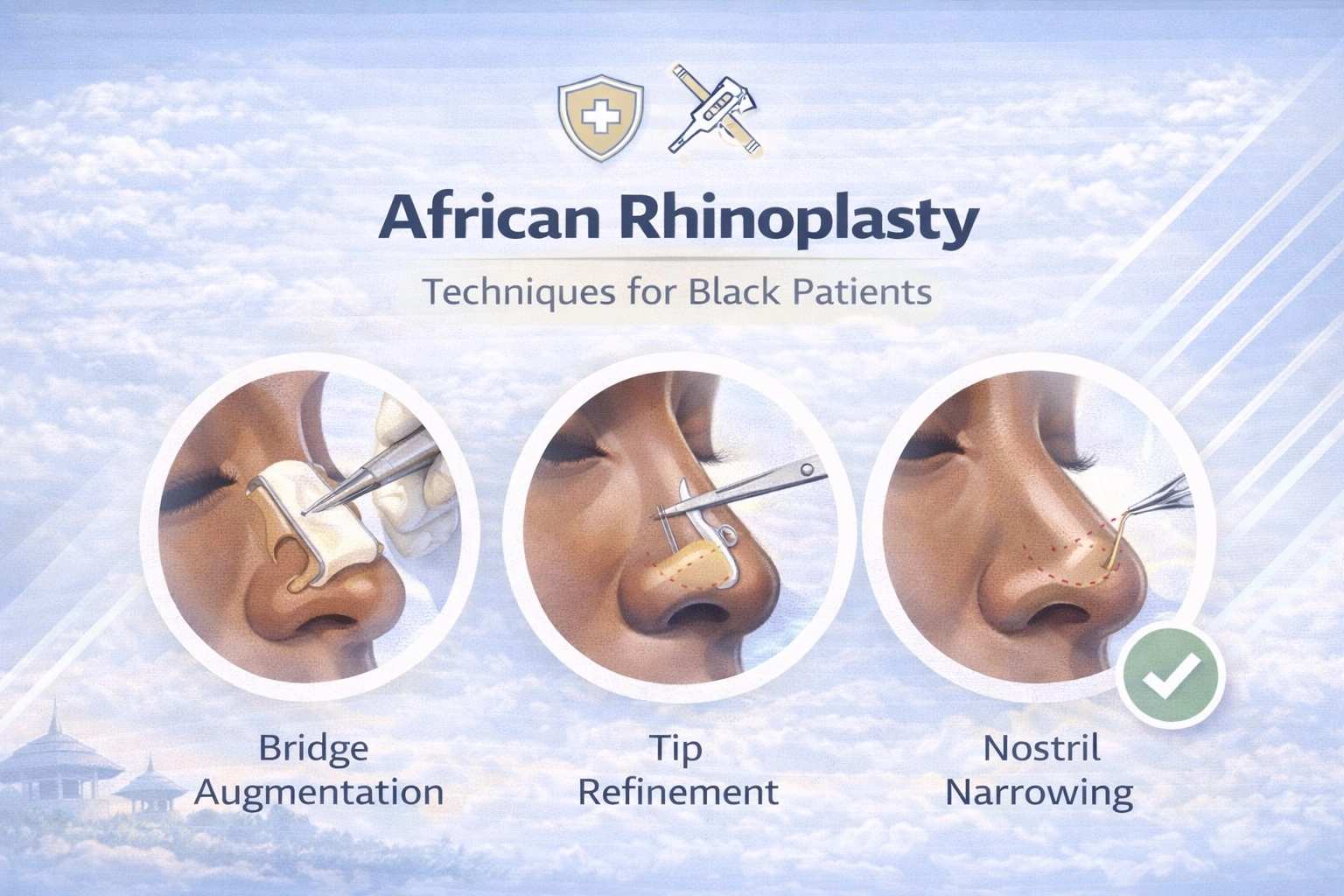
Tip Refinement Surgery
The nasal tip presents the greatest surgical challenge in African rhinoplasty due to thick skin covering soft, weak cartilage. Surgeons use several approaches:
Suture techniques reshape existing cartilage by plicating (folding) and securing the alar cartilages to increase definition. This provides immediate improvement though results depend on skin thickness and long-term tissue response.
Cartilage grafting builds structural support using the patient’s own tissue. A columellar strut graft positioned between the medial crura (inner leg of the alar cartilages) provides a foundation for tip projection. Shield grafts placed at the tip itself create definition, while cap grafts and onlay grafts add refinement layers.
For thick-skinned patients, tip defatting may complement cartilage work. Surgeons carefully remove excess fibrofatty tissue between the skin and cartilage to improve definition without compromising blood supply.
Dorsal Augmentation
Building up the nasal bridge requires adding structural material since the native dorsum is typically low and flat. Options include:
Cartilage grafts—particularly rib cartilage—provide permanent augmentation with the patient’s own tissue. The graft is carved into a fusiform (spindle) shape to create a natural-appearing bridge.
Alloplastic implants like silicone or Gore-Tex offer another option, though they carry higher risks of infection, extrusion, and capsule formation compared to autologous tissue. Most experienced ethnic rhinoplasty surgeons prefer cartilage grafts.
Diced cartilage wrapped in fascia (tissue covering muscle) provides smooth contours and natural integration when precise shaping is needed.
Nasal Bone Work
When the nasal bones are wide, osteotomies (controlled bone cuts) narrow the bony vault. Ultrasonic piezo rhinoplasty represents an advancement that uses ultrasonic vibrations to precisely shape bone with less trauma than traditional techniques, potentially reducing bruising and recovery time.
Cartilage Grafting Options
Cartilage grafts form the foundation of successful African rhinoplasty, providing the structural support necessary for tip definition, bridge augmentation, and long-lasting results.
The choice of graft material depends on the extent of work needed, availability of donor tissue, and patient preferences. Three primary sources exist:
Septal Cartilage
The nasal septum—the wall dividing the nasal cavity—provides the ideal graft material when available. Septal cartilage offers appropriate rigidity, is easily accessible through the same surgical approach, and matches the nose’s natural tissue.
During septoplasty for deviated septum repair or standalone harvesting, surgeons remove a portion of cartilage while preserving the L-strut (10-15mm along the dorsum and caudal edge) to maintain nasal support. The harvested cartilage is then carved into columellar struts, spreader grafts, shield grafts, or other required shapes.
However, African American patients often have smaller septal cartilage reserves, and previous surgery may have depleted this source. When septal cartilage is insufficient, alternative sources become necessary.
Ear (Conchal) Cartilage
The conchal bowl of the ear provides moderately firm, naturally curved cartilage suitable for tip grafting and smaller applications. Harvesting occurs through an incision behind the ear, leaving no visible scar.
Ear cartilage works well for cap grafts, alar rim grafts, and situations requiring flexibility. Its curved nature can be advantageous for certain tip modifications. However, the quantity is limited and may not provide enough material for extensive dorsal augmentation.
Rib (Costal) Cartilage
Rib cartilage represents the gold standard for major African rhinoplasty procedures requiring substantial grafting material. Typically harvested from the sixth or seventh rib through a small incision below the breast fold, rib cartilage provides ample tissue for comprehensive reconstruction.
The advantages include abundant supply, excellent structural strength, and the ability to carve precisely shaped grafts for both dorsal augmentation and tip work. Experienced surgeons shape the rib into a fusiform dorsal onlay graft while using remaining portions for septal extension grafts, columellar struts, and spreader grafts.
The primary concern with rib cartilage is warping—gradual bending over time. Surgeons mitigate this through careful carving techniques, using the central portion of the cartilage, and allowing harvested cartilage to equilibrate before shaping. When performed properly, rib cartilage rhinoplasty provides excellent, long-lasting results.
Some surgeons offer irradiated cadaveric rib cartilage (allograft) as an alternative to autologous tissue. While this eliminates the donor site and its associated discomfort, it carries slightly higher risks of resorption and infection compared to the patient’s own tissue.
Alar Base Reduction (Alarplasty)
Alar base reduction, also known as alarplasty, addresses wide nostrils and alar flaring—common concerns in African rhinoplasty that require careful, conservative technique to avoid an over-operated appearance.
The procedure narrows the nostril width and reduces flaring by removing small wedges of tissue at the nostril base. When performed correctly, scars hide in natural creases and become virtually invisible with time.
When Alar Base Reduction Is Indicated
Alarplasty is appropriate when the interalar distance (nostril width) significantly exceeds the intercanthal distance (inner corner of eyes), or when alar flaring extends notably beyond the alar-facial groove. However, surgeons should evaluate whether the apparent width is truly excessive or simply part of natural ethnic features.
Important consideration: A weak nasal tip can create the illusion of a wide base. Increasing tip projection sometimes narrows the perceived nasal base without requiring tissue excision. Experienced surgeons assess this relationship before committing to alar reduction.
Surgical Techniques
Three main approaches exist for alarplasty:
Weir (Wedge) Excision removes a wedge-shaped piece of tissue from the alar lobule where it meets the cheek. This reduces nostril flaring without affecting the internal nostril circumference. The incision hides in the alar-facial groove.
Nasal Sill Excision removes tissue from the nostril floor (sill), narrowing the nostril opening. The incision is made inside the nostril, leaving no external scar. This technique addresses both alar base width and nostril circumference.
Combined Techniques address both flaring and width simultaneously. Surgeons often use a modified approach that preserves the natural alar curve while achieving appropriate narrowing.
Critical Principle: Conservative Removal
Over-narrowing is the most common complication in alar base reduction for ethnic patients. Removing too much tissue creates a pinched, unnatural appearance that screams “operated.” The goal is subtle refinement—typically removing no more than 2-3mm on each side—preserving the natural ethnic character while improving facial balance.
Alar base reduction is often performed as the final step in rhinoplasty after tip work is complete, allowing the surgeon to assess the true base width after tip projection is established.
Open vs. Closed Rhinoplasty
The choice between open and closed rhinoplasty approaches significantly impacts surgical access, precision, and scarring—with most African rhinoplasty cases favoring the open technique.
Open (External) Rhinoplasty
Open rhinoplasty involves a small incision across the columella (the tissue between the nostrils) plus internal incisions, allowing the surgeon to lift the nasal skin and directly visualize all structures.
This approach is generally preferred for African American rhinoplasty because it provides complete visualization of the nasal framework, essential when working with weak cartilage that requires grafting. The improved access allows precise placement of multiple grafts, symmetric tip modifications, and better control over the final shape.
The columellar scar, when properly executed using a stair-step or V-shaped incision pattern, typically heals to be nearly invisible within months. For patients with darker skin tones, proper wound care and sun protection minimize any pigmentation changes.
Open rhinoplasty is particularly appropriate for complex tip work requiring extensive grafting, dorsal augmentation with cartilage, revision cases where scar tissue obscures anatomy, and procedures combining multiple techniques.
Closed (Endonasal) Rhinoplasty
Closed rhinoplasty uses incisions entirely inside the nostrils, leaving no external scar. The surgeon works through limited access, which requires greater technical skill for complex modifications.
This approach may be appropriate for minor tip refinements, simple dorsal adjustments, patients with very thin skin where the columellar scar might be visible, and straightforward cases not requiring extensive grafting.
However, closed rhinoplasty limits visualization of the tip cartilages and makes precise graft placement more challenging. Given that African rhinoplasty typically requires structural augmentation and multiple grafts, the closed approach is less commonly used.
Duration and Technical Considerations
African American rhinoplasty generally takes 2-4 hours depending on complexity. The open approach typically adds 15-30 minutes compared to closed surgery but provides proportionally greater precision and control.
Recovery Timeline
Recovery from African rhinoplasty follows a predictable timeline, though thick nasal skin in Black patients often extends the period before final results become visible.
Immediate Post-Operative Period (Days 1-7)
The first week focuses on managing swelling, bruising, and discomfort while protecting the surgical site:
A nasal splint supports the new nasal structure and is typically removed at 5-7 days. Internal splints or packing, if used, come out within the first few days. Bruising around the eyes peaks at 48-72 hours, then gradually resolves. Most patients experience moderate swelling that makes the nose appear larger than the final result.
Patients should sleep with the head elevated at 30-45 degrees to minimize swelling, apply cold compresses around (not on) the nose, avoid blowing the nose, and use saline spray to keep nasal passages moist. Most patients feel comfortable returning to non-strenuous work within 7-10 days.
Early Recovery (Weeks 2-4)
During this phase, visible swelling and bruising continue to resolve. The cast is removed, and patients see their first glimpse of results—though significant swelling remains, particularly in the tip. Social activities can typically resume by week 2-3, when most bruising has faded.
Patients should continue avoiding strenuous exercise, wearing glasses directly on the nose (use tape or special frames instead), and any activities risking nasal trauma. Follow-up appointments allow the surgeon to monitor healing and address concerns.
Intermediate Recovery (Months 1-3)
Most visible swelling resolves during this period, with the nose taking on a more refined shape. Patients notice improvement week by week, though the thick skin characteristic of African American noses may retain puffiness longer than thinner-skinned patients.
By month 3, approximately 80% of swelling has resolved. However, the nasal tip—where skin is thickest—continues to refine. Light exercise can resume around week 4-6, with full activity typically permitted by month 2-3.
Long-Term Healing (Months 6-18)
Final results in African rhinoplasty take longer to manifest than in Caucasian rhinoplasty due to thicker nasal skin. Medical literature consistently notes that postoperative edema can persist for 12-18 months in patients with thick, sebaceous skin.
Extended nasal taping helps skin contract around the new framework. Some surgeons prescribe low-dose corticosteroid injections to encourage skin contraction and reduce prolonged tip swelling. Low-dose isotretinoin (Accutane) may be used in select cases to reduce sebaceous activity and improve skin draping.
Patients should expect subtle refinements continuing through 18 months, with some experts noting final results may not be fully apparent for up to 3-5 years in thick-skinned patients. This extended timeline requires patience but typically rewards it with excellent, natural-appearing results.
Risks and Complications
African rhinoplasty carries standard rhinoplasty risks plus considerations specific to ethnic nasal anatomy and skin characteristics.
General Surgical Risks
All rhinoplasty procedures carry potential complications including bleeding (typically 1-2% of cases), infection (less than 1%), adverse anesthesia reactions, and poor wound healing. Proper pre-operative preparation, experienced surgical teams, and adherence to post-operative instructions minimize these risks.
Scarring Concerns
Keloid and hypertrophic scarring represent a particular concern for Black patients, who may be up to 15 times more likely to develop keloids than lighter-skinned individuals. However, research specifically examining African American rhinoplasty has found that keloid formation is actually uncommon in nasal surgery, even in patients with a history of keloids elsewhere.
This favorable finding likely relates to the nose’s blood supply and the specific incision locations used. Still, surgeons take precautions including tension-free wound closure, fine permanent sutures at the columella incision, and early intervention if hypertrophic changes develop.
For alar base reduction, careful technique and appropriate wound management help scars heal imperceptibly within the natural creases.
Prolonged Swelling
The thick, sebaceous skin characteristic of African American noses takes longer to contract around the new nasal framework. Patients should understand that swelling—particularly in the tip—can persist for 12-18 months, requiring patience before judging final results.
Management strategies include prolonged nasal taping, corticosteroid injections for persistent edema, and meticulous follow-up to address concerns as healing progresses.
Revision Surgery
Published revision rates for rhinoplasty range from 5% for tip-only procedures to approximately 15% for complex cases. Ethnic rhinoplasty may carry slightly higher revision rates due to the technical challenges of working with thick skin and weak cartilage.
Factors increasing revision likelihood include inexperienced surgeons, unrealistic expectations, and failure to adequately address structural support. Selecting a surgeon with specific expertise in ethnic rhinoplasty significantly reduces revision risk.
Aesthetic Concerns
Potential aesthetic complications include asymmetry (often mild and sometimes present before surgery), over-narrowing creating a pinched appearance, under-correction leaving the patient unsatisfied, visible or palpable graft material, and loss of ethnic identity from overly aggressive surgery.
These outcomes underscore the importance of choosing a surgeon experienced specifically in African American rhinoplasty who understands the anatomical nuances and aesthetic goals of ethnic patients.
How This Applies in Turkey
International guidelines for rhinoplasty apply equally at Turkey’s JCI-accredited facilities, which follow identical clinical protocols and safety standards as American and European institutions while offering significant expertise in ethnic rhinoplasty.
Turkey’s geographic position at the crossroads of Europe, Asia, and the Middle East gives Turkish surgeons extensive experience with diverse facial structures. The country performs over 100,000 rhinoplasty procedures annually on international patients, with ethnic rhinoplasty representing a significant and growing portion.
Turkish surgeons have developed particular expertise in cartilage grafting techniques essential for African rhinoplasty. The high volume of ethnic procedures provides experience that surgeons in less diverse populations may lack.
At Carely Clinic in Istanbul, African rhinoplasty is performed by board-certified plastic surgeons at JCI-accredited partner hospitals. The surgical team includes specialists with fellowship training in ethnic rhinoplasty techniques, experience with rib cartilage harvesting and grafting, and understanding of the unique aesthetic goals of Black patients.
All-inclusive packages typically cover surgery and anesthesia at accredited facilities, pre-operative consultations and medical testing, post-operative medications and follow-up care, hotel accommodation for recovery, airport transfers and translation services, and telemedicine follow-up for 6-12 months after return home.
International patients typically complete the entire process within 10-14 days in Turkey, compared to longer timelines in countries with insurance requirements or surgical scheduling constraints.
Learn more about Rhinoplasty at Carely Clinic.
Cost Comparison
African rhinoplasty costs vary dramatically by location, with Turkey offering 50-70% savings compared to Western countries while maintaining international quality standards.
| Country | Price Range | What’s Typically Included |
|---|---|---|
| Turkey | €3,000–€6,000 | Surgery, hospital, anesthesia, hotel, transfers, follow-up |
| United States | $8,000–$20,000 | Surgeon fee only; anesthesia, facility fees extra |
| United Kingdom | £7,000–£15,000 | Varies by clinic; often excludes accommodation |
| Germany | €8,000–€15,000 | Surgery and hospital; aftercare varies |
Why Turkey Costs Less
The price difference reflects economic factors rather than quality differences:
Lower operating costs, favorable currency exchange rates, and healthcare systems structured for efficiency allow Turkish facilities to offer competitive pricing. Surgeons perform high volumes of procedures, maintaining expertise while spreading fixed costs across more patients.
International patients should evaluate what’s included in quoted prices. Turkish all-inclusive packages typically cover components billed separately in Western countries—hospital fees, anesthesia, follow-up visits, and accommodation. The true cost differential may be even larger than headline comparisons suggest.
Ethnic Rhinoplasty Cost Considerations
African rhinoplasty involving rib cartilage grafting typically costs 20-40% more than standard rhinoplasty due to the additional operating time, graft harvesting, and complexity. When comparing international options, ensure quotes specify whether rib cartilage work is included.
Value Beyond Price
While cost matters, surgical outcomes depend on surgeon expertise, facility quality, and appropriate technique—not price alone. Turkey’s combination of competitive pricing, high volume creating extensive experience, and JCI-accredited facilities makes it particularly compelling for ethnic rhinoplasty patients seeking both value and quality.
Summary Table
| Aspect | Details |
|---|---|
| Primary Techniques | Tip refinement with cartilage grafts, dorsal augmentation, alar base reduction (alarplasty) |
| Graft Sources | Septal cartilage (limited), ear cartilage, rib cartilage (preferred for major cases) |
| Surgical Approach | Open rhinoplasty preferred for visibility and precise graft placement |
| Procedure Duration | 2–4 hours depending on complexity |
| Initial Recovery | 7–10 days (splint removal, return to desk work) |
| Visible Swelling Resolution | 2–3 weeks (most bruising); 3–6 months (majority of swelling) |
| Final Results | 12–18 months (thick skin extends healing); subtle refinements up to 3–5 years |
| Infection Risk | <1% at accredited facilities with proper technique |
| Keloid Risk | Uncommon in nasal surgery despite higher general risk in Black patients |
| Revision Rate | 5–15% (varies by complexity and surgeon experience) |
| Turkey Cost | €3,000–€6,000 all-inclusive |
| USA/UK Cost | $8,000–$20,000 / £7,000–£15,000 (often excluding extras) |
Frequently Asked Questions
What makes African rhinoplasty different from regular rhinoplasty?
African rhinoplasty uses augmentation techniques with cartilage grafts to build up the nasal bridge and tip, rather than the reduction techniques used in Caucasian rhinoplasty. Black patients have thicker nasal skin, weaker cartilage structures, and wider nasal bases that require specialized surgical approaches. The primary difference is preserving ethnic identity while achieving refinement, versus conforming to a single aesthetic standard.
Will I still look like myself after African American rhinoplasty?
Yes, you will maintain your ethnic identity when surgery is performed by an experienced ethnic rhinoplasty surgeon who focuses on refinement rather than westernization. The procedure enhances facial harmony while preserving the natural characteristics that make your face authentically yours. During consultation, discuss your specific aesthetic goals to ensure the surgeon understands what features you want to preserve and what you want refined.
Why do Black patients need rib cartilage more often?
Black patients require rib cartilage because they typically have less available septal cartilage and need substantial grafting material to build nasal bridge height and tip projection. The weaker alar cartilages require strong structural reinforcement, and thick nasal skin needs a robust framework underneath to show definition. Rib cartilage provides abundant, sturdy material—often 6-8cm of usable graft tissue—necessary for comprehensive augmentation that ear or septal cartilage alone cannot provide.
How long until I see my final rhinoplasty results?
Final results take 12-18 months to fully appear in Black patients due to thick nasal skin, with some subtle refinements continuing up to 3-5 years. Most visible swelling resolves within 3-6 months, allowing you to see approximately 80% of your final result. The nasal tip—where skin is thickest—continues to refine throughout the first 18 months as the skin gradually contracts around the new framework.
Is there a risk of keloid scarring with African rhinoplasty?
Nasal keloid formation after rhinoplasty is uncommon in Black patients despite their 15-times higher general keloid risk compared to lighter-skinned individuals. Medical literature on African American rhinoplasty shows keloids rarely develop on the nose due to the area’s excellent blood supply and strategic incision placement. Surgeons further minimize risk through tension-free wound closure, fine permanent sutures at the columella, and early intervention if hypertrophic changes develop during healing.
What is alarplasty and do I need it?
Alarplasty is a procedure that narrows the nostrils and reduces alar flaring by removing small wedges of tissue where the nostril meets the cheek. Not all patients need alarplasty—some apparent nostril width resolves naturally when tip projection increases during rhinoplasty. Your surgeon will evaluate whether the interalar distance (nostril width) truly exceeds the intercanthal distance (inner eye spacing) or if tip augmentation alone will achieve proper facial balance without requiring tissue removal.
Can African rhinoplasty improve my breathing?
Yes, African rhinoplasty can significantly improve breathing by correcting structural issues like deviated septum, internal valve collapse, or turbinate hypertrophy during the same surgery. Many patients have both cosmetic concerns and functional breathing problems that can be addressed simultaneously. During your consultation, inform your surgeon about any breathing difficulties, nasal congestion, or sleep issues so the surgical plan incorporates functional improvements alongside aesthetic refinement.
How do I choose a surgeon for ethnic rhinoplasty?
Choose a board-certified plastic surgeon or facial plastic surgeon with specific documented experience performing African American rhinoplasty procedures, not just general rhinoplasty. Review extensive before-and-after photo galleries showing results in Black patients with similar nasal anatomy to yours. During consultation, ensure the surgeon discusses preserving your ethnic identity, understands cultural aesthetic preferences, and can explain their specific approach to thick skin and cartilage grafting techniques.
Is rhinoplasty in Turkey safe for Black patients?
Yes, rhinoplasty in Turkey is safe for Black patients when performed at JCI-accredited facilities by experienced surgeons who regularly treat ethnic patients. Turkey’s location at the crossroads of three continents gives surgeons extensive experience with diverse facial structures, with over 100,000 international rhinoplasty procedures performed annually. Verify your surgeon has specific ethnic rhinoplasty credentials, review their before-and-after results in Black patients, and confirm the facility meets Joint Commission International standards.
How long do I need to stay in Turkey for rhinoplasty?
Plan for 10-14 days total stay in Turkey for African rhinoplasty, including pre-operative consultations, surgery, and initial recovery until splint removal. The timeline includes 1-2 days for medical evaluations and final planning, surgery day, 7-10 days post-operative recovery monitoring until your surgeon clears you to fly home, and a small buffer for any unexpected needs. Remote telemedicine follow-up continues for 6-12 months after you return to your home country.
Will insurance cover African American rhinoplasty?
Insurance does not cover purely cosmetic African American rhinoplasty procedures performed solely for aesthetic enhancement. However, if you have documented functional breathing problems from a deviated septum, nasal valve collapse, or turbinate hypertrophy, insurance may cover the functional portion of surgery while you pay for cosmetic enhancements. In Turkey, transparent all-inclusive pricing eliminates insurance complexities, with most patients paying €3,000-€6,000 out-of-pocket for comprehensive care.
What should I tell my surgeon during consultation?
Tell your surgeon your specific nasal concerns (tip shape, bridge height, nostril width, breathing problems), your aesthetic goals with reference photos, what features you want to preserve, complete medical history including keloid tendencies, and realistic expectations about results and recovery. Bring photos of rhinoplasty results you find appealing—preferably from patients with similar ethnic backgrounds—and clearly communicate what you don’t want changed. Discuss any previous nasal trauma, surgeries, or breathing difficulties that may affect your surgical plan.
Conclusion
African rhinoplasty has evolved into a sophisticated subspecialty that honors the unique anatomical features of Black patients while achieving meaningful aesthetic improvement. The shift toward ethnic preservation rather than westernization represents a fundamental advancement in how surgeons approach rhinoplasty for diverse populations.
The techniques essential for successful outcomes—cartilage grafting from septal, ear, or rib sources; conservative alar base reduction; tip refinement for thick-skinned patients; and appropriate dorsal augmentation—require specific expertise that not all rhinoplasty surgeons possess. Selecting a surgeon with demonstrated experience in African American rhinoplasty significantly impacts results.
Turkey has emerged as a compelling destination for ethnic rhinoplasty, combining high surgical volumes that build expertise, competitive pricing that makes quality accessible, and JCI-accredited facilities that meet international standards.
Individual requirements and outcomes vary based on anatomy, healing characteristics, and surgical approach. This guide provides general information based on medical literature and international guidelines. Consult qualified medical professionals for personalized advice regarding your specific situation.
If you’re considering African rhinoplasty and would like to explore your options, contact Carely Clinic for a consultation with our ethnic rhinoplasty specialists.
Medical Review: Dr. Aliraz Jahangirov