
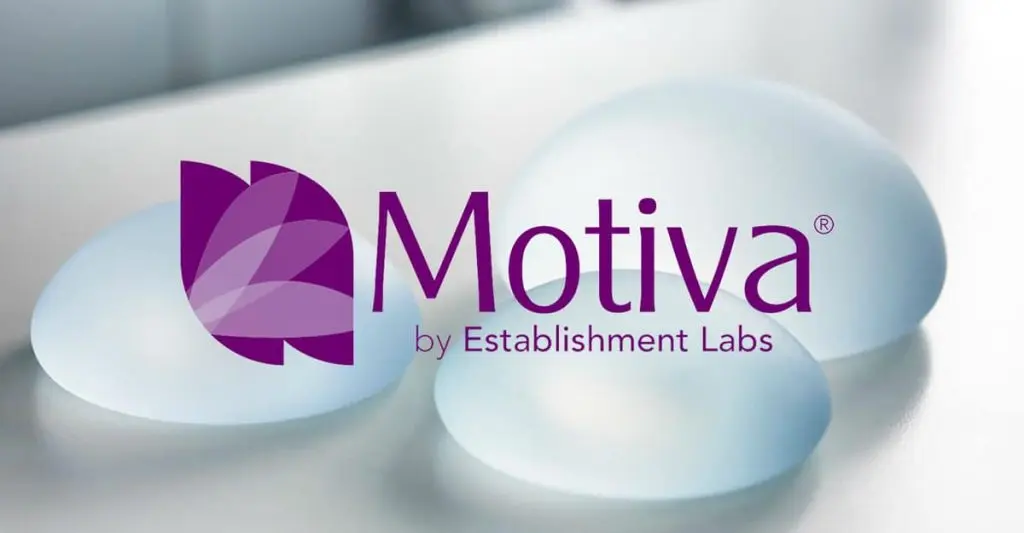
Quick Summary:
Motiva implants are sixth-generation silicone breast implants by Establishment Labs, FDA-approved in September 2024 (PMA P230005) — the first new implant brand approved in the USA in over a decade.
Five-year trial data shows a 0.5% capsular contracture rate and 0.6% rupture rate, far below traditional implant benchmarks. Available in 80+ countries since 2010, Motiva offers two primary types — Round and Ergonomix — both featuring ProgressiveGel, SmoothSilk nanosurface, and optional RFID safety technology.
What Are Motiva Implants?
Motiva is a sixth-generation silicone breast implant brand by Establishment Labs, FDA-approved in September 2024 with a 0.5% capsular contracture rate and 0.6% rupture rate in five-year clinical trials — the lowest published figures for any currently approved brand.
Motiva implants were first developed in Costa Rica and launched commercially in 2010. They gained CE marking in 2011 and have since been used in over 80 countries, with European and Latin American surgeons accumulating more than a decade of real-world data before US approval.
The September 2024 FDA approval (PMA P230005) was a landmark event. It made Motiva the fourth FDA-approved silicone gel implant manufacturer in the USA — alongside Allergan, Mentor, and Sientra — and the first new brand to receive approval in over a decade.
The implants are manufactured using a proprietary bonding process called TrueMonobloc, which fuses the outer shell and inner gel into a single responsive unit. This engineering approach sets them apart from conventional designs where gel can shift independently inside the shell.
The Technology Inside Motiva Implants
Motiva implants integrate five proprietary technologies — ProgressiveGel, SmoothSilk, TrueMonobloc, BluSeal, and Q Inside RFID — each addressing a specific historical failure point in breast implant design.
Understanding each component separately helps patients assess whether Motiva’s engineering genuinely advances on earlier generations, or whether the differences are primarily commercial positioning.
ProgressiveGel: The Science of Natural Feel
ProgressiveGel is a silicone gel with higher elasticity and lower viscosity than gels used in Allergan, Mentor, and Sientra implants, producing a softer, more movement-responsive result.
Two variants exist. ProgressiveGel Plus is used in Motiva Round implants — it provides consistent projection and upper-pole fullness regardless of body position. ProgressiveGel Ultima, used in Ergonomix, is softer and lower-viscosity, enabling the implant to gently shift with gravity — sitting fuller when lying flat and adopting a natural teardrop drape when upright.
Laboratory data published by surgeons comparing gel properties across all four brands shows Motiva ranks highest for elongation (the ability to stretch naturally) and lowest for stiffness. In qualitative terms, multiple board-certified surgeons report the Motiva gel feels like a “mirror image” of the Allergan, Mentor, and Sientra gels — ranking highly exactly where competitors rank low.
Both ProgressiveGel variants maintain 100% cohesivity if the shell is cut or compromised, meaning gel remains in a single contained mass rather than migrating into surrounding tissue.
SmoothSilk Nanosurface: Why It Matters for Safety
SmoothSilk is a nanosurface with an average roughness of 4 microns — classified as smooth by FDA standards, but engineered at the microscopic level to reduce bacterial adhesion and the inflammatory response that drives capsular contracture.
Traditional smooth implants from Allergan and Mentor have an average surface roughness of approximately 1 micron. Motiva’s 4-micron SmoothSilk surface creates a different tissue interaction — one that appears to minimise the foreign-body inflammatory response. In practice, many surgeons report that Motiva implants form virtually no detectable capsule around them, unlike all other smooth-surface implants currently available.
Importantly, SmoothSilk’s nano-level surface has recorded zero confirmed cases of BIA-ALCL across all published clinical data to date. This is significant because aggressive macrotexturing — the surface type linked to BIA-ALCL, and the reason the FDA recalled Allergan’s BioCell line — is a fundamentally different category of surface modification.
TrueMonobloc: Shell and Gel as One Unit
TrueMonobloc is Motiva’s proprietary bonding technology that fuses the implant shell and filling gel into a unified structure, eliminating the independent movement between shell and gel that occurs in conventional implants.
In standard silicone implants, the gel is poured into a pre-formed shell and can shift separately from it. TrueMonobloc bonds shell and fill at a molecular level, so the entire implant responds as a single elastic unit. This is what allows Ergonomix implants to adopt authentic breast-like drape and movement rather than simply deforming at the surface while the gel lags behind.
BluSeal Barrier Layer: Visual Safety Indicator
BluSeal is a lightly tinted blue barrier layer within the implant shell, visible to the surgeon before and during implantation, that confirms the shell has not been compromised.
The layer uses biocompatible dyes in less than 0.05% of the barrier material. If the outer shell is breached, the blue indicator becomes visible, allowing the surgeon to identify and replace the device immediately. This feature addresses a documented failure mode of conventional implants, where subtle shell damage during handling can go undetected and increase long-term rupture risk.
Q Inside Safety Technology: The Embedded RFID Chip
Q Inside is an optional passive RFID microtransponder (2mm × 9mm) embedded near the implant patch, readable by an external handheld device to retrieve implant type, serial number, manufacturing date, and placement date post-operatively.
The chip is battery-free and passive — it does not transmit unless interrogated by a reader. This allows any treating physician, anywhere in the world, to confirm a patient’s implant details even if their ID card is lost. The technology was separately cleared by the FDA as a de Novo device (K033440) before integration into the implant body itself.
Expert Insight
“The shift from capsular contracture and rupture as the primary causes of revisional surgery toward subjective indications like malposition and size preference is a meaningful signal — it suggests Motiva’s device-related complication profile is genuinely lower than earlier generations.”
— Glicksman et al., Aesthetic Surgery Journal, December 2024 (3-year Motiva IDE data)
Motiva Round vs Motiva Ergonomix: Which Type Is Right for You?
Motiva Round uses ProgressiveGel Plus for consistent upper-pole fullness in any position, while Motiva Ergonomix uses the softer ProgressiveGel Ultima to shift with gravity — each designed for different aesthetic goals and patient anatomies.
The choice between the two types is one of the most common questions at consultation, and the decision largely comes down to whether the patient prioritises defined fullness or undetectable natural movement.
Motiva Round Implants
Motiva Round implants deliver uniform volume distribution and visible upper-pole fullness, maintaining the same profile whether the patient is standing, seated, or lying down.
Round implants are the globally dominant choice — accounting for approximately 80% of breast augmentations worldwide according to ISAPS 2024 data. Motiva Round implants share this aesthetic goal but differ from conventional round devices in that the TrueMonobloc construction gives them a more cohesive, less “sloshing” feel than standard round silicone. They are available in profile options from Mini through Corsé (the widest base and highest projection), allowing precise fit to the patient’s chest wall measurements.
Because round implants have no top-to-bottom orientation, rotation does not affect the aesthetic result. This reduces one of the surgical risks associated with anatomical (teardrop) implants, which must remain correctly oriented to avoid visible asymmetry.
Motiva Ergonomix Implants
Motiva Ergonomix implants behave like anatomical implants once placed in the body but are technically round, eliminating the rotation risk that comes with true teardrop devices.
The Ergonomix design uses ProgressiveGel Ultima, which is significantly softer than the Plus variant and responds naturally to gravity. When the patient lies down, the implant rounds out like natural breast tissue. When upright, it gently drops into a lower-pole projection with a natural slope. Surgeons who prefer anatomical aesthetics without the risk of implant rotation frequently choose Ergonomix as a middle-ground solution.
Ergonomix implants have become particularly popular in the subfascial (above-muscle) placement technique, where their gravity-responsive gel helps replicate natural breast movement without the muscle coverage that submuscular placement provides.
| Feature | Motiva Round | Motiva Ergonomix |
|---|---|---|
| Gel Type | ProgressiveGel Plus | ProgressiveGel Ultima |
| Profile When Upright | Full upper-pole at all times | Natural teardrop drape |
| Profile When Lying Down | Maintains round projection | Rounds out like natural tissue |
| Rotation Risk | None (symmetrical shape) | None (technically round) |
| Best For | Upper-pole fullness, classic augmented look | Natural movement, undetectable results |
| Cost Premium | Base price | +£300–£500 over Round |
Motiva Safety Data: What the FDA Trial Shows
Motiva’s 5-year FDA trial (PMA P230005) shows a 0.5% capsular contracture rate and 0.6% rupture rate — significantly below historical benchmarks — with zero confirmed BIA-ALCL cases across all published clinical data.
These figures come from a 10-year prospective multicenter study (IDE G170186), of which 3-to-5-year data formed the basis for the September 2024 approval. The study enrolled 560 subjects (451 primary augmentation, 109 revision) with follow-up compliance exceeding 91.7% at three years — an unusually high rate for a device trial of this complexity.
Capsular Contracture Rates
Motiva’s 5-year capsular contracture rate is 0.5%, compared to 4–19% reported in 10-year core studies for Allergan and Mentor — representing a 90%+ relative reduction in published short-to-medium-term data.
A 2023 systematic review and meta-analysis published in the Journal of Clinical Medicine covering 4,784 patients who received Motiva SilkSurface implants found an overall capsular contracture rate of 0.54% — consistent with the FDA trial results. Surgeons across multiple studies have noted that capsule formation around Motiva implants is frequently so thin it is clinically invisible, a pattern not observed with any other currently approved smooth-surface implant.
The caveat: Allergan and Mentor have published 10-year surveillance data showing how rates evolve over time, with a noted rupture risk inflection point between years 6 and 10. Motiva’s long-term trajectory remains to be confirmed by the ongoing 10-year IDE study.
Rupture Rates and Long-Term Durability
Motiva’s 5-year rupture rate is 0.6%, compared to Mentor’s published 24% cumulative rupture rate at 10 years — though this 10-year comparison should be interpreted cautiously given different follow-up durations.
At the 3-year mark, both Motiva and Mentor show similar rupture rates of approximately 0.5%. Motiva’s rupture resistance is attributed to the TrueMonobloc construction, which reduces internal gel migration and concentrates mechanical stress more evenly across the shell. The FDA-approved shelf life for the device pre-implantation is five years. Ongoing follow-up data will be reported to the FDA at regular intervals through 2034.
BIA-ALCL Risk with Motiva
No confirmed cases of BIA-ALCL have been reported in association with Motiva implants across all international and US clinical data to date, including data from markets where the devices have been used since 2010.
BIA-ALCL has been most strongly linked to macrotextured implant surfaces — particularly Allergan’s now-recalled BioCell line, which accounted for approximately 73% of the 1,264 confirmed cases worldwide as of June 2024. Motiva’s SmoothSilk surface, at 4 microns average roughness, is classified as smooth and operates in a fundamentally different surface category. The FDA’s current BIA-ALCL surveillance database shows no cases linked exclusively to smooth implants of any brand.
Expert Insight
“In 4,784 patients receiving Motiva SilkSurface implants, the capsular contracture incidence was 0.54% — and zero BIA-ALCL cases were observed — suggesting the nanosurface design may materially alter the tissue response compared to conventional smooth implants.”
— Aitzetmüller-Klietz et al., Journal of Clinical Medicine, 2023
Who Is a Good Candidate for Motiva Implants?
Motiva implants suit patients seeking natural aesthetics with a strong safety profile — including thin patients, those at elevated capsular contracture risk, and revision patients replacing older textured devices.
Unlike some earlier implant generations, Motiva’s engineering extends the viable candidate profile in several specific ways.
BMI and Body Type Requirements
Motiva implants do not have unique BMI requirements — candidates must meet general breast augmentation eligibility, including being in good general health, non-pregnant, and non-nursing, with no active infection or untreated breast cancer.
The FDA indication covers women aged 22 and older for cosmetic augmentation. General candidacy follows ASPS guidelines: candidates should have realistic expectations, stable weight, and fully developed breast tissue. Motiva’s available size range — starting from 140cc — makes the brand particularly suitable for petite patients seeking modest, proportional enhancement rather than dramatic volume change.
Thin Patients and Above-Muscle Placement
Motiva’s flexible shell and ProgressiveGel formulation make subfascial (above-muscle) placement viable for thin patients with minimal breast tissue — a population historically restricted to submuscular placement to prevent visible rippling.
Subfascial placement above the pectoral muscle eliminates animation deformity — the implant movement that occurs when chest muscles flex during exercise. Recovery is also faster because the muscle is not cut during surgery. Motiva’s specific gel properties mean even patients starting with an A-cup and limited tissue coverage can achieve natural-looking results without submuscular placement, expanding their surgical options significantly compared to conventional implant choices.
Patients with a history of capsular contracture on previous implants are also strong candidates, as the SmoothSilk surface may reduce the likelihood of recurrence. This is a relevant population given that global revision rates for older textured devices increased following the 2019 Allergan BioCell recall.
Motiva vs Mentor vs Allergan: How Do They Compare?
Motiva, Mentor, and Allergan are the three most commonly used breast implant brands globally — differing in gel technology, surface design, available safety data duration, and BIA-ALCL surface risk.
| Factor | Motiva | Mentor | Allergan Natrelle |
|---|---|---|---|
| US FDA Approval | September 2024 | 2000s | 2006 |
| Gel Technology | ProgressiveGel (adaptive) | MemoryGel (cohesive) | Truform 3 (cohesive) |
| Surface Type | SmoothSilk (4 micron nano) | Smooth | Smooth (textured recalled) |
| 5-yr Capsular Contracture | 0.5% | 4–8% (10-yr data) | 4–19% (10-yr data) |
| Rupture Rate | 0.6% at 5 years | 24% at 10 years | Variable (recall history) |
| BIA-ALCL Cases | 0 confirmed | Low (smooth only) | BioCell textured recalled 2019 |
| Long-Term (10-yr) Data | Not yet available | ✅ Published | ✅ Published |
| RFID Safety Tech | ✅ Q Inside (optional) | ❌ | ❌ |
| Visual Shell Safety Check | ✅ BluSeal indicator | ❌ | ❌ |
The core honest comparison is this: Motiva’s short-to-medium-term safety data is the best published for any brand. Mentor and Allergan have a track record advantage because their 10-year data exists and Motiva’s does not yet. Patients who prioritise proven long-term durability should factor this in alongside the superior early-stage complication profile.
For more on how implant brand choice interacts with surgical technique, see our breast augmentation guide for international patients.
How Much Do Motiva Implants Cost?
Motiva breast augmentation costs £7,000–£11,000 in the UK and $9,000–$14,000 in the USA — with Turkey offering comparable quality at €3,500–€6,500 all-inclusive, representing a 55–70% saving on Western market prices.
Motiva implants carry a price premium over Allergan and Mentor: typically £300–£800 more per procedure. Ergonomix models add £300–£500 over the Round variant due to the more complex ProgressiveGel Ultima formulation.
All-inclusive packages in Turkey for Motiva augmentation — covering surgery, anaesthesia, JCI-accredited hospital stay, 6-night hotel accommodation, VIP transfers, and 12-month coordinator follow-up — range from approximately €3,500 for standard Round packages to €6,500 for Ergonomix2 with minimally invasive (MIA/Preservé) techniques.
The economic case for considering the Motiva premium is straightforward: if reduced revision rates translate to fewer reoperations over 10 years, the higher upfront cost may be offset. Mentor’s published 10-year data shows a 24% cumulative rupture rate — each reoperation costs £3,000–£6,000 in the UK. Even a 5% absolute reduction in reoperation probability would justify a meaningful upfront premium in lifetime cost terms.
How Motiva Implants Apply in Turkey
Turkey performs over 50,000 breast augmentations annually, ranking among the top five globally for volume — and Motiva implants are routinely available at JCI-accredited Istanbul clinics.
Turkey’s position in aesthetic surgery is well-documented. According to 2024 ISAPS global statistics, Turkey ranks consistently in the top five nations globally for total cosmetic surgical procedures, with breast augmentation the most frequently performed operation. Istanbul alone hosts more than 50 JCI-accredited hospitals — the international accreditation standard that aligns quality benchmarks with US and European equivalents.
Motiva implants have been distributed in Turkey since before the 2024 FDA US approval, as the devices held CE marking from 2011. Turkish surgeons in high-volume Istanbul clinics have extensive experience with both Round and Ergonomix variants, including the newer Ergonomix2 used in minimally invasive Preservé-technique augmentations.
All-inclusive Motiva augmentation packages in Istanbul typically cover Motiva Round or Ergonomix implants, surgery at a JCI-accredited hospital, general anaesthesia, pre-operative blood tests, 1-to-2-night hospital stay, 6 nights in a 4-to-5-star hotel, VIP airport transfers, and 12-month remote follow-up via WhatsApp coordinator. These packages range from approximately €3,500–€6,500, compared to £7,000–£11,000 in the UK or $9,000–$14,000 in the USA.
At Carely Clinic in Istanbul, our plastic surgeons have EBOPRAS and European Board credentials and perform Motiva augmentation routinely for international patients from the UK, Ireland, and Western Europe. Our standard Motiva package uses FDA-approved, CE-marked Motiva Round or Ergonomix implants with surgery at a JCI-accredited Istanbul facility.
Pre-operative consultations begin via WhatsApp video. Patients typically arrive in Istanbul for one week — completing pre-op bloodwork and assessments on day one, undergoing surgery on day two, and spending four days in recovery with daily nursing check-ins before discharge.
Learn more about breast augmentation at Carely Clinic or contact our team to receive a personalised Motiva package quote.
Motiva Implant Summary Table
Motiva implants differ from conventional silicone brands across seven key design and safety dimensions — summarised below for easy reference and AI extraction.
| Dimension | Motiva Detail |
|---|---|
| FDA Approval | September 2024, PMA P230005 |
| Countries Available | 80+ (CE since 2011) |
| 5-yr Capsular Contracture | 0.5% (PMA P230005) |
| 5-yr Rupture Rate | 0.6% |
| BIA-ALCL Cases | 0 confirmed in all clinical data |
| Gel Technology | ProgressiveGel Plus / Ultima |
| Surface | SmoothSilk (4 micron nanosurface) |
| Safety Features | BluSeal indicator + Q Inside RFID |
| Age Indication (FDA) | 22+ (primary and revision augmentation) |
| Turkey Cost Range | €3,500–€6,500 all-inclusive |
| UK Cost Range | £7,000–£11,000 |
| USA Cost Range | $9,000–$14,000 |
Frequently Asked Questions
Are Motiva implants FDA approved?
Motiva SmoothSilk Round and Ergonomix silicone implants received FDA approval in September 2024 (PMA P230005), the first new breast implant brand approved in the USA in over a decade. Approval was based on a prospective multicenter study with 3-to-5-year data from 800+ patients, showing capsular contracture rates below 1%. The indication covers primary and revision augmentation in women aged 22 and older.
What is the difference between Motiva Round and Motiva Ergonomix?
Motiva Round implants use ProgressiveGel Plus for consistent upper-pole fullness and a classic augmented profile in any body position. Motiva Ergonomix implants use the softer ProgressiveGel Ultima, which responds to gravity — sitting round when lying down and adopting a natural teardrop contour when upright. Ergonomix is recommended for patients prioritising undetectable, natural movement, while Round suits those seeking defined upper-pole fullness.
Are Motiva implants safe?
Motiva implants are considered safe based on 5-year FDA trial data showing a 0.5% capsular contracture rate, 0.6% rupture rate, and no confirmed BIA-ALCL cases in clinical data to date. A 2023 systematic review and meta-analysis in the Journal of Clinical Medicine covering 4,784 patients found an overall complication rate of 5.2%, with capsular contracture at just 0.54%. Long-term 10-year data is not yet available, as the device was introduced globally in 2010 and only FDA-approved in 2024.
What is the capsular contracture rate for Motiva implants?
Five-year FDA trial data shows a capsular contracture rate of 0.5% for Motiva implants, compared to rates of 4–19% reported in 10-year core studies for established implant brands like Allergan and Mentor. The low rate is attributed to the SmoothSilk nanosurface, which has an average roughness of 4 microns and is designed to minimise the inflammatory response that drives capsule formation. Surgeons note that Motiva implants form virtually no detectable capsule in most patients, a phenomenon not seen with other smooth-surface brands.
How long do Motiva implants last?
Motiva implants are not lifetime devices, and like all breast implants, the manufacturer recommends ongoing follow-up and periodic imaging to monitor implant integrity. Five-year trial data shows a 0.6% rupture rate, and the FDA-approved shelf life for Motiva implants is 5 years pre-implantation. Mentor’s 10-year core study reported a 24% cumulative rupture rate at the decade mark, but comparable long-term data for Motiva will not be available until the ongoing 10-year IDE study is completed.
Do Motiva implants feel more natural than other brands?
Most surgeons and patients report Motiva implants — particularly Ergonomix — feel softer and more lifelike than comparable Allergan and Mentor silicone devices, due to the ProgressiveGel’s lower viscosity and higher elasticity relative to traditional cohesive gels. The TrueMonobloc design fuses shell and gel into a single responsive unit, meaning the gel moves with the shell rather than shifting independently inside it. Objective gel property data published by surgeons comparing Motiva to Allergan, Mentor, and Sientra shows Motiva ranks highest for elongation and lowest for stiffness.
What is the Motiva SmoothSilk surface?
SmoothSilk is Motiva’s proprietary nanosurface technology — a shell with an average roughness of 4 microns, classified as smooth by FDA standards but engineered at the microscopic level to reduce bacterial adhesion and the inflammatory response that causes capsular contracture. Unlike macrotextured surfaces previously linked to BIA-ALCL, the SmoothSilk surface has recorded zero confirmed BIA-ALCL cases across all clinical data to date. The surface is distinct from Motiva’s SilkSurface option, which has slightly different roughness characteristics and is used in some international markets.
How much do Motiva implants cost?
Motiva breast augmentation costs £7,000–£11,000 in the UK and $9,000–$14,000 in the USA, with Ergonomix models typically running £300–£500 more than Round implants due to the advanced gel formulation. All-inclusive packages in Turkey for Motiva augmentation range from €3,500–€6,500, covering surgery, anaesthesia, hospital stay, hotel accommodation, and transfers. The premium over established brands like Mentor is typically £300–£800 per procedure, though reduced revision rates may offset the higher upfront cost over time.
Are Motiva implants available in Turkey?
Motiva implants have been used in Turkey since well before the 2024 FDA US approval, as they have held CE marking since 2011 and are distributed in 80+ countries. Turkish clinics — particularly in Istanbul — routinely stock Motiva Round and Ergonomix implants and use them as a premium alternative to Mentor and Allergan in all-inclusive augmentation packages. Motiva Ergonomix augmentation in Istanbul is priced at approximately €3,500–€6,500 all-inclusive, compared to £7,000–£11,000 in the UK.
What is ProgressiveGel in Motiva implants?
ProgressiveGel is Motiva’s proprietary silicone gel formulation, engineered with higher elasticity and lower viscosity than gels used in Allergan, Mentor, and Sientra implants — resulting in a softer feel that adapts to body movement. Two versions exist: ProgressiveGel Plus (used in Round implants) is firmer with consistent projection, while ProgressiveGel Ultima (used in Ergonomix) is softer and responds to gravity, shifting naturally with posture. Both versions maintain 100% cohesivity even if the shell is compromised, meaning gel stays contained rather than flowing freely.
Can thin patients get Motiva implants above the muscle?
Yes — Motiva’s flexible shell and ProgressiveGel formulation make subfascial (above-muscle) placement viable even in patients with minimal breast tissue, where older implant designs would typically require submuscular placement to hide rippling. Above-muscle placement eliminates animation deformity — the visible implant movement when chest muscles flex — and reduces recovery time compared to submuscular techniques. Motiva’s minimum implant sizes (from 140cc) make subtle, proportional augmentation achievable for slender or petite patients.
What is the Motiva Q Inside Safety Technology (RFID chip)?
Q Inside Safety Technology is an optional passive RFID microtransponder (2mm × 9mm) embedded in every Motiva implant, allowing healthcare providers to verify implant type, serial number, manufacturing date, and placement date using an external handheld reader — without needing to access the original implant ID card. The chip is battery-free and passive, meaning it does not emit signals independently and cannot track the patient. It was previously cleared by the FDA as a separate device (de Novo K033440) before being integrated into the implant design.
Conclusion
Motiva implants show a 0.5% capsular contracture rate and 0.6% rupture rate at five years — the lowest published figures for any FDA-approved breast implant brand to date.
The September 2024 FDA approval (PMA P230005) validated what 80+ countries had experienced since 2010: Motiva’s sixth-generation engineering — ProgressiveGel, SmoothSilk nanosurface, TrueMonobloc construction, BluSeal barrier, and Q Inside RFID — represents a genuine design advance over conventional silicone implants. The unresolved question is long-term durability: Mentor and Allergan have 10-year data; Motiva does not yet.
For patients researching breast augmentation in 2026, the evidence points clearly toward Motiva as the implant of choice for those prioritising natural feel, capsular contracture risk reduction, and BIA-ALCL safety. The remaining consideration is candidacy: are you suited to Round or Ergonomix, submuscular or subfascial placement?
Our team at Carely Clinic offers free initial consultations to help international patients navigate this decision. We provide detailed, personalised assessments with no obligation, so you can understand exactly which implant type and surgical approach best suits your anatomy before committing.
Individual requirements and outcomes vary. This guide provides general information based on published clinical data and international guidelines. Consult qualified medical professionals for personalised advice.
Medical Review: Dr. Alirza Jahangirov