
Quick Summary
Male rhinoplasty requires specialized surgical techniques that preserve masculine facial characteristics including a straight or slightly convex dorsal profile, nasolabial angle of 90-100 degrees, and stronger projection compared to female rhinoplasty.
According to systematic reviews published in medical literature, the overall major complication rate for rhinoplasty remains low at approximately 0.7%, with revision rates of 5-15% depending on procedure complexity.
This guide covers masculine nose aesthetics, surgical techniques, eligibility requirements, recovery timelines, safety statistics, and cost comparisons across Turkey, USA, and UK.
Why Trust This Guide
This comprehensive guide draws upon peer-reviewed research published in Aesthetic Surgery Journal, Plastic and Reconstructive Surgery, and clinical guidelines from the International Society of Aesthetic Plastic Surgery (ISAPS) and American Society of Plastic Surgeons (ASPS).
Carely Clinic maintains partnerships with JCI-accredited hospitals in Istanbul that adhere to international safety protocols. Our editorial team synthesizes the latest medical literature to provide accurate, balanced information for men considering rhinoplasty.
What Is Male Rhinoplasty?
Male rhinoplasty is a specialized surgical procedure that reshapes the nose while preserving or enhancing masculine facial characteristics, focusing on maintaining a strong nasal profile rather than the refined, delicate appearance typically desired in female rhinoplasty.
Unlike general rhinoplasty approaches, male nose surgery demands fundamentally different aesthetic goals. Surgeons must understand that over-refinement or excessive dorsal reduction can feminize the male face and produce unsatisfactory results. The procedure addresses both cosmetic concerns and functional issues such as breathing difficulties from deviated septums or previous nasal trauma.
Men represent approximately 18-25% of all rhinoplasty patients globally, with rhinoplasty consistently ranking among the top cosmetic procedures for male patients. According to ISAPS 2024 global survey data, rhinoplasty remains the most common surgical procedure for patients aged 17 and younger, while eyelid surgery leads among adult male patients.
The psychological impact of male rhinoplasty is significant. Research indicates that many men seeking rhinoplasty have specific concerns about dorsal humps from sports injuries, deviated septums causing breathing issues, or overall facial balance. Unlike female patients who often have precise aesthetic goals, men frequently describe wanting their nose to look “better” or “more masculine” without dramatic changes.
Male vs Female Nose Aesthetics
Male rhinoplasty preserves a stronger, more angular nasal structure with a straight or slightly convex dorsal profile, while female rhinoplasty typically creates softer contours with a subtle supratip break and slightly upturned nasal tip.
The fundamental anatomical differences between male and female noses require distinct surgical approaches. Men typically have thicker nasal skin, stronger underlying cartilage, larger nasal bones, and a more robust skeletal framework. These characteristics make the male nose more challenging to reshape while also requiring preservation of masculine features.
Key differences in aesthetic goals include:
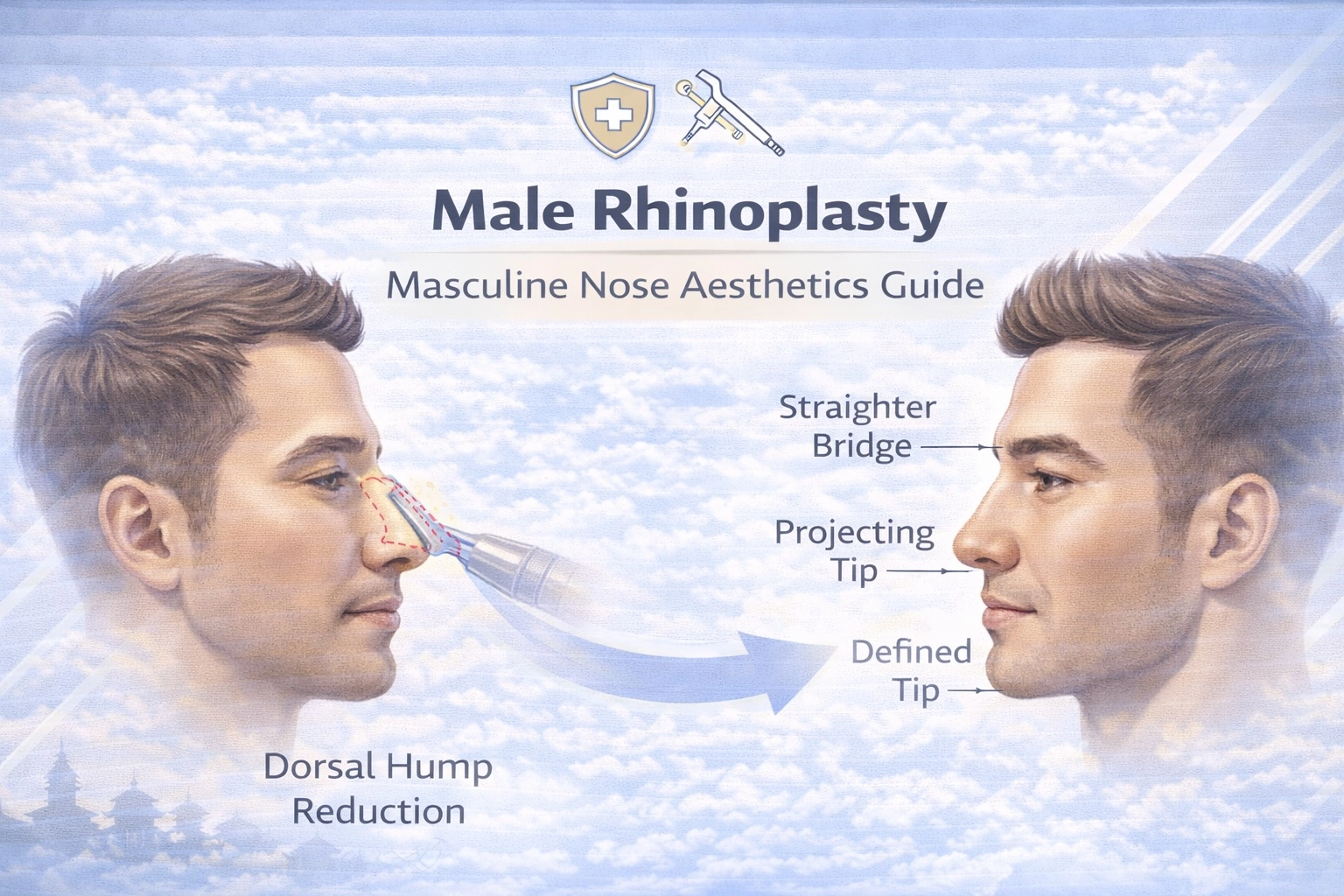
Dorsal Profile: The ideal male nose maintains a straight or slightly convex bridge. A “scooped” or concave profile that works beautifully for women appears unnatural and feminized on men. Some men even prefer to retain a subtle dorsal hump as it contributes to a rugged, masculine appearance.
Nasal Tip Rotation: Female rhinoplasty often includes tip elevation (rotation) to create a slightly upturned appearance. For men, minimal to no tip rotation is preferred to maintain a stronger, more horizontal profile.
Supratip Break: Women often benefit from a subtle supratip break—a gentle indentation between the nasal dorsum and tip. This feature is typically avoided in male rhinoplasty as it creates a more feminine appearance.
Bridge Width: Male noses are generally wider and broader across the bridge. Excessive narrowing during rhinoplasty can feminize the face and create disharmony with other masculine features like angular jawlines and prominent brow ridges.
Skin Characteristics: Male nasal skin is thicker and oilier than female skin, making it more difficult to manipulate and potentially obscuring subtle surgical changes. Surgeons must account for these differences when planning the procedure and setting patient expectations.
Ideal Male Nose Measurements
The ideal male nasolabial angle measures 90-100 degrees, with a nasofrontal angle of 120-130 degrees, creating a stronger projection compared to the 105-110 degree nasolabial angle preferred in female rhinoplasty.
Research published in facial plastic surgery literature has quantified the aesthetic parameters that define attractive male noses. While individual variation exists and cultural preferences influence perceptions of beauty, several measurements provide helpful surgical guidelines.
Nasolabial Angle: This angle, formed where the columella meets the upper lip, is crucial for determining tip position. Studies indicate the ideal male nasolabial angle ranges from 90-100 degrees, compared to 100-110 degrees for women. A nasolabial angle closer to 90 degrees creates a straighter, more masculine profile.
Nasofrontal Angle: The angle where the nose meets the forehead (glabella) should measure approximately 120-130 degrees in men, compared to 115-125 degrees in women. Research published in Facial Plastic Surgery journal found that a nasofrontal angle of approximately 130 degrees is perceived as ideal, with a range of 127-142 degrees deemed acceptable.
Tip Projection: The ideal male nasal tip projection ratio is approximately 0.55-0.57, measured as the ratio of alar crease-to-tip distance divided by nasion-to-tip length. This creates appropriate projection without appearing over-projected or under-projected.
Dorsal Profile: A straight dorsum is most desirable in both genders, though a slight convexity (small dorsal hump) may be acceptable or even preferred in some male patients seeking a more rugged appearance.
Alar Width: The width of the nasal base should approximately equal the intercanthal distance (distance between the inner corners of the eyes). The ideal male alar width relative to intercanthal distance varies slightly by ethnicity and individual facial proportions.
Common Reasons Men Seek Rhinoplasty
Men typically seek rhinoplasty to address dorsal humps from sports injuries, breathing difficulties from deviated septums, overall facial imbalance, or genetic characteristics they find unsatisfactory—often preferring subtle enhancement over dramatic transformation.
Understanding male motivations helps surgeons create targeted treatment plans. Unlike women who often have very specific aesthetic goals, men frequently present with more general concerns about their appearance.
Dorsal Hump Reduction: Many men develop prominent bumps along the nasal bridge from sports injuries, accidents, or genetics. While some embrace this rugged characteristic, others prefer a smoother profile that projects confidence without aggression. The key is conservative reduction that maintains a strong, straight profile rather than creating a scooped appearance.
Breathing Difficulties: Functional concerns drive many male rhinoplasty consultations. Issues such as deviated septums, enlarged turbinates, or previous nasal trauma can significantly impair breathing, affecting sleep quality, exercise capacity, and overall quality of life. Combining cosmetic rhinoplasty with functional septoplasty addresses both aesthetic and breathing concerns in a single procedure.
Previous Nasal Trauma: Men are more likely to have sustained nasal fractures from sports, accidents, or altercations. These injuries can leave visible deformities and internal structural problems that rhinoplasty can correct.
Facial Balance: Some men feel their nose is disproportionate to other facial features. A nose that appears too large, too wide, or too prominent can draw unwanted attention and affect self-confidence. Rhinoplasty can create better harmony between the nose and other masculine features like the jawline, chin, and brow.
Bulbous or Wide Nasal Tip: A round, undefined nasal tip can make the nose appear larger and less refined. Careful tip refinement can improve definition while maintaining masculine characteristics.
Career and Social Considerations: With increasing acceptance of male aesthetic procedures, more men recognize that subtle improvements to their appearance can boost professional confidence and social comfort without appearing obviously “done.”
Eligibility Requirements
Male rhinoplasty candidates must have completed nasal development (typically by age 17-18 for males), be in good overall health, have realistic expectations, and be emotionally prepared for the recovery process and potential outcomes.
Age requirements reflect the need for complete facial growth before surgical intervention. Since the nose continues developing through adolescence, operating too early can produce unpredictable results as growth continues post-surgery.
Age Considerations:
- Minimum age: 17-18 years for males (slightly earlier for females at 15-16)
- No upper age limit provided the patient is in good health
- Patients under 18 require parental consent
- Age verification typically includes physical examination and sometimes X-rays to assess remaining growth potential
Physical Health Requirements:
- Good overall health without uncontrolled chronic conditions
- Non-smoker or willing to stop smoking 4-6 weeks before and after surgery
- No active sinus infections or nasal conditions
- Stable body weight
- No blood clotting disorders or medications that increase bleeding risk
Psychological Readiness:
- Realistic expectations about outcomes
- Undergoing surgery for personal reasons (not external pressure)
- Understanding that results take 12-18 months to fully manifest
- Emotional stability to handle the recovery process
- No body dysmorphic disorder (BDD) or unrealistic expectations about how rhinoplasty will change their life
Contraindications:
- Active infection
- Uncontrolled diabetes
- Severe cardiovascular disease
- Blood clotting disorders
- Current smoker unwilling to quit temporarily
- Unrealistic expectations
- Body dysmorphic disorder
Pre-operative Evaluation:
Comprehensive consultation includes facial analysis, nasal anatomy assessment, review of medical history, discussion of aesthetic goals, computer imaging to preview potential results, and psychological evaluation to ensure appropriate candidacy.
Surgical Techniques
Male rhinoplasty employs either closed (endonasal) or open approaches, with closed rhinoplasty preferred for many male patients due to faster recovery and no external scarring, while open rhinoplasty provides greater visibility for complex structural modifications.
The choice of technique depends on the complexity of changes required, surgeon preference, and patient anatomy. Both approaches can achieve excellent results in experienced hands.
Closed Rhinoplasty:
All incisions are made inside the nostrils, leaving no visible external scars. This technique is often preferred for male patients because:
- Faster recovery with less swelling
- No visible scarring
- Suitable for less complex modifications
- Preserves structural support better
- Procedure time is typically shorter
The closed approach works well for straightforward dorsal hump reduction, tip refinement, and minor structural adjustments. However, it provides more limited visibility of the nasal framework.
Open Rhinoplasty:
This technique involves a small incision across the columella (the tissue between the nostrils) in addition to internal incisions. The skin is lifted to provide direct visualization of nasal structures. Benefits include:
- Superior visibility for complex reconstructions
- Precise cartilage manipulation
- Better for significant structural changes
- Allows for grafting procedures
- Preferred for revision rhinoplasty
The external scar typically heals to become virtually invisible within several months.
Piezo (Ultrasonic) Rhinoplasty:
This advanced technique uses ultrasonic energy to reshape nasal bones with greater precision than traditional methods. Benefits include:
- More precise osteotomies (bone cuts)
- Reduced trauma to surrounding soft tissues
- Less post-operative swelling (20-30% reduction)
- Faster visible recovery
- Fewer fractured bone fragments
Piezo rhinoplasty adds €200-500 to standard procedure costs due to specialized equipment but may advance recovery milestones by 3-5 days.
Key Surgical Considerations for Men:
- Conservative dorsal reduction to avoid feminization
- Maintaining or strengthening tip support
- Preserving natural masculine angles
- Addressing functional issues simultaneously
- Accounting for thicker skin when planning changes
Is Male Rhinoplasty Safe?
Male rhinoplasty is considered safe with a major complication rate of 0.7% and revision rates of 5-15% when performed by board-certified surgeons at accredited facilities, making it comparable in safety to routine surgical procedures like gallbladder removal.
Safety outcomes depend significantly on surgeon expertise, facility accreditation, patient health, and adherence to pre- and post-operative instructions.
Complication Rates:
According to a study of 4,978 rhinoplasty patients published in Aesthetic Surgery Journal:
- Overall major complication rate: 0.7%
- Hematoma (blood collection): 0.2%
- Infection: 0.2%
- Pulmonary complications: 0.1%
Systematic reviews of rhinoplasty literature report reoperation rates of 2.73% for open rhinoplasty and 1.56% for closed rhinoplasty, with overall revision rates of 5-15% depending on complexity.
Risk Factors for Complications:
- Age 40 or older (relative risk 2.05 for any major complication)
- Combining rhinoplasty with procedures on other body regions (increases from 0.58% to 1.02-2.09%)
- Previous nasal surgery or trauma
- Smoking
- Uncontrolled health conditions
Potential Risks:
- Bleeding (usually resolves within days)
- Infection (rare, typically <2%)
- Asymmetry requiring revision
- Breathing difficulties (temporary or requiring revision)
- Numbness (usually temporary)
- Scarring (minimal with closed technique)
- Dissatisfaction with aesthetic results
- Need for revision surgery
Factors That Improve Safety:
- Board-certified facial plastic surgeon or plastic surgeon
- JCI-accredited surgical facility
- Comprehensive pre-operative evaluation
- Stopping smoking and blood-thinning medications
- Following all post-operative instructions
- Attending follow-up appointments
Expert Insight
“It is essential that masculine features be preserved for male rhinoplasty patients. Excessive dorsal reduction or tip refinement produces unsatisfactory results and increases revision rates.”
— Published guidance from peer-reviewed rhinoplasty literature
Recovery Timeline
Most male rhinoplasty patients return to work within 7-10 days, see major swelling resolve by 4-6 weeks, and achieve final results at 12-18 months, with the nasal tip being the last area to fully settle.
Recovery from male rhinoplasty follows predictable stages, though individual healing varies based on technique used, extent of changes, and personal factors.
Week 1: Initial Recovery
Days 1-3:
- Swelling peaks within first 48-72 hours
- Bruising appears around eyes and nose
- Nasal splint and internal packing in place
- Pain manageable with prescribed medication
- Head should remain elevated, even during sleep
- Cold compresses help reduce swelling (applied to cheeks, not directly on nose)
Days 4-7:
- Swelling and bruising begin to subside
- Splint and any external sutures typically removed around day 7
- First glimpse of new nose shape (still significantly swollen)
- Most patients begin feeling more like themselves
- Avoid bending over, heavy lifting, or strenuous activity
Week 2: Early Recovery
- Bruising largely fades
- Significant swelling reduction continues
- Many patients feel comfortable returning to work or school
- Makeup can cover remaining discoloration
- Nasal breathing may feel congested due to internal swelling
- Continue avoiding physical exertion
Weeks 3-4: Progressive Improvement
- Most visible swelling subsided (approximately 50%+ resolved)
- Bruising should be completely gone
- Nose shape becomes more defined
- Light exercise may be resumed with surgeon approval
- Social activities can resume comfortably
- Continued avoidance of contact sports and heavy lifting
Months 1-3: Intermediate Healing
- Majority of swelling resolved
- Bridge of nose appears refined
- Nasal tip still slightly swollen (normal)
- Numbness or stiffness begins improving
- Most exercise routines can resume
- Residual internal healing continues
Months 3-6: Refinement Phase
- 80-90% of swelling resolved
- Subtle contour changes continue
- Breathing improvements become more apparent
- Numbness largely resolved
- Most activities unrestricted
Months 6-12: Final Results
- 95-97% of swelling resolved
- Nasal tip settles into final position
- Scar tissue matures
- Final results become apparent
- For complex cases, subtle changes may continue to 18 months
Recovery Tips for Faster Healing:
- Keep head elevated for first 2-3 weeks
- Apply cold compresses as directed (first 48-72 hours)
- Take prescribed medications on schedule
- Stay well hydrated (8-10 glasses of water daily)
- Eat nutritious foods rich in vitamins A, C, zinc, and protein
- Avoid salty foods that increase swelling
- No smoking or alcohol for at least 4 weeks
- Protect nose from sun exposure
- Avoid wearing glasses directly on nose bridge for 4-6 weeks
Cost Comparison by Country
Male rhinoplasty costs €2,500-€4,500 in Turkey compared to $10,000-$18,000 in the USA and £6,500-£13,000 in the UK, representing savings of 60-75% for international patients choosing Turkish facilities.
Understanding what these prices include is crucial for accurate comparisons, as pricing structures vary significantly between countries.
| Country | Price Range | What’s Typically Included | Additional Costs |
|---|---|---|---|
| Turkey | €2,500-€4,500 | Surgery, anesthesia, hospital stay, hotel (3-4 nights), transfers, medications, follow-ups | Flights, extended stay, additional tours |
| USA | $10,000-$18,000 | Surgeon’s fee only (often) | Anesthesia ($2,000-4,000), facility fees ($2,000-6,000), medications, follow-ups |
| UK | £6,500-£13,000 | Surgery, anesthesia, hospital (varies by clinic) | Consultations, follow-ups (may be separate) |
| Canada | CAD $10,000-$16,000 | Surgery, anesthesia, facility (varies) | Consultations, follow-ups, medications |
| Australia | AUD $12,000-$18,000 | Surgery, anesthesia, hospital | Consultations, aftercare, medications |
Why Turkey Is More Affordable:
The significant price difference between Turkey and Western countries reflects economic factors rather than quality differences:
- Lower operational costs and overhead expenses
- Favorable exchange rates for international patients
- Government support for medical tourism industry
- High competition among well-qualified surgeons
- Lower cost of living enabling competitive pricing
- High procedure volumes creating efficiency
What Affects Price Within Each Country:
- Surgeon experience and reputation
- Complexity of the procedure (primary vs. revision)
- Technique used (standard, piezo, preservation)
- Facility type and location (major city vs. regional)
- Combined procedures (rhinoplasty + septoplasty)
- Package inclusions
Revision Rhinoplasty Costs:
Revision procedures are typically 30-50% more expensive due to increased complexity:
- Turkey: €4,000-€6,500
- USA: $15,000-$25,000+
- UK: £10,000-£18,000
How This Applies in Turkey
International surgical guidelines and safety protocols apply equally at Turkey’s JCI-accredited hospitals, which follow identical clinical standards as American and European institutions while offering 60-75% cost savings for male rhinoplasty.
Turkey has established itself as a leading destination for medical tourism, with approximately 1.3 million medical tourists visiting in 2024. The country ranks second worldwide for JCI-accredited facilities, with 46 hospitals holding this prestigious international certification.
Turkish Healthcare Standards:
- JCI accreditation requires infection control protocols, sterile operating environments, documented outcomes, and regular safety audits
- Accreditation renews every three years through rigorous re-evaluation
- Many facilities also hold ISO 9001 certification for quality management
- Turkish Ministry of Health registers and inspects all medical facilities
Why Men Choose Turkey for Rhinoplasty:
- Cost savings of 60-75% compared to USA/UK prices
- Access to surgeons who perform 200-400+ rhinoplasties annually
- Extensive experience with diverse nasal anatomies due to Turkey’s geographic position between Europe, Asia, and Middle East
- All-inclusive packages eliminating hidden costs and logistical concerns
- Shorter wait times compared to Western countries
- Opportunity to combine medical procedure with tourism
Typical Turkey Package Includes:
- Pre-operative consultation and medical tests
- Surgery with general anesthesia
- Hospital stay (usually 1 night)
- Hotel accommodation (3-4 nights)
- VIP airport-hotel-clinic transfers
- Post-operative medications
- Follow-up appointments before departure
- Translator/patient coordinator services
At Carely Clinic in Istanbul:
Male rhinoplasty is performed by board-certified facial plastic surgeons at JCI-accredited partner hospitals. Our comprehensive packages are designed specifically for international patients, including detailed pre-arrival communication, personalized surgical planning using 3D imaging, and thorough post-operative care protocols.
Learn more about Male Rhinoplasty at Carely Clinic.
Summary Table
| Aspect | Male Rhinoplasty Specifics | Key Considerations |
|---|---|---|
| Ideal Nasolabial Angle | 90-100 degrees | Less rotation than female (105-110°) |
| Nasofrontal Angle | 120-130 degrees | Slightly wider than female (115-125°) |
| Dorsal Profile | Straight or slightly convex | Avoid scooped/concave appearance |
| Supratip Break | Not desired | Creates feminine appearance in men |
| Minimum Age | 17-18 years | After nasal development complete |
| Procedure Duration | 2-4 hours | Depends on complexity |
| Major Complication Rate | 0.7% | At accredited facilities |
| Revision Rate | 5-15% | Varies by complexity/surgeon |
| Return to Work | 7-10 days | Desk work; longer for physical jobs |
| Final Results | 12-18 months | Tip settles last |
| Turkey Cost | €2,500-€4,500 | All-inclusive packages |
| USA Cost | $10,000-$18,000 | Often surgeon fee only |
| UK Cost | £6,500-£13,000 | Private clinic rates |
Frequently Asked Questions
How is male rhinoplasty different from female rhinoplasty?
Male rhinoplasty maintains a straight dorsal profile and 90-100 degree nasolabial angle, while female rhinoplasty creates softer contours with a supratip break and 105-110 degree angle. Men require stronger projection and broader bridges to preserve masculine features. Over-refinement produces feminized, unnatural results in male patients.
What is the ideal age for male rhinoplasty?
The ideal age is 17-18 years or older, after nasal development is complete. Facial growth finishes by age 17-18 in most males. Operating earlier risks unpredictable results as the nose continues changing. Surgeons verify growth completion through physical examination and sometimes X-rays.
How long does male rhinoplasty surgery take?
Male rhinoplasty takes 2-4 hours depending on complexity. Simple procedures require 1.5-2 hours, while comprehensive rhinoplasty with septoplasty takes 3-4 hours. Surgery duration depends on whether open or closed technique is used and extent of modifications needed.
Will there be visible scars after male rhinoplasty?
Closed rhinoplasty produces no visible scars because all incisions are inside the nostrils. Open rhinoplasty creates a small columella scar that becomes virtually invisible within several months. Most observers cannot detect scarring after complete healing at 6-12 months.
How long until I can return to work after rhinoplasty?
Most men return to desk work within 7-10 days after rhinoplasty. Physical jobs requiring exertion need 2-3 weeks off. Residual bruising can be concealed with makeup by day 10-14, when most patients feel comfortable in professional settings.
Can rhinoplasty fix my breathing problems?
Yes, rhinoplasty combined with septoplasty corrects breathing problems from deviated septums or structural abnormalities. Both aesthetic and functional goals are achieved in one surgery. Many male patients seek rhinoplasty specifically for this dual benefit of improved appearance and breathing.
What is the major complication rate for male rhinoplasty?
The major complication rate is 0.7% at accredited facilities, with hematoma and infection each at 0.2%. Age 40+ doubles complication risk, while combining procedures increases rates to 1-2%. Board-certified surgeons at JCI facilities minimize risks through proper protocols.
How much does male rhinoplasty cost in Turkey compared to the USA?
Turkey costs €2,500-€4,500 all-inclusive versus $10,000-$18,000 in the USA for surgeon fees alone. Total USA expenses reach $15,000-$25,000 with anesthesia and facility fees. Turkey provides 60-75% savings with equivalent quality at JCI-accredited hospitals.
When will I see my final rhinoplasty results?
Final results appear at 12-18 months when all swelling resolves and tissues settle completely. Visible improvement occurs when the splint is removed at day 7. The nasal tip settles last, particularly in patients with thick skin.
What happens if I’m unhappy with my rhinoplasty results?
Wait 12-18 months for complete healing before considering revision surgery, as minor irregularities often resolve naturally. Revision rhinoplasty addresses persistent concerns but costs 30-50% more than primary surgery. Choosing an experienced surgeon initially reduces revision likelihood.
Can I wear glasses after male rhinoplasty?
Avoid resting glasses on the nasal bridge for 4-6 weeks to prevent pressure on healing bones. Contact lenses can be worn immediately post-surgery. Use special tape techniques or nose-guards if glasses are essential during the healing period.
Is male rhinoplasty more difficult than female rhinoplasty?
Yes, male rhinoplasty is more technically challenging due to thicker skin, stronger cartilage, and narrower margin for error. Over-refinement immediately creates visible feminization. Surgeons must preserve masculine features while making improvements, requiring specialized expertise in male facial aesthetics.
Conclusion
Male rhinoplasty requires specialized expertise to achieve natural results that enhance masculine features while addressing aesthetic or functional concerns. With major complication rates of 0.7% and patient satisfaction rates exceeding 85%, rhinoplasty is a safe and effective option for men seeking nasal improvement.
The key to successful male rhinoplasty lies in selecting a surgeon experienced specifically in masculine aesthetics, understanding the unique requirements of male nasal surgery, and having realistic expectations about outcomes and recovery timelines. Unlike female rhinoplasty where refinement is often the goal, male rhinoplasty success depends on preservation—maintaining the strength and character that define an attractive masculine nose.
For men considering rhinoplasty, Turkey offers a compelling combination of experienced surgeons, JCI-accredited facilities, and significant cost savings compared to Western countries. The all-inclusive package model eliminates hidden costs and logistical concerns, making the process straightforward for international patients.
Disclaimer: Individual requirements and outcomes vary. This guide provides general information based on international guidelines and peer-reviewed research. Consult qualified medical professionals for personalized advice regarding your specific situation and goals.
If you’re considering male rhinoplasty and want to explore your options, contact Carely Clinic for a complimentary consultation with our specialist team. We provide detailed facial analysis, realistic outcome previews using 3D imaging, and transparent pricing with no hidden fees.
Medical Review: Dr. Vepa Silapov