
Quick Summary
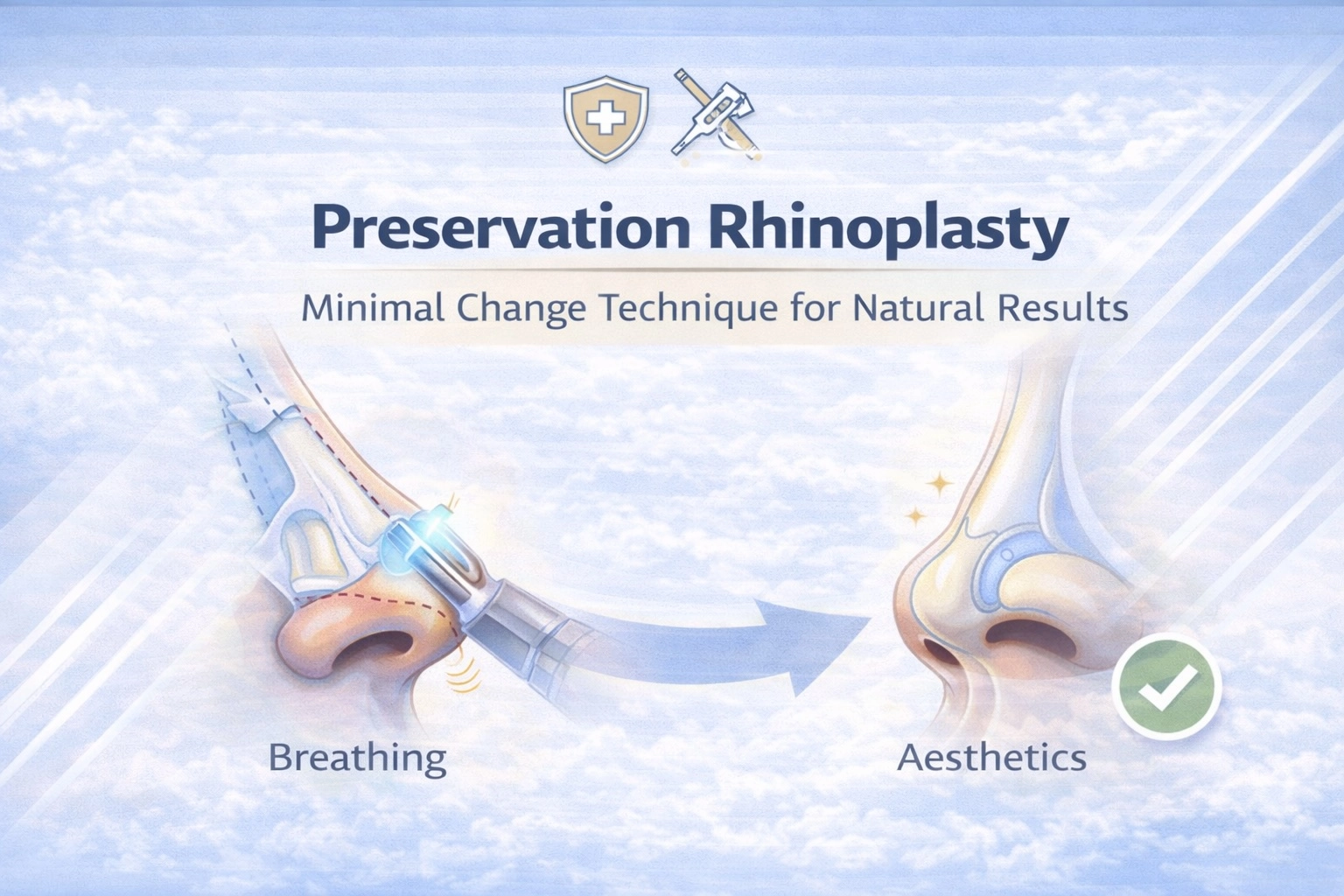
Preservation rhinoplasty is a nose job technique that lowers the nasal bridge as one unit from underneath, instead of cutting the hump off the top. The natural dorsal lines and the keystone area (where bone meets cartilage) stay intact, so fewer grafts are needed and the result tends to look less operated.
The best current evidence is a 2025 systematic review and meta-analysis in Facial Plastic Surgery & Aesthetic Medicine (Shim et al.): across four randomised trials with 419 patients, preservation rhinoplasty scored better than structural rhinoplasty for both breathing and appearance after dorsal hump reduction. The authors still describe the result cautiously — preservation “might provide” better satisfaction — because the trials are few and the cosmetic results varied between them.
At Carely Clinic in Istanbul, preservation is one of the approaches our surgeons use for rhinoplasty in Turkey; the technique is chosen at your in-person consultation, and rhinoplasty costs €2,850 all-inclusive (valid until December 2026), including septoplasty when it is needed, the hospital stay, 6 nights in a 5-star hotel, VIP transfers and 12 months of WhatsApp follow-up. This guide explains how the technique works, who it suits, what the research actually shows, the risks, the recovery timeline and the cost.
Sources Used in This Guide
Every figure in this article is taken from a source you can open: the Shim et al. 2025 meta-analysis of randomised trials (Facial Plastic Surgery & Aesthetic Medicine 2025;27(6):564–571); the Saban, Daniel et al. 2018 series of 320 dorsal preservation cases (Aesthetic Surgery Journal 2018;38(2):117–131); the Abdelwahab et al. 2020 radiological study of the internal nasal valve (Aesthetic Plastic Surgery 2020;44(3):879–887); the Layliev et al. 2017 analysis of 4,978 rhinoplasty patients (Aesthetic Surgery Journal 2017;37(7):757–767); and the NHS guide to nose reshaping (last reviewed 22 September 2023). Where a claim is only surgeon opinion, we say so.
What Is Preservation Rhinoplasty?
Preservation rhinoplasty is a surgical technique that reshapes the nose by modifying structures beneath the nasal bridge rather than removing bone and cartilage from the top, so the nose keeps its natural dorsal aesthetic lines.
Dorsal preservation is not a new idea. Older “push-down” operations were reassessed and brought back into mainstream rhinoplasty in the 2010s, most visibly by Yves Saban and Rollin K. Daniel, whose 2018 paper in Aesthetic Surgery Journal describes the current technique based on 320 cases performed over five years.
Modern preservation rhinoplasty has three parts: dorsal preservation (the bony-cartilaginous bridge is kept as one piece), preservation of the skin and soft-tissue envelope through dissection in deeper planes, and preservation of the tip cartilages, which are reshaped with sutures rather than cut away wherever possible.
How Preservation Rhinoplasty Works
Preservation rhinoplasty lowers the entire nasal dorsum as a single unit by removing a strip of cartilage from the septum underneath it and freeing the bony pyramid with controlled bone cuts, so the bridge can settle to a lower position without opening the keystone area.
There are two foundation techniques. In the push-down operation the mobilised nasal pyramid is pressed down into the face after bone cuts on the sides; in the let-down operation a wedge of bone is removed where the nose meets the cheekbone so the pyramid can drop further. In the Saban series, push-down was used for smaller humps of less than 4 mm and let-down when more than 4 mm of lowering was needed.
The Surgical Process
The operation usually follows a standard sequence. Access is most often endonasal (closed), without an external incision, although an open approach can be combined with dorsal preservation when the tip needs more work. The surgeon then removes a precisely planned strip of septal cartilage just below the bridge; its shape and height are decided before surgery from your photographs and examination.
Complete lateral, transverse and radix bone cuts free the nasal pyramid. Finally, the dorsum is lowered by push-down or let-down, depending on how much reduction is needed. The whole bony-cartilaginous vault descends as one piece, which is why the dorsal lines are preserved.
Several variants exist, differing in where the septal strip is taken (directly under the dorsum, higher or lower in the septum). The 2018 Saban series reported no dorsal irregularities and no inverted-V deformities after 320 operations; it is a single-surgeon series (level 4 evidence), so these results describe what an experienced preservation surgeon achieved, not an average outcome.
Preservation vs. Traditional Rhinoplasty
The fundamental difference between preservation and traditional rhinoplasty lies in how the bridge is treated: preservation keeps the bridge’s natural contour and lowers it, while traditional (structural) rhinoplasty removes the hump and rebuilds the bridge.
Traditional structural rhinoplasty, based on Joseph’s technique from the early 20th century, removes the dorsal hump by cutting bone and cartilage from the top of the nasal bridge. This leaves an “open roof” that has to be reconstructed with spreader grafts or spreader flaps to keep the middle of the nose stable and the airway open.
Preservation rhinoplasty does the opposite. Rather than removing the hump from above, the surgeon modifies the structures beneath the dorsum, allowing the whole nasal pyramid to settle into a lower position while keeping its original surface.
What the Clinical Evidence Shows
The 2025 systematic review and meta-analysis by Shim and colleagues screened 38 studies and included four randomised controlled trials with 419 patients comparing preservation and structural rhinoplasty for dorsal hump reduction. Preservation scored significantly better for breathing (standardised mean difference −0.317, 95% CI −0.509 to −0.124) and for appearance (SMD −0.460, 95% CI −0.851 to −0.069), measured with the SCHNOS questionnaire and visual analogue scales.
Two caveats matter for patients. The functional results were consistent across trials (I² = 0%), but the cosmetic results varied considerably between trials (I² = 67%), and four trials is a small evidence base. The authors therefore conclude only that preservation “might provide” better functional and cosmetic satisfaction — a real advantage, but not a promise for every nose.
| Factor | Preservation Rhinoplasty | Traditional (Structural) Rhinoplasty |
|---|---|---|
| Dorsum treatment | Lowered as a single unit | Hump removed, bridge reconstructed |
| Keystone area | Preserved | Opened; spreader grafts or flaps usually needed |
| Dorsal aesthetic lines | Kept as they are | Must be recreated |
| Patient-reported outcomes (4 RCTs, 419 patients) | Better breathing and appearance scores (Shim et al. 2025) | Reference group |
| Best suited to | Humps with a straight or V-shaped profile, good skin, first-time surgery | Major reconstruction, crooked noses, most revisions |
| Main technique-specific risk | Hump recurrence if the pyramid is not fully mobilised | Open-roof irregularities, inverted-V deformity |
| Surgeon availability | Fewer surgeons trained in it | Taught in every training programme |
Who Is an Ideal Candidate?
Ideal candidates for preservation rhinoplasty are patients with a dorsal hump, good nasal skin, no significant previous nasal trauma or surgery, and goals focused on subtle refinement rather than dramatic change.
The technique works best for specific anatomy. Patients with a “tension nose” — a high starting point of the bridge, a projecting dorsum, a narrow middle third and narrow nostrils — are classic candidates. A V-shaped hump with a single curve flattens more predictably than an S-shaped hump with two curves.
Anatomical Considerations
Skin thickness influences the result. Thinner skin shows the preserved dorsal lines clearly; very thick skin hides fine changes, and some thick-skinned patients get a better-defined result from structural techniques.
The mix of cartilage and bone in the hump also matters. Humps that are mostly cartilage with short nasal bones respond well to preservation, while large bony humps, a very deep angle between the forehead and the nose, or an irregular bony pyramid are harder to treat this way.
Key Point
Lowering the bridge as one unit has predictable side effects: the starting point of the bridge (radix) drops, the bridge projects less, and the middle third of the nose becomes slightly wider. The ideal candidate is someone for whom these changes are improvements, not compromises — which is why the decision is made on your face, not in a general article.
Who May Not Be Suitable
Preservation rhinoplasty has limits. A low radix (the bridge already starts low), existing irregularities of the dorsum, a wide middle vault and certain septal shapes make the technique less suitable. Patients who need extensive reconstruction, correction of major asymmetry, or revision of a nose that has already been operated on structurally usually do better with structural techniques.
Even surgeons who specialise in preservation still perform conventional hump removal when the anatomy favours it. The goal is matching the technique to your anatomy, not applying one method to everyone.
Benefits of Preservation Rhinoplasty
The documented advantages of preservation rhinoplasty are a more natural-looking bridge, fewer grafts, and better patient-reported breathing and appearance scores in the randomised trials published so far.
Natural Aesthetic Outcomes
The main advantage is that the nose keeps its own aesthetic lines. Because the surface of the dorsum is never cut, the bridge retains its original architecture — the “non-operated” look that patients ask for. Traditional hump removal has to rebuild those lines, which can leave visible irregularities even in skilled hands.
Keeping the keystone area intact also avoids the open-roof deformity that makes spreader grafts necessary in traditional rhinoplasty. Fewer grafts mean less internal scarring and less cartilage harvested from elsewhere.
Breathing and Function
In the 2025 meta-analysis, patients who had preservation rhinoplasty reported better breathing than those who had structural hump reduction. The likely reason is that the internal nasal valve and the keystone area — structures that control airflow — are not opened.
The picture is not uniform, however. A 2020 cadaver study by Abdelwahab and colleagues measured the internal nasal valve before and after each technique and found that the let-down variant and conventional hump resection did not reduce the valve, while the push-down variant significantly did. In other words, a breathing benefit is not automatic; it depends on the variant used and on your anatomy, and a septoplasty is still needed when the septum is deviated.
Less Internal Dissection
Because the keystone area is not opened and fewer grafts are placed, there is less internal dissection than in a structural operation. Surgeons who use the technique report less bruising, but this has not been measured in the randomised trials, and the NHS notes that swelling after any nose reshaping can take up to 6 months to go completely. Expect a normal rhinoplasty recovery, possibly a gentler one.
Long-Term Stability
Keeping the natural support of the keystone area and the nasal ligaments may make results more stable over time, with less risk of cartilage warping or gradual changes to the bridge. This is a plausible argument made by preservation surgeons; long-term comparative data against structural rhinoplasty are still limited.
Potential Risks and Limitations
Preservation rhinoplasty carries the general risks of any rhinoplasty plus some specific ones: hump recurrence, a limited range of correction, and the need for a surgeon with specific training in the technique.
Hump Recurrence
The most discussed concern is that the hump partly comes back. If the bony pyramid is not fully mobilised or the septal support is insufficient, the dorsum can drift back towards its original position. In the Saban series, hump recurrence, lateral deviation of the dorsum and widening of the middle third were the main reasons for the dorsal revisions the authors performed.
Careful patient selection and complete mobilisation of the nasal pyramid reduce this risk, which is one reason the technique is best performed by surgeons who do it regularly.
Limited Scope of Correction
Preservation rhinoplasty is most effective for moderate corrections and cannot achieve every change possible with structural rhinoplasty. Patients who need significant narrowing, extensive tip work or major reconstruction may be better served by traditional techniques, or by a hybrid operation that preserves the dorsum and works structurally on the tip.
It also has limited use in revision cases where earlier surgery has already altered the dorsum. If your first operation used preservation, a second preservation procedure often remains possible.
Technical Demands
Preservation rhinoplasty requires specific training and a steeper learning curve than conventional hump removal, and fewer surgeons offer it. Complications specific to the technique include a saddle deformity if too much septum is removed, asymmetry of the bony pyramid, a visible step at the radix, and the hump recurrence described above.
General Rhinoplasty Risks
Like any rhinoplasty, preservation rhinoplasty carries surgical risks. In a 2017 analysis of 4,978 rhinoplasty patients in Aesthetic Surgery Journal, the overall major complication rate was 0.7%, with haematoma and infection each occurring in about 0.2% of cases.
The NHS lists the specific risks of nose reshaping as permanent breathing difficulty, damage to the cartilage wall between the nostrils, an altered sense of smell and heavy nosebleeds, plus the general risks of any operation: excessive bleeding, a blood clot in a vein, infection and an allergic reaction to the anaesthetic. Revision surgery is sometimes needed after any rhinoplasty technique; published revision rates vary widely between studies and surgeons, so ask your surgeon about theirs.
Recovery Timeline
Recovery after preservation rhinoplasty follows the same pattern as any rhinoplasty: a splint for about a week, up to 2 weeks off work, strenuous exercise after 4 to 6 weeks, and up to 6 months for the swelling to go completely, according to the NHS. The tip can keep refining for 12 to 18 months.
Week-by-Week Recovery
Days 1–3: Swelling and bruising peak in the first 72 hours. Expect a blocked nose, mild to moderate discomfort controlled with the medication you are given, and some bloody discharge under a drip pad. Sleep with your head raised on pillows; the NHS advises this for the first couple of days.
Days 4–7: The splint stays on, taped over the nose. Swelling and bruising plateau and start to improve. Pain settles into tenderness. Avoid blowing your nose, hot baths and getting the splint wet; sneeze through your mouth.
Week 2: The splint comes off at around 7 days — see our guide to rhinoplasty cast removal. Bruising fades enough for most people to feel comfortable in public, and desk work is usually possible, though the NHS says you may need up to 2 weeks off. The bridge shape is visible; the tip is still swollen.
Weeks 3–6: Bruising and swelling around the eyes have usually gone by 3 weeks, when swimming is generally allowed. Strenuous exercise and contact sports wait until 4 to 6 weeks. Light walking is encouraged from the first days.
Months 2–6: The swelling keeps going down and the new contour becomes clearer month by month; the NHS gives up to 6 months for swelling to disappear completely. See rhinoplasty swelling stages for what is normal at each point.
Months 6–18: The tip is the last area to settle, especially in thicker skin. Your surgeon assesses the final result at the 12-month review, and subtle refinement can continue to 18 months.
Tips for a Smoother Recovery
Keep your head raised, especially while sleeping, and use cold compresses on the cheeks and under the eyes (not on the nose) during the first 48 hours. Drink enough water and avoid very salty food.
Do not smoke, and stop before surgery for as long as your surgeon instructs — nicotine narrows blood vessels and slows healing. Avoid blood-thinning medicines and alcohol exactly as directed, and tell your surgeon about every medicine and supplement you take.
Preservation Rhinoplasty Cost in Turkey
Rhinoplasty at Carely Clinic in Istanbul — including preservation rhinoplasty — costs €2,850 all-inclusive (valid until December 2026). The price includes septoplasty when it is needed, the hospital stay, 6 nights in a 5-star hotel, VIP transfers and 12 months of WhatsApp follow-up; the full list is on the rhinoplasty package in Turkey page. There is no deposit: you pay in Istanbul after your in-person consultation with your surgeon.
| Where | Price | What the figure covers | Source |
|---|---|---|---|
| Carely Clinic, Istanbul | €2,850 | All-inclusive: surgery, septoplasty if needed, hospital stay, 6 nights 5-star hotel, VIP transfers, 12 months follow-up | Carely Clinic price list, valid until December 2026 |
| United Kingdom (private) | £4,000–£7,000 | Surgery; the NHS notes consultations, follow-up and any further surgery may be extra | NHS, reviewed 22 Sep 2023 |
| United States | $7,500–$12,500 | Surgeon fee only; facility, anaesthesia and aftercare billed separately | ASPS 2024 average surgeon fees |
We do not publish a percentage saving because the figures do not measure the same thing: the UK and US numbers are surgery or surgeon fees, while the Carely Clinic price also covers the hospital, hotel and transfers. For a detailed comparison with British private clinics, see rhinoplasty in Turkey vs the UK.
Preservation Rhinoplasty at Carely Clinic, Istanbul
At Carely Clinic, rhinoplasty is led by Op. Dr. Vepa Silapov, an ear, nose and throat surgeon who specialises in rhinoplasty, with Assoc. Prof. Dr. Mustafa Sagit (ENT) also performing primary and revision rhinoplasty. Our surgeons perform open, closed, preservation, functional and revision rhinoplasty, and choose the approach that fits your anatomy and goals — whether preservation suits your nose is decided when your surgeon examines you in Istanbul, not before.
Surgery takes place in an accredited partner hospital in Istanbul, including BHT CLINIC İstanbul Tema Hospital (JCI accredited May 2024, TEMOS re-accredited January 2026, TÜSKA Gold 2026); the hospital for your operation is named in your written treatment plan. You stay in hospital for 1 night (2 if your surgeon advises) and in a 5-star hotel for 6 nights, so the whole trip takes about 7 days, with the splint usually removed before you fly home.
The package is €2,850 all-inclusive (valid until December 2026) and includes septoplasty when it is needed, the hospital stay, 6 nights in a 5-star hotel, VIP transfers and 12 months of WhatsApp follow-up. Your treatment plan is put in writing, and no payment is taken until you have met your surgeon in Istanbul. Read the full details on our rhinoplasty in Turkey page or contact Carely Clinic to send your photos for a preliminary assessment.
Summary Table
| Aspect | Key Information |
|---|---|
| Definition | Technique that lowers the nasal dorsum as a single unit rather than removing the hump |
| Primary techniques | Push-down (humps under 4 mm) and let-down (more than 4 mm of lowering) — Saban et al. 2018 |
| Evidence | 4 randomised trials, 419 patients: better breathing and appearance scores than structural rhinoplasty — Shim et al. 2025 |
| Ideal candidates | Dorsal hump, thin to normal skin, first-time rhinoplasty, subtle goals |
| Less suitable | Low radix, wide middle vault, major reconstruction, most revisions |
| Operation | Usually 1.5 to 3 hours under general anaesthetic (NHS) |
| Splint and work | Splint about 7 days; up to 2 weeks off work (NHS) |
| Final result | Swelling largely gone by 6 months (NHS); tip refines to 12–18 months |
| Cost at Carely Clinic | €2,850 all-inclusive, valid until December 2026 |
| Hospital | Accredited partner hospital, e.g. BHT CLINIC İstanbul Tema Hospital (JCI 2024, TEMOS 2026, TÜSKA Gold 2026) |
What to Expect: Timeline
Before Surgery
- Before you travel: Send your photos on WhatsApp; our medical team replies within 24 hours with a preliminary assessment, and your written treatment plan follows
- As instructed by your surgeon: Stop smoking and pause blood-thinning medicines or supplements
- Day 1–2 in Istanbul: In-person consultation and examination with your surgeon, blood tests and anaesthetic assessment; payment is made after this consultation
- Night before surgery: Fast from the time the hospital tells you
Surgery Day
You arrive at the hospital for final checks. The operation is done under general anaesthetic and usually takes 1.5 to 3 hours according to the NHS, depending on whether the tip or the septum is also treated. You wake up with a splint on your nose and spend the night in a private room; a second night is added only if your surgeon advises it.
Recovery Milestones
- Days 1–3: Rest with your head raised; cold compresses on the cheeks
- About day 7: Splint removal and first clear view of the new bridge, normally before your flight home
- Week 2: Most bruising gone; desk work possible (NHS: up to 2 weeks off)
- Weeks 4–6: Strenuous exercise and contact sports can resume (NHS)
- Month 6: Swelling largely resolved (NHS: up to 6 months)
- Months 12–18: Final result; your surgeon reviews your photos at 1 week, 1, 3, 6 and 12 months on WhatsApp
Frequently Asked Questions
How does preservation rhinoplasty differ from traditional rhinoplasty?
Preservation rhinoplasty lowers the nasal bridge as one unit from beneath, while traditional rhinoplasty removes the hump from above and rebuilds the bridge. Preservation keeps the natural dorsal lines and the keystone area intact, so spreader grafts are usually not needed. In a 2025 meta-analysis of four randomised trials (419 patients), preservation gave better breathing and appearance scores than structural rhinoplasty for dorsal hump reduction.
Am I a good candidate for preservation rhinoplasty?
Ideal candidates have a dorsal hump, good nasal skin, no previous nasal surgery and want subtle refinement. A low radix, a wide middle vault, very thick skin or the need for extensive reconstruction usually point to a structural technique instead. Your surgeon decides at the in-person examination in Istanbul; a preliminary opinion from photos is possible but not final.
Is preservation rhinoplasty safer than traditional rhinoplasty?
The general risks are the same. A 2017 analysis of 4,978 rhinoplasty patients in Aesthetic Surgery Journal found a 0.7% major complication rate, with haematoma and infection each around 0.2%. Preservation adds a specific risk of hump recurrence if the pyramid is not fully mobilised, and the NHS lists permanent breathing difficulty, septal damage, altered smell and heavy nosebleeds as possible outcomes of any nose reshaping. Choose a surgeon who performs the technique regularly.
How long does recovery take compared to traditional rhinoplasty?
The timeline is the same: a splint for about 7 days, up to 2 weeks off work, strenuous exercise after 4 to 6 weeks and up to 6 months for swelling to disappear, according to the NHS; the tip can refine for 12 to 18 months. Surgeons who use preservation report less bruising because the keystone area is not opened, but this has not been measured in randomised trials.
Can preservation rhinoplasty improve breathing?
It can. In the 2025 meta-analysis of randomised trials, patients who had preservation rhinoplasty reported better breathing than those who had structural hump reduction, probably because the internal nasal valve is not opened. A 2020 cadaver study found that the push-down variant reduced internal valve dimensions while let-down did not, so the benefit depends on the variant and your anatomy. A deviated septum still needs a septoplasty, which is included in the Carely Clinic price when needed.
What happens if I’m not satisfied with my results?
Swelling changes the nose for months, so most concerns in the first year are reviewed rather than operated on. At Carely Clinic any concern about your result is reviewed by your surgeon during the 12-month WhatsApp follow-up, and the next steps are discussed with you individually. If your first operation used preservation, a second preservation procedure often remains possible.
How much does preservation rhinoplasty cost in Turkey?
At Carely Clinic in Istanbul, rhinoplasty — including preservation rhinoplasty — costs €2,850 all-inclusive, valid until December 2026. The price covers septoplasty when needed, the hospital stay, 6 nights in a 5-star hotel, VIP transfers and 12 months of WhatsApp follow-up. For comparison, the NHS puts private nose reshaping in the UK at £4,000 to £7,000 for the surgery alone, and ASPS 2024 data put the US surgeon fee at $7,500 to $12,500.
How do I verify a Turkish clinic’s credentials?
Ask for the surgeon’s name and specialty and check their profile — at Carely Clinic, rhinoplasty is led by Op. Dr. Vepa Silapov, an ENT surgeon, with Assoc. Prof. Dr. Mustafa Sagit. Ask which hospital you will be operated in and check its accreditation on the accreditor’s own website; BHT CLINIC İstanbul Tema Hospital’s JCI, TEMOS and TÜSKA accreditations are published by the hospital and by TEMOS. Finally, insist on a written treatment plan before you travel and keep every promise in writing.
How long should I stay in Turkey for the procedure?
Plan about 7 days. At Carely Clinic you arrive on day 1, meet your surgeon and have your tests on days 1–2, have surgery on day 3 with 1 night in hospital (2 if advised), recover at your 5-star hotel for the rest of the 6 hotel nights, and usually have the splint removed around day 7 before flying home. Follow-up then continues on WhatsApp for 12 months.
Can preservation rhinoplasty be combined with other procedures?
Yes. It is commonly combined with septoplasty for breathing, with tip refinement using sutures, and with narrowing of the nostril base when needed. Dorsal preservation can also be combined with structural work on the tip in a hybrid operation. Your surgeon plans the combination at your consultation so everything is done in a single operation.
Are preservation rhinoplasty results permanent?
The change to the bridge is intended to be permanent, and preservation surgeons argue that keeping the keystone area and nasal ligaments intact makes the result more stable than a reconstructed bridge. Long-term comparative studies against structural rhinoplasty are still limited. Normal ageing, injury and significant weight change can alter any nose over time, and partial hump recurrence is the technique’s specific risk.
What questions should I ask my surgeon during consultation?
Ask how often they perform preservation rhinoplasty, whether your anatomy suits it or a structural technique would serve you better, and how they manage hump recurrence. Ask to see before-and-after photos of patients with a similar nose, what exactly is included in the price, which hospital you will be in, how long the splint stays on, and how follow-up works after you fly home. A good surgeon welcomes these questions and puts the answers in your written treatment plan.
Is preservation rhinoplasty available at Carely Clinic in Istanbul?
Yes. Carely Clinic’s surgeons perform open, closed, preservation, functional and revision rhinoplasty in Istanbul and choose the approach that fits your anatomy. Preservation is offered within the standard rhinoplasty package at €2,850 all-inclusive; whether it is the right technique for your nose is confirmed at your in-person consultation with your surgeon.
Conclusion
Preservation rhinoplasty is a significant development in nose surgery: for patients with the right anatomy it keeps the nose’s own dorsal lines, needs fewer grafts and, in the randomised trials published so far, gives better breathing and appearance scores than structural hump reduction.
It is not for every nose. Low bridges, wide middle vaults, major asymmetry and most revision cases are still better treated structurally, and the technique carries its own risk of partial hump recurrence. The right question is not “which technique is best?” but “which technique is best for my nose?” — and only an examination can answer it.
At Carely Clinic in Istanbul, preservation is one of the techniques our rhinoplasty surgeons use, within a €2,850 all-inclusive (valid until December 2026) package that includes septoplasty when it is needed, the hospital stay, 6 nights in a 5-star hotel, VIP transfers and 12 months of WhatsApp follow-up.
Individual requirements and outcomes vary. This guide provides general information based on the published literature cited above. Consult a qualified surgeon for advice about your own anatomy and goals.
Ready to find out whether preservation rhinoplasty is right for you? Contact Carely Clinic to send your photos for a preliminary assessment by our medical team and a consultation with your rhinoplasty surgeon in Istanbul.
Written by Carely Clinic Medical Team · Last updated: November 2026