
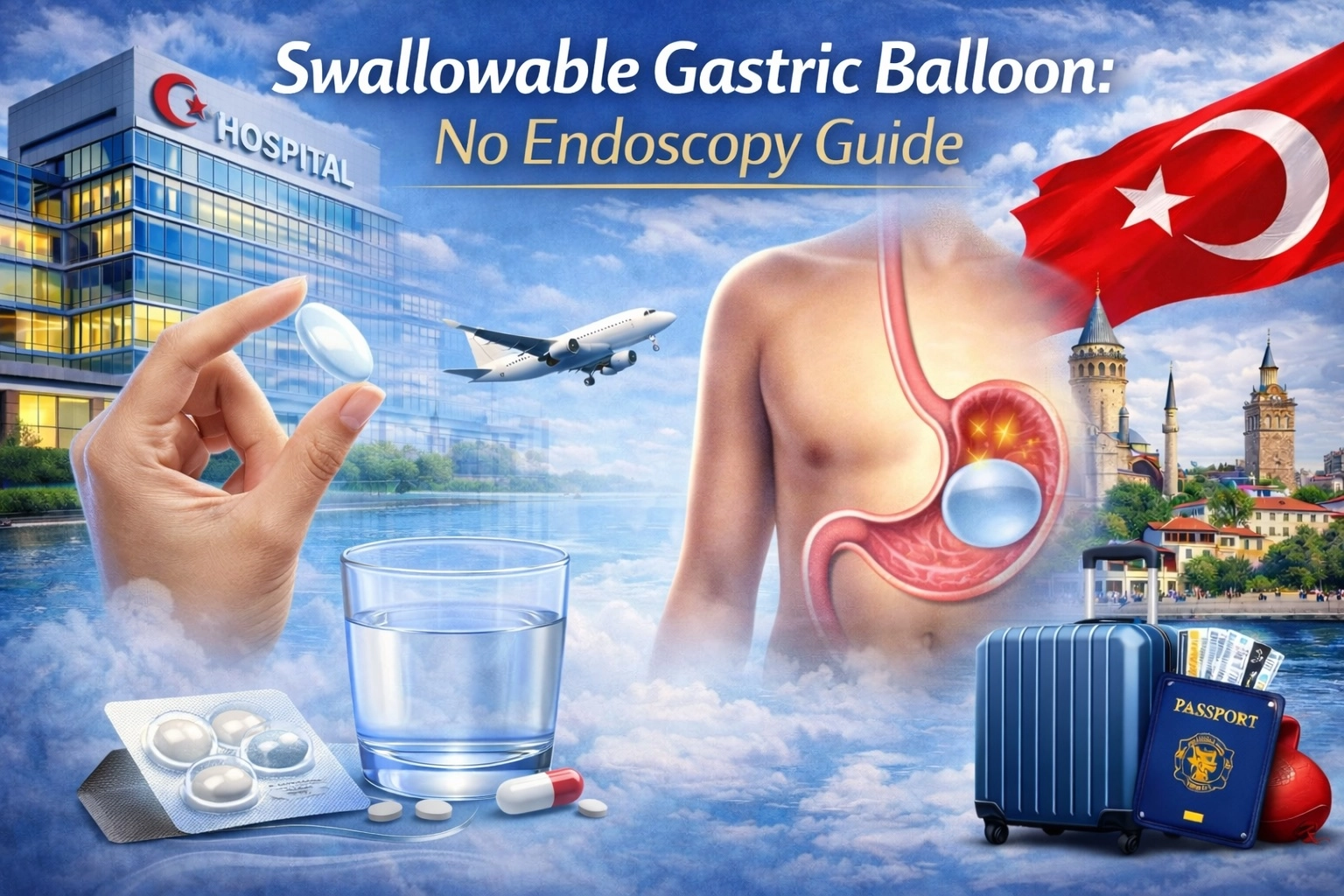
A swallowable gastric balloon is a weight-loss balloon that you swallow as a capsule instead of having it placed with an endoscope. Once the capsule is in the stomach, the balloon is filled with liquid through a thin tube, and after about four months it empties itself and leaves the body naturally. It is not surgery.
The largest published report on it followed 1,770 patients at 19 obesity centres. After 4 months they had lost on average 14.2% of their total body weight, according to the study published in the journal Obesity Surgery. The same study shows the limits: there was no comparison group, and 2.9% of patients needed an endoscopy after all, to take the balloon out because they could not tolerate it. This guide explains how the balloon works, what the evidence says, the risks, who it suits and what it costs.
Quick Summary:
- What it is: a balloon compressed inside a capsule that you swallow, filled with 550 ml of liquid once it reaches the stomach.
- How it is placed: in an outpatient visit of about 20 minutes, checked by X-ray, without endoscopy or sedation in typical use.
- How long it stays: about 16 weeks. It then empties itself and passes naturally.
- Weight loss results: an average of 14.2% of total body weight (13.5 kg) at 4 months in a study of 1,770 patients with no comparison group.
- Risks: in that study, 2.9% had the balloon removed by endoscopy for intolerance, and 3 patients needed keyhole surgery for a bowel blockage.
- Approval: the manufacturer states that its swallowable balloon is FDA approved for adults aged 22 to 65 with a BMI of 30 to 40.
- At Carely Clinic: a swallowable balloon is available, and its price and stay are written in your treatment plan. A 6-month balloon placed by endoscopy costs €2,000.
What Is a Swallowable Gastric Balloon?
A swallowable gastric balloon does the same job as any gastric balloon: it takes up space in the stomach, so you feel full on smaller meals. The difference is how it gets in and out. The best-known device of this type is the Allurion Balloon, which was called the Elipse Balloon in earlier studies.
The Obesity Surgery study describes it as a balloon compressed into a swallowable capsule connected to a thin catheter. It is filled with 550 ml of liquid after it reaches the stomach. At about 4 months a valve in the balloon opens, the balloon empties, and it is excreted naturally. The manufacturer’s website says the balloon is designed to stay in the stomach for approximately 16 weeks, with an average observed time of 15.3 weeks.
The manufacturer also states that the Allurion Balloon is FDA approved, with a United States indication for adults between 22 and 65 years old who have obesity and a BMI of 30 to 40, and that up to two balloons may be placed during a 10-month period. That is the company’s own statement of its approval.
How Is a Swallowable Gastric Balloon Placed?
According to the study and the manufacturer, placement is done in an outpatient visit of about 20 minutes:
- You swallow the capsule, which is attached to a thin catheter.
- An X-ray confirms that the capsule is in the stomach.
- The balloon is filled with liquid through the catheter.
- A second X-ray checks the filled balloon, and the catheter is then removed through the mouth.
Not everyone swallows the capsule easily. In the study, 99.9% of patients were able to swallow it, but 35.9% needed help from a stylet, a thin wire passed inside the catheter to stiffen it. One patient could not swallow the capsule at all.
Is It Really a Gastric Balloon Without Endoscopy?
In typical use, yes: the study reports placement without endoscopy or sedation. Two qualifications are worth knowing before you choose it.
- An endoscopy may still be needed later. The manufacturer says that in rare cases the balloon may require endoscopic or surgical intervention for removal. In the study, 52 patients (2.9%) had the balloon removed by endoscopy because they could not tolerate it.
- Nobody looks inside the stomach first. The NHS description of a gastric balloon has a camera passed through the mouth into the stomach before the balloon is swallowed, and says you may be offered a local anaesthetic or sedative. Whether a camera check is done before a swallowable balloon depends on the clinic and on your history.
Our separate guide to having a gastric balloon without endoscopy looks at this question on its own.
Swallowable Gastric Balloon Results: How Much Weight Do People Lose?
The largest published report is a registry study of 1,770 consecutive patients (1,264 women and 506 men) treated at 19 obesity centres in Europe and the Middle East between January 2016 and June 2019. Their average age was 38.8 years, their average BMI was 34.4 and their average weight was 94.6 kg. The study included adults aged 18 to 65 with a BMI above 27 who had already tried diets without success.
| Result at 4 months | Average in the study |
|---|---|
| Weight lost | 13.5 kg (about 30 lb) |
| Share of total body weight lost | 14.2% |
| Fall in BMI | 4.9 points |
| Patients who had the balloon removed before 4 months | 63 of 1,770 (3.6%) |
Three things are worth noticing about this evidence.
- There was no comparison group. Everyone in the study had the balloon. It was not a randomised trial against diet alone, so it cannot show how much of the weight loss came from the balloon and how much from the diet programme around it.
- Some authors had ties to the manufacturer. The paper states that two authors are consultants for Allurion and one is an adviser.
- They are averages. Some patients lost more than 14.2% and some lost less.
How Does This Compare With Other Gastric Balloons?
Mayo Clinic, in its guide to the intragastric balloon, says a loss of about 12% to 40% of body weight is typical during the six months after a balloon is placed, and that the amount depends on how much you can change your lifestyle habits. The swallowable balloon average of 14.2% falls inside that range, over a shorter time. For the randomised trial figures of two balloons placed by endoscopy, see our guides to the Orbera gastric balloon and the Spatz adjustable balloon.
Does the Weight Come Back After the Balloon Passes?
The 1,770-patient study did not follow its patients after the balloon had passed. It cites earlier data in which patients kept 72% of their weight loss 12 months after the balloon left the body, which also means some of the weight returned. Mayo Clinic says it is possible not to lose significant weight, or to regain weight, after any weight-loss procedure, and that permanent healthy changes in your diet are needed.
What Are the Risks and Side Effects of a Swallowable Gastric Balloon?
The Obesity Surgery study reports these events among its 1,770 patients:
| Event | Patients | What happened |
|---|---|---|
| Intolerance | 52 (2.9%) | Balloon removed by endoscopy |
| Early deflation | 11 (0.6%) | Balloon passed without further problems |
| Empty balloon vomited | 11 (0.6%) | Balloon came out by mouth instead of passing |
| Small bowel obstruction | 3 (0.17%) | Each needed keyhole surgery to remove the balloon. All three were in 2016, with an earlier design |
| Spontaneous hyperinflation | 4 | Balloon became overfilled on its own |
| Gastric perforation | 1 (0.06%) | Repaired by keyhole surgery and the balloon removed |
| Pancreatitis | 1 (0.06%) | Balloon removed by endoscopy |
| Gastric outlet obstruction | 1 (0.06%) | Balloon removed by endoscopy |
Nausea, vomiting and abdominal pain in the first days are common with gastric balloons in general. Mayo Clinic says pain and nausea affect about one-third of people soon after a balloon is placed and usually last only a few days, and it lists deflation, overinflation, acute pancreatitis, ulcers and perforation as rare but serious risks.
Key Point
A swallowable balloon passes on its own about four months after placement, when most international patients are back at home. Before you choose one, ask any clinic who you contact if something goes wrong at that point, and where an endoscopy would be done if you needed one.
Severe abdominal pain or vomiting that does not stop are reasons to contact a doctor straight away and not to wait for a routine check.
Who Can Have a Swallowable Gastric Balloon?
The published criteria differ by source. The manufacturer states a United States indication for adults aged 22 to 65 with obesity and a BMI of 30 to 40. The Obesity Surgery study, run in Europe and the Middle East, included adults aged 18 to 65 with a BMI above 27 after failed diets. Mayo Clinic, for intragastric balloons in general, describes a BMI between 30 and 40, a commitment to lifestyle changes and follow-up, and no previous surgery on the stomach or oesophagus.
In the study, 4 patients had the balloon removed by endoscopy because they turned out to have had earlier surgery that ruled the balloon out, which shows why a full medical history matters. The doctor who assesses you decides whether a balloon is suitable. If your BMI is above 40, a doctor may talk to you about surgery instead, and our guide to weight loss surgery in Turkey explains the options.
Swallowable vs Endoscopic Gastric Balloon: What Is the Difference?
| Feature | Swallowable balloon | Balloon placed by endoscopy |
|---|---|---|
| How it goes in | Swallowed as a capsule on a thin catheter, checked by X-ray | Placed through the mouth with an endoscope, under sedation |
| Time for placement | About 20 minutes, outpatient | About half an hour, outpatient (Mayo Clinic) |
| How long it stays | About 16 weeks | Up to 6 months for most; up to 8 months for an adjustable balloon under its FDA approval |
| How it comes out | Empties itself and passes naturally | Removed with an endoscope |
| Is the stomach examined first? | Not as part of placement | Yes, the endoscope shows the stomach |
| Main published evidence | Registry of 1,770 patients, no comparison group | Randomised trials against a lifestyle programme |
The practical trade-off is this: a swallowable balloon avoids sedation and two endoscopies, but it stays for a shorter time, its evidence comes from a study without a comparison group, and it leaves the body when you are no longer near the clinic. A balloon placed by endoscopy needs a second procedure to remove it, which is also a moment when a doctor sees you again.
How Much Does a Swallowable Gastric Balloon Cost in Turkey?
Carely Clinic offers a swallowable balloon, and its price is stated in your written treatment plan before you travel. We do not publish a figure for it here. For comparison, at Carely Clinic a 6-month gastric balloon placed by endoscopy costs €2,000 all-inclusive and a 12-month balloon costs €3,000, with prices valid until December 2026.
When you compare prices for a swallowable balloon between clinics, check three things: whether the X-rays are included, what follow-up you get during the 16 weeks, and what happens, and who pays, if the balloon has to be removed by endoscopy. Our gastric balloon in Turkey page sets out the price of the 6-month balloon next to published UK and US prices.
What Carely Clinic Offers
Carely Clinic does not advertise a balloon brand. The type of balloon, how long it stays in and the price are written in your treatment plan before you travel. If you want a swallowable balloon, tell us when you send your details so that your plan answers it in writing.
- Swallowable balloon: available. It is swallowed and not placed with an endoscope, and it has its own price, stated in your written treatment plan.
- 6-month balloon placed by endoscopy: €2,000, including the procedure under sedation in the endoscopy unit of a partner hospital in Istanbul, tests, 3 nights in a 5-star hotel, VIP airport transfers, medications and a written, staged diet plan. Removal and flights are not included.
- Follow-up: 12 months on WhatsApp, with check-ins at 1 week and at 1, 3, 6 and 12 months, and replies within 24 hours.
- Payment: no deposit or advance payment is required. You pay after your in-person consultation in Istanbul, and you may cancel at any time before treatment.
The full details are on our all-inclusive gastric balloon package page.
Frequently Asked Questions
How long does a swallowable gastric balloon stay in your stomach?
About 16 weeks. The manufacturer says the balloon is designed to stay for approximately 16 weeks, with an average observed time of 15.3 weeks. The Obesity Surgery study describes it as about 4 months, after which a valve opens, the balloon empties itself and it passes naturally.
How much weight will I lose with a swallowable gastric balloon?
In the largest published study, 1,770 patients lost on average 14.2% of their total body weight, or 13.5 kg, at 4 months. The study had no comparison group, so it cannot show how much of that was due to the balloon alone. Your own result may be higher or lower.
What happens if I can’t swallow the capsule?
The doctor can help with a stylet, a thin wire passed inside the catheter to stiffen it. In the Obesity Surgery study, 35.9% of patients needed this help, and 99.9% swallowed the capsule in the end. One patient out of 1,770 could not swallow it.
Does a swallowable gastric balloon really need no endoscopy?
In typical use it needs none, for placement or removal. But in the Obesity Surgery study, 52 of 1,770 patients (2.9%) had the balloon removed by endoscopy because they could not tolerate it, and the manufacturer says that in rare cases endoscopic or surgical removal may be needed.
How does a swallowable gastric balloon come out?
On its own. At about 4 months a valve in the balloon opens, the liquid drains, and the empty balloon passes through the bowel. In the Obesity Surgery study, 11 patients (0.6%) vomited the empty balloon instead, and 3 patients had a bowel blockage that needed keyhole surgery, all with an earlier design.
What should I do if I experience severe pain or vomiting?
Contact a doctor straight away. Nausea and pain in the first days are common with gastric balloons, but severe abdominal pain or vomiting that does not stop needs a medical check. In the Obesity Surgery study, 2.9% of patients had the balloon removed by endoscopy because of intolerance.
Will I regain the weight after a swallowable balloon passes?
Some regain is likely. The 1,770-patient study did not follow patients after the balloon passed, but it cites earlier data in which patients kept 72% of their weight loss 12 months later. Mayo Clinic says weight regain is possible after any weight-loss procedure and that permanent changes in your diet are needed.
Can I have a second balloon after the first one passes?
It can be possible. The manufacturer states that its United States indication allows up to two balloons to be placed during a 10-month period. Whether a second balloon is right for you is a decision for the doctor who has followed your first one.
Is the swallowable gastric balloon FDA approved?
The manufacturer of the Allurion Balloon states on its website that it is FDA approved, for adults aged 22 to 65 with obesity and a BMI of 30 to 40. The large Obesity Surgery study was carried out earlier, in Europe and the Middle East, and included adults with a BMI above 27.
Does Carely Clinic offer a swallowable gastric balloon?
Yes. Carely Clinic offers a swallowable balloon, which is swallowed and not placed with an endoscope. It has its own price, which is stated in your written treatment plan before you travel together with the type of balloon and how long it stays in.
Conclusion
A swallowable gastric balloon removes the two things many people fear about a gastric balloon: sedation and endoscopy. The largest study of it reports an average loss of 14.2% of total body weight at 4 months in 1,770 patients, with few serious events. The same study had no comparison group, 2.9% of its patients needed an endoscopy to take the balloon out, and the balloon leaves the body about four months later, wherever you are by then.
It suits people who want a short, temporary aid and are ready to change how they eat while it is in place. If you would like a doctor to assess whether a swallowable balloon or a balloon placed by endoscopy is right for you, send us your height, weight, health history and medications, and you will receive a written treatment plan with the balloon type, the stay and the price.
Sources and disclaimer: the figures in this article come from the multicentre study of 1,770 patients published in Obesity Surgery (2020), the manufacturer’s website, the NHS page on how weight loss surgery is done (reviewed February 2024) and the Mayo Clinic guide to the intragastric balloon (May 2026), all read in November 2026. This article provides general information and is not medical advice. Results and risks vary from person to person, and your own doctor decides what is suitable for you.
Written by Carely Clinic Medical Team · Medically reviewed by Assoc. Prof. Dr. Gökmen Öztürk, general and bariatric surgeon · Last updated: November 2026