
Quick Summary:
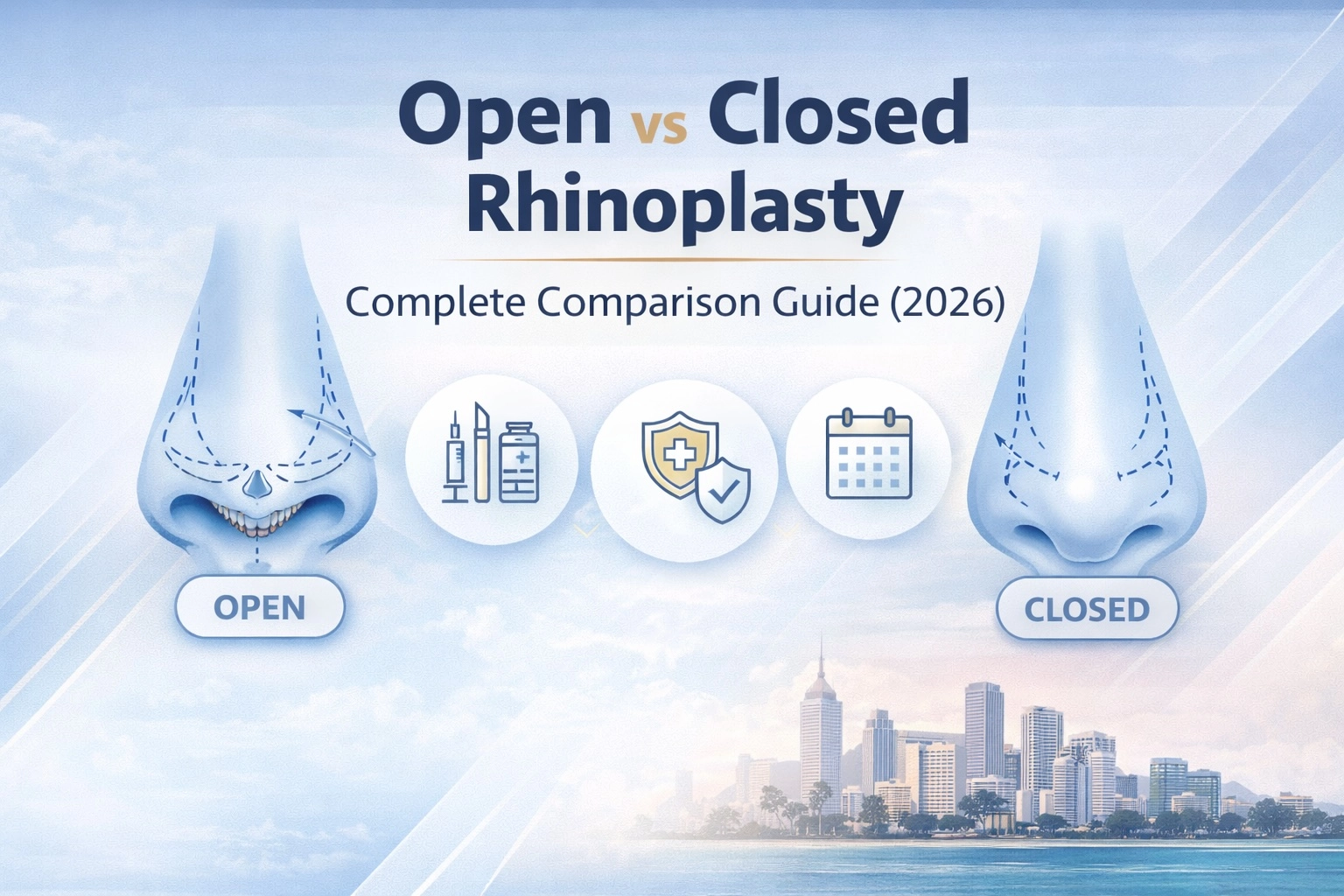
Open rhinoplasty uses a small external incision on the columella for full visibility of nasal structures, while closed rhinoplasty works entirely through internal nostril incisions with no visible scarring.
According to a 2024 systematic review in PMC, no significant differences exist in patient satisfaction, complication rates, or aesthetic outcomes between the two techniques.
This guide compares both approaches including recovery timelines, ideal candidates, costs, and how to choose the right technique for your goals.
Why Trust This Guide
This guide draws from peer-reviewed systematic reviews published in medical journals, ISAPS global surgery statistics, and clinical guidelines from board-certified plastic surgeons and otolaryngologists.
Carely Clinic’s medical team reviews all content to ensure accuracy and adherence to current surgical standards, providing balanced information to help patients make informed decisions.
Quick Comparison: Open vs Closed Rhinoplasty
Both open and closed rhinoplasty achieve comparable aesthetic and functional outcomes with similar patient satisfaction rates, according to systematic reviews analyzing over 1,000 patients.
The primary difference lies in surgical access: open rhinoplasty provides direct visualization through an external incision, while closed rhinoplasty works through internal incisions only. Your surgeon’s recommendation depends on your specific anatomy, desired changes, and the complexity of the procedure.
| Factor | Open Rhinoplasty | Closed Rhinoplasty |
|---|---|---|
| Incision Location | Small external cut on columella + internal | Internal incisions only (inside nostrils) |
| Visible Scarring | Minimal scar on columella (fades over time) | No visible external scars |
| Surgical Visibility | Full, direct visualization | Limited indirect visualization |
| Best For | Complex cases, revision surgery, major reshaping | Minor refinements, hump reduction, simple corrections |
| Operating Time | Longer (2-4 hours typically) | Shorter (1-2 hours typically) |
| Initial Swelling | Slightly more in first weeks | Slightly less initial swelling |
| Tip Numbness | More common initially | Less common |
| Final Results | Comparable to closed | Comparable to open |
| Revision Rate | 2.73% (primary cases) | 1.56% (primary cases) |
What Is Open Rhinoplasty?
Open rhinoplasty involves a small incision across the columella (the tissue between your nostrils) combined with internal incisions, allowing the surgeon to lift the skin and directly visualize all nasal structures.
This approach provides surgeons with an unobstructed view of the nasal cartilage, bone, and framework. The enhanced visibility makes open rhinoplasty the preferred technique for complex reconstructions, significant tip work, and revision surgeries where previous scarring may obscure the anatomy.
The columella incision typically measures 4-5 millimeters and heals to become nearly invisible within 6-12 months for most patients. Surgeons position this incision in the natural shadow beneath the nose, where it remains hidden during normal conversation and social interaction.
Advantages of Open Rhinoplasty
The open technique offers precision that benefits specific patient populations. Surgeons can directly compare both sides of the nose simultaneously, improving symmetry outcomes. Cartilage grafting and structural modifications become more predictable when the surgeon can see exactly how tissues align.
Complex tip reshaping benefits significantly from open access. The nasal tip contains delicate cartilages that determine projection, rotation, and definition. Working blindly through internal incisions limits a surgeon’s ability to create precise, symmetrical tip changes.
Limitations of Open Rhinoplasty
The external incision represents the primary trade-off. While most scars heal well, some patients develop visible scarring, particularly those with darker skin tones or a history of keloid formation. The additional dissection also creates slightly more swelling during the first few weeks of recovery.
Operating time typically runs 30-60 minutes longer than closed procedures. This increases anesthesia exposure slightly, though the difference is clinically insignificant for healthy patients.
What Is Closed Rhinoplasty?
Closed rhinoplasty performs all incisions inside the nostrils, leaving no external scars and typically resulting in less initial swelling and faster recovery compared to open techniques.
The surgeon works through the nostril openings to access and reshape the underlying nasal structures. This requires exceptional technical skill since modifications occur with limited direct visualization. Surgeons rely on tactile feedback and internal palpation to guide their work.
Closed rhinoplasty has a long history dating back to the 1880s and remains the preferred approach for straightforward cases. Many experienced surgeons achieve excellent results with this technique for appropriate candidates.
Advantages of Closed Rhinoplasty
The absence of external scarring appeals to many patients. For those concerned about visible marks, closed rhinoplasty eliminates this worry entirely. The technique also preserves more of the nose’s natural support structures since less dissection occurs.
Recovery often proceeds slightly faster. Studies show less initial swelling during the first two weeks, allowing some patients to return to social activities sooner. The preserved blood supply to the nasal tip may contribute to more rapid healing.
Closed procedures generally cost less due to shorter operating times. This translates to reduced facility fees and anesthesia charges in most healthcare systems.
Limitations of Closed Rhinoplasty
Limited visibility restricts what surgeons can accomplish. Complex tip modifications, significant asymmetry corrections, and revision cases often prove difficult or impossible through closed access alone. Surgeons cannot directly compare both sides of the nose simultaneously.
The technique depends heavily on surgeon experience. Fewer surgeons today train extensively in closed rhinoplasty, making finding an expert practitioner more challenging in some regions.
Key Differences Explained
The choice between open and closed rhinoplasty depends on what changes you want, your anatomy, and your surgeon’s expertise rather than one technique being universally superior.
A 2024 systematic review and meta-analysis found no statistically significant differences between open and closed approaches across multiple outcome measures. Researchers analyzed over 1,000 patients and evaluated Rhinoplasty Outcome Evaluation (ROE) scores, Nasal Obstruction Symptom Evaluation (NOSE) scores, complication rates, and patient satisfaction levels.
Both techniques demonstrated high success rates when performed by experienced surgeons on appropriate candidates. The key lies in matching the technique to the patient’s needs rather than defaulting to one approach for everyone.
Surgical Access and Precision
Open rhinoplasty provides what surgeons describe as “full exposure.” By lifting the nasal skin, surgeons see every cartilage, bone, and structural element directly. This visibility becomes critical when placing cartilage grafts, correcting severe asymmetry, or reconstructing damaged nasal frameworks.
Closed rhinoplasty limits visualization but preserves tissue attachments. The skin remains connected to underlying structures, potentially maintaining more stable long-term results for simple modifications. However, this restricted view makes complex changes challenging.
Scarring Considerations
The columella scar from open rhinoplasty typically measures 4-5 millimeters. With proper surgical technique and postoperative care, most scars fade significantly within 12 months. Some become virtually invisible, while others remain slightly visible upon close inspection.
Individual healing varies considerably. Patients with a history of keloid scarring, darker skin pigmentation, or previous columella trauma may experience more noticeable scarring. Closed rhinoplasty eliminates this variable entirely.
Recovery Timeline Differences
Initial recovery shows modest differences. Open rhinoplasty patients often experience slightly more swelling during weeks 1-3 due to the additional dissection required. Bruising patterns remain similar between techniques.
Long-term recovery timelines converge. Both techniques require approximately 12 months for final results as residual swelling resolves. The nasal tip typically retains subtle swelling longest regardless of surgical approach.
Expert Insight
“Most studies determined that there may be potential indications when a certain technique should be utilized over the other, but no consensus exists on which is superior in terms of aesthetic result, complications, and patient satisfaction.”
— PMC Systematic Review, 2022
Which Technique Is Better?
Neither open nor closed rhinoplasty is inherently better—the optimal choice depends on your specific goals, nasal anatomy, and the expertise of your surgeon.
Research consistently shows comparable outcomes when surgeons select the appropriate technique for each case. A 2017 analysis of nearly 5,000 rhinoplasty patients found the overall major complication rate was just 0.7%, with no significant differences based on surgical approach.
The surgeon’s experience often matters more than the technique itself. A surgeon highly skilled in closed rhinoplasty may achieve better results through that approach than through open surgery they perform less frequently. Conversely, surgeons specializing in open techniques deliver excellent outcomes with that method.
When Open Rhinoplasty Excels
Open rhinoplasty typically delivers superior results for complex cases requiring maximum precision and visibility. Revision rhinoplasty presents particular challenges since previous surgery creates scar tissue that obscures anatomy. The open approach helps surgeons navigate these difficult cases.
Significant structural changes also benefit from open access. Patients requiring major tip modifications, dorsal augmentation with cartilage grafts, or reconstruction after trauma generally achieve more predictable results with the open technique.
When Closed Rhinoplasty Excels
Closed rhinoplasty works well for focused, limited modifications. Patients seeking dorsal hump reduction, minor tip refinement, or correction of small asymmetries often achieve excellent outcomes without an external incision.
The technique also benefits patients prioritizing the fastest possible recovery. Less tissue disruption translates to reduced swelling in the early weeks, allowing quicker return to normal activities for suitable candidates.
Who Should Choose Open Rhinoplasty
Open rhinoplasty is recommended for patients requiring significant structural changes, complex tip modifications, revision surgery, or those with severe asymmetry or previous nasal trauma.
The enhanced visualization proves essential when surgeons need to place multiple cartilage grafts, reconstruct damaged frameworks, or create precise symmetry in complex cases. Most revision rhinoplasty patients benefit from the open approach since scar tissue from prior surgery makes closed techniques more challenging.
Ideal Open Rhinoplasty Candidates
Patients with the following characteristics typically benefit most from open rhinoplasty:
Significant tip asymmetry or deformity requiring precise cartilage modification. The nasal tip contains paired lower lateral cartilages that determine tip shape, and correcting major irregularities requires direct visualization.
Previous rhinoplasty with unsatisfactory results. Revision cases involve navigating scar tissue and potentially distorted anatomy that closed techniques cannot adequately address.
Ethnic rhinoplasty requiring structural augmentation. Patients seeking dorsal augmentation or tip projection enhancement through cartilage grafting achieve more predictable results with open access.
Cleft lip rhinoplasty or congenital nasal deformities. These complex reconstructive cases demand maximum surgical precision and typically require the open approach.
Severely deviated septum combined with external nasal deviation. Correcting both functional and aesthetic concerns simultaneously may require open access for complete visualization.
Who Should Choose Closed Rhinoplasty
Closed rhinoplasty suits patients seeking minor to moderate refinements, dorsal hump reduction, or subtle tip adjustments who want to avoid any external scarring.
The technique works well for focused corrections that don’t require extensive structural modification. Patients with relatively straightforward anatomy and limited changes often achieve excellent results faster with closed techniques.
Ideal Closed Rhinoplasty Candidates
Patients with the following goals typically succeed with closed rhinoplasty:
Isolated dorsal hump reduction without significant tip changes. Reducing a nasal bump through closed techniques is well-established with predictable outcomes.
Minor tip refinement that doesn’t require major cartilage restructuring. Subtle improvements in tip definition or rotation can be achieved through internal incisions.
Bridge straightening for mild to moderate deviation. Surgeons can address many nasal bone irregularities through closed access.
Scar-conscious patients who prioritize invisible incisions. Those highly concerned about any external marks may prefer closed techniques despite potentially limited modification options.
First-time rhinoplasty patients with straightforward goals. Primary cases without complex anatomy often achieve excellent results with either technique.
Recovery Comparison
Recovery from both techniques follows similar timelines, with most patients returning to work within 7-14 days and seeing final results at approximately 12 months.
The initial recovery period shows the most variation. Open rhinoplasty patients may experience slightly more swelling during weeks 1-3 due to additional tissue manipulation. However, this difference diminishes significantly by the one-month mark.
Week-by-Week Recovery Timeline
Days 1-3: Both techniques involve the most significant swelling and discomfort during this period. Bruising around the eyes peaks within 72 hours. Patients wear a nasal splint for protection and support. Most describe pain as moderate and manageable with prescribed medication.
Days 4-7: Swelling begins stabilizing. Congestion and pressure remain common. The splint stays in place providing structural support. Many patients begin noticing improvement in bruising. Cold compresses and head elevation continue helping manage swelling.
Week 2: Splint and external sutures typically removed. Bruising substantially fades or resolves. Open rhinoplasty patients may notice slightly more persistent nasal tip swelling compared to closed cases. Most patients feel comfortable returning to non-physical work.
Weeks 3-4: Bruising should resolve completely. Most visible swelling subsides. Patients often feel excited seeing early results emerge. Activity restrictions begin lifting for low-impact exercise.
Months 1-3: Significant continued improvement in nasal contour. Numbness in nasal skin gradually resolves. Most patients resume normal activities including moderate exercise. Nasal bones typically healed enough for glasses after 6 weeks.
Months 3-6: Approximately 90-95% of swelling resolved. The nose looks and feels increasingly natural. Subtle refinement continues, particularly in the nasal tip area.
Months 6-12: Final results emerge as remaining swelling resolves. The nasal tip, which retains subtle swelling longest, achieves its final appearance. Both techniques reach comparable endpoint results regardless of slightly different early recovery patterns.
Recovery Tips for Both Techniques
Keep your head elevated, especially while sleeping, for at least two weeks to minimize swelling. Apply cold compresses around (not directly on) the nose during the first 48 hours. Avoid strenuous activity and heavy lifting for 4-6 weeks. Protect your nose from accidental bumps or impacts.
Do not blow your nose for at least two weeks. Sneeze through your mouth if needed. Avoid wearing glasses that rest on the nasal bridge for approximately 6 weeks unless your surgeon approves alternatives.
Cost Comparison by Country
Rhinoplasty costs range from €2,500-€4,500 in Turkey to $10,000-$18,000 in the USA and £6,000-£15,000 in the UK, with open procedures typically costing 10-20% more than closed techniques.
These price variations reflect differences in healthcare systems, facility overhead costs, surgeon fees, and what’s included in quoted prices. Turkey’s all-inclusive packages contrast with itemized billing common in the USA and UK.
| Country | Primary Rhinoplasty | Revision Rhinoplasty | What’s Typically Included |
|---|---|---|---|
| Turkey | €2,500-€4,500 | €4,000-€6,500 | Surgery, hospital, anesthesia, hotel, transfers, medications, follow-up |
| USA | $10,000-$18,000 | $20,000-$40,000 | Surgeon fee often quoted separately; facility and anesthesia billed separately |
| UK | £6,000-£15,000 | £12,000-£20,000 | Usually surgeon, anesthesia, facility; follow-ups may be extra |
| Canada | CAD $10,000-$16,000 | CAD $16,000-$26,000 | Surgeon, anesthesia, facility; varies by province |
| Australia | AUD $12,000-$18,000 | AUD $20,000+ | Usually surgeon, anesthesia, facility; hospital stays extra |
Why Price Differences Exist
Turkey’s lower prices reflect economic factors rather than quality differences. Lower operating costs, favorable exchange rates, government support for medical tourism, and competitive market dynamics contribute to accessible pricing. JCI-accredited Turkish facilities maintain safety and hygiene protocols comparable to major international hospitals.
The USA’s higher costs stem from elevated malpractice insurance premiums, facility overhead in major cities, and the itemized billing structure where surgeon fees represent only part of total costs. Top surgeons in New York or Los Angeles command premium fees reflecting demand and expertise.
UK pricing falls between these extremes. Private clinics in London charge more than regional centers. NHS coverage applies only to medically necessary procedures like septoplasty for breathing problems, not cosmetic rhinoplasty.
How This Applies in Turkey
International guidelines from plastic surgery associations apply at Turkey’s JCI-accredited medical facilities, following identical clinical protocols and safety standards as American and European institutions.
Turkey performed over 550,000 plastic surgery procedures in 2023 according to ISAPS, establishing itself as a global leader in rhinoplasty expertise. Board-certified Turkish surgeons complete extensive training and perform hundreds of rhinoplasty procedures annually, developing expertise comparable to or exceeding surgeons in other countries.
The key differences for international patients involve cost and accessibility. Rhinoplasty in Turkey costs €2,500-€4,500 compared to $10,000-$18,000 in the USA and £6,000-£15,000 in the UK. All-inclusive packages cover surgery, hospital stay, medications, hotel accommodation, airport transfers, and follow-up appointments—eliminating surprise costs common with itemized billing elsewhere.
At Carely Clinic in Istanbul, both open and closed rhinoplasty are performed by board-certified surgeons at JCI-accredited partner hospitals. Comprehensive packages include pre-operative consultations, 3D imaging simulation, surgery with general anesthesia, hospital stay, post-operative care, and virtual follow-up appointments after returning home. Learn more about Rhinoplasty at Carely Clinic.
Choosing Between Open and Closed in Turkey
Turkish surgeons offer expertise in both techniques and recommend the appropriate approach based on your consultation. The surgeon evaluates your nasal anatomy, discusses your goals, and explains which technique will best achieve your desired results.
Many Turkish clinics utilize 3D imaging technology during consultations, allowing you to visualize potential outcomes before deciding on surgery. This technology helps patients understand realistic expectations and make informed decisions about their procedure.
Summary Table
| Consideration | Choose Open Rhinoplasty | Choose Closed Rhinoplasty |
|---|---|---|
| Complexity of Changes | Major structural modifications needed | Minor refinements only |
| Tip Work Required | Significant tip reshaping | Subtle tip adjustments |
| Previous Surgery | Revision rhinoplasty | First-time surgery |
| Scarring Concern | Can accept small hidden scar | Wants zero external scarring |
| Cartilage Grafting | Multiple grafts needed | No grafting or minimal |
| Asymmetry Severity | Significant asymmetry | Minor or no asymmetry |
| Recovery Priority | Prioritizes precision over speed | Wants fastest possible recovery |
| Cost Sensitivity | Willing to pay more if needed | Prefers lower cost option |
Frequently Asked Questions
Is open or closed rhinoplasty safer?
Both techniques demonstrate similar safety profiles with major complication rates around 0.7% according to large database studies. Safety depends more on surgeon experience, facility accreditation, and patient health than the specific technique used.
Which technique produces better results?
Neither technique produces universally superior results. Systematic reviews consistently show comparable patient satisfaction and aesthetic outcomes. The best results come from matching the technique to the patient’s specific needs and the surgeon’s expertise.
Does open rhinoplasty leave a visible scar?
The columella scar from open rhinoplasty typically heals to become nearly invisible within 6-12 months. The incision placement in natural shadowing beneath the nose helps conceal any residual marks. Some patients with darker skin tones or keloid-prone skin may experience more noticeable scarring.
How long does swelling last after rhinoplasty?
Most visible swelling resolves within 2-4 weeks. However, subtle swelling—particularly in the nasal tip—continues for 6-12 months. Open rhinoplasty may produce slightly more initial swelling, but both techniques reach similar endpoints by one year.
Can closed rhinoplasty achieve the same results as open?
For appropriate candidates with straightforward goals, closed rhinoplasty achieves excellent results. However, complex cases requiring significant structural changes, revision surgery, or major tip modifications typically achieve more predictable outcomes with open techniques.
Is open rhinoplasty more expensive than closed?
Open rhinoplasty typically costs 10-20% more due to longer operating times. In Turkey, this difference amounts to approximately €200-€500. The price difference is larger in the USA and UK where facility fees accumulate with longer procedures.
Which technique has a shorter recovery?
Closed rhinoplasty produces approximately 20-30% less initial swelling during weeks 1-3, allowing slightly faster return to social activities. Both techniques share the same overall timeline with most patients returning to work within 7-14 days and achieving final results at 12 months.
How do I know which technique I need?
Your surgeon evaluates your nasal anatomy, photographs, desired changes, and medical history during consultation to recommend the appropriate technique. Complex structural changes, revision cases, and significant tip work typically require open rhinoplasty, while minor refinements like hump reduction succeed with closed techniques.
What percentage of rhinoplasties are open vs closed?
Current estimates suggest approximately 70-80% of rhinoplasties use the open technique. This reflects both surgeon training trends and the technique’s versatility for various case complexities rather than inherent superiority.
Can I choose my technique, or does the surgeon decide?
The surgeon recommends the technique based on medical assessment, but you have final say in your treatment decision. Ethical surgeons will explain if your goals require a specific technique—for example, major tip reshaping or revision surgery typically needs open rhinoplasty for safe, predictable results regardless of patient preference.
Is revision rhinoplasty always done with open technique?
Most revision rhinoplasties use open technique because scar tissue from previous surgery makes closed approaches more difficult. However, simple revisions requiring minor adjustments may sometimes be performed through closed access.
Does the technique affect breathing outcomes?
Functional outcomes for breathing improvement show similar results between techniques. The key factor is whether the surgeon addresses underlying structural issues like a deviated septum, regardless of the approach used for external reshaping.
Conclusion
Open and closed rhinoplasty represent two well-established approaches with comparable safety profiles and patient satisfaction rates. The optimal technique depends on your specific anatomy, the complexity of changes desired, and your surgeon’s expertise.
Open rhinoplasty provides superior visibility for complex cases, revision surgery, and major structural modifications, while closed rhinoplasty offers faster initial recovery and no external scarring for appropriate candidates seeking minor refinements. Research shows a 2.73% reoperation rate for primary open rhinoplasty compared to 1.56% for closed, though this difference isn’t statistically significant.
The most important factor in achieving excellent rhinoplasty results isn’t the technique—it’s choosing a qualified, experienced surgeon who evaluates your case individually and recommends the approach best suited to your goals.
Disclaimer: Individual requirements and outcomes vary. This guide provides general information based on current medical literature and international surgical guidelines. Consult qualified medical professionals for personalized advice regarding your rhinoplasty options.
Considering rhinoplasty in Turkey? Carely Clinic’s board-certified surgeons perform both techniques at JCI-accredited facilities. Contact us for a personalized consultation to determine which approach best fits your goals.