
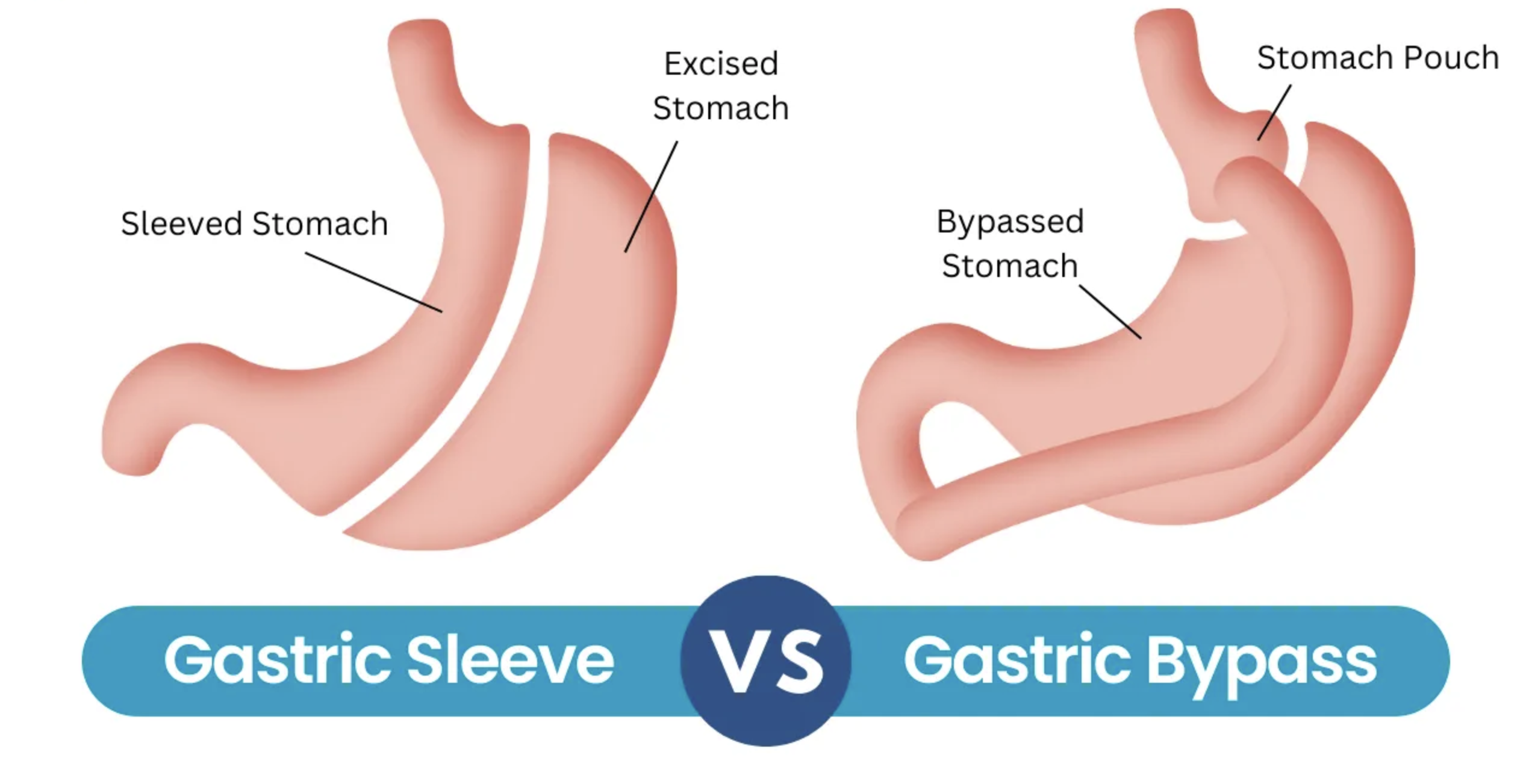
Gastric bypass vs gastric sleeve comes down to a trade: a bypass gives somewhat more weight loss on average and is kinder to acid reflux, while a sleeve is a simpler operation with fewer vitamin problems afterwards. Both are usually done by keyhole surgery, and both are permanent decisions.
The longest head-to-head evidence is a randomised trial that followed patients for 10 years. It found that people who had a bypass had lost 51.9% of their excess weight and people who had a sleeve 43.5%, and that inflammation of the oesophagus was far more common after a sleeve, according to the SLEEVEPASS trial published in JAMA Surgery. This guide compares the two operations on results, reflux, diabetes, risks, vitamins and reversibility, and explains how the choice is made at Carely Clinic.
Quick Summary:
- What is done: a sleeve removes about 80% of the stomach. A bypass makes a small stomach pouch and connects the small intestine to it.
- Weight loss: bypass gives more on average. At 10 years in a randomised trial, excess weight loss was 51.9% after bypass and 43.5% after sleeve.
- Reflux: a sleeve may cause or worsen reflux. A bypass usually helps it.
- Vitamins: both need supplements, and a bypass causes more vitamin and mineral shortages than a sleeve.
- Complexity: the sleeve is technically simpler and shorter. The bypass is more complex and had more complications in the month after surgery, according to the US National Institute of Diabetes and Digestive and Kidney Diseases.
- Reversibility: a sleeve cannot be reversed. A bypass is difficult to reverse.
- At Carely Clinic: gastric sleeve €2,600 and gastric bypass €2,750, all-inclusive in Istanbul, with the operation chosen by your surgeon and written in your treatment plan.
What Is the Difference Between Gastric Bypass and Gastric Sleeve?
A gastric sleeve (sleeve gastrectomy) changes only the stomach. Mayo Clinic says that in a sleeve gastrectomy about 80% of the stomach is removed, leaving a narrow tube, that it is usually done by laparoscopy through small cuts, and that the surgery usually takes about 1 to 3 hours with a hospital stay of 1 to 2 nights.
A gastric bypass changes the stomach and the route food takes. Mayo Clinic describes the Roux-en-Y gastric bypass as creating a small pouch from the stomach, then cutting the small intestine and sewing part of it directly onto the pouch, so that food skips most of the stomach and the first part of the small intestine. It says the surgery usually takes a few hours and the hospital stay is typically 1 to 2 days.
| Feature | Gastric sleeve | Gastric bypass (Roux-en-Y) |
|---|---|---|
| What is done | About 80% of the stomach is removed | Small stomach pouch, small intestine connected to it |
| Intestines changed? | No | Yes |
| Operating time (Mayo Clinic) | About 1 to 3 hours | A few hours |
| Hospital stay (Mayo Clinic) | 1 to 2 nights | Typically 1 to 2 days |
| Typical weight loss within two years (Mayo Clinic) | 25% to 30% of total body weight | About 70% or more of excess weight |
| Excess weight loss at 10 years (SLEEVEPASS) | 43.5% | 51.9% |
| Acid reflux | May cause or worsen it | Usually helps it |
| Vitamin and mineral shortages | A risk | More than after a sleeve |
| Dumping syndrome | Not on the Mayo Clinic risk list | A listed long-term risk |
| Can it be reversed? | No | Difficult |
One caution about the two Mayo Clinic weight-loss figures: they are not measured the same way. The sleeve figure is a share of total body weight and the bypass figure is a share of excess weight, so they cannot be compared directly. The 10-year trial figures in the next section use one measure for both operations.
Gastric Bypass vs Gastric Sleeve: Which Gives More Weight Loss?
Bypass, on average, but the gap is moderate. The SLEEVEPASS trial randomly assigned 240 adults to a sleeve (121 patients) or a Roux-en-Y bypass (119 patients) and followed them for 10 years.
| Result at 10 years | Gastric sleeve | Gastric bypass |
|---|---|---|
| Excess weight lost (estimated mean) | 43.5% | 51.9% |
| Difference | — | 8.4 percentage points more |
| Type 2 diabetes in remission | 26% | 33% (difference not statistically significant) |
| High blood pressure in remission | 8% | 24% |
The trial’s own conclusion was that excess weight loss was greater after bypass and the two procedures were not equivalent for weight loss, but that both resulted in good and sustainable weight loss. The US National Institute of Diabetes and Digestive and Kidney Diseases (NIDDK) reaches the same summary from other research: gastric bypass produced greater weight loss on average, but had more complications in the month after surgery.
Key Point
The difference between the two operations at 10 years was about 8 percentage points of excess weight. That is a real difference, but it is one factor among several: reflux, other health conditions and what the surgeon finds on assessment also count.
Which Is Better if You Have Acid Reflux?
Bypass. This is the clearest difference between the two operations. The American Society for Metabolic and Bariatric Surgery (ASMBS) lists among the disadvantages of the sleeve that it may worsen or cause new onset reflux and heartburn, and says of the bypass that the operation also helps patients with reflux and that symptoms often improve quickly.
The 10-year trial put numbers on it. Inflammation of the oesophagus (oesophagitis) was found in 31% of the sleeve group and 7% of the bypass group, and 64% of the sleeve group were taking acid-reducing medicine (a proton pump inhibitor) at 10 years, against 36% of the bypass group. If you already have reflux or a hiatal hernia, tell the surgeon; it is one of the main things that decides between the two.
Does Gastric Bypass or Gastric Sleeve Work Better for Type 2 Diabetes?
Both can put type 2 diabetes into remission, and the evidence for a difference is weaker than many websites claim. In SLEEVEPASS, 26% of sleeve patients with diabetes and 33% of bypass patients with diabetes were in remission at 10 years, a difference that was not statistically significant. ASMBS lists “less impact on metabolism compared to bypass procedures” as a disadvantage of the sleeve, and Mayo Clinic lists type 2 diabetes among the conditions that gastric bypass may improve. Your surgeon weighs your diabetes together with everything else.
What Are the Risks of Each Operation?
Both are major operations with the general risks of surgery: bleeding, infection, reactions to the anaesthetic, blood clots and leaks. The longer-term risks differ.
Gastric Sleeve Risks
Mayo Clinic lists these longer-term risks after a sleeve gastrectomy:
- gastroesophageal reflux disease or worsening heartburn
- low blood sugar (hypoglycaemia)
- vitamin and mineral deficiencies
- narrowing of the sleeve (stricture), hernia and bowel blockage
- ongoing nausea or vomiting
Gastric Bypass Risks
Mayo Clinic lists these longer-term risks after a gastric bypass:
- bowel obstruction
- dumping syndrome, which causes diarrhoea, nausea or vomiting
- gallstones or kidney stones
- hernias
- low blood sugar (hypoglycaemia)
- malnutrition
- ulcers, and a hole in the stomach (perforation)
ASMBS adds that the bypass is technically more complex than the sleeve, carries a risk of small bowel complications and obstruction, and a risk of ulcers, especially with anti-inflammatory painkillers or tobacco. NIDDK notes that bypass may increase the risk of alcohol use disorder.
Do You Need Vitamins for Life After Both?
Plan on it. Mayo Clinic says that after a sleeve gastrectomy you take vitamin supplements for life. After a bypass the need is greater: ASMBS says it causes more vitamin and mineral deficiencies than a sleeve, and NIDDK describes a higher chance of vitamin and iron shortage than with a sleeve. With either operation, regular blood tests with your own doctor are part of living with it.
Can Either Operation Be Reversed?
Not in any practical sense. NIDDK says plainly that a gastric sleeve cannot be reversed, because part of the stomach has been removed, and that a gastric bypass is difficult to reverse, although a surgeon may do it if medically necessary. Choose either operation as a permanent change.
Who Is a Better Candidate for a Sleeve, and Who for a Bypass?
Mayo Clinic gives slightly different BMI criteria on its two pages: for a sleeve, a BMI of 35 or higher, or 30 to 34.9 with a serious weight-related condition; for a bypass, a BMI of 40 or higher, or 35 to 39.9 with a serious weight-related condition. Within those ranges, the published sources point in these directions:
- Towards a bypass: existing acid reflux, and a wish for the larger average weight loss.
- Towards a sleeve: a preference for the simpler and shorter operation, no changes to the intestines, and a lower burden of vitamin shortages.
These are tendencies in the evidence, not rules. The decision belongs to the surgeon who has your history, your tests and, where it is done, the findings of an endoscopy before surgery.
All the bypass evidence in this article is about the Roux-en-Y gastric bypass. There is also a one-anastomosis (mini) gastric bypass, which the sources above do not cover.
What Carely Clinic Offers
At Carely Clinic in Istanbul both operations are done by keyhole surgery, and the choice between them is made by your surgeon after your assessment and written in your treatment plan before you travel. For a bypass, the surgeon also chooses between a Roux-en-Y and a one-anastomosis bypass.
| At Carely Clinic | Gastric sleeve | Gastric bypass |
|---|---|---|
| Price, all-inclusive | €2,600 | €2,750 |
| Hospital stay | 1 to 2 nights, as your surgeon decides | 1 to 2 nights, as your surgeon decides |
| Hotel | 5 nights in a 5-star hotel | 5 nights in a 5-star hotel |
| Follow-up | 12 months on WhatsApp | 12 months on WhatsApp |
- Included: the surgery, surgeon and anaesthetist fees, tests, hospital, hotel, VIP airport transfers, medications and a written, staged diet plan. Flights are not included.
- Tests: an ECG and chest X-ray, an endoscopy of the stomach before surgery, and a leak test before you leave hospital.
- Payment: no deposit or advance payment is required. You pay after your in-person consultation in Istanbul, and you may cancel at any time before treatment.
Prices are valid until December 2026. The full details are on our gastric sleeve in Turkey and gastric bypass in Turkey pages, in the weight loss surgery packages, and on our page about weight loss surgery costs in Turkey. For all the options, including procedures that are not surgery, see weight loss surgery in Turkey.
Gastric Bypass vs Gastric Sleeve Cost: Turkey vs the UK and the US
Prices as published on each provider’s own page, read in November 2026.
| Where | Gastric sleeve | Gastric bypass | What the price covers |
|---|---|---|---|
| Carely Clinic, Istanbul | €2,600 | €2,750 | Surgery, tests, 1 to 2 hospital nights, 5 hotel nights, transfers, 12 months of WhatsApp follow-up. Flights not included |
| Ramsay Health Care UK | From £10,495 | From £10,900 | 24 months of aftercare |
| Spire Bristol Hospital, UK | From £13,260 | Not listed on the page read | Pre-assessment tests, surgeon and anaesthetist fees, hospital stay, aftercare |
| Denver Health, Colorado, US | $11,337 | $15,920 | Up to a two-day hospital stay, surgeon and anaesthesia fees, first 90 days of care. The page lists about $1,621 of further costs |
| NKC Health, US | $13,050 | $18,050 | Hospital stay of up to three days, tests, follow-up visits to 3 months |
These prices are in three currencies and are not like for like: what each price covers differs, and a hospital in your own country follows you up in person close to home, which a clinic abroad cannot do. Sources: Ramsay Health Care UK price list, Spire Bristol Hospital, Denver Health self-pay prices and NKC Health.
In every row that lists both operations the bypass costs more than the sleeve: by €150 at Carely Clinic, £405 at Ramsay Health Care, $4,583 at Denver Health and $5,000 at NKC Health. At Carely Clinic the gap is small enough that cost should not decide between the two operations. Whichever you have, budget for what no surgery price includes: your flights, and the vitamin supplements and blood tests you will need at home in the years afterwards.
Frequently Asked Questions
What is the difference between gastric sleeve and gastric bypass?
A gastric sleeve removes about 80% of the stomach and leaves the intestines alone. A gastric bypass makes a small stomach pouch and connects the small intestine to it, so food skips most of the stomach. The bypass gives somewhat more weight loss and helps reflux; the sleeve is simpler and causes fewer vitamin shortages.
Which surgery results in more weight loss?
Gastric bypass, on average. In the SLEEVEPASS randomised trial, people had lost 51.9% of their excess weight 10 years after a bypass and 43.5% after a sleeve, a difference of 8.4 percentage points. The trial concluded that both operations gave good and sustainable weight loss.
Which is safer: gastric sleeve or gastric bypass?
Both are major operations. The US National Institute of Diabetes and Digestive and Kidney Diseases says gastric bypass had more complications in the month after surgery, and the surgical society ASMBS describes the sleeve as technically simpler. Over the long term each has its own risks: reflux after a sleeve, and bowel obstruction, ulcers and dumping syndrome after a bypass.
Which procedure is better for GERD or acid reflux?
Gastric bypass. ASMBS says a sleeve may worsen or cause reflux, while a bypass helps it. In the 10-year SLEEVEPASS trial, inflammation of the oesophagus was found in 31% of sleeve patients and 7% of bypass patients, and 64% against 36% were taking acid-reducing medicine.
Does gastric bypass or sleeve work better for type 2 diabetes?
The difference is smaller than often claimed. In the SLEEVEPASS trial, 33% of bypass patients and 26% of sleeve patients with type 2 diabetes were in remission at 10 years, and the difference was not statistically significant. ASMBS does say the sleeve has less impact on metabolism than bypass procedures.
What are the long-term risks of gastric bypass vs gastric sleeve?
Mayo Clinic lists reflux, low blood sugar, vitamin and mineral deficiencies, stricture and hernia after a sleeve. After a bypass it lists bowel obstruction, dumping syndrome, gallstones or kidney stones, hernias, low blood sugar, malnutrition and ulcers. Both need long-term vitamin supplements and blood tests.
What is dumping syndrome and which surgery causes it?
Dumping syndrome is a reaction after eating that Mayo Clinic describes as causing diarrhoea, nausea or vomiting. It is listed as a long-term risk of gastric bypass, and ASMBS also names it as a possible effect of bypass. It is not on the Mayo Clinic risk list for the gastric sleeve.
Do you need vitamins for life after gastric bypass and gastric sleeve?
Yes after a sleeve, and the need is greater after a bypass. Mayo Clinic says you take vitamin supplements for life after a sleeve gastrectomy. ASMBS says gastric bypass causes more vitamin and mineral deficiencies than a sleeve, so supplements and regular blood tests matter even more after a bypass.
How long is recovery from gastric bypass compared to gastric sleeve?
The hospital stay is similar. Mayo Clinic gives 1 to 2 nights after a sleeve and typically 1 to 2 days after a bypass. At Carely Clinic both operations mean 1 to 2 nights in hospital, as your surgeon decides, followed by 5 nights in a hotel in Istanbul, and you follow a written, staged diet plan after both.
Who is a better candidate for gastric bypass vs gastric sleeve?
It depends mainly on reflux, other health conditions and the surgeon’s assessment. Existing acid reflux points towards a bypass. A wish for the simpler operation and fewer vitamin shortages points towards a sleeve. The surgeon makes the recommendation after your tests, and at Carely Clinic it is written in your treatment plan.
How much does gastric bypass vs gastric sleeve cost in Turkey?
At Carely Clinic in Istanbul a gastric sleeve costs €2,600 and a gastric bypass €2,750, all-inclusive: surgery, tests, 1 to 2 nights in hospital, 5 nights in a 5-star hotel, VIP transfers, medications and 12 months of follow-up. Flights are not included. Prices are valid until December 2026.
Conclusion
Gastric bypass and gastric sleeve both produce large, lasting weight loss, and the 10-year trial that compared them directly found a real but moderate advantage for bypass: 51.9% against 43.5% of excess weight lost. The sharper difference is reflux, where the sleeve can make things worse and the bypass usually helps. Against that, the sleeve is the simpler operation and leaves the intestines untouched, with fewer vitamin shortages afterwards.
Neither operation can be undone in practice, so the choice deserves a proper assessment. Send us your height, weight, health history and medications, and you will receive a written treatment plan with the operation your surgeon recommends, the stay and the price.
Sources and disclaimer: the figures in this article come from the Mayo Clinic guides to sleeve gastrectomy (October 2026) and gastric bypass (November 2025), the US National Institute of Diabetes and Digestive and Kidney Diseases (reviewed September 2020), the American Society for Metabolic and Bariatric Surgery (updated May 2021) and the SLEEVEPASS randomised trial at 10 years (JAMA Surgery, 2022), all read in November 2026. This article provides general information and is not medical advice. Results and risks vary from person to person, and your own surgeon decides what is suitable for you.
Written by Carely Clinic Medical Team · Medically reviewed by Assoc. Prof. Dr. Gökmen Öztürk, general and bariatric surgeon · Last updated: November 2026