
Quick Summary
Closed rhinoplasty (endonasal rhinoplasty) is a surgical technique where all incisions are made inside the nostrils, eliminating visible external scarring and reducing recovery time by approximately 20-30% compared to open rhinoplasty.
According to peer-reviewed literature and clinical data, closed rhinoplasty offers faster healing with less postoperative swelling, making it ideal for patients requiring mild to moderate nasal refinement such as dorsal hump reduction, tip refinement, or bridge narrowing.
This comprehensive guide explains the closed rhinoplasty technique, its advantages over open rhinoplasty, ideal candidates, recovery timeline, costs, and how international patients can access this procedure at JCI-accredited facilities.
Why Trust This Guide
This guide synthesizes current clinical evidence from the American Society of Plastic Surgeons (ASPS), International Society of Aesthetic Plastic Surgery (ISAPS), peer-reviewed journals including Aesthetic Plastic Surgery and Aesthetic Surgery Journal, and the National Center for Biotechnology Information (NCBI). Our medical team regularly reviews rhinoplasty outcomes and maintains expertise in both open and closed surgical approaches, ensuring patients receive accurate, evidence-based information for informed decision-making.
What Is Closed Rhinoplasty?
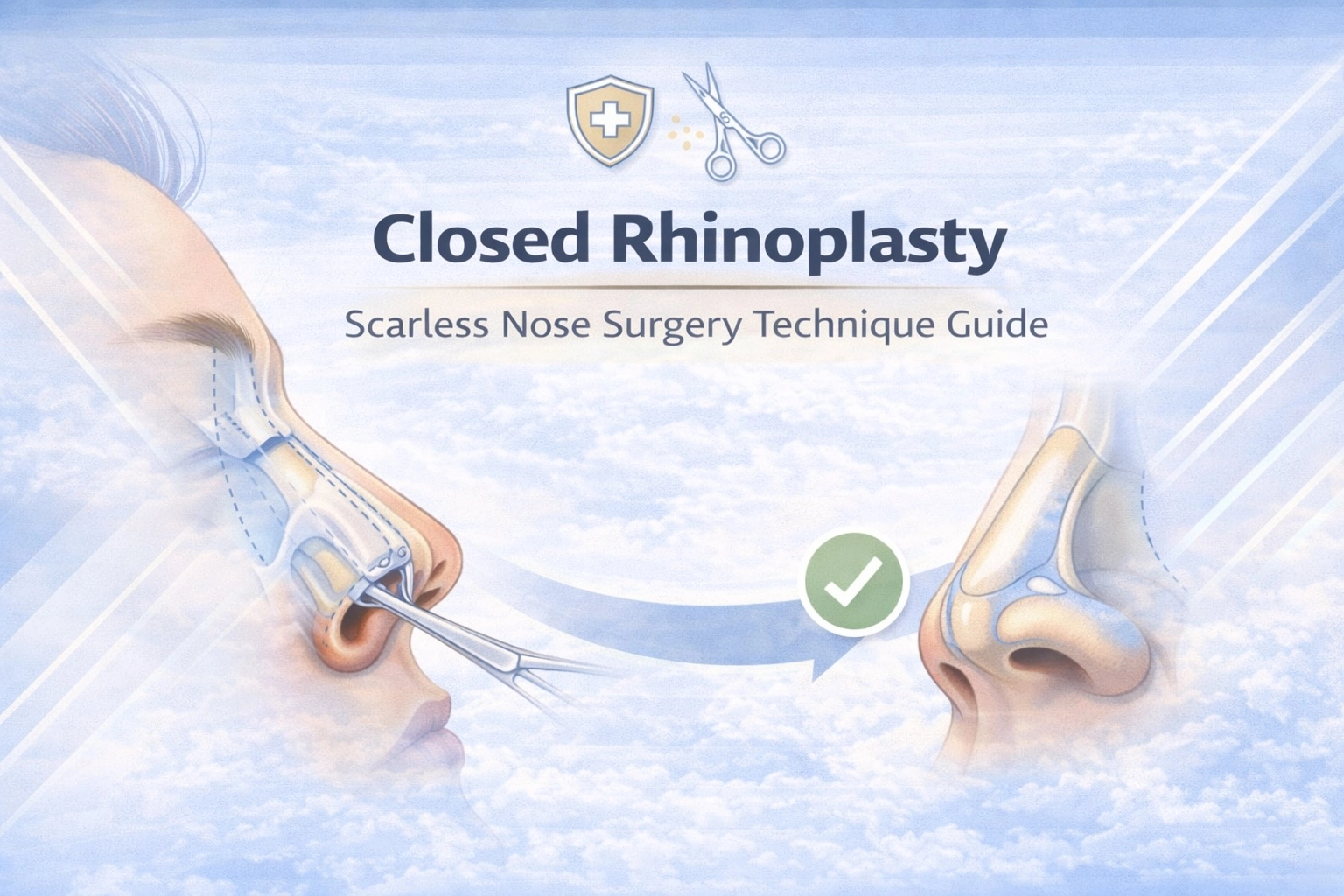
Closed rhinoplasty, also called endonasal rhinoplasty, involves making all surgical incisions inside the nostrils, leaving no visible external scars. The surgeon reshapes nasal bone, cartilage, and soft tissue through narrow nostril openings without lifting the nasal skin.
This technique has been practiced since the early origins of rhinoplasty surgery and remains a valuable approach for surgeons who have mastered working within limited visibility. According to StatPearls medical reference, the endonasal approach allows modification of the upper third of the nose, including osteotomies (controlled bone cuts) and dorsal hump reduction, while avoiding the columellar incision used in open techniques.
The procedure is particularly effective for addressing specific aesthetic concerns: refining the nasal tip, reducing a dorsal hump, narrowing the bridge, adjusting nostril width, and making subtle corrections to nasal asymmetry. Because the nasal skin remains attached to underlying structures, the natural support mechanisms of the nose are better preserved throughout surgery.
Modern closed rhinoplasty techniques have evolved significantly. Experienced surgeons now perform sophisticated tip suturing, cartilage grafting, and structural modifications through endonasal incisions that were previously thought to require open access. Research published in Aesthetic Plastic Surgery demonstrates that tip restructuring with intercrural sutures, septal extension grafts, and fixated tip grafts can be successfully achieved through the closed approach.
Closed vs Open Rhinoplasty: Key Differences
The primary difference between closed and open rhinoplasty lies in surgical access: closed rhinoplasty uses only internal nostril incisions, while open rhinoplasty adds a small external cut across the columella (the tissue between the nostrils) to fully expose the nasal framework.
Open rhinoplasty provides surgeons with complete visualization of all nasal structures, making it the preferred choice for complex reconstructive cases, significant asymmetry corrections, and revision surgeries. The enhanced visibility facilitates precise cartilage manipulation and accurate graft placement. However, this comes with tradeoffs: longer surgical duration, increased tissue disruption, and a small visible scar that typically fades over time.
Closed rhinoplasty offers distinct advantages when surgical goals can be achieved with limited access. The technique preserves more natural tip support structures, causes less tissue trauma, and typically results in faster resolution of postoperative swelling. Because the skin envelope remains attached, blood supply to the nasal tip is better maintained.
| Factor | Closed Rhinoplasty | Open Rhinoplasty |
|---|---|---|
| Incision Location | Inside nostrils only | Nostrils + columella (external) |
| Visible Scarring | None | Small scar (usually fades) |
| Surgery Duration | 30-90 minutes | 1.5-3 hours |
| Surgical Visibility | Limited (through nostrils) | Full nasal framework exposed |
| Swelling Duration | Resolves 20-30% faster | Can persist 6-12+ months |
| Tip Support | Better preserved | May require additional grafting |
| Best For | Mild-moderate corrections | Complex/revision cases |
| Return to Work | 5-7 days | 7-14 days |
A systematic review examining outcomes of open versus closed rhinoplasty found that both techniques demonstrate high patient and provider satisfaction, with no significant advantage between approaches when properly matched to patient needs. The choice ultimately depends on anatomical considerations, desired outcomes, and surgeon expertise.
Advantages of Closed Rhinoplasty
Closed rhinoplasty offers several compelling advantages that make it the preferred technique for many patients and surgeons when surgical goals permit its use.
No Visible Scarring. The most significant benefit is the complete absence of external incisions. All cuts are made within the nostril lining, ensuring no visible marks remain after healing. This is particularly important for patients who are concerned about any possibility of columellar scarring, even though open rhinoplasty scars typically fade to near-invisibility in skilled hands.
Faster Recovery and Less Swelling. Because closed rhinoplasty involves less tissue dissection and preserves blood supply to the nasal tip, postoperative swelling and bruising are generally less pronounced and resolve more quickly. Many patients report returning to work within one week, compared to the two-week recovery commonly recommended after open rhinoplasty. Research indicates swelling reduction can be 20-30% faster with the closed approach.
Preserved Natural Support. The closed technique maintains more of the native tip support mechanisms because the skin envelope remains attached to underlying cartilage. This preservation reduces the need for additional structural grafts solely to maintain tip position—grafts that might otherwise be required in open surgery simply to restore baseline support.
Shorter Surgical Time. Closed rhinoplasty typically requires 30-90 minutes compared to 1.5-3 hours for open procedures. The shorter operative time means less anesthesia exposure and potentially reduced surgical fees in some settings.
Maintained Blood Supply. By avoiding the columellar incision, the closed approach preserves the blood circulation pathway to the nasal tip. This can be particularly advantageous for patients with risk factors for healing complications, such as previous nasal surgery or a history of nasal filler injections.
Lower Complication Risk. Studies suggest the closed approach may carry slightly lower risks of certain complications, including temporary numbness and prolonged tip swelling. The less invasive nature reduces overall tissue trauma and associated healing challenges.
Expert Insight
“The open vs. closed debate often misses the point—what matters is matching technique to patient anatomy and goals. Closed rhinoplasty achieves excellent results when the surgical plan aligns with what endonasal access permits.”
— Adapted from clinical guidance, Facial Plastic Surgery Clinics of North America
Who Is an Ideal Candidate for Closed Rhinoplasty?
Closed rhinoplasty works best for patients with specific anatomical features and aesthetic goals that can be addressed without requiring full nasal framework exposure. Understanding candidacy criteria helps set realistic expectations.
Ideal candidates typically present with:
Mild to moderate dorsal hump requiring reduction. The closed approach effectively addresses nasal bridge bumps through internal access, using rasps or controlled osteotomies to smooth the profile.
Nasal tip refinement needs that don’t involve major structural reconstruction. Patients wanting subtle tip narrowing, improved projection, or correction of a mildly drooping tip often achieve excellent results through endonasal techniques.
Symmetrical nasal anatomy without significant structural deformities. Noses that are relatively balanced benefit most, as limited visibility makes asymmetry correction more challenging.
Wide nasal bridge requiring narrowing. Lateral osteotomies to narrow the bony vault can be performed effectively through closed access.
Patients seeking minor nostril adjustments. Alar base reduction and nostril reshaping can complement closed rhinoplasty procedures.
Previous rhinoplasty requiring minor refinements. Some revision cases involving small touch-ups or localized asymmetry can be addressed through the closed approach, though complex revisions typically require open surgery.
Closed rhinoplasty may not be suitable for:
Patients requiring extensive tip restructuring with complex grafting. Significant tip rotation, major projection changes, or substantial asymmetry correction typically requires the visibility that only open rhinoplasty provides.
Severe nasal asymmetry or structural deformities. Congenital abnormalities, cleft lip nose deformity, or significant trauma-related damage usually necessitate open access for adequate assessment and correction.
Major revision rhinoplasty cases. Noses that have undergone multiple previous surgeries often have scar tissue and altered anatomy that demands full exposure for safe, effective revision.
Patients with very thick skin. Thick nasal skin makes it difficult to see subtle structural changes, and the limited visibility of closed rhinoplasty compounds this challenge.
Complex cases requiring structural cartilage grafts. While some grafting is possible through closed access, cases requiring septal extension grafts, rib cartilage, or major tip grafts typically benefit from open visualization.
Your surgeon will determine the most appropriate approach based on detailed evaluation of your nasal anatomy, skin characteristics, previous surgical history, and specific aesthetic goals.
The Closed Rhinoplasty Procedure: Step by Step
Understanding what happens during closed rhinoplasty helps patients prepare mentally and know what to expect. Here is a typical procedural overview.
Pre-Operative Consultation
Before surgery, you will meet with your surgeon for comprehensive evaluation. This includes physical examination of your nasal structure, discussion of goals, review of medical history, and often computer imaging to visualize potential outcomes. Your surgeon will explain whether closed or open rhinoplasty best suits your needs.
Day of Surgery
Anesthesia: Closed rhinoplasty is performed under general anesthesia or local anesthesia with sedation, depending on the extent of modifications and patient preference. General anesthesia is more common for procedures involving osteotomies.
Incisions: The surgeon makes small incisions inside the nostrils—typically a combination of intercartilaginous incisions (between the upper and lower lateral cartilages) and transfixion incisions (through the septum). Through these internal openings, the surgeon accesses the nasal skeleton.
Cartilage and Bone Modification: Working through the narrow nostril openings, the surgeon reshapes cartilage using specialized instruments. For dorsal hump reduction, excess bone and cartilage are carefully removed or rasped smooth. Osteotomies (controlled bone fractures) narrow the nasal bridge when needed. Tip modifications are achieved through conservative cartilage trimming, suture techniques, and precise grafting when required.
Closure: After completing all modifications, dissolvable sutures close the internal incisions. External splints or casts are applied to support the newly shaped nose during initial healing.
Duration: The entire procedure typically takes 30-90 minutes, depending on complexity.
Immediate Post-Operative Care
You will recover in a monitored setting until anesthesia effects subside. Most patients go home the same day. Expect nasal packing or splints, which are removed within 5-7 days at your follow-up appointment.
Closed Rhinoplasty Recovery Timeline
Recovery from closed rhinoplasty follows a predictable pattern, though individual variation exists. The closed approach generally offers faster initial recovery compared to open rhinoplasty.
Days 1-3: Immediate Recovery
Expect moderate swelling and bruising, primarily around the eyes and cheeks. Nasal congestion is common due to internal swelling. Most patients manage discomfort with prescribed pain medication. Keep your head elevated, even while sleeping, to minimize swelling. Cold compresses around (not directly on) the nose help reduce bruising.
Days 4-7: Splint Removal
Swelling and bruising begin decreasing noticeably. Your surgeon removes the external splint/cast and any internal packing, usually around day 5-7. Many patients describe significant improvement once the splint is removed. At this point, your nose will still be swollen but should have a much-improved contour compared to before surgery.
Weeks 1-2: Return to Normal Activities
Most patients feel comfortable returning to work and light daily activities within 5-7 days following splint removal. Avoid strenuous exercise, bending over, and any activities that could result in nasal trauma. Minor residual bruising may be present but is typically concealable with makeup.
Weeks 2-4: Early Healing
Swelling continues decreasing gradually. You can usually resume moderate exercise by week 3-4, though contact sports should wait until cleared by your surgeon. The nose begins looking more natural as superficial swelling resolves.
Months 1-3: Intermediate Recovery
Approximately 80-90% of swelling has resolved. The nasal shape becomes more refined, and you will start seeing results closer to your final outcome. Subtle fluctuations in swelling are normal, often more noticeable in the morning.
Months 3-12: Final Results
Residual swelling in the tip (the last area to fully settle) continues resolving. Final results typically emerge between 6-12 months, though patients with thicker skin may require up to 18 months for complete resolution. The nose feels stronger and more natural to touch.
| Timeframe | Milestone | What to Expect |
|---|---|---|
| Days 1-3 | Peak swelling/bruising | Rest at home, head elevated, manage discomfort |
| Days 5-7 | Splint removal | Significant improvement visible, bruising fading |
| Week 2 | Return to work | Social presentable, light activities resume |
| Week 4 | Resume exercise | Moderate physical activity permitted |
| Month 3 | 80-90% swelling gone | Shape largely visible, minor fluctuations normal |
| Months 6-12 | Final results | Complete healing, definitive outcome |
Risks and Safety Considerations
Rhinoplasty is considered safe when performed by qualified, experienced surgeons at accredited facilities. However, like all surgical procedures, it carries inherent risks that patients should understand.
Overall Safety Profile. According to data published in Aesthetic Surgery Journal, the major complication rate for rhinoplasty is approximately 0.7%, based on analysis of nearly 5,000 patients. The most common complications were hematoma (0.2%), infection (0.2%), and pulmonary complications (0.1%). Serious systemic or life-threatening complications are estimated at 1.7-5% of cases, though rates at accredited facilities with experienced surgeons are typically lower.
Revision Surgery Rates. Published revision rates for rhinoplasty range from 5% for tip-focused procedures to 15% for complex revision cases. Factors associated with higher revision rates include previous nasal surgery, uncorrected underlying septal deformities, and postoperative complications like infection.
Specific Risks of Rhinoplasty:
Temporary numbness in the nasal tip or upper lip, which typically resolves within weeks to months.
Persistent swelling, particularly in patients with thick skin, which may take 12-18 months to fully resolve.
Asymmetry or irregularities that may require revision surgery.
Breathing difficulties if nasal valves or septum are inadvertently affected.
Dissatisfaction with aesthetic results, highlighting the importance of realistic expectations and clear communication with your surgeon.
Rare but serious complications including infection, septal perforation, bleeding, and adverse anesthesia reactions.
Closed Rhinoplasty-Specific Considerations. The closed approach may carry slightly lower risk of certain complications due to reduced tissue trauma. However, limited visibility increases the technical demands on the surgeon, making expertise in endonasal techniques particularly important.
Minimizing Risks:
Choose a board-certified plastic surgeon or facial plastic surgeon with extensive rhinoplasty experience. Verify credentials through organizations like ASPS, ISAPS, or national plastic surgery boards.
Select accredited facilities. JCI-accredited hospitals maintain international standards for safety, infection control, and quality.
Disclose complete medical history including previous surgeries, medications, supplements, and smoking history.
Follow all pre- and post-operative instructions carefully.
Maintain realistic expectations and ensure your goals align with what surgery can achieve.
Closed Rhinoplasty Cost by Country
Rhinoplasty costs vary significantly worldwide, influenced by surgeon experience, facility standards, geographic location, and what is included in quoted prices. Understanding these variations helps patients make informed decisions.
United States: Rhinoplasty costs range from $6,000 to $15,000 for surgeon fees alone, with total costs (including anesthesia, facility fees, and medications) reaching $12,000-$25,000 in major metropolitan areas. According to ASPS data, the average surgeon fee is approximately $6,500, but this excludes substantial additional costs.
United Kingdom: Private rhinoplasty ranges from £5,000-£10,000 (approximately $6,500-$13,000), with London clinics typically at the higher end. NHS rarely covers cosmetic rhinoplasty.
Turkey: All-inclusive rhinoplasty packages range from €2,500-€5,000 ($2,700-$5,500), typically including surgeon fees, hospital stay, anesthesia, medications, hotel accommodation (3-5 nights), airport transfers, and follow-up care. This represents 50-70% savings compared to US and UK prices.
Other Destinations: Mexico ($3,000-$6,000), South Korea ($5,000-$10,000), and Thailand ($3,000-$6,000) also offer competitive pricing for international patients.
| Country | Price Range | What’s Typically Included |
|---|---|---|
| USA | $12,000-$25,000 | Surgery, anesthesia, facility; excludes hotel/travel |
| UK | £5,000-£10,000 | Surgery, consultation, aftercare; excludes accommodation |
| Turkey | €2,500-€5,000 | All-inclusive: surgery, hotel, transfers, aftercare |
| Mexico | $3,000-$6,000 | Variable; some packages include accommodation |
| South Korea | $5,000-$10,000 | Surgery and consultation; packages vary |
Why Turkey Costs Less:
Lower operating costs including labor, facilities, and overhead compared to Western countries.
Favorable exchange rates benefiting international patients paying in USD, EUR, or GBP.
Government support for medical tourism through infrastructure investment and regulatory frameworks.
High surgical volume enabling efficiency without compromising quality.
Competitive market among qualified providers driving value.
Important: Lower prices do not necessarily indicate lower quality. Many Turkish surgeons trained in Europe and the United States, operate in JCI-accredited facilities, and perform hundreds of rhinoplasties annually—giving them experience levels that often exceed Western counterparts.
How This Applies in Turkey
International guidelines and surgical techniques for closed rhinoplasty apply equally at Turkey’s JCI-accredited facilities. Turkish hospitals follow identical clinical protocols and safety standards as American and European institutions, with many surgeons holding international board certifications.
Turkey has emerged as one of the world’s leading destinations for rhinoplasty, with ISAPS data confirming it among the top three countries globally for procedure volume. This high volume translates to substantial surgeon experience—many Turkish rhinoplasty specialists perform 200-400 or more procedures annually, developing refined skills through extensive practice.
The cost advantage is significant without compromising quality. Closed rhinoplasty in Turkey typically costs €2,500-€4,000 compared to $12,000-$25,000 in the USA and £5,000-£10,000 in the UK—representing savings of 60-75%. These packages are comprehensive, including pre-operative consultations and testing, surgical fees and anesthesia, hospital stay (typically one night for monitoring), hotel accommodation (3-5 nights), airport transfers and local transportation, medications and post-operative supplies, and follow-up appointments before departure.
Turkey’s geographic position at the crossroads of Europe, Asia, and the Middle East means surgeons have extensive experience with diverse nasal anatomies and ethnic rhinoplasty requirements. Istanbul’s international airports offer direct connections to over 120 countries, making travel logistics straightforward for international patients.
At Carely Clinic in Istanbul, closed rhinoplasty is performed by board-certified surgeons at JCI-accredited partner hospitals. Patients receive personalized assessment to determine whether closed or open rhinoplasty best suits their goals, with complete transparency about expected outcomes and realistic timelines. All-inclusive packages ensure a seamless experience from initial consultation through recovery and follow-up.
Learn more about Rhinoplasty at Carely Clinic.
Summary Comparison Table
| Aspect | Closed Rhinoplasty Details |
|---|---|
| Alternative Names | Endonasal rhinoplasty, scarless rhinoplasty, internal rhinoplasty |
| Incisions | Inside nostrils only; no external cuts |
| Visible Scarring | None |
| Surgery Duration | 30-90 minutes |
| Anesthesia | General or local with sedation |
| Hospital Stay | Day surgery or 1 night observation |
| Splint Duration | 5-7 days |
| Return to Work | 5-7 days after splint removal |
| Resume Exercise | 3-4 weeks (light); 6 weeks (strenuous) |
| Final Results | 6-12 months (up to 18 months for thick skin) |
| Ideal Candidates | Mild-moderate hump reduction, tip refinement, bridge narrowing |
| Not Recommended For | Complex revisions, severe asymmetry, major structural grafting |
| Turkey Cost | €2,500-€5,000 all-inclusive |
| USA/UK Cost | $12,000-$25,000 / £5,000-£10,000 |
| Major Complication Rate | Approximately 0.7% at accredited centers |
Frequently Asked Questions
Is closed rhinoplasty better than open rhinoplasty?
Neither technique is universally better—the right choice depends on your anatomy and surgical goals. Closed rhinoplasty suits mild-moderate corrections with no visible scarring and 20-30% faster recovery. Open rhinoplasty provides better access for complex cases requiring extensive tip restructuring or revision surgery.
Will I have any visible scars after closed rhinoplasty?
No, closed rhinoplasty leaves zero visible scars because all incisions are made inside the nostrils. This complete absence of external scarring is the primary advantage over open rhinoplasty, which creates a small columellar scar.
How long does closed rhinoplasty surgery take?
Closed rhinoplasty typically takes 30-90 minutes depending on procedure complexity. This is significantly shorter than open rhinoplasty which requires 1.5-3 hours due to additional tissue dissection and columellar incision steps.
When can I return to work after closed rhinoplasty?
Most patients return to work within 5-7 days after splint removal (typically one week post-surgery). This faster recovery compares favorably to open rhinoplasty requiring 10-14 days off work. Avoid strenuous activities and heavy lifting for 4-6 weeks.
How long until I see final results from closed rhinoplasty?
Final results emerge at 6-12 months, though 80-90% of swelling resolves by 3 months. Patients with thick nasal skin may require up to 18 months for complete resolution of subtle tip swelling. Initial improvement is visible immediately after splint removal at one week.
Can closed rhinoplasty fix a deviated septum?
Yes, closed rhinoplasty can be combined with septoplasty to address both aesthetic concerns and breathing difficulties from a deviated septum. The septum is fully accessible through endonasal incisions, allowing simultaneous correction of deviation and external reshaping.
Is closed rhinoplasty suitable for ethnic rhinoplasty?
Closed rhinoplasty works well for ethnic rhinoplasty when goals involve subtle refinement while preserving ethnic identity. Procedures requiring significant augmentation (common in Asian or African rhinoplasty for bridge building) may benefit from open approach visibility for precise graft placement.
What is the success rate of closed rhinoplasty?
Closed rhinoplasty achieves 80-90% patient satisfaction when performed by experienced surgeons on properly selected candidates. Success depends on realistic expectations, appropriate technique selection, surgeon expertise with endonasal methods, and careful post-operative compliance.
Can closed rhinoplasty be performed as a revision surgery?
Minor revision surgery for small asymmetries, localized irregularities, or subtle refinements can sometimes be addressed through closed rhinoplasty. However, complex revision cases involving significant structural issues, extensive scar tissue, or prior complications typically require open rhinoplasty for safe correction.
Why is rhinoplasty cheaper in Turkey than the USA or UK?
Turkey offers 60-75% lower costs due to reduced operating overhead, favorable exchange rates, government medical tourism investment, and high surgical volumes. Quality remains high—Turkey has 40+ JCI-accredited hospitals, and many surgeons trained internationally while performing 200-400+ procedures annually.
How do I know if I’m a good candidate for closed rhinoplasty?
Good candidates want mild-moderate changes (hump reduction, tip refinement, bridge narrowing), have relatively symmetrical noses without major structural deformities, and maintain realistic expectations. A consultation with an experienced rhinoplasty surgeon provides personalized candidacy assessment.
Is closed rhinoplasty permanent?
Yes, closed rhinoplasty produces permanent results because structural changes to bone and cartilage are lasting. Unlike non-surgical rhinoplasty using temporary fillers that dissolve within 12-18 months, surgical rhinoplasty provides definitive lifelong improvement, though natural aging continues.
Conclusion
Closed rhinoplasty offers an effective, scarless approach to nasal refinement for carefully selected patients. The technique’s advantages—no visible scarring, faster recovery, preserved natural support structures, and shorter surgical time—make it an attractive option for those seeking mild to moderate improvements to their nasal appearance.
The key to successful outcomes lies in matching technique to patient needs. Experienced surgeons evaluate each patient’s anatomy, skin characteristics, and goals to determine whether closed or open rhinoplasty will deliver optimal results. When closed rhinoplasty is appropriate, patients can expect natural-looking improvements with minimal visible evidence of surgery.
For international patients considering rhinoplasty in Turkey, JCI-accredited facilities offer the same clinical standards as Western hospitals at 50-70% lower cost. All-inclusive packages simplify the medical travel experience, covering surgery, accommodation, transfers, and aftercare in one transparent price.
Individual requirements and outcomes vary. This guide provides general information based on current clinical evidence and international guidelines. Consult qualified medical professionals for personalized advice specific to your situation.
If you’re considering closed rhinoplasty and would like to explore your options with experienced surgeons, contact Carely Clinic for a personalized consultation and treatment plan.