
Quick Summary
Middle Eastern rhinoplasty is a specialized ethnic nose surgery that reshapes distinctive nasal features—including dorsal humps, thick skin, and drooping tips—while preserving cultural identity and facial harmony.
According to PMC research, this procedure requires precise techniques tailored to thicker skin envelopes and weaker lower lateral cartilages common in Middle Eastern patients.
This guide covers candidacy, techniques, recovery, costs, and how Turkey has become a leading destination for ethnic rhinoplasty with savings of 50-70% compared to Western countries.
Why Trust This Guide
This comprehensive resource draws from peer-reviewed medical literature published in journals including Plastic and Reconstructive Surgery, clinical guidelines from the American Society of Plastic Surgeons (ASPS), and global statistics from the International Society of Aesthetic Plastic Surgery (ISAPS).
Our editorial team collaborates with board-certified facial plastic surgeons who specialize in ethnic rhinoplasty, ensuring all information reflects current best practices and evidence-based techniques used at JCI-accredited facilities.
What Is Middle Eastern Rhinoplasty?
Middle Eastern rhinoplasty is an ethnic rhinoplasty subspecialty designed to enhance nasal aesthetics while preserving the cultural characteristics that define Middle Eastern, Arab, Persian, Turkish, and Armenian facial features.
This specialized procedure differs fundamentally from standard rhinoplasty approaches developed for Caucasian patients. Surgeons must understand that applying traditional reduction techniques to Middle Eastern noses can result in “racial incongruity”—an unnatural appearance that erases ethnic identity rather than enhancing natural beauty. The goal is refinement that maintains recognizable heritage features.
Middle Eastern rhinoplasty addresses both cosmetic concerns and functional issues simultaneously. Many patients seek improvement in breathing alongside aesthetic enhancement, making this a dual-purpose procedure that requires expertise in both structural reconstruction and artistic nasal shaping.
The procedure has become increasingly popular globally. According to the ISAPS 2024 Global Survey, over 1 million rhinoplasties were performed worldwide, with face and head procedures showing 4.3% growth from the previous year. Middle Eastern patients represent a significant portion of this market, particularly those seeking treatment at specialized ethnic rhinoplasty centers.
Unique Characteristics of Middle Eastern Noses
Middle Eastern noses present several anatomical features that require specialized surgical approaches, making standard rhinoplasty techniques often inadequate for achieving optimal results.
Patients of Middle Eastern descent commonly present with distinct characteristics that influence both surgical planning and expected outcomes. Understanding these features is essential for surgeons and patients alike when setting realistic expectations for the procedure.
Thick Nasal Skin Envelope
The skin overlying Middle Eastern noses tends to be significantly thicker than in Caucasian patients, particularly at the nasal tip. This thickness can limit definition achievable through surgery and requires specialized tip refinement techniques. Surgeons often need to create stronger underlying cartilage frameworks to provide visible definition through thicker skin coverage.
Thicker skin presents both challenges and advantages. While it can mask surgical refinements, it also helps conceal minor irregularities and provides better long-term structural support. Recovery timelines extend longer in thick-skinned patients, with final results sometimes taking 12-18 months to fully manifest.
Dorsal Hump
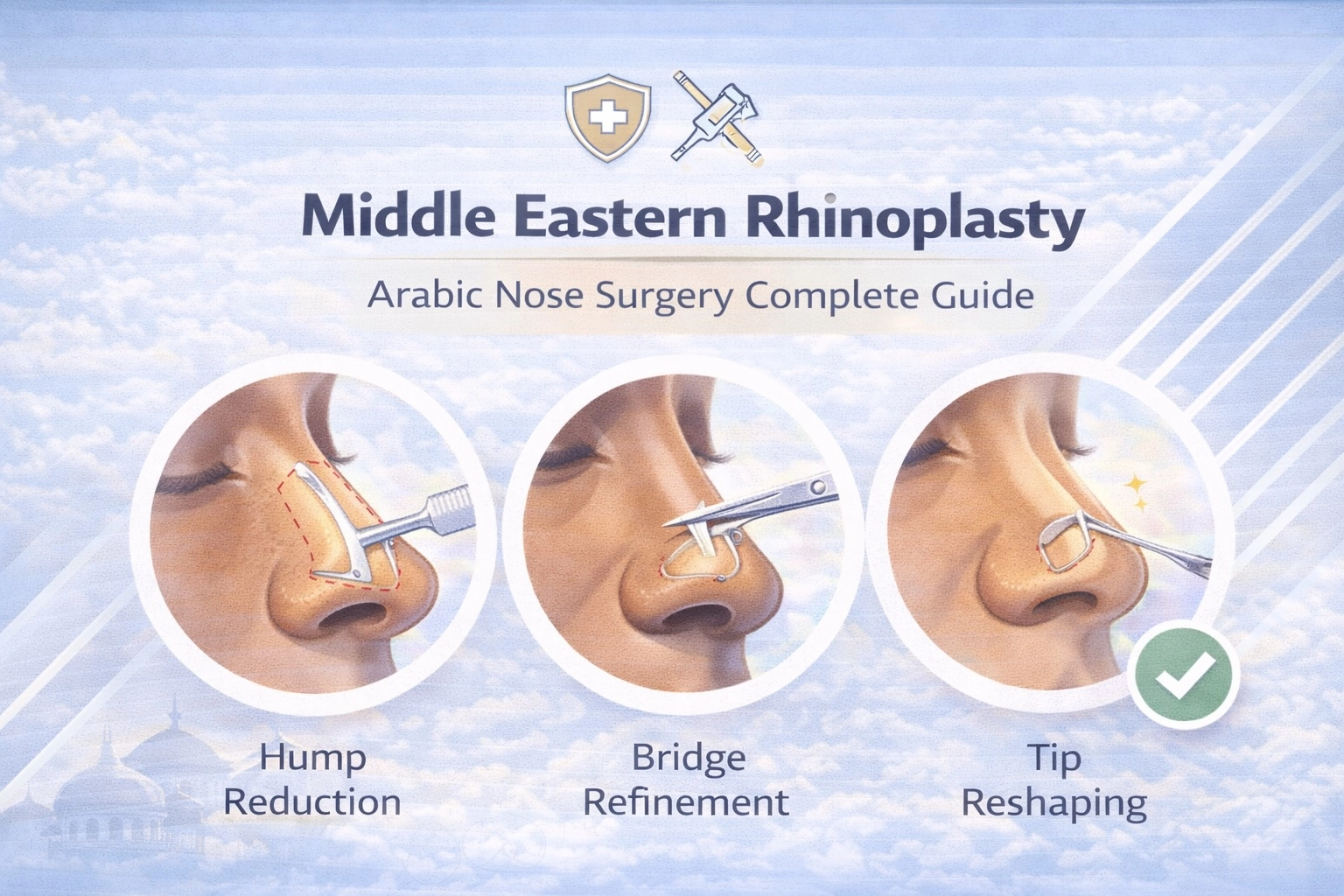
A prominent dorsal hump—the bump on the nasal bridge visible from the profile view—is one of the most common concerns among Middle Eastern rhinoplasty patients. This cartilaginous and bony convexity often draws significant attention from patients seeking profile refinement.
Modern techniques focus on conservative hump reduction rather than aggressive removal. Many patients prefer maintaining a straight dorsum rather than creating the “scooped” appearance that can look unnatural on Middle Eastern faces. This preference varies between male and female patients, with men typically desiring stronger, more masculine profiles.
Drooping Nasal Tip
Middle Eastern noses frequently feature a tip that droops during rest and drops further with smiling due to weak lower lateral cartilages. This dynamic tip ptosis creates the appearance of a longer nose and can significantly impact facial harmony.
Tip support techniques using cartilage grafts and specialized suturing methods address this concern while maintaining natural tip movement. Overcorrection creating an “over-rotated” tip is a common pitfall that skilled ethnic rhinoplasty surgeons carefully avoid.
Weak Cartilage Framework
The underlying cartilage structure in Middle Eastern noses is often weaker and thinner than in other ethnicities, contributing to tip ptosis and limiting natural projection. Combined with thick overlying skin, this creates a challenging combination requiring structural augmentation.
Cartilage grafting from the septum, ear, or rib becomes essential for building adequate support. These grafts provide the structural foundation necessary to achieve definition visible through thicker skin envelopes.
Wide Nostrils and Alar Base
Alar flaring—widening of the nostrils at the base—is common in Middle Eastern patients. Alarplasty techniques can narrow the nostril base when desired, though conservative approaches prevent an overly pinched appearance that would look unnatural.
Candidacy and Eligibility Requirements
Ideal candidates for Middle Eastern rhinoplasty must meet physical, psychological, and health criteria to ensure safe surgery and satisfactory outcomes.
The evaluation process assesses multiple factors beyond simply expressing desire for nasal improvement. Surgeons conduct thorough assessments to identify appropriate candidates while screening out those for whom surgery may not be advisable.
Age Requirements
Facial maturity must be complete before undergoing rhinoplasty. For females, the nose typically finishes developing around age 15-16, while males reach full nasal maturity between ages 17-18. Surgery performed before growth completion can result in unpredictable changes as development continues.
There is no maximum age limit for rhinoplasty, provided patients maintain good overall health. Patients in their 40s, 50s, and beyond can achieve excellent results, though healing may proceed more slowly and skin elasticity changes affect surgical planning.
Physical Health Criteria
Candidates should be in good general health without uncontrolled medical conditions that could increase surgical risks or impair healing. Conditions requiring evaluation include diabetes, hypertension, bleeding disorders, and autoimmune diseases.
Non-smokers achieve significantly better outcomes than smokers. Nicotine restricts blood flow, impairing healing and increasing complication risks. Surgeons require smoking cessation at least 4 weeks before surgery and during the recovery period.
Psychological Readiness
Emotional maturity and realistic expectations are essential for patient satisfaction. Candidates should understand that rhinoplasty enhances rather than perfects, and that results may not match idealized images or celebrity comparisons.
Patients should pursue surgery for personal reasons rather than external pressure. Body dysmorphic disorder and unrealistic expectations are contraindications that responsible surgeons screen for during consultations.
Functional Considerations
Many Middle Eastern rhinoplasty candidates have concurrent breathing issues—deviated septum, enlarged turbinates, or nasal valve collapse—that can be addressed simultaneously. This functional component may partially or fully justify the procedure beyond purely cosmetic goals.
| Criterion | Requirement | Notes |
|---|---|---|
| Minimum Age | 15-16 (females), 17-18 (males) | Facial growth must be complete |
| Maximum Age | No strict limit | Good health required; healing slower with age |
| Smoking Status | Non-smoker preferred | Cessation 4+ weeks before surgery required |
| Health Status | Good general health | Chronic conditions evaluated individually |
| Expectations | Realistic goals | Enhancement not perfection |
| Parental Consent | Required under 18 | Legal requirement for minors |
Surgical Techniques for Middle Eastern Rhinoplasty
Middle Eastern rhinoplasty employs specialized surgical approaches that differ significantly from standard rhinoplasty techniques developed for Caucasian patients, requiring cartilage grafting and structural reinforcement.
The complexity of ethnic rhinoplasty often necessitates an open surgical approach for optimal visualization and precision. Surgeons must balance reduction with augmentation, often adding structure in some areas while refining others.
Open vs. Closed Approach
Open rhinoplasty, performed through a small columellar incision, provides superior visualization for the complex structural work typical in Middle Eastern cases. This approach allows direct access to cartilage frameworks and enables precise graft placement.
Closed rhinoplasty, using only internal incisions, remains viable for simpler cases but limits the surgeon’s ability to address multiple concerns simultaneously. Most experienced ethnic rhinoplasty specialists prefer the open approach despite the minimal external scar.
Dorsal Hump Reduction
Conservative hump reduction respects the ethnic profile while achieving balanced aesthetics. Modern preservation rhinoplasty techniques reshape the dorsum without completely removing the hump, maintaining some natural bridge prominence that suits Middle Eastern facial proportions.
Traditional reduction techniques involved removing cartilage and bone, then reconstructing the “open roof” created. Preservation approaches instead push down or laterally mobilize structures, maintaining internal support and reducing complications.
Cartilage Grafting Techniques
Structural grafting is fundamental to Middle Eastern rhinoplasty success. The weaker native cartilage combined with thick skin necessitates building stronger frameworks to achieve visible definition.
Common graft sources include septal cartilage as the primary source for straightforward cases, ear (auricular) cartilage for softer tip refinements, and rib cartilage for major structural reconstruction in complex or revision cases.
Specific graft applications include columellar struts for tip support, spreader grafts for middle vault reconstruction, shield grafts for tip projection, and alar contour grafts for nostril shaping.
Tip Refinement
Bulbous tip correction in thick-skinned patients requires strategic approaches that create visible improvement despite limited skin retraction. Tip suturing techniques combined with structural grafts achieve projection and definition.
Conservative approaches prevent the “pinched” tip appearance that results from overcorrection. Maintaining some tip width often produces more natural results than aggressive narrowing.
Alar Base Reduction
Alarplasty narrows wide nostrils through strategic tissue removal at the nostril base. Incisions are carefully placed within natural creases to minimize visible scarring.
This component is performed conservatively to maintain proportionality with other facial features. Excessive narrowing creates an unnatural appearance that cannot be easily corrected.
Expert Insight
“The key to natural-looking Middle Eastern rhinoplasty is conservative refinement that maintains ethnic character. Overcorrection with aggressive tip narrowing or excessive hump removal produces ‘operated’ appearances that patients regret.”
— PMC Published Review: Middle Eastern Rhinoplasty Update
Piezo Ultrasonic Technology
Piezo ultrasonic rhinoplasty uses high-frequency sound waves to precisely sculpt nasal bones with minimal trauma to surrounding soft tissues, reducing bruising and accelerating recovery.
This advanced technology has transformed nasal bone reshaping, offering significant advantages over traditional hammer-and-chisel techniques that have been used for decades.
How Piezo Technology Works
The piezoelectric device converts electrical energy into precise ultrasonic vibrations that cut bone without affecting soft tissue. This selective action occurs because bone density allows energy transmission while softer tissues remain unaffected.
Surgeons operate under direct visualization, precisely shaping bone rather than making blind cuts. This precision enables controlled modifications that traditional instruments cannot achieve.
Advantages Over Traditional Methods
Reduced bleeding results from selective bone cutting that spares blood vessels in surrounding tissues. Patients experience less dramatic bruising than with conventional osteotomes.
Decreased swelling follows the reduced trauma to soft tissues, with some studies suggesting 20-30% less postoperative edema. This translates to faster visible recovery and earlier return to normal activities.
Enhanced precision allows surgeons to sculpt rather than simply fracture nasal bones, creating smoother contours and more predictable outcomes. Accidental fracture extensions and splintering are significantly reduced.
Faster recovery means patients often have minimal bruising by the time splints are removed at one week, compared to persistent discoloration lasting 2-3 weeks with traditional techniques.
Ideal Candidates for Piezo Rhinoplasty
Patients requiring dorsal hump reduction benefit most from piezo technology, as bone reshaping represents its primary advantage. Those with thick bones or those undergoing revision surgery with previously altered anatomy also benefit from enhanced precision.
Piezo technology does not address cartilage or soft tissue concerns—these require traditional suturing and grafting techniques. Tip refinement, for instance, relies on conventional methods regardless of whether piezo is used for bony work.
Cost Considerations
Piezo rhinoplasty typically costs €200-€500 more than traditional approaches due to specialized equipment requirements and additional operating time. Many patients consider this premium worthwhile given the recovery advantages.
Recovery Timeline
Full recovery from Middle Eastern rhinoplasty takes 12-18 months for final results, though most patients return to work within 1-2 weeks and social activities within 2-3 weeks.
Thick skin characteristic of Middle Eastern patients extends swelling duration compared to thinner-skinned patients. Understanding this timeline helps set appropriate expectations and prevent premature concerns about results.
First Week: Acute Recovery
Swelling and bruising peak within 48-72 hours after surgery, with significant facial puffiness around the nose and eyes. A nasal splint protects the healing structures during this critical period.
Pain is typically moderate and well-controlled with prescribed medications. Most patients describe discomfort rather than severe pain, with symptoms improving daily.
Breathing through the nose is restricted due to internal swelling and possible splints. Mouth breathing is normal during this period. Rest with head elevated reduces swelling accumulation.
Week Two: Splint Removal
External splints and sutures are typically removed 7-10 days after surgery. This milestone reveals the nose’s new shape, though significant swelling obscures final results.
Bruising transitions from purple to yellow-green before fading, usually resolving by the end of week two. Some patients feel comfortable returning to work at this stage, while others prefer additional recovery time.
Weeks 2-4: Early Recovery
Major swelling subsides significantly during this period, though residual puffiness remains apparent to the patient. Social activities can typically resume, with makeup helping conceal any remaining discoloration.
Light walking and gentle activity are encouraged to promote circulation, while strenuous exercise, heavy lifting, and contact sports must wait. Nasal bones remain vulnerable to displacement.
Months 1-3: Intermediate Recovery
The nose continues refining as deeper swelling resolves. Patients notice progressive improvement in definition, particularly along the bridge and upper nose.
Strenuous exercise typically resumes at 6 weeks when bone healing is adequate. Glasses should rest on the forehead or use protective devices rather than directly contacting the nasal bridge.
Months 3-6: Advanced Healing
Most swelling has resolved by this stage, with the nose appearing close to its final shape. Subtle refinement continues, particularly at the nasal tip where residual edema persists longest.
Numbness and unusual sensations in the nasal tip gradually resolve. Some patients notice intermittent mild swelling with heat, alcohol, or salt intake.
Months 6-12+: Final Results
The nasal tip, which holds swelling longest in thick-skinned patients, achieves final definition during this period. Complete resolution may extend to 18 months in some cases.
Final photographs and outcome assessments occur at the one-year mark, when the healing process is considered complete and the nose has settled into its permanent shape.
| Timeframe | Milestone | What to Expect |
|---|---|---|
| Days 1-3 | Peak swelling | Maximum puffiness, rest with head elevated |
| Days 7-10 | Splint removal | First view of new shape; sutures removed |
| Week 2 | Bruising resolves | Most patients comfortable in public |
| Week 4 | Major swelling down | 50%+ swelling resolved; light activity resumes |
| Week 6 | Bone healing complete | Resume strenuous exercise; glasses allowed |
| Months 3-6 | Bridge definition | Upper nose approaches final shape |
| Months 6-12 | Tip refinement | Final tip definition in thick skin |
| 12-18 months | Complete healing | Final results achieved; permanent shape |
Safety and Complication Rates
Rhinoplasty is considered a safe procedure with mortality rates comparable to gallbladder removal surgery, though complications requiring revision occur in 5-15% of cases according to peer-reviewed literature.
Understanding realistic risk profiles helps patients make informed decisions while maintaining appropriate expectations about surgical outcomes.
General Safety Profile
Rhinoplasty mortality is extremely rare, with rates reported at 0.03-0.1% at accredited surgical facilities. This makes nose surgery one of the safer plastic surgery procedures when performed by qualified surgeons in appropriate settings.
Major complications including infection, significant bleeding, and anesthesia-related events occur in approximately 2-3% of cases. These rates decrease further when surgery is performed at JCI-accredited facilities with comprehensive safety protocols.
Common Complications
Minor complications occurring in a larger percentage of patients include prolonged swelling, temporary numbness, and minor asymmetries. These typically resolve without intervention during the normal healing period.
Wound infection rates following rhinoplasty are generally quoted at less than 2% according to medical literature. Antibiotic protocols and sterile technique minimize this risk.
Revision Rates
Postoperative deformities requiring revision surgery occur in 5-15% of rhinoplasty cases according to published studies. The most common indication for revision is “pollybeak deformity,” representing approximately 50% of revision rhinoplasty cases.
Ethnic rhinoplasty may carry slightly higher revision rates due to its technical complexity and the challenges of achieving definition through thick skin. Choosing an experienced ethnic rhinoplasty specialist reduces this risk.
Functional Considerations
Breathing disturbances are reported in a significant percentage of revision rhinoplasty patients according to research, highlighting the importance of initial surgery done correctly. Functional assessment during primary rhinoplasty helps prevent these issues.
Risk Mitigation
Selecting a board-certified facial plastic surgeon with specific ethnic rhinoplasty experience is the most significant factor in reducing complication risk. Verifying hospital accreditation, reviewing before-and-after photographs, and ensuring realistic expectations further contribute to safe outcomes.
Expert Insight
“Patient selection is considered the most critical predictor of operative success and the most effective means of avoiding complications. Thorough consultation and honest discussion of limitations significantly improve outcomes.”
— PubMed: Rhinoplasty StatPearls, 2024
Middle Eastern Rhinoplasty Cost Comparison
Middle Eastern rhinoplasty costs €2,500-€4,500 in Turkey compared to $12,000-$25,000 in the USA and £10,000-£16,000 in the UK, representing 60-75% savings while maintaining equivalent quality standards.
Understanding price variations helps patients make informed decisions about where to pursue treatment. Cost differences reflect economic factors rather than quality disparities when comparing accredited facilities.
Price Comparison by Country
| Country | Price Range | What’s Typically Included |
|---|---|---|
| Turkey | €2,500-€4,500 | Surgery, hospital, hotel, transfers, medications |
| USA | $12,000-$25,000 | Surgeon fee only; anesthesia, facility, aftercare extra |
| UK | £10,000-£16,000 | Surgery and facility; accommodation separate |
| Germany | €8,000-€15,000 | Variable inclusions by clinic |
| Australia | AUD 8,000-€40,000 | Surgeon fee typically quoted; additional costs vary |
Why Price Differences Exist
Lower operating costs in Turkey—including labor, facilities, and administrative expenses—enable competitive pricing without compromising quality. Government support for medical tourism and favorable exchange rates further contribute to accessibility.
High surgical volume provides Turkish surgeons with extensive experience, particularly in ethnic rhinoplasty given Turkey’s geographic position serving patients from the Middle East, Europe, and Asia.
Understanding All-Inclusive Packages
Turkish clinics typically offer comprehensive packages that bundle all services into a single transparent price, avoiding the surprise charges common in Western healthcare systems.
Standard package inclusions typically encompass pre-operative consultations and testing, surgeon and anesthesia fees, operating facility charges, 3-4 nights hotel accommodation, airport and local transfers, post-operative medications, and follow-up appointments before departure.
Factors Affecting Individual Pricing
Procedure complexity influences cost—revision rhinoplasty typically costs 30-50% more than primary procedures due to increased technical demands. Piezo ultrasonic technology adds €200-€500 to standard fees.
Surgeon experience affects pricing, with specialists having 10+ years of ethnic rhinoplasty experience commanding premium fees that often justify their higher success rates and lower revision rates.
How This Applies in Turkey
International guidelines for rhinoplasty apply equally at Turkey’s JCI-accredited facilities, which follow identical clinical protocols and safety standards as American and European institutions while offering significant cost advantages.
Turkey has emerged as a global leader for ethnic rhinoplasty, with surgeons gaining unparalleled experience from the country’s unique position serving diverse patient populations from multiple continents.
Why Turkey for Middle Eastern Rhinoplasty
Turkey ranks among the top 3 countries globally for rhinoplasty volume, with Turkish surgeons performing tens of thousands of procedures annually. This high volume translates to exceptional expertise, particularly in ethnic rhinoplasty for Middle Eastern, Arab, and Persian patients.
Geographic positioning provides Turkish surgeons with diverse patient populations rarely encountered in Western countries. This exposure develops nuanced understanding of ethnic nasal characteristics and cultural aesthetic preferences.
Accreditation and Safety Standards
Turkey hosts over 40 JCI-accredited hospitals, more than most European countries. These facilities meet rigorous international standards for infection control, surgical safety, and patient care documentation.
The Turkish Ministry of Health regulates medical tourism, requiring facilities to meet specific licensing requirements and maintain quality certifications. This regulatory framework provides additional patient protections.
The All-Inclusive Experience
International patients choosing Turkey receive comprehensive care packages eliminating the logistical challenges of coordinating medical travel independently.
Typical experiences include airport greeting and VIP transfer on arrival, hotel accommodation at partnered facilities near clinics, detailed pre-operative consultations with digital imaging, surgery performed at accredited hospital facilities, post-operative monitoring and follow-up care, patient coordinators providing 24/7 support, and medical documentation for home country follow-up.
At Carely Clinic
Carely Clinic in Istanbul partners with JCI-accredited hospitals to provide Middle Eastern rhinoplasty performed by board-certified surgeons with extensive ethnic rhinoplasty experience. Our comprehensive packages include all-inclusive pricing covering accommodation, transfers, surgery, and aftercare—with no hidden fees.
Learn more about Middle Eastern Rhinoplasty at Carely Clinic.
Summary Table
| Aspect | Details |
|---|---|
| Procedure Duration | 2-4 hours depending on complexity |
| Anesthesia | General anesthesia |
| Hospital Stay | Outpatient or 1 night observation |
| Return to Work | 1-2 weeks |
| Resume Exercise | 6 weeks |
| Final Results | 12-18 months (thick skin) |
| Turkey Cost | €2,500-€4,500 all-inclusive |
| Revision Rate | 5-15% (varies by surgeon experience) |
| Stay in Turkey | 7-10 days recommended |
Frequently Asked Questions
What makes Middle Eastern rhinoplasty different from regular rhinoplasty?
Middle Eastern rhinoplasty uses specialized techniques for thick skin, weak cartilage, dorsal humps, and drooping tips. Standard Caucasian techniques can create unnatural “westernized” results on Middle Eastern faces. Surgeons must understand ethnic anatomy and cultural aesthetic preferences to achieve natural-looking outcomes that enhance rather than erase heritage features.
How long do Middle Eastern rhinoplasty results last?
Results are permanent once healing completes at 12-18 months after surgery. The surgical changes to bone and cartilage structure remain stable indefinitely. Natural aging affects the nose over decades, and trauma can alter results, but the refinements achieved through surgery last for life with proper healing.
Will I lose my ethnic appearance after rhinoplasty?
No, skilled ethnic rhinoplasty surgeons enhance features while preserving cultural identity and heritage characteristics. The goal is refinement that improves proportion and facial harmony, not erasure of ethnicity. Clear communication during consultation—such as preferring a straight rather than scooped bridge—ensures your results align with your cultural aesthetic values and personal preferences.
Is Middle Eastern rhinoplasty more expensive than standard rhinoplasty?
Ethnic rhinoplasty costs slightly more due to increased complexity and cartilage grafting requirements. In Turkey, prices range €2,500-€4,500 for Middle Eastern rhinoplasty compared to €2,500-€3,500 for simpler procedures. The difference reflects longer operating time and advanced techniques, but remains significantly more affordable than Western countries where costs exceed $12,000-$25,000.
How do I choose a surgeon for Middle Eastern rhinoplasty?
Select board-certified facial plastic surgeons with extensive ethnic rhinoplasty experience and before-and-after photos of Middle Eastern patients. Verify JCI hospital accreditation and review patient testimonials. Ensure comfortable communication during consultation and confirm the surgeon understands your cultural aesthetic goals. Experience with your specific ethnic background significantly impacts final results and satisfaction.
What is the minimum age for Middle Eastern rhinoplasty?
Females can undergo rhinoplasty at age 15-16 once facial growth completes. Males require minimum age 17-18 as they mature slightly later. Parental consent is mandatory for all patients under 18. There is no maximum age limit provided patients maintain good overall health, though healing may be slower in older individuals.
Can breathing problems be fixed during cosmetic rhinoplasty?
Yes, functional and cosmetic goals are routinely addressed in the same surgery. Deviated septum correction, turbinate reduction, and nasal valve repair combine with aesthetic changes. This comprehensive approach improves both appearance and breathing function, eliminating the need for separate procedures and reducing overall recovery time and costs.
How painful is Middle Eastern rhinoplasty recovery?
Pain is moderate and well-controlled with prescribed medications during the first 3-5 days. Most patients describe pressure and congestion rather than severe pain. Discomfort diminishes significantly by day 5 and becomes minimal by splint removal at 7-10 days. Very few patients report the experience as truly painful when following medication protocols.
When can I wear glasses after rhinoplasty?
Avoid resting glasses directly on the nasal bridge for 6 weeks after surgery. Protective devices transfer weight to the forehead, or tape can hold glasses in elevated position. Contact lenses provide an alternative during this period. After 6 weeks, bone healing is sufficient to resume normal glasses wear without risk of displacement.
How visible is scarring from open rhinoplasty?
The columellar incision becomes nearly invisible within 3-6 months after surgery. Most patients cannot locate their own scar once fully healed. The tiny external incision is strategically placed and heals remarkably well. The improved surgical precision and access provided by open rhinoplasty far outweigh concerns about this minimal, well-hidden scar.
Why does swelling last longer in Middle Eastern patients?
Thicker nasal skin retains fluid significantly longer than thin skin types. Final tip definition may take 12-18 months to fully manifest in Middle Eastern patients. This extended timeline is normal and expected, not a complication. Experienced ethnic rhinoplasty surgeons plan for this reality and set appropriate expectations during consultation to prevent premature concerns.
Can I combine rhinoplasty with other procedures?
Yes, common combinations include chin augmentation for profile balance or blepharoplasty for eye rejuvenation. Combined procedures reduce total recovery time and can be more cost-effective than separate operations. Your surgeon evaluates safety based on your health status and procedure complexity. Most combinations extend surgery time by 1-2 hours but eliminate the need for future operations.
Conclusion
Middle Eastern rhinoplasty represents a sophisticated subspecialty requiring surgeons who understand both the unique anatomical characteristics of ethnic noses and the cultural importance of preserving identity while enhancing features.
The procedure addresses common concerns including dorsal humps, drooping tips, thick skin, and wide nostrils through specialized techniques including cartilage grafting, conservative reduction, and structural reinforcement. Modern piezo ultrasonic technology has further refined bone reshaping with reduced trauma and faster recovery.
Turkey has emerged as a leading destination for ethnic rhinoplasty, offering world-class expertise at 60-75% savings compared to Western countries. High surgical volumes, JCI-accredited facilities, and surgeons experienced with diverse ethnic populations make it an attractive option for international patients.
Individual results and recovery experiences vary. This guide provides general information based on international guidelines and published medical literature. Consult qualified medical professionals for personalized advice regarding your specific situation and goals.
Ready to explore your options? Contact Carely Clinic for a complimentary consultation with our board-certified rhinoplasty specialists.